Asmenol
Poland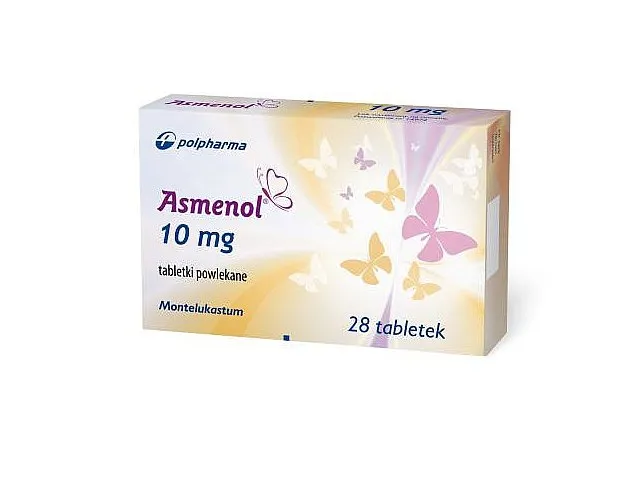
Table of Contents
Package leaflet: Information for the patient
Asmenol
10 mg, film-coated tablets
Montelukastum
Please read all of this leaflet carefully before taking this medicine, because it contains
important information for the patient.
- Keep this leaflet, as you may need to read it again.
- If you have any further questions, ask your doctor or pharmacist.
- This medicine has been prescribed for a specific individual. Do not pass it on to others. It may harm other people, even if their symptoms are the same.
- If you experience any side effects, including any not listed in this leaflet, tell your doctor or pharmacist. See section 4.
Contents of the leaflet
- What Asmenol is and what it is used for
- Important information before taking Asmenol
- How to take Asmenol
- Possible side effects
- How to store Asmenol
- Contents of the pack and other information
1. What Asmenol is and what it is used for
The active substance in Asmenol is montelukast, which is a leukotriene receptor antagonist.
It blocks the action of naturally occurring substances in the lungs called leukotrienes. These compounds
cause narrowing of the airways and inflammation in the lungs, which may lead to asthma symptoms.
Leukotrienes also contribute to allergic symptoms. Blocking the action of leukotrienes helps relieve
seasonal allergy symptoms (also known as seasonal allergic rhinitis or hay fever).
When taken regularly, Asmenol helps relieve asthma symptoms such as breathlessness and prevents
asthma attacks.
Asmenol is prescribed in the following cases:
- When adequate asthma control cannot be achieved with other medicines and additional treatment is required.
- To prevent exercise-induced bronchoconstriction.
- For the simultaneous treatment of asthma and hay fever (seasonal allergic rhinitis) in patients with asthma aged 15 years and older.
What is asthma?
Asthma is a chronic disease.
In asthma, the following occur:
- Breathing difficulties caused by narrowing of the airways. This narrowing increases and decreases in response to various triggers.
- Hypersensitivity of the airways, which react to many factors such as cigarette smoke, pollen, cold air, or physical exertion.
- Swelling (inflammation) of the mucous membrane lining the airways.
Asthma symptoms include: cough, wheezing, and a feeling of tightness in the chest.
What are seasonal allergies?
Seasonal allergies (also known as hay fever or seasonal allergic rhinitis) are allergic reactions often triggered by airborne pollen from trees, grasses, and weeds. Typical symptoms of seasonal allergies may include: nasal congestion, runny nose, itchy nose; sneezing; watery, swollen, red, and itchy eyes.
2. Important information before taking Asmenol
When not to take Asmenol
- If the patient is allergic to montelukast or to any of the other ingredients of this medicine (listed in section 6).
Warnings and precautions
Before starting to take Asmenol, discuss it with your doctor or pharmacist.
If asthma symptoms worsen or breathing difficulties increase, inform your doctor immediately.
Remember that Asmenol is not intended for the treatment of acute asthma attacks. In such cases,
the medicine will not be helpful and should never be used for this purpose. If an asthma attack occurs,
use a medicine intended for immediate relief and follow your doctor's instructions strictly. It is very important
to always have readily available the medicine needed during an asthma attack (i.e., a short-acting inhaled
beta-agonist, also known as a bronchodilator, in an inhaler).
If you need to use the inhaled beta-agonist more frequently than usual, consult your doctor as soon as possible.
It is important to continue taking all asthma medicines prescribed by your doctor.
Do not replace your current steroid medications (inhaled or oral) with Asmenol.
You should also inform your doctor if the following symptoms occur while taking Asmenol: flu-like symptoms,
sensory disturbances such as tingling or numbness in the limbs, worsening of respiratory symptoms, and/or skin rash.
Your doctor will decide on further management.
The patient should not take acetylsalicylic acid (aspirin) or non-steroidal anti-inflammatory drugs (also known as NSAIDs),
if they worsen asthma symptoms.
Inform your doctor about any current or past medical conditions and allergies.
Neuropsychiatric events (for example, changes in behavior and mood, depression, and suicidal tendencies) have been reported in patients of all ages treated with montelukast (see section 4). If such symptoms occur during treatment with montelukast, consult your doctor.
Children and adolescents
For children aged 6 months to 5 years, a 4 mg granule formulation is available.
For children aged 2 to 5 years, a 4 mg chewable tablet formulation is available.
For children aged 6 to 14 years, a 5 mg chewable tablet formulation is available.
Asmenol with other medicines
Tell your doctor or pharmacist about any other medicines the patient is currently taking, has recently taken, or plans to take.
Asmenol can be taken together with other medicines used in asthma treatment.
However, some medicines may affect the action of Asmenol, and conversely, Asmenol may affect the action of certain other medicines.
It is especially important to inform your doctor if you are taking phenobarbital or phenytoin (medicines used to treat epilepsy),
rifampicin (a medicine used to treat tuberculosis and certain other infections), or gemfibrozil (a medicine used to treat high lipid levels in plasma).
In such cases, caution should be exercised, especially in children.
Asmenol with food and drink
Asmenol 10 mg film-coated tablets can be taken with or without food.
Pregnancy and breastfeeding
Limited data on the use of the medicine during pregnancy do not indicate a causal link between montelukast use and congenital malformations (e.g., limb defects), which have been rarely reported worldwide since the medicine was introduced.
Pregnancy
If the patient is pregnant, suspects she may be pregnant, or is planning to become pregnant, she should consult her doctor before taking this medicine. The doctor will assess whether Asmenol can be used during this period.
Breastfeeding
It is not known whether the medicine passes into breast milk. Therefore, if a woman is breastfeeding or planning to breastfeed, she should consult her doctor before taking this medicine.
The doctor will discuss further management with the patient.
Driving and using machines
Asmenol generally does not impair the ability to drive or operate machinery. However, the effect of the medicine may vary between individuals. In very rare cases, dizziness and drowsiness have been reported, which may affect reaction ability.
Asmenol contains lactose
If the patient has been previously diagnosed with intolerance to certain sugars, the patient should contact their doctor before taking this medicine.
Asmenol contains sodium
The medicine contains less than 1 mmol (23 mg) of sodium per tablet, meaning the medicine is considered "sodium-free".
3. How to use Asmenol
This medicine should always be taken as directed by the physician. If in doubt, consult a doctor or pharmacist.
The doctor will determine how to use Asmenol based on the patient's symptoms and severity of asthma.
It is important to take Asmenol every evening as directed by the physician.
Asmenol should be taken even when the patient has no symptoms and on days when an asthma attack occurs.
The patient should also continue taking all other asthma medications prescribed by the physician. Asmenol must not be used as a substitute for other medicines.
This is an oral medicine.
Usual dosage:
Adults and adolescents aged 15 years and older:
1 film-coated tablet of 10 mg Asmenol once daily in the evening. The medicine may be taken with or without food.
If the patient is taking Asmenol, ensure that they are not taking other medicines containing the same active substance, montelukast.
Taking more Asmenol than recommended
Seek immediate medical advice from a doctor.
In most reports of overdose, no adverse effects were reported.
The most commonly reported symptoms following overdose in adults and children were:
abdominal pain, drowsiness, thirst, headache, vomiting, and hyperactivity.
If a dose of Asmenol is missed
Try to take the medicine as directed by the physician. However, if one dose is missed, resume the regular dosing schedule—1 tablet once daily. Do not take a double dose to make up for the missed dose.
Stopping Asmenol treatment
It is important to take Asmenol for as long as prescribed by the physician, regardless of whether symptoms are present or absent. Asmenol is effective in treating asthma only when taken regularly.
If you have any further questions about the use of this medicine, consult your doctor or pharmacist.
4. Possible adverse reactions
Like all medicines, this medicine can cause adverse reactions, although not everyone will experience them.
In clinical trials using montelukast at a dose of 10 mg, the following adverse reactions were most frequently reported (in less than 1 in 10 patients taking the medicine) and were considered probably related to montelukast use:
- abdominal pain
- headache.
These were usually mild and occurred more frequently in patients treated with montelukast than with placebo (a tablet containing no active drug).
The frequency of possible adverse reactions listed below is defined using the following convention:
- very common (affects more than 1 in 10 people)
- common (affects less than 1 in 10 people)
- uncommon (affects less than 1 in 100 people)
- rare (affects less than 1 in 1,000 people)
- very rare (affects less than 1 in 10,000 people).
Additionally, following the introduction of the medicine into the market, the following adverse reactions have been reported:
- upper respiratory tract infection (very common),
- increased tendency to bleeding (rare),
- allergic reactions, including facial, lip, tongue, and/or throat swelling, which may cause difficulty in breathing or swallowing (uncommon),
- changes in behaviour and mood: sleep disorders, including nightmares, difficulty falling asleep, sleepwalking, irritability, anxiety, restlessness, particularly motor restlessness, agitation, including aggressive behaviour or hostility, depression (uncommon); tremor, attention disorders, memory disturbances (rare); hallucinations, disorientation, suicidal thoughts and behaviours, stuttering (very rare),
- dizziness, drowsiness, tingling and/or numbness, seizures (uncommon),
- palpitations (rare),
- nosebleeds (uncommon),
- diarrhoea, nausea, vomiting (common); dry mouth, dyspepsia (uncommon),
- hepatitis (very rare),
- rash (common); bruising, itching, urticaria (uncommon); tender, red nodules under the skin, most commonly appearing on the lower legs (erythema nodosum), severe skin reactions (erythema multiforme), which may occur without warning (very rare),
- joint or muscle pain, muscle cramps (uncommon),
- fever (common); weakness, fatigue, malaise, oedema (uncommon).
In patients with asthma treated with montelukast, very rare cases of a syndrome characterised by symptoms such as flu-like symptoms, tingling or numbness in hands and feet, worsening of respiratory symptoms and/or rash (Churg-Strauss syndrome) have been reported. If a patient experiences one or more of these symptoms, the treating physician should be notified immediately.
For detailed information on the medicine's adverse reactions, consult a physician or pharmacist.
Reporting of adverse reactions
If any adverse reactions occur, including any adverse reactions not listed in this leaflet, inform a physician or pharmacist. Adverse reactions can be reported directly to the Department of Monitoring Adverse Drug Reactions, Office for Registration of Medicinal Products, Medical Devices and Biocidal Products
Al. Jerozolimskie 181C
02-222 Warsaw
Phone: +48 22 49 21 301
Fax: +48 22 49 21 309
Website: https://smz.ezdrowie.gov.pl
Adverse reactions can also be reported to the marketing authorisation holder.
Reporting adverse reactions helps to provide more information on the safety of the medicine.
5. How to store Asmenol
Keep this medicine out of sight and reach of children.
No special storage precautions apply.
Do not use this medicine after the expiry date stated on the blister and outer packaging.
The marking on the blister: EXP refers to the expiry date, and Lot/LOT refers to the batch number.
Medicines must not be disposed of via wastewater or household waste. Ask your pharmacist how to dispose of medicines no longer in use. This will help protect the environment.
6. Contents of the package and other information
What Asmenol contains
- The active substance is montelukast (in the form of montelukast sodium). Each coated tablet contains 10 mg of montelukast in the form of montelukast sodium.
- Other ingredients are:
Tablet core: Microcrystalline cellulose, lactose monohydrate, sodium croscarmellose, disodium edetate, magnesium stearate.
Tablet coating: Hypromellose 6cP, hydroxypropylcellulose, titanium dioxide (E171), yellow iron oxide (E172), red iron oxide (E172).
What Asmenol looks like and contents of the pack
Asmenol 10 mg coated tablets are beige, round, film-coated tablets.
Asmenol is available in aluminum/aluminum blisters containing 14 or 28 tablets.
Not all pack sizes may be marketed.
Marketing Authorisation Holder and Manufacturer
Marketing Authorisation Holder
Zakłady Farmaceutyczne POLPHARMA S.A.
ul. Pelplińska 19
83-200 Starogard Gdański
Poland
Manufacturers
Zakłady Farmaceutyczne POLPHARMA S.A.
ul. Pelplińska 19
83-200 Starogard Gdański
Poland
HBM Pharma s.r.o.
Sklabinská 30
036 80 Martin
Slovakia
Saneca Pharmaceutical a.s.
Nitrianska 100
920 27 Hlohovec
Slovakia