Asicor
Poland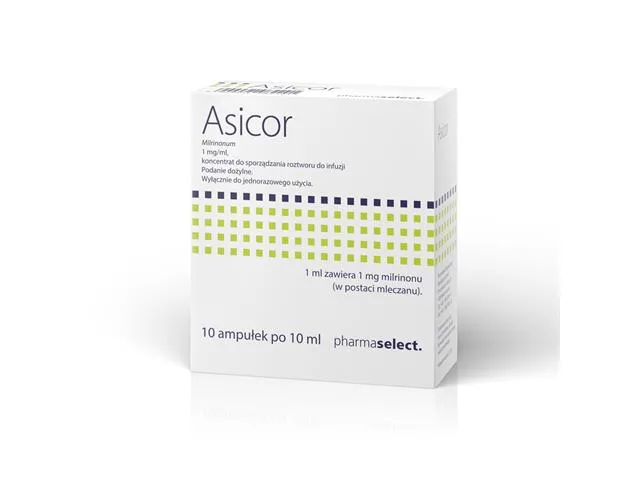
Table of Contents
Package leaflet: Information for the user
Asicor, 1mg/ml, concentrate for solution for infusion
Milrinone
Please read all of this leaflet carefully before use, as it contains important information for the patient.
- Keep this leaflet, so that you can read it again if necessary.
- If you have any further questions, please consult your doctor or nurse.
- If you experience any adverse reactions, including any not listed in this leaflet, inform your doctor or nurse. See section 4.
Contents of the leaflet
- What Asicor is and what it is used for
- Important information before using Asicor
- How to use Asicor
- Possible side effects
- How to store Asicor
- Contents of the pack and other information
1. What Asicor is and what it is used for
The name of this medicine is Asicor.
Asicor contains the active substance milrinone (in the form of lactate). It belongs to a group of medicines known as phosphodiesterase inhibitors.
The medicine works by making the heart muscle contract more strongly and by widening blood vessels. This means that blood can flow more easily, enabling the heart to pump blood more effectively.
Asicor may be used in adults for:
Short-term (48 hours) treatment of severe congestive heart failure (when the heart cannot pump sufficient blood to the rest of the body), when other medicines have proven ineffective.
Asicor may be used in children for short-term treatment (up to 35 hours):
- Severe congestive heart failure (when the heart cannot pump sufficient blood to the rest of the body), when other medicines have proven ineffective.
- Acute heart failure after heart surgery, i.e., when the patient's heart has difficulty pumping blood to the entire body.
2. Important information before using Asicor
When not to use Asicor:
- If the patient is allergic to milrinone or any of the other ingredients of this medicine (listed in section 6).
- If there is significant reduction in circulating blood volume.
Warnings and precautions
Before starting treatment with Asicor, discuss with your doctor or nurse if:
- The patient has recently suffered a myocardial infarction (heart attack).
- The patient has severe heart valve disorders such as stenosis, fibrosis, or outflow tract obstruction.
- The patient has irregular or uncontrolled rapid heartbeat. The patient may also experience palpitations, dizziness, weakness, or shortness of breath.
- The patient has low blood pressure causing pain, dizziness, or feeling weak.
- The patient has previously taken diuretics (water tablets) which caused heart problems.
- The patient has low potassium levels in the blood. The doctor may perform a blood test to check this.
- The patient has too low a number of platelets involved in blood clotting (thrombocytopenia) and/or reduced hemoglobin concentration.
- The patient has kidney problems.
- The patient has liver problems.
Children
In addition to the warnings and precautions described for adults, the following should also be considered:
Before starting infusion of Asicor, the doctor will check various parameters such as heart rhythm and blood pressure. Blood tests will also be ordered.
Infusion should not be started if the child's heart rhythm and blood pressure are not stable.
Inform the doctor if:
- The child has kidney problems.
- The child is a premature newborn or has low birth weight.
- The child has a heart defect called patent ductus arteriosus: a connection between two major blood vessels (aorta and pulmonary artery) that persists although it should have closed.
In these cases, the treating doctor will decide whether the child should receive Asicor.
Asicor and other medicines
Tell your doctor or nurse about all medicines the patient is currently taking or has recently taken, as well as any medicines the patient plans to take, because milrinone may affect the action of other medicines. Likewise, some medicines may affect the action of milrinone.
Inform your doctor or nurse, especially if the patient is taking:
- Digoxin (used for heart problems).
- Other heart medications affecting heart muscle contractions (inotropic agents).
- Diuretics (water tablets).
- Medicines used to treat high blood pressure or angina (chest pain), such as amlodipine, nifedipine, or felodipine.
Pregnancy, breastfeeding and fertility
If the patient is pregnant or breastfeeding, suspects she may be pregnant, or is planning to have a baby, she should consult her doctor before using this medicine.
Driving and using machines
The patient will usually receive Asicor during a hospital stay, as close clinical monitoring of treatment is recommended. Therefore, the effect on the ability to drive or operate machinery is unknown.
Asicor contains sodium
This medicine contains less than 1 mmol of sodium (23 mg) per dose, meaning the medicine is considered "sodium-free".
3. How to use Asicor
Asicor will always be administered intravenously by a doctor or nurse, as it must be given as an intravenous infusion. The appropriate dose will be determined by the doctor based on the type of symptoms. Asicor is intended for hospital use only.
Tests:
During administration, electrocardiography (ECG) should be used to monitor the patient's heart function. Blood tests should also be performed, and the patient's blood pressure and pulse should be monitored.
How the medicine will be administered:
- This medicine is usually given in a "drip" after dilution with a sugar or saline solution.
- You should inform the doctor or nurse if the patient feels that the effect of the medicine is too weak or too strong.
Recommended dose
Adults
- Based on the patient's body weight, the doctor will decide how much medicine the patient should receive.
- If the patient has kidney problems, a lower dose may be given. Asicor infusions are usually administered for up to 48 hours.
Use in children
- The initial dose given to a child is 50 to 75 micrograms per kilogram of body weight, administered over 30 to 60 minutes.
- Subsequent doses range from 0.25 to 0.75 micrograms per kilogram of body weight per minute, depending on the child's clinical response to treatment and the occurrence of adverse effects. Asicor may be administered for up to 35 hours. During the infusion, the child's condition must be closely monitored: the doctor will check various parameters such as heart rhythm and blood pressure. Blood samples should also be taken to assess response to treatment and the occurrence of adverse effects.
Use of a higher than recommended dose of Asicor
If there are any doubts regarding the administered dose, consult the doctor.
In case of overdose of Asicor, the following symptoms may occur: pain, dizziness, feeling of weakness (due to low blood pressure), and irregular heartbeat.
Missed dose of Asicor
Inform the doctor or nurse if there is a suspicion that a dose of Asicor has been missed.
If you have any further questions about the use of this medicine, consult your doctor or nurse.
4. Possible adverse reactions
Like all medicines, this medicine can cause adverse reactions, although not everybody will experience them.
You must stop administering Asicor and immediately inform your doctor if:
An allergic reaction occurs. Possible symptoms include: rash, difficulty swallowing or
breathing, swelling of the lips, face, throat or tongue. This occurs very rarely.
You should immediately inform your doctor or nurse if any of the following
adverse reactions occur:
Common (affects up to 1 in 10 people)
- Irregular, rapid or fast heartbeat. You may also feel palpitations in the chest, dizziness, weakness or shortness of breath.
- Headaches: in most cases mild to moderate.
- Low blood pressure: symptoms include headache, dizziness or weakness. If in addition you experience symptoms such as rapid or irregular heartbeat or chest pain, this may be a more serious adverse reaction (see above).
Uncommon (affects up to 1 in 100 people)
- Ventricular fibrillation – a serious heart rhythm disorder. Symptoms include very fast, irregular or strong heartbeat (palpitations), dizziness and loss of consciousness. Nausea, cold sweats, shortness of breath and chest pain may also occur.
- Thrombocytopenia – a blood disorder (lack of blood platelets). A symptom may be bruising more easily than usual.
- Chest pain.
- Hypokalemia – low potassium levels in the blood. Symptoms include fatigue, disorientation, muscle weakness and muscle cramps.
- Muscle cramps (tremor).
- Blood tests may show changes in liver function.
Very rare (affects up to 1 in 10,000 people)
- Torsade de pointes – a serious heart rhythm disorder. Symptoms include very fast, irregular or strong heartbeat (palpitations), dizziness and loss of consciousness. Nausea, cold sweats, shortness of breath, unusually pale appearance and chest pain may also occur.
- Breathing difficulties, wheezing, chest tightness.
- Skin reactions.
Frequency not known (frequency cannot be estimated from available data)
- Decrease in the number of red blood cells and/or hemoglobin concentration.
- Reaction at the site of intravenous infusion.
Additional adverse reactions in children
In addition to adverse reactions observed in adults, the following have been reported in children:
Frequency not known:
- Bleeding into fluid-filled spaces (ventricles) surrounding the brain (intraventricular hemorrhage).
- A heart defect known as patent ductus arteriosus: a connection between the two main blood vessels (aorta and pulmonary artery) that persists although it should have closed. This may lead to fluid accumulation in the lungs, bleeding, intestinal damage or necrosis of part of the intestine, and may result in death. Furthermore, compared to adults, a decrease in platelet count appears to occur more frequently in children, and the risk of this adverse reaction increases with the duration of Asicor infusion. Heart rhythm disorders appear to occur less frequently in children than in adults.
Reporting of adverse reactions
If any adverse reactions occur, including any possible adverse reactions
not listed in this leaflet, consult your doctor or pharmacist.
Adverse reactions can be reported directly to the Department of Monitoring Adverse Drug Reactions of the Office for Registration of Medicinal Products, Medical Devices and Biocidal Products
Al. Jerozolimskie 181 C, 02-222 Warsaw
Tel.: +48 22 49 21 301
Fax: +48 22 49 21 309
e-mail: [email protected]
Adverse reactions can also be reported to the marketing authorization holder.
By reporting adverse reactions, additional information on the safety of the medicine can be collected.
5. How to store Asicor
The medicine should be stored by a doctor or nurse in a safe place
out of sight and reach of children.
Do not use this medicine after the expiry date stated on the cardboard box and
vial after Expiry.
The expiry date refers to the last day of the stated month.
There are no special storage instructions for this medicine.
Do not freeze.
For single use only.
Chemical and physical stability has been demonstrated for 72 hours after opening, at room temperature
(15–25°C) or under refrigerated conditions (2–8°C).
Medicines must not be disposed of via wastewater or household waste. Ask a
pharmacist how to dispose of medicines no longer required. Such measures will help protect
the environment.
6. Contents of the pack and other information
What Asicor contains
- Asicor is a sterile solution of milrinone lactate equivalent to 1 mg of milrinone per 1 ml.
- The other ingredients are (S)-lactic acid, anhydrous glucose, water for injections, and sodium hydroxide (to adjust pH).
What Asicor looks like and contents of the pack
Asicor is a clear, colourless to pale yellow liquid.
Asicor is available in packs containing 10 glass ampoules of 10 ml or 20 ml.
Not all pack sizes may be marketed.
Marketing Authorisation Holder and Manufacturer
Pharmaselect International Beteiligungs GmbH
Ernst-Melchior-Gasse 20
1020 Vienna
Austria
This medicinal product is authorised in the European Economic Area countries under the following names:
Austria, Poland: Asicor
Hungary, Romania: Unacor
Czech Republic, Slovak Republic: Asicord
Information intended exclusively for medical professionals:
Asicor, 1 mg/ml, concentrate for solution for infusion
For complete information, refer to the SmPC.
Preparation of the medicinal product for administration
Solutions for infusion, diluted as recommended, with sodium chloride 4.5 mg/ml (0.45%), sodium chloride 9 mg/ml (0.9%), or glucose 50 mg/ml (5%), should be prepared immediately before administration.
For single use only.
The diluted solution should be inspected visually for precipitation or discoloration prior to administration.
Shelf life: 3 years, prior to opening.
Chemical and physical stability after opening has been demonstrated for 72 hours at room temperature (15–25°C) or under refrigerated conditions (2–8°C).
From a microbiological standpoint, the diluted solution should be used immediately. If not used immediately, the responsibility for storage conditions and duration prior to use lies with the user and should generally not exceed 24 hours at a temperature of 2–8°C, unless dilution was performed under controlled and validated aseptic conditions. Any unused medicinal product or waste material should be disposed of in accordance with local regulations.
Safety information:
During treatment with Asicor, blood pressure, heart rate, clinical status, electrocardiogram, fluid balance, electrolytes, and renal function (i.e., creatinine) should be closely monitored.
Pharmaceutical incompatibilities:
Furosemide or bumetanide must not be administered into an intravenous infusion line containing milrinone lactate, as precipitation will occur.
Milrinone must not be diluted in sodium bicarbonate infusion solution.
Do not mix the medicinal product Asicor with other medicinal products until further compatibility data are available.
Administration:
For intravenous use only.
Extravascular administration must be avoided. The drug should be administered into the largest possible vein to minimize infusion site reactions. During milrinone therapy, blood pressure, heart rate, clinical status, electrocardiogram, fluid balance, electrolytes, and renal function (i.e., serum creatinine concentration) should be closely monitored.
Ensure immediate availability of equipment necessary for the treatment of potential cardiac adverse reactions (e.g., life-threatening ventricular arrhythmias). The infusion rate should be adjusted according to the hemodynamic response.
The duration of treatment should be based on clinical response. Infusion duration should not exceed 48 hours due to lack of evidence on safety and efficacy of long-term treatment in patients with chronic heart failure.
Dosage
Adults
Asicor should be administered as a loading dose of 50 μg/kg body weight given over 10 minutes, followed by a continuous infusion at a maintenance dose typically ranging from 0.375 μg/kg body weight/min to 0.75 μg/kg body weight/min (standard dose 0.5 μg/kg body weight/min), adjusted according to hemodynamic response and considering the possible onset of adverse effects such as hypotension or cardiac arrhythmias. Total daily dose must not exceed 1.13 mg/kg body weight.
Below is the dosing instruction and infusion rates for the maintenance infusion using a solution containing 200 μg/ml milrinone, prepared by adding 400 ml diluent to 100 ml of injection solution (40 ml diluent per 10 ml vial or 80 ml diluent per 20 ml vial).
| Maintenance dose (microgram/kg body weight/min) | Maintenance infusion (microgram/kg body weight/hour) | 200µg/ml |
| 0.375 | 22.5 | 0.11 |
| 0.400 | 24.0 | 0.12 |
| 0.500 | 30.0 | 0.15 |
| 0.600 | 36.0 | 0.18 |
| 0.700 | 42.0 | 0.21 |
| 0.750 | 45.0 | 0.22 |
Solutions of different concentrations may be used according to the patient's fluid requirements. The duration of treatment should depend on the patient's response.
Elderly patients
Current experience suggests that no special dosage recommendations are necessary for patients with normal renal function. However, renal clearance may be reduced in elderly patients, and in such cases lower doses of the medicinal product Asicor may be required.
Patients with impaired renal function
Dosage adjustment is necessary. Dosage adjustment in patients with impaired renal function is based on data obtained from patients with the most common type of renal impairment but without congestive heart failure, which indicate a significant prolongation of milrinone elimination half-life. The loading dose remains unchanged, but the maintenance dose may need to be reduced depending on the severity (creatinine clearance) of renal impairment (see table below):
| Creatinine clearance (ml/min/1.73m2) | Maintenance dose (microgram/kg body surface area/min) | 200µg/ml Infusion rate (ml/kg body surface area/hour) |
| 5 | 0.20 | 0.06 |
| 10 | 0.23 | 0.07 |
| 20 | 0.28 | 0.08 |
| 30 | 0.33 | 0.10 |
| 40 | 0.38 | 0.11 |
| 50 | 0.43 | 0.13 |
Children
In published studies in infants and children, the following doses have been used:
- Intravenous loading dose: 50 to 75 μg/kg body weight administered over 30 to 60 minutes.
- Continuous intravenous infusion: initiated based on hemodynamic response and considering the potential onset of adverse effects, at a rate of 0.25 to 0.75 μg/kg body weight/min for up to 35 hours. In clinical studies on low cardiac output syndrome in infants and children under 6 years of age following corrective surgery for congenital heart defects, a loading dose of 75 μg/kg body weight administered over 60 minutes, followed by an infusion of 0.75 μg/kg body weight/min for 35 hours, significantly reduced the risk of developing low cardiac output syndrome. Pharmacokinetic study results should be taken into account.
Renal impairment
Due to lack of data, milrinone is not recommended in children and adolescents with renal impairment.
Patent ductus arteriosus:
If use of milrinone is considered in preterm neonates or full-term newborns with patent ductus arteriosus or at risk of developing patent ductus arteriosus, the benefit-risk ratio should be carefully evaluated.
Contraindications
- Hypersensitivity to the active substance or to any of the excipients
- Severe hypovolemia
Overdose
Symptoms
High doses of the medicinal product Asicor may cause hypotension (due to its vasodilatory effect) and cardiac arrhythmias.
Management
In such cases, administration of the medicinal product Asicor should be discontinued until the patient's clinical condition stabilizes. There is no specific antidote for milrinone; supportive measures to maintain cardiovascular function should be applied.