Artigo
Poland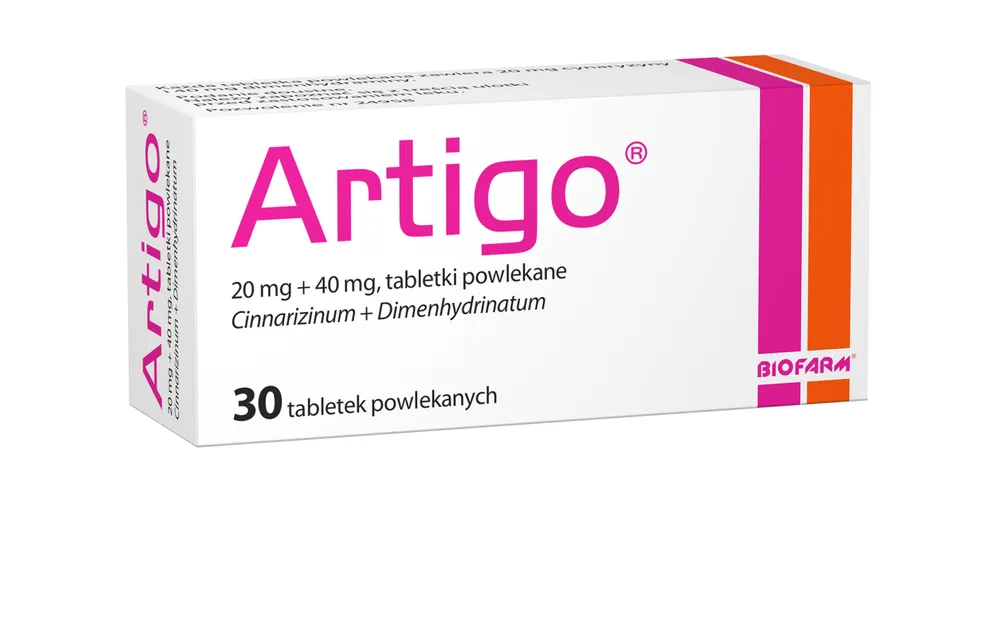
Table of Contents
Package leaflet: Information for the user
Artigo, 20 mg + 40 mg, coated tablets
Cinnarizinum + Dimenhydrinatum
Please read carefully the entire leaflet before using the medicine, as it contains
important information for the patient.
- Keep this leaflet, so that you can read it again if necessary.
- If you have any doubts, please consult your doctor or pharmacist.
- This medicine has been prescribed for a specific individual. Do not share it with others. The medicine may harm another person, even if their symptoms are the same.
- If the patient experiences any adverse reactions, including any adverse reactions not listed in this leaflet, inform your doctor or pharmacist. See section 4.
Table of contents of the leaflet
- What is Artigo and what is it used for.
- Important information before taking Artigo.
- How to take Artigo.
- Possible side effects.
- How to store Artigo.
- Contents of the pack and other information.
1. What is Artigo and what is it used for
The medicine contains two active substances: cinnarizine and dimenhydrinate.
These substances belong to different groups of medicines. Cinnarizine belongs to a group of medicines known as
calcium antagonists. Dimenhydrinate belongs to a group of antihistamine medicines.
Both substances help reduce symptoms of vertigo (a sensation of dizziness or "spinning") and nausea. When both substances are used together, they are more effective than when used separately.
Artigo is used in adults for the treatment of vertigo of various origins. There may be several different causes of vertigo. Treatment with Artigo may help in performing daily activities that are made difficult due to vertigo.
2. Important information before using Artigo
When not to use Artigo:
- if the patient is allergic to cynarizine, dimenhydrinate, or diphenhydramine, or to any of the other ingredients of this medicine (listed in section 6),
- in patients under 18 years of age,
- if the patient is allergic to any other antihistamine medicine (e.g. astemizole, chlorpheniramine, and terfenadine used as antiallergic agents). This medicine should not be used without a doctor's recommendation.
- in patients with closed-angle glaucoma (a type of eye disease),
- in patients with epilepsy,
- in patients with increased intracranial pressure (e.g. due to a tumour),
- in patients with alcohol abuse,
- in patients with urinary tract or prostate disorders that make urination difficult,
- in patients with liver or kidney failure.
Warnings and precautions
Before starting to take Artigo, consult your doctor or pharmacist if the patient has:
- low or high blood pressure,
- increased intraocular pressure,
- intestinal obstruction,
- enlarged prostate,
- hyperthyroidism,
- severe heart disease,
- Parkinson's disease.
Use of Artigo may worsen the patient's condition. Artigo may still be suitable for the patient, but the doctor must take these factors into account.
Artigo and other medicines
Inform your doctor or pharmacist about all medicines the patient is currently taking or has recently taken, as well as any medicines the patient plans to take.
Artigo may interact with other medicines the patient is taking.
When Artigo is used in combination with the following medicines, it may cause fatigue or drowsiness:
- barbiturates (medicines often used as sedatives),
- opioids (strong painkillers such as morphine),
- sedatives (medicines used in the treatment of depression and anxiety).
Artigo may enhance the effects of the following medicines:
- tricyclic antidepressants (used in the treatment of depression and anxiety),
- atropine (a muscle-relaxing medicine, often used during ophthalmological examinations),
- ephedrine (may be used in the treatment of certain tumours),
- medicines used to lower blood pressure.
Aminoglycosides (a type of antibiotic) may damage the inner ear. When Artigo is used, such damage may go unnoticed.
Do not take Artigo with medicines used to treat irregular heartbeat (antiarrhythmic medicines).
Furthermore, Artigo may alter skin reactions to allergens during skin tests.
Taking Artigo with food, drink, and alcohol
Artigo may cause indigestion. This can be reduced by taking the tablets after meals. Alcohol must not be consumed while taking Artigo, as it may cause fatigue and drowsiness.
Pregnancy, breastfeeding, and fertility
If the patient is pregnant or breastfeeding, suspects she may be pregnant, or is planning to have a child, she should consult a doctor or pharmacist before using this medicine.
Artigo must not be used during pregnancy or breastfeeding, or when there is suspicion that a woman may be pregnant.
Driving and operating machinery
Artigo may cause drowsiness. If this side effect occurs, the patient must not drive or operate machinery.
The medicine contains less than 1 mmol (23 mg) of sodium per recommended daily dose (3 tablets per day), meaning the medicine is considered "sodium-free".
3. How to take Artigo
This medicine should always be taken as directed by the physician. In case of doubts, consult a doctor or pharmacist.
Recommended dose
The recommended dose of this medicine is 1 tablet taken three times daily after meals, accompanied by liquid. The tablet should be swallowed whole, without chewing.
Artigo is usually administered for 4 weeks. The physician will inform the patient if prolonged treatment with Artigo is necessary.
Use of a higher than recommended dose of Artigo
In case of accidental ingestion of more tablets than recommended, or if a child has swallowed the tablets, seek immediate medical advice.
If an excessive number of Artigo tablets is taken, the patient may experience a strong feeling of fatigue, dizziness, and convulsions. Pupil dilation and inability to urinate may occur. Dryness of the mouth, sudden facial flushing, increased heart rate, fever, sweating, and headache may also appear.
In case of ingestion of a large amount of Artigo, epileptic seizure, hallucinations, high arterial blood pressure, tremor, excitement, and breathing difficulties may occur. Coma may also develop.
Missed dose of Artigo
If a dose of Artigo is missed, simply skip it. Take the next dose at the usual time. Do not take a double dose to make up for the missed dose.
Stopping treatment with Artigo
Do not stop taking Artigo without consulting your doctor. If treatment is discontinued prematurely, symptoms of dizziness (dizziness and vertigo) may recur.
If you have any further questions about the use of this medicine, consult your doctor or pharmacist.
4. Possible adverse reactions
Like all medicines, this medicine can cause adverse reactions, although they do not occur in everyone.
Common adverse reactions (occur in up to 1 in 10 people): drowsiness, dry mouth, headache, and abdominal pain. These reactions are usually mild and resolve within a few days, even if Artigo treatment is continued.
Uncommon adverse reactions (occur in up to 1 in 100 people): sweating, skin redness, indigestion, nausea, diarrhoea, nervousness, muscle spasms, confusion, tinnitus (ringing in the ears), paraesthesia (tingling of hands or feet), convulsions (tremor).
Rare adverse reactions (occur in up to 1 in 1,000 people): blurred vision, allergic reactions (e.g. skin reactions), light sensitivity, and difficulty in passing urine.
Very rare adverse reactions (occur in less than 1 in 10,000 people): possible decrease in white blood cells and platelets, and a significant reduction in red blood cells, leading to weakness, easy bruising, and increased susceptibility to infections. If an infection with fever or a serious deterioration in general health occurs, contact your doctor and inform them about the medication you are taking.
Other possible adverse reactions (frequency cannot be determined from available data), which may occur with this type of medicine, include: weight gain, constipation, chest tightness, jaundice (yellowing of the skin or whites of the eyes due to liver or blood disorders), worsening of acute angle-closure glaucoma symptoms (an eye disease associated with increased intraocular pressure), uncontrolled movements, unusual excitement or restlessness (especially in children), and severe skin reactions.
Reporting of adverse reactions
If any adverse reactions occur, including any not listed in this leaflet, inform your doctor or pharmacist. Adverse reactions can be reported directly to the Department of Monitoring Adverse Drug Reactions of the Office for Registration of Medicinal Products, Medical Devices and Biocidal Products
Al. Jerozolimskie 181C
02-222 Warsaw
Phone: +48 22 49 21 301
Fax: +48 22 49 21 309
Website: https://smz.ezdrowie.gov.pl
Adverse reactions can also be reported to the marketing authorization holder.
Reporting adverse reactions helps provide more information on the safety of this medicine.
5. How to store Artigo
No special storage conditions are required for this medicine.
Keep the medicine out of sight and reach of children.
Do not use this medicine after the expiry date stated on the carton.
The expiry date refers to the last day of the stated month.
Medicines should not be disposed of via wastewater or household waste. Ask your pharmacist how to dispose of medicines no longer required. This will help protect the environment.
6. Contents of the packaging and other information
What Artigo contains
- The active substances are: cinarizine 20 mg and dimenhydrinate 40 mg.
- Other ingredients are: microcrystalline cellulose, sodium croscarmellose, colloidal anhydrous silica, magnesium stearate, talc, polyvinyl alcohol, titanium dioxide (E171), macrogol 4000.
What Artigo looks like and contents of the pack
White, round, biconvex film-coated tablets, 7.9 mm – 8.3 mm in diameter.
The tablets are packed in PVC/PVDC/Al blisters placed in a cardboard box.
Pack contents: 10, 20, 30, 50, 60 or 100 film-coated tablets.
Not all pack sizes may be marketed.
Marketing Authorisation Holder and Manufacturer
Biofarm Sp. z o.o.
ul. Wałbrzyska 13
60-198 Poznań
Tel. +48 61 66 51 500