Arthryl fast
Poland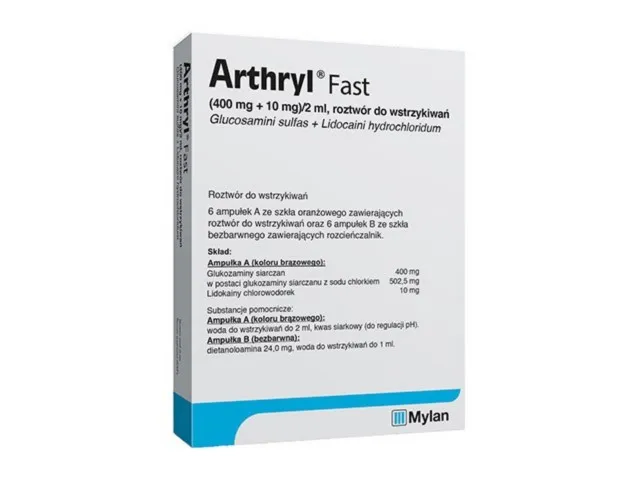
Table of Contents
- Package leaflet: Information for the patient
- 1. What Arthryl Fast is and what it is used for
- 2. Important information before using Arthryl Fast
- 3. How to use Arthryl Fast
- 4. Possible adverse reactions
- 5. HOW TO STORE ARTHRYL FAST
- 6. Contents of the pack and other information
- Information intended exclusively for medical professionals:
Package leaflet: Information for the patient
Arthryl Fast, (400 mg + 10 mg)/2ml, solution for injection
Glucosamini sulfas + Lidocaini hydrochloridum
Please read all of this leaflet carefully before using this medicine, because it contains
important information for you.
- Keep this leaflet, as you may need to read it again.
- If you have any further questions, please ask your doctor, pharmacist, or nurse.
- This medicine has been prescribed for a specific individual. Do not pass it on to others. It may harm other people, even if their symptoms are the same.
- If you experience any adverse reactions, including any adverse reactions not listed in this leaflet, inform your doctor, pharmacist, or nurse. See section 4.
Contents of the leaflet
- What Arthryl Fast is and what it is used for
- Important information before using Arthryl Fast
- How to use Arthryl Fast
- Possible side effects
- How to store Arthryl Fast
- Contents of the pack and other information
1. What Arthryl Fast is and what it is used for
Arthryl Fast belongs to a group of medicines known as other non-steroidal anti-inflammatory and anti-rheumatic agents.
Arthryl Fast is used in the treatment of symptoms of mild to moderate osteoarthritis of the knee joints in patients in whom oral administration of glucosamine is contraindicated.
2. Important information before using Arthryl Fast
When not to use Arthryl Fast
- if the patient is allergic to glucosamine or lidocaine, or to any of the other ingredients of this medicine (listed in section 6);
- if the patient is allergic to shellfish-derived substances, as glucosamine is produced from shellfish.
The injectable solution, due to its lidocaine content, is contraindicated in patients
with arrhythmia, acute heart failure, and in patients with hypersensitivity to lidocaine.
Warnings and precautions
- if the patient has impaired glucose tolerance, the physician may order laboratory tests at the beginning of treatment to determine blood glucose levels;
- if the patient has asthma, the patient should be informed about the potential risk of symptom exacerbation before starting treatment with glucosamine;
- if the patient has acute liver or kidney failure;
- if the patient is on a sodium-controlled diet.
Due to the presence of lidocaine, Arthryl Fast should be used with caution in patients:
- with autoimmune neurological disorders causing severe muscle weakness and myasthenia, or neurological disorders characterized by epileptic seizures;
- with heart failure (congestive heart failure), bradycardia (slow heart rate), or respiratory insufficiency;
- who have experienced blood volume loss due to bleeding or dehydration (hypovolemia), or in cases of impaired venous return, e.g. in the presence of significant fluid accumulation in the peritoneal cavity (ascites) or a large abdominal tumor, as these patients may develop low blood pressure (arterial hypotension);
- receiving antiarrhythmic drugs of class III (e.g. amiodarone), as the effect of lidocaine on the heart muscle may be enhanced during concomitant use of class III antiarrhythmics. In such cases, the patient should be closely monitored by a physician.
Intramuscularly administered lidocaine may increase the activity of creatine phosphokinase enzyme,
which may complicate the diagnosis of myocardial infarction (acute myocardial infarction).
Lidocaine should be avoided in patients with disorders in the function of certain
enzymes involved in the production of pigments known as porphyrins, as lidocaine has been shown
to induce porphyria in animals.
Injecting lidocaine into an area affected by inflammation or infection may reduce the effectiveness of lidocaine.
Combining this medicine with other injectable solutions should be avoided.
Children and adolescents
Arthryl Fast should not be used in children and adolescents under 18 years of age. The safety profile and efficacy of glucosamine have not been established in this age group.
Arthryl Fast and other medicines
Inform your doctor about all medicines currently used or recently used, as well as any medicines you plan to use.
Exercise caution when using Arthryl Fast concomitantly with other medicines, particularly with certain types of anticoagulants (e.g. warfarin, dicoumarol, phenprocoumon, acenocoumarol, and fluindione). The effect of these medicines may be enhanced when used simultaneously with glucosamine. Patients receiving such combinations should be carefully monitored when starting and stopping glucosamine treatment.
Inform your doctor also about concomitant use of tetracyclines (a group of antibiotics used to treat infections).
Due to the presence of lidocaine in Arthryl Fast, inform your doctor if you are taking:
- medicines used to treat seizures (hydantoin derivatives such as phenytoin),
- medicines used to treat cardiac arrhythmias (class III antiarrhythmics),
- cimetidine, primarily used in the treatment of gastric ulcers,
- beta-blockers, used in the treatment of cardiac arrhythmias, cardioprotection after myocardial infarction, and arterial hypertension,
- muscle relaxants.
Nonsteroidal anti-inflammatory and analgesic drugs may be used concomitantly during treatment with glucosamine sulfate.
Physical therapy, physiotherapy, and physical exercises may be performed during treatment.
Pregnancy, breastfeeding, and fertility
If the patient is pregnant or breastfeeding, suspects she may be pregnant, or plans to become pregnant, she should consult a doctor or pharmacist before using this medicine.
Arthryl Fast should not be used during pregnancy.
Use of Arthryl Fast during breastfeeding is not recommended.
Driving and operating machinery
Caution is advised in case of headache, drowsiness, fatigue, dizziness, or visual disturbances. Injection of lidocaine may cause numbness in areas of the body relevant to driving and operating machinery. Driving and operating machinery should be avoided until normal function in these areas is restored.
Arthryl Fast contains sodium
Arthryl Fast contains 40.3 mg of sodium (the main component of table salt) per ampoule.
This corresponds, depending on the number of ampoules administered, to 2% (1 ampoule) or 4% (2 ampoules) of the maximum recommended daily sodium intake in the diet of adults. Patients on a sodium-controlled diet should take this into account.
3. How to use Arthryl Fast
This medicine should always be used as directed by a physician. In case of doubt, consult a doctor or pharmacist.
The contents of vial A (brown) should be mixed in one syringe with the contents of vial B (colorless). The solution should be used immediately.
The yellowish color of the resulting solution does not affect the efficacy and safety of Arthryl Fast.
The recommended dosage is 1 or 2 vials administered intramuscularly, 3 times a week, for 4 to 6 weeks.
Arthryl Fast should not be used in the form of injections if oral administration of the medicine is possible.
Glucosamine is not indicated for the treatment of acute pain. Symptom relief (especially pain) may occur after several weeks of treatment, and in some cases even after a longer period.
Use in children and adolescents
Arthryl Fast is not recommended for use in children and adolescents under 18 years of age, as efficacy and safety have not been established.
Use in elderly patients
No special dosage recommendations apply.
Use in patients with renal and/or hepatic impairment
Due to insufficient data, there are no special dosage recommendations.
Use of a higher than recommended dose of Arthryl Fast
If a higher than recommended dose of Arthryl Fast has been administered, consult a doctor or pharmacist or go to a hospital emergency department.
Missed dose of Arthryl Fast
Do not use a double dose to make up for a missed dose. Take the next dose at the usual time.
Discontinuation of Arthryl Fast
If you have any further doubts regarding the use of this medicine, consult your doctor or pharmacist.
4. Possible adverse reactions
Like all medicines, this medicine can cause adverse reactions, although not everyone will experience them.
Reported adverse reactions were usually transient and mild in intensity. Systemic treatment with glucosamine is associated with the adverse reactions listed below.
Nausea and very rarely vomiting, specific to intramuscular administration, may occur due to the presence of lidocaine in the medicine. In addition, administration as an injection solution may occasionally cause reactions at the injection site (e.g. abscess and subcutaneous tissue inflammation).
Observed adverse reactions have been classified according to the following frequency:
Common (may affect up to 1 in 10 people):
- headache, drowsiness
- diarrhoea, constipation, nausea, flatulence, abdominal pain, dyspepsia
- fatigue.
Uncommon (may affect up to 1 in 100 people):
- hot flushes (sudden feeling of warmth, particularly felt in the neck and head)
- rash, itching, skin rash.
Frequency not known (cannot be estimated from available data):
- allergic reactions (hypersensitivity), inadequate control of diabetes, insomnia, dizziness, visual disturbances, asthma or worsening of asthma, vomiting, jaundice, hair loss, angioedema, urticaria, reaction at injection site (abscess and subcutaneous tissue inflammation), oedema (excessive accumulation of fluid in tissues) / peripheral oedema (most commonly affecting limbs – legs), increased liver enzyme activity, increased blood glucose concentration, fluctuations in the international normalized ratio (INR) used to determine the effect of anticoagulant medicines.
Other adverse reactions
Nausea and very rarely vomiting may occur due to the presence of lidocaine.
In addition, cases of hypercholesterolaemia (increased cholesterol concentration in blood) have been reported, although a relationship between the use of the medicine and this disorder has not been established.
Reporting of adverse reactions
If any adverse reactions occur, including any adverse reactions not listed in this leaflet, inform your doctor, pharmacist, or nurse. Adverse reactions can be reported directly to the Department of Monitoring Adverse Drug Reactions of the Office for Registration of Medicinal Products, Medical Devices and Biocidal Products, Al. Jerozolimskie 181C, 02-222 Warsaw, tel.: + 48 22 49 21 301, fax: + 48 22 49 21 309, website: https://smz.ezdrowie.gov.pl
Adverse reactions can also be reported to the marketing authorization holder.
Reporting adverse reactions allows further information on the safety of the medicine to be collected.
5. HOW TO STORE ARTHRYL FAST
Keep this medicine out of sight and reach of children.
Store below 25°C.
Do not use this medicine after the expiry date stated on the packaging after "Expiry date". The expiry date refers to the last day of the specified month.
Medicines must not be disposed of via wastewater or household waste. Ask your pharmacist how to dispose of medicines no longer required. This will help protect the environment.
6. Contents of the pack and other information
What Arthryl Fast contains
The active substances are: glucosamine sulfate, lidocaine hydrochloride.
Each ampoule A (brown-coloured) contains: glucosamine sulfate 400 mg as glucosamine sulfate with
sodium chloride 502.5 mg (see also section “Arthryl Fast contains sodium” in section 2), lidocaine
hydrochloride 10 mg.
Other components are:
Ampoule A (brown-coloured): water for injections, sulfuric acid (for pH adjustment).
Ampoule B (colourless): diethanolamine, water for injections.
What Arthryl Fast looks like and contents of the pack
6 ampoules A made of amber glass type I, containing solution for injection, and 6 ampoules B made of
colourless glass type I, containing diluent, packed in a PVC blister within a cardboard box.
Marketing Authorisation Holder:
Cooper Consumer Health B.V.
Verrijn Stuartweg 60
1112AX Diemen
The Netherlands
Manufacturer:
Biologici Italia Laboratories S.r.l.
Via Filippo Serpero 2
20060 Masate (MI)
Italy
Information intended exclusively for medical professionals:
Arthryl Fast, (400 mg + 10 mg)/2 ml, solution for injection
The contents of vial A (brown) must be combined in one syringe with the contents of vial B (colorless).
From a microbiological standpoint, the prepared solution should be used immediately.
The yellowish color of the resulting solution does not affect the drug's efficacy or tolerability.