Apo-pentox 400 sr
Poland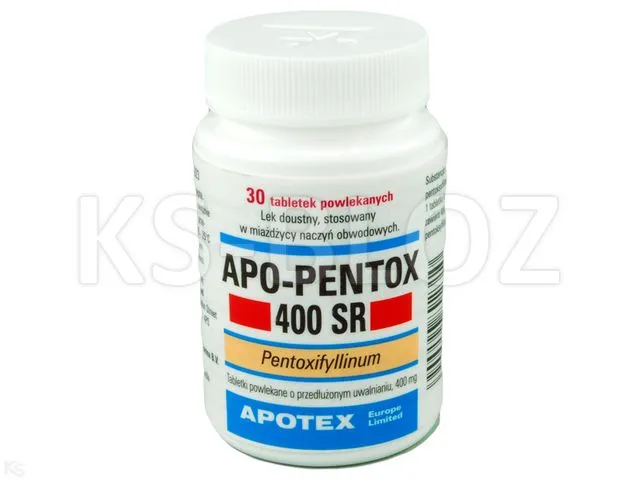
Table of Contents
Package leaflet: Information for the user
Apo-Pentox 400 SR, 400 mg, prolonged-release coated tablets
Pentoxifyllinum
Please read all of this leaflet carefully before taking this medicine because it contains
important information for you.
- Keep this leaflet. You may need to read it again.
- If you have any further questions, please ask your doctor or pharmacist.
- This medicine has been prescribed for a specific individual. Do not pass it on to others. It may harm them even if their symptoms are the same.
- If you experience any adverse reactions, including any not listed in this leaflet, tell your doctor or pharmacist. See section 4.
Leaflet contents:
- What Apo-Pentox 400 SR is and what it is used for
- What you need to know before taking Apo-Pentox 400 SR
- How to take Apo-Pentox 400 SR
- Possible side effects
- How to store Apo-Pentox 400 SR
- Contents of the pack and other information
1. What Apo-Pentox 400 SR is and what it is used for
Apo-Pentox 400 SR increases the flexibility of red blood cells, facilitating their circulation through capillaries with diameters close to that of red blood cells. It reduces blood viscosity, dilates blood vessels, and exerts an antithrombotic effect. It improves blood flow in the lower limb vessels, cerebral vessels, and reduces retinal ischemic disturbances. Improved blood flow enhances oxygen delivery to tissues. Pentoxifylline (the active substance of the medicine) alleviates cerebral ischemia symptoms (lack of concentration, memory disturbances, depression, etc.), prolongs intermittent claudication distance, relieves nocturnal pain in cases of chronic lower limb ischemia, and accelerates healing of ischemic ulcers.
Apo-Pentox 400 SR is indicated for:
- Chronic peripheral arterial disease at stage IIb according to Fontaine (intermittent claudication), obliterative arterial disease, when other treatments such as walking or reconstructive procedures (e.g. vessel lumen dilation) are not possible, cannot be performed, or are contraindicated
- Inner ear function disorders (hearing disturbances, sudden hearing loss, etc.) caused by circulatory disorders
- Treatment of leg ulcers
2. Important information before using Apo-Pentox 400 SR
When not to use Apo-Pentox 400 SR:
- if the patient is allergic to pentoxifylline, other similar substances known as methylxanthines: caffeine, theophylline, theobromine, or any of the other ingredients of this medicine listed in section 6,
- if the patient has experienced severe bleeding or diseases with a high risk of haemorrhage,
- if the patient has had a large haemorrhage into the retinal layer of the eye (extensive bleeding from the retina),
- if the patient has severe cardiac arrhythmia,
- if the patient has suffered a myocardial infarction.
Warnings and precautions
Before starting treatment with Apo-Pentox 400 SR, discuss this with your doctor or pharmacist.
If the first symptoms of a sudden and generalized allergic reaction (anaphylactic or anaphylactoid reaction) occur, stop taking Apo-Pentox 400 SR immediately and contact your doctor without delay.
Close monitoring is required:
- if hypotension or uncontrolled blood pressure is present, due to the increased risk of further blood pressure reduction; see also section 3,
- if the patient has severe coronary artery disease (impaired function of the arteries supplying blood to the heart muscle), cardiac rhythm disorders (irregular heartbeat), or myocardial infarction (so-called "heart attack") – blockage of arteries supplying blood to the heart,
- if the patient has low arterial blood pressure (hypotension). Dizziness, malaise, angina pectoris, or arrhythmia may then occur,
- if the patient has severe renal impairment (reduced kidney function, creatinine clearance less than 30 ml/min),
- if the patient has severe hepatic impairment (impaired liver function),
- if the patient has an increased tendency to bleed, e.g. due to treatment with anticoagulant drugs or blood coagulation disorders (see section "When not to use Apo-Pentox 400 SR"),
- if Apo-Pentox 400 SR is taken concomitantly with vitamin K antagonists or drugs that inhibit platelet aggregation,
- if the patient is taking Apo-Pentox 400 SR together with drugs controlling blood glucose levels (antidiabetic agents),
- if the patient is taking Apo-Pentox 400 SR together with the antibiotic ciprofloxacin,
- if the patient is being treated simultaneously with pentoxifylline and drugs containing theophylline.
- children, as there is a lack of data regarding the use of pentoxifylline in this patient group.
Children and adolescents
There is no experience with the use of pentoxifylline in this patient group.
Apo-Pentox 400 SR and other medicines
Tell your doctor or pharmacist about any other medicines you are currently taking, have recently taken, or plan to take.
In rare cases, high doses of pentoxifylline may enhance the blood glucose-lowering (hypoglycaemic) effect of insulin and other antidiabetic agents. However, no changes in insulin release have been observed after administration of pentoxifylline.
Therefore, patients taking antidiabetic agents should be under continuous medical supervision.
In patients taking pentoxifylline concomitantly with vitamin K antagonists, events indicating enhanced anticoagulant effect have been reported. When initiating or modifying the dose of Apo-Pentox 400 SR, close monitoring of anticoagulant effect is recommended in these patients.
Apo-Pentox 400 SR may enhance the blood pressure-lowering effect caused by antihypertensive drugs (medicines used to treat high blood pressure, such as angiotensin-converting enzyme inhibitors – ACE inhibitors) and other drugs that may reduce blood pressure (such as nitrates).
Concomitant use of Apo-Pentox 400 SR with another medicine containing theophylline may increase the plasma concentration of theophylline in some patients, leading to an increase in the severity or frequency of theophylline-related adverse effects.
Concomitant use of Apo-Pentox 400 SR with ciprofloxacin (an antibiotic) may lead to an increase in the severity or frequency of pentoxifylline-related adverse effects.
Potential additive effects with platelet aggregation inhibitors: due to the increased risk of bleeding, caution should be exercised in patients taking pentoxifylline concomitantly with platelet aggregation inhibitors such as clopidogrel, eptifibatide, tirofiban, epoprostenol, iloprost, abciximab, anagrelide, non-selective nonsteroidal anti-inflammatory drugs (other than selective COX-2 inhibitors), acetylsalicylates (acetylsalicylic acid or lysine acetylsalicylate), ticlopidine, dipyridamole.
Concomitant use of Apo-Pentox 400 SR with cimetidine may increase plasma concentrations of pentoxifylline and its active metabolite.
Apo-Pentox 400 SR with food and drink
Tablets should be taken orally, swallowed whole, with food or immediately after a meal.
The tablet should be taken with a large amount of water.
Pregnancy and breastfeeding
If the patient is pregnant or breastfeeding, suspects she may be pregnant, or is planning to become pregnant, she should consult her doctor or pharmacist before using this medicine.
Pregnancy
Due to insufficient data on the use of pentoxifylline in pregnant women, the use of Apo-Pentox 400 SR is not recommended during pregnancy.
Breastfeeding
Pentoxifylline passes into breast milk in small amounts. Due to insufficient data, the doctor should carefully weigh whether the potential benefits outweigh the risks to the infant.
Driving and using machines
This medicine has negligible influence on the ability to drive and use machines.
3. How to use Apo-Pentox 400 SR
This medicine should always be taken exactly as described in this patient leaflet or as prescribed by your
doctor. If in doubt, consult your doctor or pharmacist.
The dosage and method of administration of Apo-Pentox 400 SR depend on the type and severity of vascular disorders and on how the patient tolerates the medicine.
The recommended initial dose is 3 tablets per day. The maintenance treatment dose is usually 2 tablets per day.
Tablets should be taken without chewing, after meals, with an adequate amount of fluid (about half a glass of water).
Special patient groups
Children and adolescents
The safety and efficacy of pentoxifylline in these patients have not been established.
Hepatic impairment
Since pentoxifylline is eliminated slowly in patients with hepatic impairment, caution should be exercised when administering this medicine to such patients.
Renal impairment
In patients with renal impairment (creatinine clearance < 30 ml/min), the doctor will reduce the dose to 50–70% of the usually recommended dose.
Other
Caution should be exercised in patients with hypotension, as well as in patients with severe coronary artery disease and cerebrovascular disease treated with Apo-Pentox 400 SR. The doctor will use a lower initial dose and then gradually increase it.
Taking more than the recommended dose of Apo-Pentox 400 SR
Overdosing on this medicine may be dangerous. If you have taken more than the recommended dose of Apo-Pentox 400 SR, inform your doctor immediately or go to the emergency department of your nearest hospital.
Missing a dose of Apo-Pentox 400 SR
Do not take a double dose to make up for a missed dose.
Stopping treatment with Apo-Pentox 400 SR
If you have any further questions about the use of this medicine, consult your doctor or pharmacist.
4. Possible side effects
Like all medicines, Apo-Pentox 400 SR may cause side effects, although not everybody gets them.
The following side effects have been reported during clinical trials or after the medicine has been marketed, and their frequency has not been established.
- Blood and lymphatic system disorders: reduced platelet count, a condition called thrombocytopenia; leukopenia/neutropenia
- Immune system disorders: anaphylactic or anaphylactoid reaction, angioedema (swelling of the face, lips or tongue), bronchospasm, anaphylactic shock
- Psychiatric disorders: restlessness, sleep disorders
- Nervous system disorders: dizziness, headache, aseptic meningitis
- Cardiac disorders: arrhythmia (heart arrhythmia), tachycardia (increased heart rate), chest pain or discomfort, angina pectoris
- Vascular disorders: hot flushes, haemorrhagic petechiae, e.g. on the skin and/or mucous membranes, in the stomach and/or intestines, especially if the patient is prone to haemorrhagic reactions
- Gastrointestinal disorders: gastrointestinal discomfort, feeling of heaviness in the stomach, feeling of fullness in the abdomen (feeling of satiety), nausea, vomiting, diarrhoea, constipation, excessive salivation (increased saliva production)
- Hepatobiliary disorders: intrahepatic cholestasis (retention of bile, a digestive fluid produced by the liver)
- Skin and subcutaneous tissue disorders: itching, skin redness and urticaria, rash
- Investigations: increased liver enzyme activity (called aminotransferases), decreased blood pressure.
If any of the side effects worsen, or if any adverse reactions not listed in this leaflet occur, inform your doctor or pharmacist.
Reporting of side effects
If you get any side effects, including any not listed in this leaflet, tell your doctor or pharmacist. Side effects can also be reported directly to the Department of Monitoring Adverse Drug Reactions of the Office for Registration of Medicinal Products, Medical Devices and Biocidal Products, Al. Jerozolimskie 181 C, 02-222 Warsaw, tel.: + 48 22 49-21-301, fax: + 48 22 49-21-309, website: https://smz.ezdrowie.gov.pl.
Side effects can also be reported to the marketing authorization holder.
Reporting side effects helps provide more information on the safety of this medicine.
5. How to store Apo-Pentox 400 SR
Keep the medicine out of sight and reach of children.
Store at room temperature, i.e. between 15 and 25°C.
Do not use this medicine after the expiry date stated on the packaging following (EXP). The expiry date refers to the last day of the specified month.
Medicines must not be disposed of via wastewater or household waste. Ask your pharmacist how to dispose of medicines no longer in use. This will help protect the environment.
6. Contents of the pack and other information
What Apo-Pentox 400 SR contains
The active substance is pentoxifylline.
One prolonged-release coated tablet contains 400 mg of pentoxifylline.
The other ingredients are:
Tablet core: hypromellose 2208K 100M, magnesium stearate, colloidal silicon dioxide.
Coating: hypromellose 2910, macrogol 3350, carnauba wax, titanium dioxide (E 171), purified water.
What Apo-Pentox 400 SR looks like and contents of the pack
Apo-Pentox 400 SR prolonged-release coated tablets are white, convex on both sides, capsule-shaped, with the imprint “APO” on one side and “400” on the other.
Pack size: 30 or 90 prolonged-release coated tablets.
Marketing Authorisation Holder
Aurovitas Pharma Polska Sp. z o.o.
ul. Sokratesa 13D lok. 27
01-909 Warszawa
Poland
Importer:
APL Swift Services (Malta) Limited
HF26, Hal Far Industrial Estate, Hal Far
Birzebbugia, BBG 3000
Malta