Apap
Poland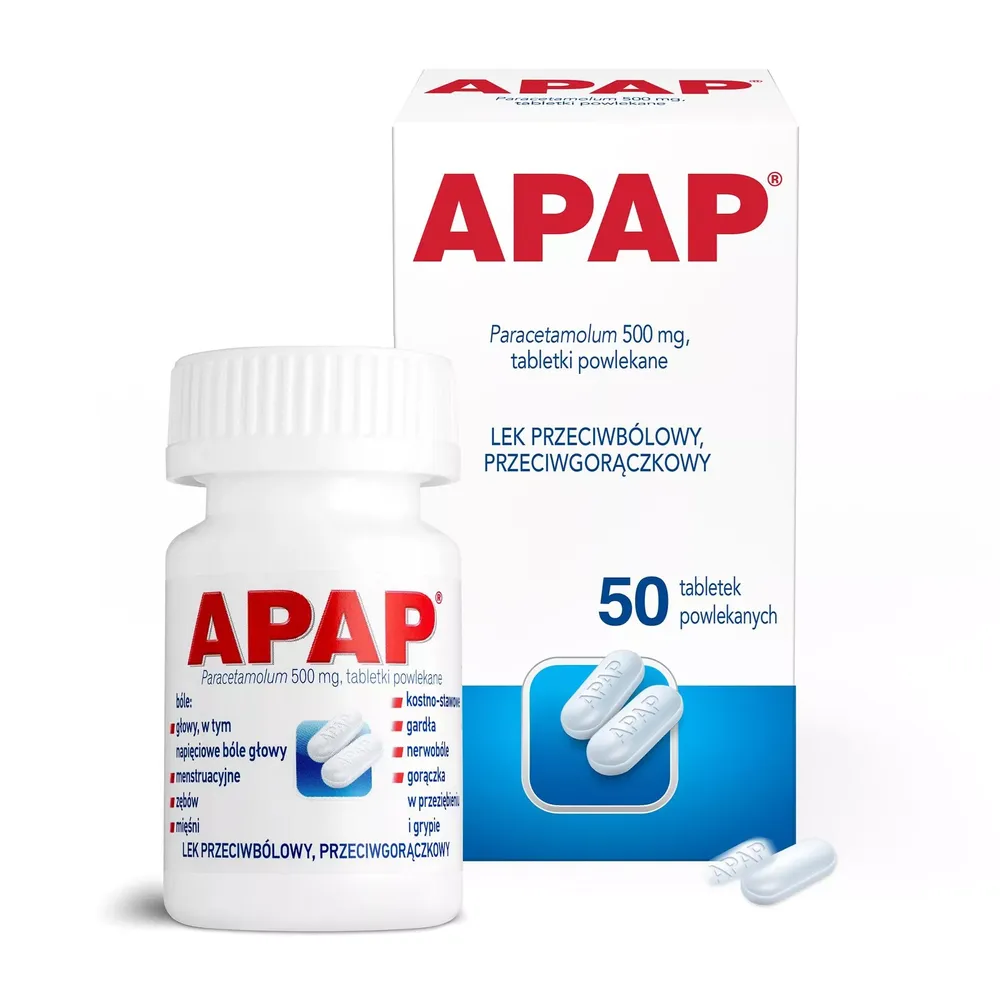
Table of Contents
Package leaflet: Information for the user
APAP
500 mg, coated tablets
Paracetamolum
Please read the entire leaflet carefully before taking this medicine, as it contains
important information for you.
This medicine should always be taken exactly as described in this patient leaflet or as directed by
your doctor or pharmacist.
- Keep this leaflet so that you can read it again if necessary.
- If you need advice or further information, please consult your pharmacist.
- If you experience any adverse reactions, including any possible adverse reactions not listed in this leaflet, inform your doctor or pharmacist. See section 4.
- If there is no improvement after 5 days (for pain) or 3 days (for fever), or if you feel worse, you should consult a doctor.
Contents of the leaflet
- What APAP is and what it is used for
- Important information before taking APAP
- How to take APAP
- Possible side effects
- How to store APAP
- Contents of the package and other information
1. What APAP is and what it is used for
APAP contains paracetamol as the active substance and is an analgesic and antipyretic medicine.
It is indicated for the treatment of mild to moderate pain of various origins, such as headache (including tension headache), menstrual pain, toothache, muscle and joint pain, sore throat, neuralgia, as well as fever, for example due to colds and influenza.
APAP is indicated for use in adults and adolescents over 12 years of age.
2. Important information before using the medicine APAP
When not to take the medicine APAP:
If the patient:
- has previously been diagnosed with hypersensitivity to paracetamol or any of the other ingredients of this medicine (listed in section 6),
- has severe liver or kidney impairment,
- has congenital glucose-6-phosphate dehydrogenase deficiency or methemoglobin reductase deficiency,
- is a child under 12 years of age.
Warnings and precautions
Due to the risk of overdose, ensure that other medicines being taken do not contain paracetamol. If a dose higher than recommended is taken, the patient should contact a doctor immediately, even if no symptoms occur, as this may lead to life-threatening liver damage.
Before starting treatment with Apap, consult a doctor or pharmacist if the patient has liver or kidney impairment, or bronchial asthma.
Use of the medicine in patients with liver impairment, those who abuse alcohol, or who are malnourished increases the risk of liver damage. Alcohol must not be consumed during treatment due to the risk of toxic liver injury.
During treatment with APAP, immediately inform the doctor if:
The patient suffers from severe diseases, including severe impairment of kidney function or sepsis (when bacteria and their toxins circulate in the blood, leading to organ damage), malnutrition, chronic alcoholism, or if the patient is also taking flucloxacillin (an antibiotic).
In such cases, patients have been reported to develop a serious condition called metabolic acidosis (a disturbance in blood and body fluid balance) when paracetamol was used regularly over a prolonged period or when paracetamol was taken together with flucloxacillin.
Symptoms of metabolic acidosis may include: severe breathing difficulties, including rapid deep breathing, drowsiness, nausea, and vomiting.
Children and adolescents
This medicine should not be given to children under 12 years of age (due to the formulation of the medicine).
APAP and other medicines
Tell your doctor or pharmacist about all medicines currently taken or recently taken, as well as any medicines planned for future use.
This medicine should not be used simultaneously with other medicines containing paracetamol, MAO inhibitors (medicines used, among others, in depression), or within 2 weeks after discontinuation of such treatment, and with zidovudine (an antiviral medicine used in HIV infection).
If oral anticoagulants (warfarin, coumarins), rifampicin and isoniazid (medicines used in tuberculosis treatment), antiepileptic drugs, barbiturates (sedative and hypnotic medicines), diflunisal (a pain-relieving medicine), sulfinpyrazone (a medicine used in the treatment of gout), or other medicines inducing hepatic microsomal enzymes are used, medical advice should be sought before taking this medicine. Caffeine enhances the analgesic effect of paracetamol.
Inform your doctor or pharmacist if the patient is taking:
- flucloxacillin (an antibiotic) due to the serious risk of blood and body fluid disturbances (called metabolic acidosis), which require urgent treatment (see section 2).
Taking APAP with food, drink, and alcohol
It is recommended to take the medicine on an empty stomach, as this allows faster analgesic and antipyretic action.
Alcohol should not be consumed during treatment with paracetamol due to increased risk of liver damage. The risk of liver injury is particularly high in malnourished individuals, regular alcohol consumers, and patients with alcoholic liver disease without cirrhosis.
Pregnancy, breastfeeding, and effects on fertility
If the patient is pregnant, breastfeeding, suspects she may be pregnant, or is planning to have a child, she should consult a doctor before using this medicine.
Apap may be administered to pregnant women if necessary. The lowest effective dose providing adequate pain relief or fever reduction should be used, and the medicine should be taken for the shortest possible duration.
If pain is not relieved or fever does not subside, or if increased dosing frequency becomes necessary, medical advice should be sought.
Driving and operating machinery
The medicine does not affect psychomotor performance.
The medicine contains less than 1 mmol (23 mg) of sodium per single dose (2 tablets), meaning the medicine is considered "sodium-free".
3. How to use APAP
This medicine should always be taken exactly as described in the patient leaflet or as directed by a doctor or pharmacist. If in doubt, consult a doctor or pharmacist.
The usual dose is:
- Adults: 1-2 coated tablets (500-1000 mg paracetamol), if necessary, 3-4 times daily (maximum 8 coated tablets per day, i.e. 4 g paracetamol per day). At least a 4-hour interval should be maintained between doses.
- Adolescents over 12 years of age: 1 coated tablet (500 mg paracetamol), if necessary, 3 to 4 times daily. At least a 4-hour interval should be maintained between doses. Do not use the medicine without consulting a doctor if pain persists for more than 5 days or fever for more than 3 days.
It is recommended to take the medicine on an empty stomach, as this accelerates its analgesic and antipyretic action.
If the effect of the medicine seems too strong or too weak, consult a doctor.
Use in children:
Do not give to children under 12 years of age (due to the formulation of the medicine).
Taking more than the recommended dose of APAP
In any case of overdose, seek immediate medical advice, even if the patient feels well, due to the risk of delayed, severe liver damage.
Within a few to several hours after ingestion, symptoms such as nausea, vomiting, excessive sweating, drowsiness, and general weakness may occur. These symptoms may subside the next day, even though liver damage may already be developing, later manifesting as abdominal discomfort, recurrence of nausea, and jaundice.
In every case of a single intake of paracetamol at a dose of 5 g or more, vomiting should be induced if no more than one hour has passed since ingestion, and immediate contact with a doctor is required. It is advisable to administer 60-100 g of activated charcoal orally, preferably mixed with water, to bind any remaining medicine in the stomach.
Missed dose of APAP
The medicine is taken as needed when symptoms occur, according to the recommended dosage and frequency described above.
Discontinuation of APAP
APAP is intended for short-term treatment of pain and fever, so its use may be discontinued at any time.
4. Possible adverse reactions
Like all medicines, this medicine can cause adverse reactions, although not everyone will experience them.
If any of the following symptoms occur, stop taking the medicine and contact your doctor immediately.
These are life-threatening conditions. They occur very rarely.
- Angioedema (swelling of the face, lips, tongue, throat, difficulty breathing), anaphylactic shock (dizziness, disturbances in consciousness, rapid heartbeat, drop in blood pressure),
- Severe skin reactions.
Other adverse reactions
occurring rarely (in 1 to 10 out of 10,000 patients taking the medicine):
- Hypersensitivity reactions, urticaria, erythema, rash,
- Nausea, vomiting, digestive disturbances,
occurring very rarely (less than 1 in 10,000 patients taking the medicine): - Thrombocytopenia (reduced number of blood platelets),
- Agranulocytosis (reduced number of granulocytes – a type of white blood cells, up to complete absence),
- Bronchospasm in patients with hypersensitivity to acetylsalicylic acid and other non-steroidal anti-inflammatory drugs,
- Acute liver injury, most commonly occurring as a result of overdose,
- Pigmented purpura.
Frequency unknown (cannot be estimated from available data): - Serious condition which may cause acidification of the blood (so-called metabolic acidosis), in patients with severe illness taking paracetamol (see section 2).
Reporting of adverse reactions
If any adverse reactions occur, including any adverse reactions not listed
in this leaflet, inform your doctor or pharmacist. Adverse reactions can
be reported directly to the Department of Monitoring Adverse Drug Reactions of the Office for Registration of Medicinal Products, Medical Devices and Biocidal Products,
Al. Jerozolimskie 181C, 02-222 Warsaw, tel.: +48 (22) 492 13 01, fax: +48 (22) 492 13 09,
website: https://smz2.ezdrowie.gov.pl
Adverse reactions can also be reported to the marketing authorization holder.
Reporting adverse reactions helps to provide more information on the safety of the medicine.
5. How to store APAP medicine
Store the medicine below 25°C. Keep out of sight and reach of children. Do not use the medicine after the expiry date stated on the carton and immediate packaging (month/year). The blister is labelled as follows:
EXP - expiry date, Lot - batch number. The expiry date refers to the last day of the stated month.
6. Contents of the packaging and other information
What APAP contains
The active substance is paracetamol (Paracetamolum).
One coated tablet contains 500 mg of paracetamol.
The other ingredients are: Carnauba wax, hypromellose, macrogol, povidone, pregelatinized starch, sodium croscarmellose, stearic acid.
What the medicine looks like and contents of the pack
A white, elongated tablet with a transparent film coating, embossed with the monogram APAP on one side.
Available pack sizes
2 tablets in a sachet; 2 tablets in 1 blister; 4 tablets in 1 blister; 6 tablets in 1 blister; 8 tablets in 1 blister; 10 tablets in 1 blister; 12 tablets in 1 blister; 24 tablets in 2 blisters (12 tablets each); 50 tablets in a bottle; 60 tablets in a bottle; 100 tablets in a bottle; 200 tablets in a bottle. Blister and bottle in a cardboard outer box.
Not all pack sizes may be marketed.
Marketing Authorisation Holder and Manufacturer
US Pharmacia Sp. z o.o., ul. Ziębicka 40, 50-507 Wrocław, Poland
For further information about this medicine, please contact:
USP Zdrowie Sp. z o.o., ul. Poleczki 35, 02-822 Warsaw, tel. +48 (22) 543 60 00.