Apap for cold caps
Poland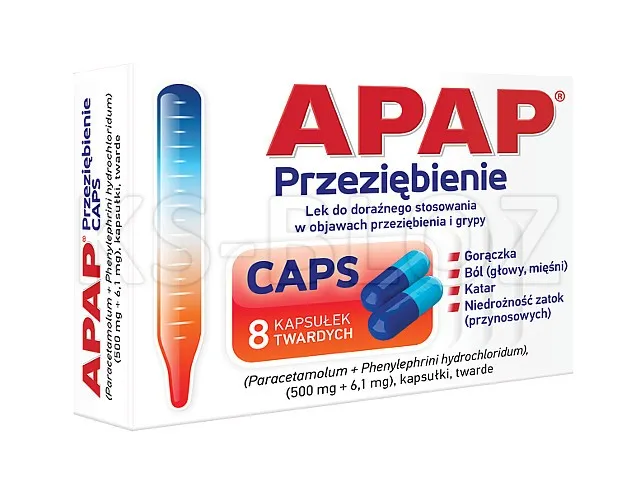
Table of Contents
- Package leaflet: Information for the patient
- 1. What APAP Przeziębienie CAPS is and what it is used for
- 2. Important information before using APAP Przeziębienie CAPS
- 3. How to use APAP Przeziębienie CAPS
- 4. Possible adverse reactions
- 5. How to store APAP Przeziębienie CAPS
- 6. Contents of the package and other information
Package leaflet: Information for the patient
APAP Przeziębienie CAPS
(500 mg + 6.1 mg), hard capsules
Paracetamolum + Phenylephrini hydrochloridum
Please read the entire leaflet carefully before using the medicine, as it contains
important information for the patient.
This medicine should always be used exactly as described in the patient leaflet or as directed by a
physician or pharmacist.
- Keep this leaflet, so that you can read it again if necessary.
- If you need advice or further information, please consult your pharmacist.
- If you experience any adverse reactions, including any possible adverse reactions not listed in this leaflet, inform your doctor or pharmacist. See section 4.
- If there is no improvement after 3 days, or if your condition worsens, consult your doctor.
Leaflet contents:
- What APAP Przeziębienie CAPS is and what it is used for
- Important information before taking APAP Przeziębienie CAPS
- How to take APAP Przeziębienie CAPS
- Possible side effects
- How to store APAP Przeziębienie CAPS
- Contents of the pack and other information
1. What APAP Przeziębienie CAPS is and what it is used for
APAP Przeziębienie CAPS is a combination medicine.
It contains two active substances: paracetamol and phenylephrine.
Paracetamol has antipyretic and analgesic effects, while phenylephrine reduces swelling and congestion of the nasal mucosa and sinuses. APAP Przeziębienie CAPS is intended for use in adults and adolescents over 12 years of age.
APAP Przeziębienie CAPS is intended for short-term use to relieve symptoms of influenza and cold, such as nasal catarrh (runny nose), headache (including headache caused by reduced sinus patency due to swelling of the nasal mucosa and impaired nasal airflow), sore throat, fever, and joint-muscle pain.
2. Important information before using APAP Przeziębienie CAPS
When not to use APAP Przeziębienie CAPS:
- if the patient is allergic to the active substances or other sympathomimetic amines or any of the other ingredients of this medicine (listed in section 6),
- if the patient has severe liver or kidney failure,
- if the patient has cardiovascular disorders,
- if the patient has cardiac arrhythmias,
- if the patient has arterial hypertension,
- if the patient has diabetes,
- if the patient has been diagnosed with pheochromocytoma,
- if the patient has been diagnosed with closed-angle glaucoma,
- if the patient has hyperthyroidism,
- if the patient has been diagnosed with benign prostatic hyperplasia,
- if the patient has congenital glucose-6-phosphate dehydrogenase deficiency or methemoglobin reductase deficiency,
- during treatment with monoamine oxidase inhibitors (MAOIs) or within 14 days after discontinuation of such treatment,
- during treatment with tricyclic antidepressants or zidovudine,
- do not use in children under 12 years of age,
- do not use during pregnancy and breastfeeding.
Warnings and precautions
Before starting treatment with APAP Przeziębienie CAPS, consult a doctor or
pharmacist if the patient:
- has liver or kidney impairment (liver enzyme activity and kidney function should be monitored),
- has arteriosclerosis,
- has Raynaud's syndrome,
- has stable coronary artery disease,
- has respiratory insufficiency,
- has bronchial asthma,
- is taking beta-adrenergic receptor antagonists,
- is taking anticoagulant medicines (dose adjustment may be required based on coagulation tests). This medicine contains paracetamol. Due to the risk of overdose, check whether other medicines being taken also contain paracetamol.
During treatment with APAP Przeziębienie CAPS, immediately inform the doctor
if:
- the patient has serious illnesses, including severe kidney disorders or sepsis (when bacteria and their toxins circulate in the blood, leading to organ damage), malnutrition, chronic fasting, or if the patient is also taking flucloxacillin (an antibiotic). In these situations, patients have been reported to develop a serious condition called metabolic acidosis (an abnormality in blood and body fluids) when taking paracetamol at standard doses for prolonged periods or when taking paracetamol together with flucloxacillin. Symptoms of metabolic acidosis may include: severe breathing difficulties, including rapid deep breathing, drowsiness, nausea, and vomiting.
Do not drink alcohol while taking this medicine. Using this medicine in patients with liver
impairment, alcohol abusers, or those who are fasting increases the risk of toxic liver damage.
Children and adolescents
This medicine should not be used in children under 12 years of age.
APAP Przeziębienie CAPS and other medicines
Inform your doctor or pharmacist about all medicines currently taken, recently taken, or planned to be taken.
The interaction of APAP Przeziębienie CAPS with other medicines results from the effects of the active
substances contained in the medicine:
Paracetamol:
- Do not take this medicine simultaneously with other medicines containing paracetamol.
- Medicines that accelerate gastric emptying (e.g. metoclopramide) increase the absorption rate of paracetamol.
- Medicines that delay gastric emptying (e.g. propantheline) may delay paracetamol absorption.
- Monoamine oxidase inhibitors (MAOIs) (used, among others, in the treatment of depression and within 2 weeks after discontinuation of treatment) may cause a state of excitation and fever.
- Concurrent use of paracetamol with zidovudine (AZT, a medicine used in HIV infection) may enhance the toxic effect of zidovudine on bone marrow.
- Paracetamol may enhance the effect of anticoagulant medicines (coumarin derivatives).
- Concurrent use of paracetamol with medicines that increase hepatic metabolism, i.e. certain sedatives or antiepileptic drugs such as phenobarbital, phenytoin, carbamazepine, as well as rifampicin (used, among others, in the treatment of tuberculosis) may lead to liver damage, even when recommended doses of paracetamol are used. Therefore, consult a doctor before using APAP Przeziębienie CAPS.
- Drinking alcohol during paracetamol treatment leads to the formation of a toxic metabolite causing necrosis of liver cells, which may subsequently lead to liver failure.
- Cholestyramine reduces paracetamol absorption; therefore, it should not be taken within the first hour after paracetamol administration.
- Probenecid prolongs the half-life of paracetamol.
Inform the doctor or pharmacist if the patient is taking:
flucloxacillin (an antibiotic) due to the serious risk of blood and body fluid disorders
(called metabolic acidosis), which must be treated urgently (see section 2).
Phenylephrine:
- Monoamine oxidase inhibitors (MAOIs) may enhance the effect of phenylephrine. Avoid simultaneous use of MAOIs with phenylephrine or administer phenylephrine at least 14 days after discontinuation of tricyclic antidepressants.
- Phenylephrine may enhance the anticholinergic effect of tricyclic antidepressants.
- Phenylephrine may reduce the antihypertensive effect of guanethidine, mecamylamine, methyldopa, and reserpine.
- Phenylephrine used simultaneously with indomethacin, beta-adrenergic receptor antagonists, or methyldopa may cause hypertensive crisis.
This medicine contains less than 1 mmol (23 mg) of sodium per single dose (1 capsule), meaning the medicine is considered "sodium-free".
APAP Przeziębienie CAPS with food, drink, and alcohol
Food does not significantly affect the absorption of the medicine.
Do not consume alcohol while taking this medicine.
Pregnancy, breastfeeding, and fertility
Do not use during pregnancy or in women who are breastfeeding.
If the patient is pregnant or breastfeeding, suspects she may be pregnant, or is planning to have a child, she should consult a doctor or pharmacist before using this medicine.
Driving and operating machinery
Exercise caution when driving or operating machinery while taking APAP Przeziębienie CAPS.
3. How to use APAP Przeziębienie CAPS
This medicine should always be taken exactly as described in the patient leaflet, or as directed by a doctor or pharmacist. If in doubt, consult a doctor or pharmacist.
APAP Przeziębienie CAPS should be taken orally.
Adults and adolescents over 12 years of age: 1 to 2 capsules, 3 to 4 times daily.
Do not take more than 8 capsules per day.
Use of a higher than recommended dose of APAP Przeziębienie CAPS
Accidental or intentional overdose may cause symptoms such as nausea, vomiting, excessive sweating, drowsiness, general weakness, restlessness, and tremor within a few to several hours. Nystagmus, elevated blood pressure, seizures, difficulty urinating, and shortness of breath may also occur. These symptoms may subside the next day, even though liver damage may have already begun, which later manifests as upper abdominal pain, recurrence of nausea, and jaundice. In case of overdose, seek immediate medical help. Treatment should be carried out in a hospital and consists of accelerating the elimination of the drug components from the body and maintaining vital functions. In cases of paracetamol overdose, antidotes such as N-acetylcysteine and (or) methionine may be required.
Missed dose of APAP Przeziębienie CAPS
If a dose is missed and symptoms persist, take the next dose of APAP Przeziębienie CAPS as scheduled. Do not take a double dose to make up for the missed dose.
Stopping treatment with APAP Przeziębienie CAPS
If you have any further doubts regarding the use of this medicine, consult your doctor or pharmacist.
4. Possible adverse reactions
Like all medicines, APAP Przeziębienie CAPS may cause adverse reactions, although they do not
occur in everyone.
If any of the following symptoms occur, do not take the medicine and contact your doctor
immediately. These are life-threatening conditions.
Occurring with unknown frequency:
- anaphylactic shock (pallor of the skin, drop in blood pressure, sweating, low urine output, laryngeal edema, rapid breathing, weakness)
- serious condition that may cause acidification of the blood (so-called metabolic acidosis) in patients with severe illness taking paracetamol (see section 2), occurring rarely:
- allergic reactions, i.e. urticaria, rash, itching, facial swelling, swelling of lips, tongue, throat (angioedema), bronchospasm causing breathing difficulties,
- hemorrhage,
- liver failure, liver necrosis, jaundice, manifested by yellowing of eyes and skin, abdominal pain, loss of appetite;
- acute pancreatitis (severe pain in the middle and upper abdomen, vomiting, abdominal distension, often with retention of gas and stool, high fever);
- kidney damage (nephropathy or tubulopathy) manifested by fever, lumbar pain, skin rash, red discoloration of urine (hematuria), renal colic, urinary retention, occurring very rarely:
- severe skin reactions: acute generalized exanthematous pustulosis, Stevens-Johnson syndrome (bullous erythema multiforme), toxic epidermal necrolysis, which manifest as follows: initially as red spots on the trunk, often with blisters in the center, pustular rash over the entire body or erosions in the mouth, eyes,
genital organs and on the skin or rupturing giant blisters, shedding of large sheets of
epidermis, accompanied by weakness, fever and joint pain;
Possible adverse reactions of the medicine due to the presence of paracetamol.
Adverse reactions occurring rarely (may occur less frequently than in 1 out of 1,000 people):
- anemia, bone marrow suppression, thrombocytopenia, agranulocytosis (lack of granulocytes in blood), leukopenia (reduced number of leukocytes), neutropenia (reduced number of neutrophil granulocytes);
- edema,
- chronic pancreatitis; abdominal pain, diarrhea, nausea,
- sweating, purpura.
Adverse reactions for which frequency cannot be determined based on available data:
- erythema multiforme, dizziness.
The medicine rarely exerts toxic effects on the kidneys; otherwise, no association with therapeutic
doses has been reported, except in cases of chronic use of the medicine.
Possible adverse reactions of the medicine due to the presence of phenylephrine.
Adverse reactions occurring frequently (may occur less frequently than in 1 out of 10 people):
- nausea, vomiting, digestive disturbances, loss of appetite.
Adverse reactions occurring rarely (may occur less frequently than in 1 out of 1,000 people):
- increased arterial pressure, tachycardia (rapid heartbeat), cardiac arrhythmias, palpitations, pallor of the skin.
Adverse reactions occurring very rarely (may occur less frequently than in 1 out of 10,000 people):
- anxiety, restlessness, tremor, nervousness, insomnia, irritability, dizziness and headache, hallucinations.
Adverse reactions for which frequency cannot be determined based on available data:
- kidney and urinary tract disorders in the form of urinary retention.
Reporting of adverse reactions
If any adverse reactions occur, including any not listed in this leaflet, inform your doctor or pharmacist.
Adverse reactions can be reported directly to the Department of Monitoring Adverse Reactions of Medicinal Products at the Office for Registration of Medicinal Products, Medical Devices and Biocidal Products:
Al. Jerozolimskie 181C, 02-222 Warsaw
tel.: +48 (22) 492-13-01, fax: +48 (22) 492-13-09
website: https://smz.ezdrowie.gov.pl/
Adverse reactions can also be reported to the marketing authorization holder.
Reporting adverse reactions helps to collect more information on the safety of the medicine.
5. How to store APAP Przeziębienie CAPS
Store below 25°C.
Keep the medicine out of the sight and reach of children.
Do not use this medicine after the expiry date stated on the outer carton
and on the immediate packaging (month/year).
Blister labelling: EXP – expiry date, BN – batch number.
Medicines must not be disposed of via household waste or sewage systems.
Ask your pharmacist how to dispose of medicines no longer required.
This will help protect the environment.
6. Contents of the package and other information
What APAP Przeziębienie CAPS contains
- The active substances in this medicine are: paracetamol and phenylephrine hydrochloride.
- One hard capsule contains:
- Other ingredients are: maize starch, sodium croscarmellose, sodium lauryl sulphate, magnesium stearate, talc; Cap: gelatin, erythrosine (E 127), titanium dioxide (E 171), indigo carmine (E 132); Body: gelatin, indigo carmine (E 132).
What APAP Przeziębienie CAPS looks like and contents of the pack
Two-coloured dark blue and/or light blue hard gelatin capsules, packed in PVC/aluminium blisters in a cardboard box.
Pack sizes: 6 capsules; 8 capsules; 10 capsules; 12 capsules; 16 capsules; 24 capsules.
Not all pack sizes may be marketed.
Marketing Authorisation Holder and Manufacturer
US Pharmacia Sp. z o.o.
ul. Ziębicka 40, 50-507 Wrocław
Manufacturer
Wrafton Laboratories Limited
Exeter Road, Wrafton, Braunton, Devon; EX33 2DL, United Kingdom
For further information about this medicine, please contact:
USP Zdrowie Sp. z o.o.
ul. Poleczki 35
02-822 Warszawa
tel. +48 (22) 543 60 00