Apap for cold junior
Poland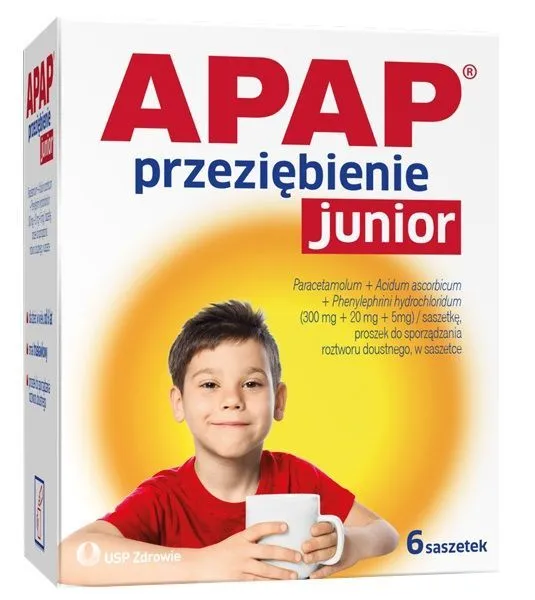
Table of Contents
- Package leaflet: Information for the patient
- 1. What APAP przeziębienie junior is and what it is used for
- 2. Important information before using APAP przeziębienie junior
- 3. How to use APAP przeziębienie junior
- 4. Possible adverse reactions
- 5. How to store APAP przeziębienie junior
- 6. Contents of the package and other information
Package leaflet: Information for the patient
APAP przeziębienie junior
(300 mg + 20 mg + 5 mg)/sachet, effervescent powder for oral solution in a sachet
Paracetamolum + Acidum ascorbicum + Phenylephrini hydrochloridum
Please read the entire leaflet carefully before using the medicine, as it contains
important information for the patient.
This medicine should always be used exactly as described in the patient leaflet or as directed by a
physician or pharmacist.
- Keep this leaflet for future reference.
- If you need advice or further information, please consult your pharmacist.
- If you experience any adverse reactions, including any possible adverse reactions not listed in this leaflet, inform your doctor or pharmacist. See section 4.
- If there is no improvement after 3 days of treatment, or if symptoms worsen, consult your doctor.
Contents of the leaflet
- What APAP przeziębienie junior is and what it is used for
- Important information before taking APAP przeziębienie junior
- How to take APAP przeziębienie junior
- Possible side effects
- How to store APAP przeziębienie junior
- Contents of the pack and other information
1. What APAP przeziębienie junior is and what it is used for
APAP przeziębienie junior is a combination medicine containing paracetamol, phenylephrine, and ascorbic acid (vitamin C). Paracetamol has antipyretic and analgesic effects. Phenylephrine reduces swelling and congestion of the mucous membranes.
This medicine is indicated for short-term relief of cold and flu symptoms such as: fever and chills, headache, muscle and joint pain, sore throat, nasal and sinus congestion with pain, and rhinitis (runny nose).
APAP przeziębienie junior is indicated for use in adults and children aged 6 years and older.
If there is no improvement after 3 days of treatment, or if symptoms worsen, consult your doctor.
2. Important information before using APAP przeziębienie junior
When not to use APAP przeziębienie junior
- If the patient is allergic to any active substance or any of the other ingredients of this medicine (listed in section 6).
- If the patient has any of the following conditions:
- unstable coronary artery disease,
- cardiac arrhythmia,
- high blood pressure,
- congenital deficiency of certain enzymes: glucose-6-phosphate dehydrogenase or methemoglobin reductase,
- severe liver or kidney failure,
- viral hepatitis,
- alcoholic liver disease,
- narrow-angle glaucoma,
- anatomically narrow filtration angle.
APAP przeziębienie junior must not be taken during treatment with MAO inhibitors or within 2 weeks after discontinuation of such medicines.
APAP przeziębienie junior must not be taken during treatment with zidovudine (a medicine used in the treatment of HIV infection).
Do not use together with other medicines containing paracetamol or other medicines for flu, colds, and medicines reducing mucosal congestion (so-called sympathomimetics).
Warnings and precautions
Before starting treatment with APAP przeziębienie junior, consult a doctor or pharmacist if:
- the patient has: liver or kidney failure, pheochromocytoma (a tumour of the adrenal gland), bronchial asthma, benign prostatic hyperplasia, hyperthyroidism, Raynaud's syndrome (pale appearance followed by blueness of fingers, toes, earlobes and nose tip, often triggered by cold or emotional stress), coronary artery disease, hypertension, diabetes;
- the patient is taking anticoagulant medicines.
Cases of liver failure have been reported in severely malnourished patients, those suffering from anorexia, with low body mass index (BMI), and regular alcohol drinkers.
During treatment with APAP przeziębienie junior, inform your doctor immediately if:
The patient suffers from serious conditions, including severe kidney dysfunction or sepsis (when bacteria and their toxins circulate in the blood, leading to organ damage), malnutrition, chronic alcoholism, or if the patient is also taking flucloxacillin (an antibiotic). In these situations, severe illness called metabolic acidosis (abnormality in blood and body fluids) has been observed in patients taking paracetamol regularly over a prolonged period or when paracetamol was taken together with flucloxacillin. Symptoms of metabolic acidosis may include: severe breathing difficulties, including rapid deep breathing, drowsiness, nausea and vomiting.
Children and adolescents
This medicine must not be used in children under 6 years of age.
APAP przeziębienie junior and other medicines
Tell your doctor or pharmacist about all medicines the patient is currently taking or has recently taken, as well as any medicines the patient plans to take.
Do not take this medicine simultaneously with other medicines containing:
- paracetamol (the active ingredient found in many cold and flu medicines), because paracetamol overdose may lead to liver failure, which could result in the need for liver transplantation or death;
- phenylephrine or pseudoephedrine (medicines belonging to the so-called sympathomimetics, used in symptomatic treatment of nasal mucosa inflammation, i.e. nasal congestion);
- other sympathomimetics or MAO inhibitors (used in the treatment of hypotension or depression);
- zidovudine (an antiviral medicine used in the treatment of HIV infections).
Consult a doctor or pharmacist before using this medicine together with the following medicines:
- anticoagulants (warfarin, coumarin);
- antiepileptic medicines;
- barbiturates (medicines with sedative and calming effects);
- other medicines inducing hepatic microsomal enzymes (e.g. isoniazid, rifampicin, antituberculosis medicines);
- metoclopramide (an antiemetic medicine);
- anticholinergics (medicines used in bronchial asthma, treatment of gastric ulcers and reflux, as antiemetics, in gastrointestinal spasm, and symptomatic treatment of Parkinson's disease);
- antihypertensive medicines (guanethidine, mecamylamine, methyldopa, reserpine);
- beta-adrenergic receptor antagonists (medicines used in hypertension and cardiovascular diseases);
- tricyclic antidepressants;
- ergot alkaloid derivatives, e.g. bromocriptine, cabergoline, lisuride, pergolide (medicines used in migraine treatment);
- bromocriptine and cabergoline (medicines lowering prolactin hormone levels);
- medicines accelerating labour;
- salicylates (e.g. acetylsalicylic acid);
- medicines neutralizing gastric juice;
- medicines or dietary supplements containing iron;
- stimulant medicines;
- appetite-reducing medicines;
- psychostimulants belonging to amphetamine derivatives (e.g. used in treatment of attention deficit hyperactivity disorder).
Inform your doctor or pharmacist if the patient is taking:
- flucloxacillin (an antibiotic) due to serious risk of blood and body fluid disorders (called metabolic acidosis), which must be urgently treated (see section 2).
If the patient is unsure whether they are taking any of these medicines, they should consult a doctor or pharmacist.
Effect on laboratory test results
Paracetamol use may cause false results in certain laboratory tests (e.g. glucose or uric acid measurements).
APAP przeziębienie junior with food, drink or alcohol
This medicine can be taken regardless of meals.
Alcohol consumption during treatment is contraindicated due to the risk of toxic liver damage.
Pregnancy, breastfeeding and fertility
Do not use during pregnancy or breastfeeding.
Driving and operating machinery
Exercise caution while driving or operating machinery during treatment with this medicine.
Warnings regarding excipients
The medicine contains less than 1 mmol (23 mg) of sodium per sachet, meaning the medicine is considered "sodium-free".
The medicine contains no more than 0.005 mg of benzyl alcohol per sachet. Benzyl alcohol may cause allergic reactions. Patients with liver or kidney disease, and women who are pregnant or breastfeeding, should contact a doctor before using a medicine containing benzyl alcohol, as large amounts of benzyl alcohol may accumulate in their bodies and cause adverse effects (so-called metabolic acidosis (see section 4)).
The medicine contains glucose (as a component of dextrose and glucose syrup with flavouring). One sachet contains 46 mg of glucose. If the patient has previously been diagnosed with intolerance to certain sugars, they should contact a doctor before taking this medicine.
The medicine contains 1.83 g of mannitol (E 421) per sachet.
The medicine may have a mild laxative effect.
3. How to use APAP przeziębienie junior
This medicine should always be used exactly as described in the patient information leaflet or as directed by a doctor or pharmacist. If in doubt, consult a doctor or pharmacist.
Use in children aged 6 to 12 years
If necessary, 1 sachet, no more frequently than every 4 to 6 hours, up to a maximum of 4 sachets per day.
Maximum daily dose of paracetamol in children: 60 mg/kg body weight per 24 hours, administered in divided doses up to 4 times daily at 15 mg/kg body weight.
Adults and adolescents over 12 years of age
If necessary, 1 or 2 sachets, no more frequently than every 4 to 6 hours, up to a maximum of 6 sachets per day.
Method of administration
For oral use. The contents of the sachet should be poured into hot water (100 ml) and stirred thoroughly until the powder is completely dissolved.
The solution should be consumed within 15 minutes after preparation.
Do not use for longer than 3 days without medical advice.
Dosage of APAP przeziębienie junior in special patient groups
Renal impairment
In patients with renal impairment, a reduced dose of paracetamol and prolonged intervals between doses are recommended as stated below:
Adults
| Glomerular filtration rate (GFR) | Single dose of paracetamol |
| 10-50 ml/min | 500 mg every 6 hours |
Do not use the medicine in case of severe renal insufficiency (glomerular filtration rate: below 10 ml/min, see "When not to use APAP przeziębienie junior").
Hepatic insufficiency
In patients with hepatic insufficiency or Gilbert's syndrome, the dose of paracetamol should be reduced or the interval between doses prolonged. The maximum daily dose of paracetamol should not exceed 2 g per day.
Elderly patients
Current experience indicates that the adult dose of paracetamol is appropriate for this patient group.
However, in elderly patients, a reduced dose or less frequent administration may be appropriate.
If the medicine is not used under medical supervision, a daily dose exceeding 2 g should not be administered to patients:
- weighing less than 50 kg
- with hepatic insufficiency (see above)
- with alcoholic liver disease
- dehydrated
- undernourished.
Use of a higher than recommended dose of APAP przeziębienie junior
In case of ingestion of a dose higher than recommended, seek immediate medical advice, even if no adverse symptoms are present.
Overdose of paracetamol may cause symptoms such as nausea, vomiting, excessive sweating, drowsiness, and general weakness. These symptoms may resolve spontaneously, but this does not exclude the possibility of developing liver damage, which may subsequently manifest as abdominal distension, recurrence of nausea, and jaundice.
Oral administration of 60–100 g of activated charcoal, preferably mixed with water, is recommended.
Overdose of phenylephrine may cause cardiovascular disturbances (excessive heart rate, elevated arterial blood pressure), circulatory collapse with respiratory depression.
Missed dose of APAP przeziębienie junior
Do not take a double dose to make up for a missed dose.
4. Possible adverse reactions
Like all medicines, this medicine can cause adverse reactions, although not everyone will experience them.
You should immediately stop taking the medicine and consult a doctor if any of the following symptoms occur:
- Allergic reactions such as skin rash or itching, sometimes accompanied by difficulty breathing or swelling of the lips, tongue, throat or face; occur rarely,
- Severe skin reactions manifesting as a rash all over the body, erosions in the mouth, eyes, genital organs and on the skin, red spots on the trunk, often with blisters in the centre, rupturing large blisters, peeling off large sheets of the epidermis, weakness, fever and joint pain; occur very rarely,
- Breathing difficulties, if similar problems occurred in the past during use of acetylsalicylic acid or other non-steroidal anti-inflammatory drugs; occur very rarely,
- Loss of vision, which may be caused by abnormally high intraocular pressure, especially in patients with closed-angle glaucoma; occurs rarely,
- Unusual rapid heartbeat or sensation of irregular heart rhythm; frequency unknown,
- Difficulty in passing urine; frequency unknown,
- Jaundice, acute liver damage most commonly due to overdose, liver failure (indicated by yellowing of the skin and eyes, liver tenderness), liver necrosis; occur very rarely,
- Hypoglycaemia (excessive decrease in blood sugar concentration); occurs very rarely,
- Serious condition which may cause blood acidification (so-called metabolic acidosis) in patients with severe disease taking paracetamol (see section 2); occurs with unknown frequency (cannot be determined based on available data),
- Dizziness, increased heart rate, tendency to develop bruises ( bone marrow suppression - reduced number of bone marrow cells producing blood cells) and coagulation disorders; occur rarely.
Adverse reactions occurring rarely (may occur less frequently than in 1 out of 1,000 patients):
- depression, confusion;
- tremor;
- pupil dilation;
- oedema;
- diarrhoea, abdominal pain;
- increased liver enzyme activity (aminotransferases), abnormal liver function;
- itching, sweating;
- malaise, fever, excessive sedation.
Adverse reactions occurring very rarely (may occur less frequently than in 1 out of 10,000 patients):
- anaemia (reduced number of red blood cells);
- leucopenia, neutropenia (reduced number of a type of white blood cells - leucocytes or neutrophils), agranulocytosis (absence of a type of white blood cells in blood), thrombocytopenia (reduced number of platelets);
- pigmented purpura;
- sterile pyuria (cloudy urine).
Adverse reactions occurring with unknown frequency (cannot be determined based on available data):
- anxiety, nervousness, restlessness, hallucinations;
- dizziness, headache, insomnia;
- increased blood pressure;
- pallor of the skin;
- nausea, vomiting, digestive disturbances, epigastric burning, dry mouth, acute or chronic pancreatitis.
Reporting of adverse reactions
If any adverse effects occur, including any adverse effects not listed in this leaflet, inform your doctor or pharmacist. Adverse reactions can be reported directly to the Department of Monitoring Adverse Drug Reactions of the Office for Registration of Medicinal Products, Medical Devices and Biocidal Products, Al. Jerozolimskie 181C, 02-222 Warsaw, tel.: +48 22 49 21 301, fax: +48 22 49 21 309, website: https://smz.ezdrowie.gov.pl
Adverse reactions can also be reported to the marketing authorisation holder.
Reporting adverse reactions helps to provide more information on the safety of the medicine.
5. How to store APAP przeziębienie junior
Store the medicine below 25°C, in the original packaging to protect
from light and moisture.
Keep the medicine out of sight and reach of children.
Do not use this medicine after the expiry date stated on the carton and
immediate packaging (month/year). The following labelling applies to the sachet: EXP - expiry date,
Lot - batch number. The expiry date refers to the last day of the stated month.
Medicines must not be disposed of via the sewage system or household waste. Ask
your pharmacist how to dispose of medicines no longer required. This will help
protect the environment.
6. Contents of the package and other information
What APAP przeziębienie junior contains
The active substances are: paracetamol, ascorbic acid and phenylephrine hydrochloride.
Each sachet contains 300 mg of paracetamol, 20 mg of ascorbic acid and 5 mg of phenylephrine hydrochloride.
Other components are: mannitol (E421), citric acid, disodium citrate dihydrate, sodium cyclamate, sodium saccharin, calcium gluconate, orange flavour (containing, among others: linalool, citral, benzyl alcohol, citronellol, dextrose (from corn/wheat), dehydrated glucose syrup (from corn), butylated hydroxyanisole (E320)) and strawberry flavour (containing, among others: dehydrated glucose syrup (from corn)).
What APAP przeziębienie junior looks like and contents of the pack
White or almost white powder with a smell reminiscent of strawberries.
Pack contents: 6 or 12 sachets.
Marketing Authorisation Holder
US Pharmacia Sp. z o.o.
ul. Ziębicka 40
50-507 Wrocław
Poland
Manufacturer
Chemax Pharma Ltd.
8A, Goritsa Str.
Sofia 1618
Bulgaria
For further information about this medicine, please contact:
USP Zdrowie Sp. z o.o.
ul. Poleczki 35
02-822 Warszawa
Poland
tel. +48 (22) 543 60 00