Apap for cold
Poland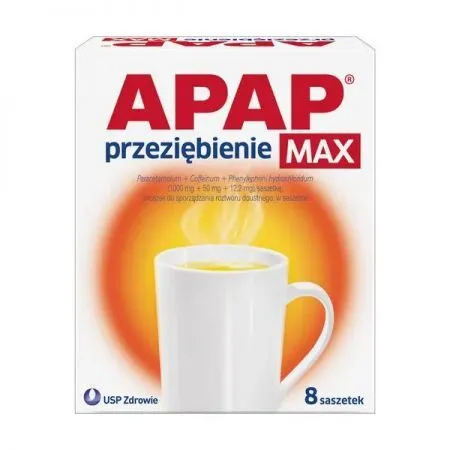
Table of Contents
Package leaflet: Information for the user
APAP przeziębienie
(650 mg + 50 mg + 10 mg) / sachet
effervescent powder for oral solution
(Paracetamolum + Acidum ascorbicum + Phenylephrini hydrochloridum)
Please read all of this leaflet carefully before taking this medicine, because it contains
important information for you.
This medicine should always be used according to the instructions in this patient leaflet or as directed by your doctor or pharmacist.
- Keep this leaflet, as you may need to read it again.
- Ask your pharmacist if you need advice or further information.
- If you experience any adverse reactions, including any possible adverse reactions not listed in this leaflet, tell your doctor or pharmacist.
- If there is no improvement after 3 days or if your condition worsens, contact your doctor.
Contents of the leaflet
1. What APAP przeziębienie is and what it is used for
2. Important information before taking APAP przeziębienie
3. How to take APAP przeziębienie
4. Possible side effects
5. How to store APAP przeziębienie
6. Contents of the pack and other information
1. What APAP przeziębienie is and what it is used for
APAP przeziębienie, effervescent powder for oral solution, is a combination medicine containing paracetamol, ascorbic acid, and phenylephrine hydrochloride. It has antipyretic, analgesic, and nasal decongestant properties. It helps relieve symptoms of cold and flu.
This medicine is indicated for the short-term relief of symptoms of cold, flu, and flu-like infections, such as fever, headache, sore throat, muscle and joint pain, and nasal mucosal congestion associated with cold and flu.
If there is no improvement after 3 days or if your condition worsens, you should consult your doctor.
2. Important information before taking APAP przeziębienie
When not to take this medicine:
- if you are allergic to any of the active substances, sympathomimetic amines, or any of the other ingredients of this medicine (listed in section 6),
- if you have any of the following conditions:
- unstable coronary artery disease,
- cardiac arrhythmias,
- high blood pressure,
- congenital glucose-6-phosphate dehydrogenase or methemoglobin reductase deficiency,
- severe liver or kidney failure,
- viral hepatitis,
- alcoholic liver disease,
- phenylketonuria (due to aspartame content),
- hyperthyroidism,
- narrow-angle glaucoma,
- during treatment with monoamine oxidase inhibitors (MAOIs) (used to treat low blood pressure and depression) and within 14 days after discontinuation of such treatment,
- in combination with tricyclic antidepressants,
- during treatment with zidovudine (a medicine used to treat HIV infection),
- in children under 12 years of age.
Warnings and precautions
Before taking this medicine, consult your doctor or pharmacist if you have:
- liver or kidney impairment,
- bronchial asthma,
- benign prostatic hyperplasia,
- Raynaud’s syndrome (pallor followed by cyanosis of fingers, toes, earlobes, and nasal tip, often triggered by cold or emotional stress),
- coronary artery disease,
- diabetes,
- intolerance to certain sugars (due to sucrose content). Use of this medicinal product in fasting individuals may pose a risk of liver damage.
You should contact your doctor even if the above warnings relate to conditions you had in the past.
During treatment with APAP przeziębienie, contact your doctor immediately if:
You have severe illnesses, including severe kidney dysfunction or sepsis (when bacteria and their toxins circulate in the blood, leading to organ damage), malnutrition, chronic alcoholism, or if you are also taking flucloxacillin (an antibiotic). In such cases, patients taking paracetamol regularly over a long period or taking paracetamol together with flucloxacillin have been reported to develop a serious condition called metabolic acidosis (an imbalance in blood and body fluids). Symptoms of metabolic acidosis may include: severe breathing difficulties, including rapid deep breathing, drowsiness, nausea, and vomiting.
Children and adolescents
Do not give APAP przeziębienie to children under 12 years of age.
APAP przeziębienie and other medicines
Do not take this medicine simultaneously with other medicines containing:
- paracetamol (an active ingredient found in many cold and flu preparations);
- phenylephrine or pseudoephedrine (used in symptomatic treatment of rhinitis, i.e. nasal congestion);
- other sympathomimetics or MAO inhibitors (used to treat low blood pressure and depression);
- zidovudine (an antiviral drug used in the treatment of HIV infection);
- tricyclic antidepressants; other flu, cold medicines, or medicines reducing nasal mucosal congestion.
Consult your doctor before taking this medicine together with:
- anticoagulants (warfarin, coumarin);
- antiepileptic drugs;
- barbiturates (sedative and calming medicines);
- drugs inducing microsomal enzymes;
- antihypertensive drugs (guanethidine, mecamylamine, methyldopa, reserpine);
- indometacin (an analgesic and anti-inflammatory drug, used e.g. in rheumatoid arthritis);
- β-adrenergic receptor antagonists (drugs used in hypertension and cardiovascular diseases);
- metoclopramide;
- anticholinergics.
Inform your doctor or pharmacist if you are taking flucloxacillin (an antibiotic) due to the serious risk of blood and body fluid disorders (called metabolic acidosis), which requires urgent treatment (see section 2).
Ascorbic acid contained in this medicine increases the absorption of:
- aluminium (found in antacids);
- iron.
APAP przeziębienie with food, drink or alcohol
Food does not reduce absorption of the medicine.
Do not drink alcohol while taking this medicine due to the risk of toxic liver damage.
Pregnancy and breastfeeding
During pregnancy, breastfeeding, if you suspect you may be pregnant, or if you are planning a pregnancy, consult your doctor or pharmacist before taking this medicine.
Do not use during pregnancy.
Do not use during breastfeeding.
Driving and using machines
Exercise caution while driving or operating machinery during treatment with this medicine.
The medicine contains excipients with known effects:
Aspartame
The medicine contains 20 mg of aspartame (E 951) per sachet. Aspartame is a source of phenylalanine.
It may be harmful to patients with phenylketonuria. This is a rare genetic disorder in which phenylalanine accumulates in the body due to improper excretion.
Sucrose and glucose (components of maltodextrin and anhydrous corn syrup glucose from flavourings)
The medicine contains 1.981 g of sucrose per sachet and 11.886 g of suc游戏副本
3. How to use APAP przeziębienie
This medicine should always be taken according to the instructions in the patient leaflet or as directed by a doctor or pharmacist. If in doubt, consult a doctor or pharmacist.
Adults and children over 12 years of age:
1 sachet every 4-6 hours (maximum 6 sachets per day).
The contents of the sachet should be dissolved in a glass of hot water.
If the effect of the medicine is too strong or too weak, consult a doctor.
Use of a higher than recommended dose of APAP przeziębienie
If more than the recommended dose has been taken, stop taking the medicine immediately and contact a doctor or the nearest hospital emergency department.
Bring the package leaflet and the medicine packaging with you.
Management of overdose:
- if the patient is conscious and less than one hour has passed since the overdose, induce vomiting,
- administer 60-100 g of activated charcoal orally, preferably mixed with water. Antidote: N-acetylcysteine, methionine, within 24 hours after overdose. Paracetamol overdose may cause severe liver damage, particularly in individuals who have previously been fasting or who abuse alcohol.
Symptoms such as nausea, vomiting, excessive sweating, drowsiness and general weakness may occur.
These symptoms may resolve spontaneously, but this does not exclude the development of liver damage.
Other symptoms may include tremor, restlessness, insomnia, increased blood pressure, marked tachycardia, pallor of the skin and mucous membranes, and urinary retention. In later stages, abdominal pain and jaundice may appear.
Missed dose of APAP przeziębienie
This medicine is intended for short-term relief of cold, flu and flu-like symptoms.
If a dose is missed and symptoms persist, take the next dose as scheduled.
Do not take a double dose to make up for a missed dose.
Stopping treatment with APAP przeziębienie
If you have any further doubts regarding the use of this medicine, consult a doctor or pharmacist.
4. Possible adverse reactions
Like all medicines, Apap przeziębienie may cause adverse reactions, although not everyone experiences them.
These include:
- Skin and subcutaneous tissue disorders: allergic reactions (itching, urticaria);
- Immune system disorders: hypersensitivity reactions up to symptoms of anaphylactic shock (manifesting as disturbances in consciousness, pale skin, drop in blood pressure, sweating, reduced urine output, rapid breathing, swelling);
- Gastrointestinal disorders: nausea, vomiting, digestive disturbances, heartburn, dryness of the mouth;
- Cardiovascular system disorders: increased blood pressure, tachycardia (rapid heartbeat), heart rhythm disturbances, pallor of the skin and mucous membranes;
- Respiratory, thoracic and mediastinal disorders: breathing difficulties, asthma attack;
- Renal and urinary disorders: disturbances in urination, renal colic, renal papillary necrosis;
- Nervous system disorders: restlessness, insomnia;
- Psychiatric disorders: hallucinations, anxiety, nervousness;
- Blood and lymphatic system disorders: granulocytopenia (reduced number of a certain type of white blood cells in the blood), agranulocytosis (absence of a certain type of white blood cells in the blood), thrombocytopenia (reduced number of blood platelets).
Frequency unknown (cannot be estimated from available data)
- Severe condition which may cause acidification of the blood (so-called metabolic acidosis) in patients with severe disease taking paracetamol (see section 2).
Adverse reactions are rare when the medicine is used for short-term treatment.
Reporting of adverse reactions
If any adverse reactions occur, including any adverse reactions not listed in this leaflet, inform your doctor or pharmacist. Adverse reactions can be reported directly to the Department of Monitoring Adverse Drug Reactions of the Office for Registration of Medicinal Products, Medical Devices and Biocidal Products
Al. Jerozolimskie 181C,
02-222 Warsaw,
tel.: +48 (22) 492 13 01,
fax: +48 (22) 492 13 09
website: https://smz.ezdrowie.gov.pl
Adverse reactions can also be reported to the marketing authorization holder.
Reporting adverse reactions helps to provide more information on the safety of the medicine.
5. How to store APAP przeziębienie
Keep this medicine below 25°C.
Keep the medicine in a place out of sight and reach of children.
Do not use this medicine after the expiry date stated on the packaging.
Medicines should not be disposed of via sewage systems or household waste bins.
Ask your pharmacist how to dispose of medicines no longer in use. Such practices help
protect the environment.
- Contents of the packaging and other information
What APAP przeziębienie contains
Each sachet contains the active substances: paracetamol 650 mg, ascorbic acid 50 mg, phenylephrine
hydrochloride 10 mg.
Other ingredients in each sachet are: sucrose, citric acid, sodium citrate, lemon flavour 87A069*,
lemon flavour 875060**, potassium acesulfame (E 950), lemon flavour 501.476/AP0504***,
lemon flavour 875928****, aspartame (E 951), quinoline yellow (E 104).
*lemon flavour 87A069 contains, among others: lemon juice concentrate (containing sulphites), natural
citral (containing: citral, citronellol, geraniol, limonene, linalool), dehydrated corn glucose syrup
**lemon flavour 875060 contains, among others: natural citral, natural linalool (containing: citral,
citronellol, geraniol, limonene, linalool), dehydrated corn glucose syrup,
butylated hydroxyanisole (E 320)
***lemon flavour 501.476/AP0504 contains, among others: corn maltodextrin
****lemon flavour 875928 contains, among others: citral, geraniol, limonene, linalool, dehydrated
corn glucose syrup
What APAP przeziębienie looks like and contents of the packaging
Sachet containing effervescent powder for oral solution.
The medicine is available in pack sizes: 5, 8, 10 or 12 sachets in a cardboard box with leaflet.
Marketing Authorisation Holder and Manufacturer
US Pharmacia Sp. z o.o.
Ziębicka 40 Street
50-507 Wrocław, Poland
For further information on this medicine, please contact:
USP Zdrowie Sp. z o.o.
Poleczki 35 Street
02-822 Warsaw, Poland
Tel. +48 (22) 543 60 00