Apap for cold max
Poland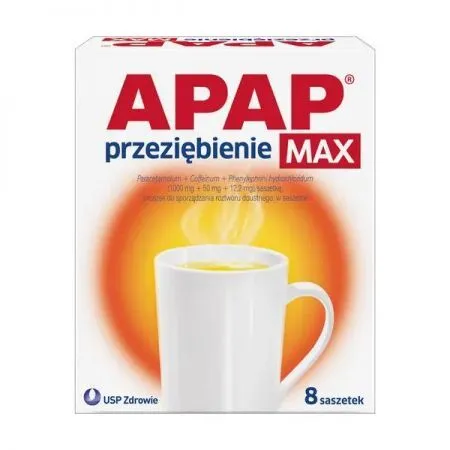
Table of Contents
- Package leaflet: Information for the patient
- 1. What APAP cold MAX is and what it is used for
- 2. Important information before using APAP przeziębienie MAX
- 3. How to use APAP przeziębienie MAX
- 4. Possible adverse effects
- 5. How to store the medicine APAP przeziębienie MAX
- 6. Contents of the package and other information
Package leaflet: Information for the patient
APAP cold MAX
(1000 mg + 50 mg + 12.2 mg)/sachet, effervescent powder for oral solution in a sachet
Paracetamolum + Coffeinum + Phenylephrini hydrochloridum
Please read the entire leaflet carefully before use, as it contains
important information for the patient.
This medicine should always be used exactly as described in this patient leaflet or as directed by
a doctor or pharmacist.
- Keep this leaflet for future reference.
- If advice or further information is needed, consult a pharmacist.
- If the patient experiences any adverse reactions, including any possible adverse reactions not listed in this leaflet, inform a doctor or pharmacist. See section 4.
- If there is no improvement after 3 days or if symptoms worsen, consult a doctor.
Table of contents:
- What APAP cold MAX is and what it is used for
- Important information before taking APAP cold MAX
- How to take APAP cold MAX
- Possible side effects
- How to store APAP cold MAX
- Contents of the pack and other information
1. What APAP cold MAX is and what it is used for
APAP cold MAX is a combination medicine. It contains three active substances: paracetamol, caffeine,
and phenylephrine. Caffeine enhances the pain-relieving effect of paracetamol and accelerates the onset
of its action.
APAP cold MAX is indicated for the short-term treatment of symptoms of cold and flu, such as:
nasal and sinus congestion, nasal mucosal hyperemia and swelling, sensation of stuffy nose, rhinitis,
pain associated with sinus congestion, headache, sore throat, muscle pain, fever, general malaise, and fatigue.
If symptoms worsen or do not improve within 3 days, consult a doctor.
2. Important information before using APAP przeziębienie MAX
When not to use APAP przeziębienie MAX:
- if the patient is allergic (hypersensitive) to paracetamol, caffeine, phenylephrine or other drugs with similar action, or to any of the other ingredients of this medicine (listed in section 6),
- in case of severe liver or kidney failure,
- if the patient has ever had peptic ulcer disease,
- if the patient has cardiovascular disorders,
- if the patient has cardiac arrhythmias,
- if the patient has arterial hypertension,
- if the patient has diabetes,
- if the patient has been diagnosed with pheochromocytoma,
- if the patient has been diagnosed with narrow-angle glaucoma,
- if the patient has hyperthyroidism,
Page 1 of 7
- if the patient has been diagnosed with benign prostatic hyperplasia,
- if the patient has congenital glucose-6-phosphate dehydrogenase deficiency or methemoglobin reductase deficiency,
- during treatment with monoamine oxidase inhibitors (MAO inhibitors) (used in the treatment of hypotension and depression) and within 14 days after discontinuation of such treatment,
- during treatment with tricyclic antidepressants (drugs used in psychiatric disorders),
- during treatment with zidovudine (AZT, a drug used in HIV infection),
- during pregnancy and breastfeeding,
- in children under 12 years of age.
Warnings and precautions
Before starting treatment, consult a doctor or pharmacist.
The medicine contains paracetamol. Due to the risk of overdose, check whether other medicines being taken contain paracetamol.
Alcohol must not be consumed during treatment. Use of this medicine in patients with liver failure, alcohol abuse, or fasting may lead to hepatotoxic liver damage.
During treatment with APAP przeziębienie MAX, immediately inform your doctor if:
The patient has serious medical conditions, including severe kidney disease or sepsis (when bacteria and their toxins circulate in the blood, leading to organ damage), malnutrition, chronic alcoholism, or if the patient is also taking flucloxacillin (an antibiotic). In these situations, severe metabolic acidosis (a blood and body fluid disorder) has been reported in patients taking paracetamol regularly over a long period or taking paracetamol together with flucloxacillin. Symptoms of metabolic acidosis may include: severe breathing difficulties, including rapid deep breathing, drowsiness, nausea, and vomiting.
Use with caution in:
- patients with liver or kidney impairment (liver enzyme activity and kidney function should be monitored),
- patients with arteriosclerosis,
- patients with Raynaud's syndrome (characterized by pallor followed by cyanosis of fingers, toes, earlobes, and nose tip, often triggered by cold or emotional stress),
- patients with stable coronary artery disease,
- patients with respiratory insufficiency,
- patients with bronchial asthma,
- patients with increased intraocular pressure,
- patients taking anxiolytic drugs,
- patients taking beta-adrenergic blocking agents (e.g., drugs used in hypertension treatment),
- patients taking anticoagulants.
Consult a doctor even if the above warnings refer to conditions that occurred in the past.
Children and adolescents
Do not use in children under 12 years of age.
APAP przeziębienie MAX and other medicines
Inform your doctor or pharmacist about all medicines currently or recently taken, as well as any medicines you plan to take.
The interaction of APAP przeziębienie MAX with other medicines results from the effects of the active substances contained in the medicine.
Page 2 of 7
Paracetamol
- Do not use this medicine simultaneously with other medicines containing paracetamol.
- Drugs that accelerate gastric emptying (e.g., metoclopramide) increase the absorption rate of paracetamol.
- Drugs that delay gastric emptying (e.g., propantheline) may delay paracetamol absorption.
- Concurrent use of paracetamol with MAO inhibitors (used in the treatment of, among others, hypotension and depression) and within 14 days after discontinuation of such treatment may cause a state of excitation and fever.
- Concurrent use of paracetamol with zidovudine (AZT, a drug used in HIV infection) may enhance the toxic effect of zidovudine on bone marrow.
- Paracetamol may enhance the effect of anticoagulant drugs (coumarin derivatives).
- Concurrent use of paracetamol with drugs that increase hepatic metabolism, such as certain sedatives or antiepileptic drugs (e.g., phenobarbital, phenytoin, carbamazepine), as well as rifampicin (used in the treatment of, among others, tuberculosis), may lead to liver damage, even when recommended doses of paracetamol are used. Therefore, consult a pharmacist or doctor before using this medicine.
- Alcohol consumption during paracetamol treatment may lead to liver failure.
- Cholestyramine reduces paracetamol absorption and therefore should not be taken within the first hour after paracetamol administration.
- Concurrent use of probenecid reduces paracetamol excretion and prolongs its duration of action.
- Inform your doctor or pharmacist if you are taking flucloxacillin (an antibiotic) due to the serious risk of blood and body fluid disorders (called metabolic acidosis), which must be urgently treated (see section 2).
Caffeine
Exercise special caution when using APAP przeziębienie MAX with the following medicines:
- sedatives and hypnotics (e.g., barbituric acid derivatives or antihistamines), as caffeine may inhibit their effects,
- drugs causing increased heart rate (e.g., thyroxine), as caffeine enhances their effects,
- theophylline (a drug used in asthma and allergic conditions), as caffeine inhibits its excretion,
- oral contraceptives, cimetidine, and disulfiram, as they inhibit caffeine metabolism in the liver,
- barbituric acid derivatives (hypnotic drugs), as they accelerate caffeine metabolism,
- certain antibiotics, as they may delay caffeine and its metabolite excretion.
Smoking accelerates caffeine metabolism.
Caffeine increases the risk of dependence on substances with ephedrine-like effects (contained in cardiac drugs).
Phenylephrine
- Monoamine oxidase inhibitors (MAO inhibitors) (used in hypotension and depression) may enhance the effects of phenylephrine. Their concurrent use with phenylephrine should be avoided, or phenylephrine should be administered at least 14 days after discontinuation of MAO inhibitors.
- Phenylephrine may enhance the anticholinergic effects of tricyclic antidepressants (drugs used in psychiatric disorders).
- Phenylephrine may reduce the antihypertensive effects of guanethidine, mecamylamine, methyldopa, and reserpine (drugs used in hypertension treatment).
- Phenylephrine used concurrently with indomethacin (a pain-relieving and anti-inflammatory drug used in rheumatic diseases), beta-adrenergic receptor antagonists (drugs
Page 3 of 7
used, e.g., in hypertension treatment) or methyldopa (a drug used, e.g., in hypertension treatment) may cause hypertensive crisis.
APAP przeziębienie MAX with food, drink, and alcohol
This medicine can be taken regardless of meals.
Alcohol must not be consumed during treatment.
Excessive consumption of coffee or tea during treatment may cause feelings of tension and irritability.
Alcohol consumption during paracetamol treatment leads to the formation of a toxic metabolite causing necrosis of liver cells, which may subsequently lead to liver failure.
Pregnancy and breastfeeding
Do not use this medicine during pregnancy.
Do not use during breastfeeding.
Driving and operating machinery
Exercise caution when driving vehicles or operating machinery during treatment with APAP przeziębienie MAX.
Warnings regarding excipients
The medicine contains 1.875 g of sucrose per sachet and glucose (component of maltodextrin and anhydrous corn syrup glucose).
This should be considered in patients with diabetes. If the patient has previously been diagnosed with intolerance to certain sugars, they should contact a doctor before taking the medicine.
The medicine contains 33 mg of aspartame (E951) per sachet.
Aspartame is a source of phenylalanine. It may be harmful to patients with phenylketonuria. This is a rare genetic disorder in which phenylalanine accumulates in the body due to improper excretion.
The medicine contains 2.5 mg of sorbitol (component of sorbitol syrup) per sachet, equivalent to 10 mg/4 sachets (maximum daily dose).
The medicine contains 117.2 mg of sodium (main component of table salt) per sachet. This corresponds to 5.9% of the maximum recommended daily sodium intake in the diet of adults.
The medicine contains a colouring agent – Orange Yellow (E110).
The medicine may cause allergic reactions.
The medicine contains sulphites – sulphur dioxide (E220).
The medicine may rarely cause severe hypersensitivity reactions and bronchospasm.
The medicine contains 0.0033 mg of benzyl alcohol per sachet.
Benzyl alcohol may cause allergic reactions.
Pregnant or breastfeeding women and patients with liver or kidney disease should contact a doctor before using the medicine, as large amounts of benzyl alcohol may accumulate in their bodies and cause adverse effects (so-called metabolic acidosis).
3. How to use APAP przeziębienie MAX
This medicine should always be taken exactly as described in this patient information leaflet or as directed by a doctor or pharmacist. If in doubt, consult a doctor or pharmacist.
Recommended dose:
Page 4 of 7
Adults and adolescents over 12 years of age: 1 sachet. The dose may be repeated if necessary, but no more frequently than every 4–6 hours. Do not take more than 4 sachets within 24 hours. Do not use for longer than 3 days without consulting a doctor.
The medicine is for oral use.
The contents of one sachet should be dissolved in a glass of hot, but not boiling water. Stir until fully dissolved. Allow to cool to a drinkable temperature. The solution should be consumed while still warm.
After dissolving, the liquid forms an opalescent yellow solution with a characteristic mint-lemon scent and no sediment.
Use in children and adolescents
Do not use in children under 12 years of age.
Taking more APAP przeziębienie MAX than recommended
Seek immediate advice from a doctor or pharmacist. The medicine contains three active substances. Symptoms of overdose may result from the effect of one or all of the active substances.
Accidental or intentional overdose may cause symptoms within several or up to several dozen hours, such as nausea, vomiting, excessive sweating, drowsiness, general weakness, restlessness, tremor. Nystagmus, increased blood pressure, seizures, difficulty urinating, and shortness of breath may occur. These symptoms may subside the next day, even though liver damage may have started to develop, which subsequently manifests as upper abdominal discomfort, recurrence of nausea, and jaundice.
In case of overdose, consult a doctor immediately, even if the patient feels well, due to the risk of delayed, severe liver damage.
Do not use with other medicinal products of similar composition.
Treatment should be carried out in a hospital. It consists of accelerating elimination of the drug components from the body and maintaining vital functions. In case of paracetamol overdose, administration of an antidote—N-acetylcysteine and (or) methionine—may be necessary.
Missed dose of APAP przeziębienie MAX
Do not take a double dose to make up for a missed dose.
4. Possible adverse effects
Like all medicines, this medicine can cause adverse effects, although they do not occur in everyone.
The frequency of adverse effects is classified as follows:
Frequent – may occur in 1 to 10 out of 100 treated patients;
Rare – may occur in 1 to 10 out of 10,000 treated patients;
Very rare – may occur in less than 1 out of 10,000 patients;
Frequency not known – cannot be estimated from the available data.
If any of the adverse effects occur or worsen, or if any adverse effects not listed in this leaflet occur, inform your doctor.
Possible adverse effects of the medicine due to the presence of paracetamol:
Rare:
- anaemia, bone marrow suppression, thrombocytopenia (low platelet count), agranulocytosis (absence of granulocytes in the blood), leukopenia (reduced number of white blood cells), neutropenia (reduced number of neutrophils),
- oedema,
- acute and chronic pancreatitis, haemorrhage, abdominal pain, diarrhoea, nausea, vomiting,
- pruritus, rash, sweating, purpura, angioedema, urticaria,
Page 5 of 7
- nephropathies and tubulopathies (kidney and urinary tract diseases).
Very rare:
liver failure, hepatic necrosis, jaundice.
Frequency not known (cannot be estimated from the available data):
- serious condition that may cause blood acidification (so-called metabolic acidosis) in patients with severe disease taking paracetamol (see section 2).
Isolated cases of epidermal necrolysis (toxic epidermal necrolysis), Stevens-Johnson syndrome, erythema multiforme, laryngeal oedema, anaphylactic shock, and dizziness have been observed.
Possible adverse effects of the medicine due to the presence of phenylephrine:
Nephrotoxic effects are rare and have not been associated with therapeutic doses, except in cases of chronic use of the medicine.
Frequent:
- nausea, vomiting, digestive disturbances, anorexia.
Rare:
- pruritus, urticaria,
- allergic and hypersensitivity reactions up to anaphylactic shock and bronchospasm,
- increased blood pressure, tachycardia, cardiac arrhythmias, palpitations, pallor.
Very rare:
- anxiety, restlessness, tremor, nervousness, insomnia, irritability, dizziness and headache, hallucinations.
Frequency not known:
- urinary retention.
After administration of caffeine, the following have been reported: palpitations, flushing, high blood pressure, tachycardia.
Reporting of adverse effects
If any adverse effects occur, including any possible adverse effects not listed in this leaflet, inform your doctor or pharmacist. Adverse effects can be reported directly to the Department of Monitoring Adverse Drug Reactions of the Office for Registration of Medicinal Products, Medical Devices and Biocidal Products, Al. Jerozolimskie 181 C, 02 - 222 Warsaw, tel.: + 48 22 49 21 301, fax: + 48 22 49 21 309, website: https://smz.ezdrowie.gov.pl/
Adverse effects can also be reported to the marketing authorisation holder.
Reporting adverse effects helps to provide more information on the safety of the medicine.
5. How to store the medicine APAP przeziębienie MAX
Store below 25°C. Keep the medicine in a place out of sight and reach of children.
Do not use this medicine after the expiry date stated on the packaging (month/year).
Medicines must not be disposed of via wastewater or household waste.
Ask your pharmacist how to dispose of medicines no longer in use.
This will help protect the environment.
Page 6 of 7
6. Contents of the package and other information
What the medicine APAP przeziębienie MAX contains
The active substances in the medicine are: paracetamol 1000 mg, caffeine 50 mg, and phenylephrine hydrochloride 12.2 mg.
Other ingredients are: sucrose, disodium citrate dihydrate, citric acid, potassium acesulfame (E950), aspartame (E951), quinoline yellow (E104), lemon flavor 87A069 (containing: sulphites, citral, citronellol, geraniol, limonene, linalool, anhydrous glucose syrup from corn), lemon flavor 875060 (containing: citral, citronellol, geraniol, limonene, linalool, anhydrous glucose syrup from corn), lemon flavor 501.476 AP0504 (containing: limonene, citral, linalool, geraniol, citronellol, farnesol, corn maltodextrin (containing glucose)), menthol flavor 550469 TP0300 (containing: limonene), peppermint flavor SC447995 (containing: limonene, linalool, citronellol, eugenol, geraniol, benzyl alcohol, corn maltodextrin (containing glucose), sorbitol syrup, sulphites), orange-yellow FCF (E110).
What APAP przeziębienie MAX looks like and contents of the pack
APAP przeziębienie MAX is a yellow, effervescent powder with a characteristic mint-lemon odour.
Packaging: 5, 8, or 12 sachets in a cardboard box.
Marketing Authorisation Holder and Manufacturer
US Pharmacia Sp. z o.o.
Ziębicka Street 40,
50-507 Wrocław, Poland
For further information on this medicine, please contact:
USP Zdrowie Sp. z o.o.
Poleczki Street 35
02-822 Warsaw, Poland
Tel.: +48 (22) 543 60 00
Page 7 of 7