Apap direct
Poland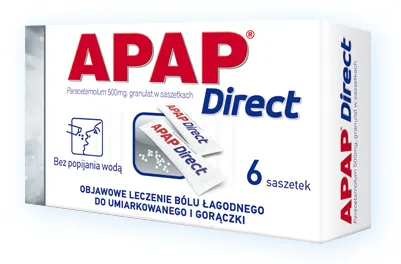
Table of Contents
- Package leaflet: Information for the user
- 1. WHAT Apap Direct IS AND WHAT IT IS USED FOR
- 2. IMPORTANT INFORMATION BEFORE TAKING Apap Direct
- 3. HOW TO USE THE MEDICINAL PRODUCT Apap Direct
- 4. POSSIBLE ADVERSE REACTIONS
- 5. HOW TO STORE THE MEDICINAL PRODUCT Apap Direct
- 6. CONTENTS OF THE PACKAGE AND OTHER INFORMATION
Package leaflet: Information for the user
Apap Direct, 500 mg, granules in sachets
Paracetamolum
Please read all of this leaflet carefully before taking this medicine because it contains
important information for you.
This medicine should always be taken exactly as described in this patient leaflet or as directed by
your doctor or pharmacist.
- Keep this leaflet as you may need to read it again.
- If you need advice or further information, please consult your pharmacist.
- If you experience any adverse effects, including any possible side effects not listed in this leaflet, tell your doctor or pharmacist. See section 4.
- If there is no improvement after 3 days, or if you feel worse, you should contact your doctor.
Contents of the leaflet:
- What Apap Direct is and what it is used for
- Important information before taking Apap Direct
- How to take Apap Direct
- Possible side effects
- How to store Apap Direct
- Contents of the pack and other information
1. WHAT Apap Direct IS AND WHAT IT IS USED FOR
Paracetamol belongs to the pharmacotherapeutic group of analgesics (pain-relieving medicines), which
also act as antipyretics (fever-reducing agents) and weak anti-inflammatory agents.
Apap Direct is used to reduce fever and relieve mild to moderate pain.
2. IMPORTANT INFORMATION BEFORE TAKING Apap Direct
When not to take Apap Direct
if you are allergic (hypersensitive) to paracetamol or any of the other ingredients of Apap Direct,
if you have severe liver impairment.
Warnings and precautions
Consult your doctor before starting to take Apap Direct if you have:
impaired kidney or liver function,
alcoholic liver disease without signs of cirrhosis,
chronic alcoholism,
glucose-6-phosphate dehydrogenase deficiency,
haemolytic anaemia,
Gilbert's syndrome (hereditary non-haemolytic jaundice).
Page 1 of 7
During treatment with Apap Direct, inform your doctor immediately if:
you have serious illnesses, including severe kidney impairment or sepsis (when bacteria and their toxins circulate in the blood, leading to organ damage), or malnutrition,
chronic alcoholism, or if you are also taking flucloxacillin (an antibiotic). In these situations, severe metabolic acidosis (a disturbance in blood and body fluid balance) has been reported in patients taking paracetamol regularly over a long period or taking paracetamol together with flucloxacillin. Symptoms of metabolic acidosis may include: severe breathing difficulties, including rapid deep breathing, drowsiness, nausea and vomiting.
Long-term or frequent use is not recommended. Patients should be advised not to take other medicines containing paracetamol simultaneously. Taking multiple daily doses at once may cause severe liver damage.
In such a case, unconsciousness does not occur, but immediate medical attention is required. Prolonged use of the medicine without medical supervision may be harmful. In children treated with paracetamol at a daily dose of 60 mg/kg, there is no justification for simultaneously administering another antipyretic unless paracetamol alone is ineffective.
Caution is advised when administering paracetamol to patients with kidney or liver impairment (mild to moderate). In such cases, consult your doctor.
The risk of overdose is higher in patients with alcohol-induced liver damage without signs of cirrhosis. Caution is required in cases of chronic alcoholism.
In such cases, the daily dose should not exceed 2 g.
If high fever or signs of secondary infection occur, or if symptoms persist beyond 3 days, the treatment should be re-evaluated.
Caution is advised when administering paracetamol to dehydrated or chronically malnourished individuals. The total daily dose of paracetamol should not exceed 3 g in adults and children weighing at least 50 kg.
If symptoms worsen or do not resolve after 3 days, or if high fever develops, consult your doctor.
If you are alcohol-dependent or have liver damage, do not use paracetamol unless prescribed by a doctor. Do not consume alcohol while taking paracetamol. Paracetamol does not enhance the effects of alcohol.
If you are taking other pain-relieving medicines containing paracetamol, do not take Apap Direct without consulting your doctor or pharmacist.
Never take Apap Direct in doses higher than recommended. Higher doses do not provide stronger pain relief but may cause severe liver damage.
The first signs of liver damage may appear after several days. Therefore, it is very important to contact your doctor immediately if Apap Direct has been taken in a dose higher than recommended in this leaflet.
Prolonged or improper use of pain-relieving medicines, or taking them in high doses, may lead to headaches, which should not be treated with higher doses of this medicine.
Generally, habitual use of pain-relieving medicines, especially combinations of several analgesic substances, may lead to permanent kidney damage with risk of kidney failure (analgesic nephropathy).
Page 2 of 7
Sudden discontinuation of the medicine after prolonged, high-dose, improper use of analgesics may cause headaches, weakness, muscle pain, restlessness and autonomic symptoms. These withdrawal symptoms resolve within a few days. Until then, further use of analgesics should be avoided and should not be restarted without consulting a doctor.
Do not take Apap Direct for long periods or in high doses without consulting your doctor or dentist.
Children
This product is not recommended for children under 8 years of age.
Apap Direct and other medicines
Tell your doctor or pharmacist about all medicines you are currently taking or have recently taken, including those obtained without a prescription.
Medicines that may interfere with Apap Direct:
- probenecid (a medicine used in the treatment of gout);
- medicines that may damage the liver, e.g. phenobarbital (sleeping tablets), phenytoin, carbamazepine, primidone (antiepileptic medicines) and rifampicin (used in the treatment of tuberculosis). Concurrent use of these medicines with paracetamol may cause liver damage;
- metoclopramide and domperidone (used to treat nausea) may accelerate the absorption and onset of action of paracetamol;
- medicines that delay gastric emptying may delay the absorption and onset of action of paracetamol;
- colestyramine (used to reduce elevated serum lipid levels) may reduce the absorption and onset of action of paracetamol. Therefore, colestyramine should not be taken within the first hour after taking paracetamol;
- anticoagulant medicines (oral anticoagulants, particularly warfarin). Repeated use of paracetamol for more than one week increases the tendency to bleed. Therefore, prolonged use of paracetamol should only occur under medical supervision. Occasional use of paracetamol has no significant effect on bleeding tendency.
Concurrent administration of paracetamol and AZT (zidovudine, a medicine used in HIV infections)
increases the risk of reduced white blood cell count (neutropenia), which impairs the immune system and increases the risk of infections. Therefore, Apap Direct may be taken together with zidovudine only on a doctor's recommendation.
Inform your doctor or pharmacist if you are taking:
- flucloxacillin (an antibiotic) due to the serious risk of blood and body fluid disturbances (called metabolic acidosis), which must be urgently treated (see section 2).
Effect of paracetamol on laboratory test results
Paracetamol may affect the measurement of blood uric acid and blood glucose levels.
Apap Direct with food, drink and alcohol
Alcohol should not be consumed during treatment with paracetamol.
Pregnancy and breastfeeding
If you are pregnant or breastfeeding, think you may be pregnant, or are planning to have a baby, you should consult your doctor before using this medicine.
Page 3 of 7
Apap Direct may be given to pregnant women if necessary. The lowest effective dose that adequately relieves pain or reduces fever should be used, and the medicine should be taken for as short a time as possible.
If pain is not relieved or fever does not subside, or if it becomes necessary to increase the frequency of dosing, consult your doctor. Paracetamol should not be used together with other medicinal products.
After oral administration, paracetamol passes into breast milk in small amounts.
During breastfeeding, Apap Direct may be used at therapeutic doses.
Driving and operating machinery
The use of Apap Direct does not affect the ability to drive or operate machinery.
Apap Direct contains sorbitol, sucrose, glucose (component of maltodextrin) and sodium.
The medicine contains 801 mg of sorbitol per sachet. Sorbitol is a source of fructose. If you (or your child) have previously been diagnosed with intolerance to certain sugars or hereditary fructose intolerance, a rare genetic disorder in which the body cannot break down fructose, you should consult your doctor before taking this medicine or giving it to your child.
If you have previously been diagnosed with intolerance to certain sugars, you should consult your doctor before taking this medicine.
The medicine contains less than 1 mmol (23 mg) of sodium per sachet, meaning the medicine is considered "sodium-free".
3. HOW TO USE THE MEDICINAL PRODUCT Apap Direct
Apap Direct should always be taken exactly as described in this leaflet.
If in doubt, consult a doctor or pharmacist.
The dose is determined according to the information provided in the table below. The dose depends on age and body weight. The usual single dose is 10–15 mg of paracetamol per kilogram of body weight, up to a maximum daily dose of 60–75 mg/kg body weight.
The appropriate interval between doses depends on symptoms and the maximum total daily dose.
A minimum interval of 6 hours should be maintained between two doses, meaning the medicine should be administered no more than 4 times a day.
If symptoms persist for more than 3 days, consult a doctor.
Body weight (age) | Single dose | Maximum daily dose
--- | --- | ---
26 kg – 40 kg | 500 mg paracetamol | 1500 mg paracetamol
(1 sachet) | (3 sachets)
(8–12 years) |
40 kg | 500–1000 mg paracetamol | 3000 mg paracetamol
(1–2 sachets) | (6 sachets of 500 mg)
(children over 12 years of age and adults)
Page 4 of 7
Method and route of administration
Apap Direct should be administered orally only.
Do not take Apap Direct after a meal.
The granulate should be placed directly into the mouth onto the tongue and then swallowed without water.
Special patient groups
Hepatic or renal impairment
In patients with hepatic or renal impairment, the dose should be reduced or the dosing interval prolonged. Consult a doctor.
Chronic alcoholism
Chronic alcohol consumption may lower the toxic threshold of paracetamol. In such patients, the minimum interval between two doses should be at least 8 hours.
Do not take more than 2 g of paracetamol per day.
Elderly patients
No dose adjustment is required.
Children and adolescents with low body weight
Paracetamol 500 mg is not intended for use in children under 8 years of age or with body weight below 26 kg, as the dose strength is inappropriate for this age group.
Alternative pharmaceutical forms and dose strengths are available for such patients.
Overdose of Apap Direct
In case of overdose of Apap Direct, contact a doctor or emergency department immediately.
Overdose has very serious consequences and may even lead to death.
Immediate treatment is necessary, even if the patient feels well, due to the risk of delayed severe liver damage.
Symptoms may be limited to nausea or vomiting and may not reflect the severity of the overdose or the risk of organ damage.
Missed dose of Apap Direct
Do not take a double dose to make up for a missed dose.
If you have any further questions about the use of this medicine, consult your doctor or pharmacist.
4. POSSIBLE ADVERSE REACTIONS
Like all medicines, Apap Direct can cause adverse reactions, although not everyone will experience them.
If any of the following symptoms occur, treatment should be discontinued and you should immediately contact your doctor:
rarely occurring (may affect fewer than 1 in 1,000 people)
- itching, rash, sweating, purpura, angioedema (swelling of the face, lips, throat, difficulty breathing), urticaria, edema;
- bleeding;
- abdominal pain, diarrhea, nausea, vomiting, liver failure, hepatic necrosis, jaundice;
- acute and chronic pancreatitis (severe abdominal pain, vomiting, bloating, fever, muscle pain, diarrhea, itching);
very rarely occurring (may affect fewer than 1 in 10,000 people)
Page 5 of 7
- severe skin reactions (rash with blisters all over the body or erosions in the mouth, eyes, genital organs and skin, red spots on the body, often with blisters in the center, ruptured blisters, large sheets of peeling skin, weakness, fever and joint pain).
Other adverse reactions occurring rarely (may affect fewer than 1 in 1,000 people)
- anemia;
- non-hemolytic anemia and bone marrow suppression;
- thrombocytopenia (reduced platelet count, nose and gum bleeding, bruising);
- kidney disorders.
Frequency of occurrence: "frequency not known" (cannot be estimated from available data)
- serious condition which may cause blood acidification (so-called metabolic acidosis) in patients with severe disease taking paracetamol (see section 2).
Paracetamol is a widely used medicine, and reports of adverse reactions are rare and usually associated with overdose.
Nephrotoxic effects are rare; no association with therapeutic doses has been reported, except in cases of long-term use of the medicine.
Reporting of adverse reactions
If any adverse reactions occur, including any adverse reactions not listed in this leaflet, inform your doctor or pharmacist. Adverse reactions can be reported directly to the Department of Monitoring of Adverse Drug Reactions of the Office for Registration of Medicinal Products, Medical Devices and Biocidal Products
Al. Jerozolimskie 181C, 02-222 Warsaw
Tel.: +48 22 49 21 301, Fax: +48 22 49 21 309
Website: https://smz.ezdrowie.gov.pl
Adverse reactions can also be reported to the marketing authorization holder.
By reporting adverse reactions, more information on the safety of this medicine can be collected.
5. HOW TO STORE THE MEDICINAL PRODUCT Apap Direct
Do not store above 30°C. Keep in the original packaging to protect from light and moisture.
Keep the medicinal product out of sight and reach of children.
Do not use Apap Direct after the expiry date stated on the carton and sachet {indicated as EXP}. The expiry date refers to the last day of the specified month.
Medicinal products must not be disposed of via wastewater or household waste. Ask your pharmacist how to dispose of medicines no longer required. This helps protect the environment.
6. CONTENTS OF THE PACKAGE AND OTHER INFORMATION
What Apap Direct contains
1 sachet contains the active substance paracetamol 500 mg.
Page 6 of 7
The other ingredients are: sorbitol (E 420), talc, basic butyl methacrylate copolymer, light magnesium oxide, sodium carmellose, sucralose (E 955), magnesium stearate, hypromellose, stearic acid, sodium lauryl sulfate, titanium dioxide (E 171), N,2,3-trimethyl-2-(propan-2-yl)butanamide, simethicone;
strawberry flavour (containing maltodextrin, arabic gum, natural and nature-identical flavours, propylene glycol, triacetin, 3-hydroxy-2-methyl-4H-pyran-4-one);
vanilla flavour (containing maltodextrin, natural and nature-identical flavours, propylene glycol, sucrose).
What Apap Direct looks like and contents of the pack
Sachets made of PETP/Aluminium/LDPE foil containing white or almost white granules.
Apap Direct is available in packs containing: 2, 6, 12, 24 sachets in a cardboard box.
Marketing Authorisation Holder and Manufacturer
US Pharmacia Sp. z o.o.
Ziębicka Street 40
50-507 Wrocław, Poland
Manufacturer
Losan Pharma GmbH
Otto-Hahn-Str. 13,
79395 Neuenburg,
Germany
For further information about this medicinal product, please contact:
USP Zdrowie Sp. z o.o.
Poleczki Street 35
02-822 Warsaw, Poland
Tel. +48 (22) 543 60 00.
Page 7 of 7