Antivenom snake venom
Poland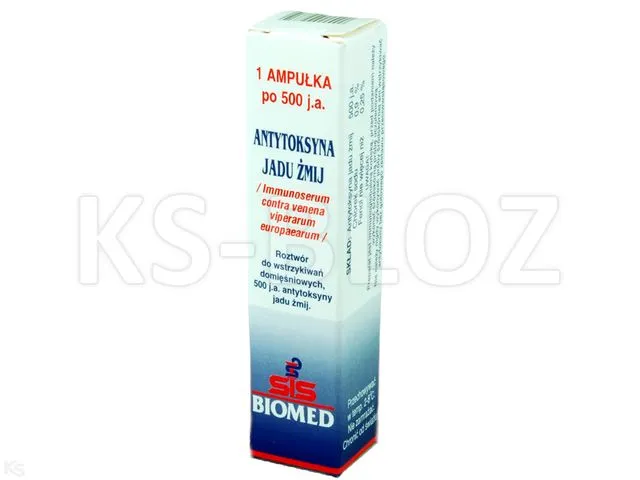
Table of Contents
- Package leaflet: Information for the user
- 1. What Viper Antivenom is and what it is used for
- 2. Important information before using Antytoksyna jadu żmij
- 3. How to use the medicine Antytoksyna jadu żmij
- 4. Possible adverse reactions
- 5. How to store the Antytoksyna jadu żmij medicine
- 6. Contents of the package and other information
Package leaflet: Information for the user
Viper Antivenom, 500 LD units, solution for injection
Immunoserum contra venena viperarum europaearum
Please read all of this leaflet carefully before you are given the medicine, because it contains
important information for the patient.
- Keep this leaflet, so that you can read it again if necessary.
- If you have any further questions, please ask your doctor or pharmacist.
- This medicine has been prescribed for a specific individual. Do not pass it on to others. It may harm other people, even if their symptoms are the same.
- If you experience any adverse reactions, including any not listed in this leaflet, tell your doctor or pharmacist. See section 4.
Contents of the leaflet
- What Viper Antivenom is and what it is used for
- Important information before administration of Viper Antivenom
- How to use Viper Antivenom
- Possible side effects
- How to store Viper Antivenom
- Contents of the pack and other information
1. What Viper Antivenom is and what it is used for
Viper Antivenom contains specific equine immunoglobulin G, which binds the venom of the common European adder (Vipera berus) and neutralizes its toxic properties. This medicine is obtained from serum of horses immunized with the venom of Vipera berus.
Viper Antivenom is used in persons bitten by the common European adder (Vipera berus).
A person bitten should be transported as quickly as possible to a medical facility, preferably to a hospital, and kept at rest while medical assistance is arranged. The medicine should be administered as soon as possible after the bite. Administration of antivenom is most appropriate in cases of severe envenomation.
2. Important information before using Antytoksyna jadu żmij
When not to use Antytoksyna jadu żmij
Do not use this medicine if the patient is allergic to the active substance (equine protein) or to any of the other
components of this medicine (listed in section 6).
In case of allergy to equine protein, in life-threatening envenomation requiring antitoxin administration,
the product may be administered by desensitization method or under cover of medications, i.e. after administration
of anti-shock agents, as described in section 3.
Warnings and precautions
Before administering Antytoksyna jadu żmij, a medical history regarding allergic conditions in the patient should be obtained,
including prior administration of equine antitoxins and use of antihistamines within the previous 48 hours.
Administration of antitoxin should be performed by personnel experienced in managing anaphylactic shock,
with immediate access to an anti-shock kit.
A skin sensitivity test must never be performed, nor should the medicine be injected without an anti-shock kit immediately available.
If the patient is allergic to equine protein, has previously received equine antitoxin, or is an allergic individual,
Antytoksyna jadu żmij should be administered by the desensitization method described in section 3.
Antytoksyna jadu żmij with other medicines
Inform the doctor about all medicines currently or recently taken by the patient, as well as any medicines the patient intends to take.
Pregnancy and breastfeeding
If the patient is pregnant or breastfeeding, suspects she might be pregnant, or is planning to have a child,
she should consult a doctor or pharmacist before using this medicine.
There are insufficient data on the use of Antytoksyna jadu żmij in pregnant and breastfeeding women.
Caution should be exercised when prescribing this medicine to pregnant women and during lactation.
Driving and operating machinery
Antytoksyna jadu żmij has no influence on the ability to drive or operate machinery.
Antytoksyna jadu żmij contains sodium
The medicine contains less than 1 mmol (23 mg) of sodium per 1 ml of solution; therefore, the medicine is considered "sodium-free".
3. How to use the medicine Antytoksyna jadu żmij
The medicine Antytoksyna jadu żmij should always be used according to the doctor's instructions.
Before deciding to administer the medicine, a medical history regarding allergic conditions in the patient, previous administration of equine antitoxin, and use of antihistamines within the last 48 hours must be taken.
Before administering antitoxin, a subcutaneous sensitivity test for equine antitoxin (equine protein) must always be performed.
Taking antihistamines within 48 hours prior to the sensitivity test may suppress the occurrence of an allergic reaction.
A negative result of the sensitivity test does not guarantee complete absence of patient sensitivity to antitoxin; therefore, extreme caution must be exercised before each administration of the medicine, and an anaphylactic shock kit must be readily available.
If rapid administration of Antytoksyna jadu żmij is necessary and there is no time to perform a sensitivity test, administration of Antytoksyna jadu żmij under cover of medication (i.e., after administration of anti-shock agents) is recommended; the decision on such management is made by the physician.
Dosage:
Children and adults
The contents of one ampoule should be administered immediately after the bite.
The dose may be repeated if necessary.
Route of administration: intramuscular.
If possible, Antytoksyna jadu żmij should be administered near the site of the bite.
Sensitivity test (intradermal):
Before performing the intradermal test and before injecting antitoxin, an anaphylactic shock kit must be prepared.
Due to the need for rapid medical intervention within 1 to 2 hours after the bite, the intradermal test should provide a quick response as to whether the patient is or is not sensitized to equine protein.
Inject 0.1 ml of antitoxin diluted 1:10 with sterile 0.9% sodium chloride solution intradermally.
Development of redness and a wheal at the injection site within 10 to 20 minutes indicates hypersensitivity to equine protein.
If no reaction occurs in the sensitivity test, the full dose (the contents of one ampoule) may be administered at once intramuscularly.
If, after 1 to 2 hours, there is no improvement in clinical symptoms of envenomation, the dose may be repeated (the contents of one ampoule of the medicine).
In case of a positive sensitivity test (appearance of a wheal and redness at the site of injection of diluted antitoxin) and concomitant indications for Antytoksyna jadu żmij, administration of the medicine by desensitization method is recommended.
Desensitization method of administering equine antitoxin:
The antitoxin diluted 1:10 (as in the sensitivity test) with sterile 0.9% sodium chloride solution should be administered subcutaneously every 30 minutes to 1 hour in doses increasing from 0.1 ml to 0.5 ml.
Then, undiluted antitoxin should also be administered subcutaneously in doses of 0.2 ml and 0.5 ml.
The remaining portion of the dose should be administered intramuscularly.
Consideration should also be given to how soon after the bite antitoxin administration is required.
The prolonged duration of the desensitization method may negatively affect the patient's condition, potentially endangering life, especially in cases of severe envenomation.
An alternative is administration of antitoxin under cover of anti-shock agents.
Depending on the patient's condition, sedatives, analgesics, and anticonvulsants may also be used. In patients with severe or very severe condition and pronounced allergic reactions, corticosteroids, antibiotics, non-steroidal anti-inflammatory drugs, and, if necessary, parenteral hydration should also be administered.
Use of a higher than recommended dose of Antytoksyna jadu żmij
The dose size depends on the patient's condition. The decision on dosage is made by the physician.
Administration of larger doses than necessary should be avoided.
Higher doses may exacerbate adverse reactions listed in section 4.
Discontinuation of Antytoksyna jadu żmij
If there are any further doubts regarding the use of the medicine, consult a doctor or pharmacist.
4. Possible adverse reactions
Like all medicines, Antytoksyna jadu żmij may cause adverse reactions, although not everyone will experience them.
The risk of adverse reactions following administration of animal antitoxin in cases of viper bites is secondary to the life-saving benefit.
The frequency of possible adverse reactions listed below is defined as follows:
- Very common (affects 1 or more out of 10 people);
- Common (affects 1 or more out of 100 people and less than 1 out of 10);
- Uncommon (affects 1 or more out of 1,000 people and less than 1 out of 100);
- Rare (affects 1 or more out of 10,000 people and less than 1 out of 1,000);
- Very rare (affects less than 1 out of 10,000 people);
- Frequency not known (cannot be estimated from available data).
General disorders and administration site conditions
Anaphylactic shock (acute systemic allergic reaction) may occur uncommonly.
Serum sickness may also occur, usually appearing between the 7th and 20th day after administration of Antytoksyna jadu żmij. Uncommonly, the following symptoms of serum sickness may occur: swelling at the injection site, enlarged lymph nodes, fever, joint swelling, and urticaria (hives).
Renal and urinary disorders
Serum sickness may occur, which in rare, acute cases may manifest as kidney damage.
Nervous system disorders
Very rarely, complications may occur in the form of inflammation of the brachial plexus nerves, cranial nerves, and peripheral nerves (i.e. encephalopathy) or Guillain-Barré syndrome (acute idiopathic, i.e. autoimmune, polyneuritis). Symptoms of the disease resolve after removal of the antigen from the body.
Reporting of adverse reactions
If any adverse reactions occur, including any possible adverse reactions not listed in this leaflet, inform your doctor, pharmacist, or nurse.
Adverse reactions can be reported directly to the Department of Monitoring Adverse Drug Reactions of the Office for Registration of Medicinal Products, Medical Devices and Biocidal Products
Al. Jerozolimskie 181C
02-222 Warszawa
Tel.: +48 22 49 21 301
Fax: +48 22 49 21 309
Website: https://smz.ezdrowie.gov.pl
Adverse reactions can also be reported to the marketing authorization holder.
Reporting adverse reactions helps to provide more information on the safety of the medicine.
5. How to store the Antytoksyna jadu żmij medicine
Store in a refrigerator (2°C – 8°C). Do not freeze.
Keep in the original packaging to protect from light.
Keep the medicine out of sight and reach of children.
Do not use this medicine after the expiry date stated on the packaging.
The expiry date refers to the last day of the stated month.
Medicines must not be disposed of via sewage systems or household waste bins. Ask your pharmacist how to dispose of medicines no longer required. This will help protect the environment.
6. Contents of the package and other information
What Antytoksyna jadu żmij contains
- The active substance is antibodies neutralizing the venom of the common European adder (Vipera berus). 1 ml contains antibodies neutralizing no less than 130 LD units of venom from the common European adder (Vipera berus). One vial contains antibodies neutralizing no less than 500 LD units of venom from the common European adder (Vipera berus).
- Other components: sodium chloride, phenol, water for injections, and sodium hydroxide and hydrochloric acid – in small amounts used to adjust pH.
What Antytoksyna jadu żmij looks like and contents of the pack
The medicine is a solution for injection, containing antibodies neutralizing no less than 500 LD units of venom from the common European adder (Vipera berus), in a type I glass vial, packed in a cardboard box – pack of 1 unit.
Marketing Authorisation Holder and Manufacturer
Wytwórnia Surowic i Szczepionek BIOMED Sp. z o.o.
ul. Chełmska 30/34
00-725 Warszawa
tel. + 48 22 841 40 71
(logo)