Antygrypin complex
Poland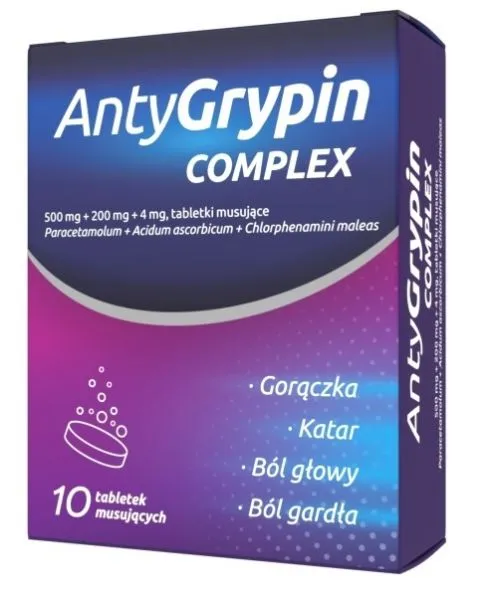
Table of Contents
AntyGrypin COMPLEX
500 mg + 200 mg + 4 mg, effervescent tablets
Paracetamolum + Acidum ascorbicum + Chlorphenamini maleas
Please read the following information carefully before taking this medicine, as it contains
important information for the patient.
This medicine should always be taken exactly as described in this patient leaflet or as directed by a
physician or pharmacist.
- Keep this leaflet, as you may need to read it again.
- If you need advice or further information, consult your pharmacist.
- If you experience any adverse reactions, including any not listed in this leaflet, inform your doctor or pharmacist. See section 4.
- If there is no improvement after 3 days of treating fever or after 5 days of treating pain, or if your condition worsens, consult your doctor.
Table of contents:
- What AntyGrypin COMPLEX is and what it is used for
- Important information before taking AntyGrypin COMPLEX
- How to take AntyGrypin COMPLEX
- Possible side effects
- How to store AntyGrypin COMPLEX
- Contents of the pack and other information
1. What AntyGrypin COMPLEX is and what it is used for
AntyGrypin COMPLEX is a combination medicine containing three active substances: paracetamol, which provides analgesic and antipyretic effects; chlorphenamine maleate, which reduces nasal mucus secretion, suppresses sneezing reflex and eye tearing; and ascorbic acid, which helps to replenish vitamin C deficiency in the body.
This medicine is used for the short-term relief of symptoms of influenza, colds and flu-like conditions, such as headache, fever, sore throat, and nasal and throat irritation in adults and adolescents over 15 years of age.
If there is no improvement after 3 days of treating fever or after 5 days of treating pain, or if you feel worse, consult your doctor.
2. Important information before taking AntyGrypin COMPLEX
When not to take AntyGrypin COMPLEX:
- if the patient is allergic to the active substances or any of the other ingredients of this medicine (listed in section 6);
- if the patient suffers from liver or kidney failure;
- if the patient is taking other medicines affecting liver function;
- if the patient abuses alcohol;
- if the patient suffers from narrow-angle glaucoma;
- in patients at risk of urinary retention related to disorders of the urethral segment passing through the prostate gland;
- in patients currently or within the last two weeks taking monoamine oxidase inhibitors (MAOIs, used in the treatment of depression);
- in children and adolescents under 15 years of age.
Warnings and precautions
Before starting treatment with AntyGrypin COMPLEX, consult your doctor or pharmacist.
Warnings
If high or persistent fever occurs, or bacterial superinfection develops, or symptoms persist for more than 3 days in case of fever and 5 days in case of pain, contact a doctor.
When using this medicine in doses higher than recommended or for prolonged treatment, there is a risk of dependence, mainly psychological.
The medicine contains paracetamol
Due to the risk of overdose, check whether other medicines being taken contain paracetamol. Paracetamol overdose may lead to severe liver damage and even death.
To avoid the risk of overdose, do not take other medicines containing paracetamol. The risk of overdose of this medicine is increased in patients with liver disease.
Caution is advised when using in patients with reduced glutathione levels.
Cases of liver failure have been reported in patients with reduced glutathione levels, especially in patients:
- severely undernourished, suffering from anorexia, with low body mass index (BMI), or cachexia;
- dehydrated;
- regularly consuming alcohol (see section "When not to take AntyGrypin COMPLEX");
- with mild to moderate liver impairment, Gilbert's syndrome (familial non-hemolytic jaundice);
- with sepsis.
During treatment with AntyGrypin COMPLEX, immediately inform the doctor if the patient has severe diseases, including severe kidney disorders or sepsis (when bacteria and their toxins circulate in the blood leading to organ damage), malnutrition, chronic alcoholism, or if the patient is also taking flucloxacillin (an antibiotic).
In these situations, patients have experienced a serious condition called metabolic acidosis (a blood and fluid imbalance) when taking paracetamol regularly in high doses over a long period or when taking paracetamol together with flucloxacillin. Symptoms of metabolic acidosis may include: severe breathing difficulties, including rapid deep breathing, drowsiness, nausea, and vomiting.
Precautions
Paracetamol should be used with caution in patients with kidney dysfunction, acute hepatitis, glucose-6-phosphate dehydrogenase deficiency, hemolytic anemia, and methemoglobin reductase deficiency.
The risk of overdose of this medicine is greater in patients with liver failure not caused by alcoholic cirrhosis.
Paracetamol administered in doses exceeding 6–8 g per day may cause liver damage.
Liver damage may occur even at significantly lower doses when administered simultaneously with alcohol, liver enzyme inducers, or other medicines toxic to the liver, e.g. monoamine oxidase inhibitors (see section "When not to take AntyGrypin COMPLEX").
Long-term alcohol consumption significantly increases the risk of paracetamol-induced toxic liver damage.
Due to the risk of hypertensive crisis, paracetamol is contraindicated in patients currently or within the last two weeks taking monoamine oxidase inhibitors.
During treatment with this medicine, due to the presence of chlorpheniramine, avoid consuming alcohol and medicines containing alcohol. The medicine may affect the ability to drive vehicles and operate machinery.
Exercise caution in patients with bronchial asthma or chronic obstructive pulmonary disease, cardiovascular diseases, arterial hypertension, hyperthyroidism, and pyloroduodenal obstruction.
During treatment, avoid using sedatives (especially barbiturates), which enhance the sedative effect of antihistamines.
Effect on laboratory test results
Administration of paracetamol may affect blood uric acid concentration tests as well as blood glucose tests. Chlorpheniramine may affect skin tests using allergens. It is recommended to discontinue the product at least 3 days before starting skin tests.
Children and adolescents
This medicine is contraindicated in children and adolescents under 15 years of age.
AntyGrypin COMPLEX and other medicines
Inform your doctor or pharmacist about all medicines currently or recently taken, as well as any medicines you plan to take.
During treatment with AntyGrypin COMPLEX, avoid taking medicines containing alcohol.
Use with caution:
- morphine derivatives (analgesics, antitussives, and substitution therapy);
- neuroleptics (medicines used to treat psychiatric disorders, mainly schizophrenia and other psychoses);
- barbiturates (sleeping pills and antiepileptic drugs);
- benzodiazepines (medicines with anxiolytic, sedative, hypnotic, anticonvulsant, and muscle-relaxant effects);
- anxiolytics other than benzodiazepines (e.g. meprobamate);
- sleeping medicines (lorazepam, diazepam);
- sedative antidepressants (amitriptyline, doxepin, mianserin, mirtazapine, trimipramine);
- H-receptor blocking antihistamines (medicines used in the treatment of allergic diseases);
- antihypertensive medicines acting on the central nervous system;
- baclofen (a muscle relaxant);
- thalidomide (an immunomodulatory medicine used in the treatment of multiple myeloma);
- anticholinergic antiparkinsonian drugs (e.g. benzatropine);
- antispasmodic medicines similar to atropine (containing hyoscine);
- disopyramide (a medicine used in heart diseases);
- phenothiazine derivative neuroleptics (medicines used in the treatment of psychoses, such as chlorpromazine, thioridazine, perphenazine);
- clozapine (a medicine used in the treatment of schizophrenia and psychiatric disorders in Parkinson's disease);
- salicylamide (an analgesic);
- rifampicin (an antibiotic);
- antiepileptic medicines (e.g. phenytoin, carbamazepine, lamotrygine, and others);
- barbiturate sleeping medicines and other medicines inducing liver enzymes;
- caffeine;
- non-steroidal anti-inflammatory drugs (aspirin, ibuprofen, diclofenac, naproxen);
- anticoagulants of the coumarin group (acenocoumarol, warfarin);
- monoamine oxidase inhibitors (medicines used in the treatment of depression);
- flufenazine (a medicine used in the treatment of psychosis).
Inform your doctor or pharmacist if the patient is taking:
- flucloxacillin (an antibiotic) due to the serious risk of blood and body fluid disorders (called metabolic acidosis), which require urgent treatment (see section 2).
Taking AntyGrypin COMPLEX with food, drink, and alcohol
During treatment with AntyGrypin COMPLEX, avoid consuming alcohol, as it may cause liver damage and excessive sedation.
Pregnancy, breastfeeding, and effects on fertility
If the patient is pregnant or breastfeeding, suspects she may be pregnant, or plans to have a child, she should consult a doctor or pharmacist before using this medicine.
Pregnancy
Use of AntyGrypin COMPLEX is not recommended during pregnancy.
Breastfeeding
Use of AntyGrypin COMPLEX is not recommended during breastfeeding.
Fertility
Animal studies have not shown harmful effects of paracetamol, chlorpheniramine maleate, or ascorbic acid on fertility.
Driving and operating machinery
Drowsiness may occur during treatment, which may affect the psycho-physical performance of individuals driving vehicles or operating machinery.
AntyGrypin COMPLEX effervescent tablets contain sodium, isomalt, and glucose (component of flavored maltodextrin)
Isomalt and glucose (component of flavored maltodextrine)
One effervescent tablet contains 799 mg of isomalt, equivalent to approximately 1.8 kcal (7.8 kJ).
If the patient has previously been diagnosed with intolerance to certain sugars, the patient should consult a doctor before taking the medicine.
Sodium
Each effervescent tablet contains 254.5 mg (11.06 mmol) of sodium. This corresponds to 12.7% of the maximum recommended daily sodium intake in the diet for adults. This should be taken into account in patients on a sodium-controlled diet.
3. How to take AntyGrypin COMPLEX
This medicine should always be taken exactly as described in this patient information leaflet or as advised by your doctor or pharmacist. If in doubt, consult your doctor or pharmacist.
Use in adults and adolescents over 15 years of age:
The recommended dose is: if necessary, 1 effervescent tablet 30 minutes before bedtime. Do not take more than 3 tablets per day, divided into doses, and doses should not be repeated more frequently than every 4 hours.
Patients with impaired kidney function
In patients with impaired kidney function, the dose of paracetamol must not exceed 500 mg:
| Glomerular filtration rate | Paracetamol dose |
| 10 – 50 ml/min | 500 mg no more frequently than every 6 hours |
Do not use the medicine in case of severe renal function impairment (see section “When not to
take AntyGrypin COMPLEX”).
Patients with hepatic impairment
In patients with impaired liver function or Gilbert's syndrome, the dose of the medicine should be reduced
or the intervals between doses should be extended.
Do not use the medicine in case of severe hepatic function impairment (see section “When not to
take AntyGrypin COMPLEX”).
Elderly patients
In elderly patients with normal kidney function, the dosage is the same as in adults.
Children and adolescents under 15 years of age
This medicinal product should not be used in children under 15 years of age.
Method of administration
Oral administration.
The effervescent tablet should be dissolved in a glass of cold or warm water.
Duration of treatment
This medicine should not be used for longer than 3 days for fever and 5 days for pain without
consulting a doctor.
Overdose of AntyGrypin COMPLEX
In case of overdose, seek immediate medical advice from a doctor or go to hospital, even if the
patient feels well.
Symptoms related to chlorphenamine maleate
Overdose of chlorphenamine may cause: seizures (especially in children), disturbances of
consciousness, coma.
Symptoms related to paracetamol
There is a particular risk of paracetamol poisoning in elderly people and young children (most common
causes are intake of doses higher than recommended and accidental poisoning); such poisonings may
lead to death. Overdose may cause symptoms within a few to several hours, such as: nausea, vomiting,
excessive sweating, drowsiness, and general weakness. These symptoms may subside the next day,
despite the fact that liver damage begins to develop, which subsequently manifests as upper abdominal
discomfort, recurrence of nausea, and jaundice. Ingestion of more than 10 g of paracetamol in adults or
150 mg/kg body weight in a single dose in children causes complete and irreversible necrosis of liver
cells. In every case of a single intake of 5 g or more of paracetamol, vomiting should be induced if no
more than one hour has passed since ingestion. Activated charcoal 60–100 g should be administered
orally, preferably mixed with water.
Treatment of AntyGrypin COMPLEX overdose should be carried out in a hospital.
Missed dose of AntyGrypin COMPLEX
Do not take a double dose to make up for a missed dose.
If you have any further doubts concerning the use of this medicine, consult your doctor or pharmacist.
4. Possible adverse effects
Like all medicines, this medicine can cause adverse effects, although not everyone will experience them.
Adverse effects associated with paracetamol:
Stop taking the medicine immediately and consult a doctor or go to hospital if the following occur:
- swelling of the larynx, making breathing impossible (single cases);
- anaphylactic shock, manifested by confusion, pale skin, drop in blood pressure, sweating, reduced urine output, rapid breathing, weakness and fainting (single cases);
- erythema multiforme (single cases);
- severe skin reaction: toxic epidermal necrolysis (Lyell's syndrome), bullous erythema multiforme (Stevens-Johnson syndrome), acute generalized exanthematous pustulosis, characterized by blistering rash all over the body, erosions in the mouth, eyes, genital organs and on the skin, red spots on the trunk, often with blisters in the center, bursting giant blisters, peeling of large sheets of epidermis, weakness, fever and joint pain (very rare cases);
- persistent itching (pruritus), skin rash, excessive sweating, appearance on the skin of nodular, haemorrhagic or vesicular eruptions (purpura), allergic reaction causing swelling of tissues beneath the skin (angioedema), allergic reaction causing blisters on the skin (urticaria); these occur rarely;
- acute or chronic pancreatitis, haemorrhage, abdominal pain, diarrhoea, nausea, vomiting, liver dysfunction (liver failure), irreversible liver damage (necrosis), yellowing of the skin, mucous membranes and whites of the eyes (jaundice); these occur rarely.
Other adverse effects include:
Rare (may occur in not more than 1 in 1,000 people):
- anaemia due to various deficiencies, bone marrow suppression, decreased platelet count;
- fluid accumulation in tissues (oedema);
- kidney dysfunction (nephropathy) and impaired reabsorption or secretion in renal tubules (tubulopathies).
Frequency not known
A serious condition which may cause acidification of the blood (so-called metabolic acidosis) in patients with severe illness taking paracetamol (see section 2).
Paracetamol is a widely used medicine and the described adverse effects are rare and usually associated with overdose.
Isolated cases of dizziness have been observed.
Adverse effects associated with chlorpheniramine:
Stop taking the medicine immediately and consult a doctor or go to hospital if an allergic reaction occurs:
- hypersensitivity reactions (allergic), anaphylactic reactions (severe allergic reactions during which cough, difficulty swallowing, rapid heartbeat, itching, swelling of eyelids or around the eyes, face, tongue, shortness of breath, fatigue, etc. may occur);
- central nervous system depression manifested as drowsiness, nausea and muscle weakness, which in some patients resolve after 2–3 days of treatment; occurs frequently;
- blockage of bile ducts (cholestasis), hepatitis or other liver function disorders (including upper abdominal or abdominal pain, dark urine, etc.); occur rarely.
Other adverse effects include:
Common (may occur in not more than 1 in 10 people):
- uncoordinated and involuntary muscle movements in the face (dyskinesias), motor coordination disorders (stiffness), tremors, numbness, tingling, burning sensation, feeling like being pricked by needles (paraesthesiae);
- blurred or double vision;
- sensation of dryness in the nose and throat, drying of mucous membranes;
- dry mouth, loss of appetite, altered taste and smell perception, gastrointestinal disturbances (nausea, vomiting, diarrhoea, constipation, upper abdominal pain), which may be reduced if the medicine is taken during a meal;
- profuse sweating;
- urinary retention and (or) difficulty passing urine.
Rare (may occur in not more than 1 in 1,000 people):
- changes in blood tests (agranulocytosis, decreased white blood cell count, anaemia due to bone marrow atrophy (aplastic anaemia) or decreased platelet count (thrombocytopenia)), which may present with symptoms such as unusual bleeding, sore throat or fatigue;
- light sensitivity, hypersensitivity to similar medicines;
- occasionally excitement, particularly when high doses are used in children or elderly people, characterized by restlessness, insomnia, nervousness, delirium, palpitations, and also convulsions;
- tinnitus (unpleasant auditory sensations), acute labyrinthitis;
- usually in cases of overdose, cardiac rhythm disturbances, palpitations, rapid heartbeat (tachycardia) may occur;
- low blood pressure (hypotension), increased blood pressure (hypertension), fluid accumulation in tissues (oedema);
- chest tightness, laboured breathing;
- inability to have sexual intercourse in men (impotence), intermenstrual bleeding.
Reporting of adverse effects
If any adverse symptoms occur, including any adverse effects not listed in this leaflet, inform your doctor, pharmacist or nurse. Adverse effects can be reported directly to the Department of Monitoring Adverse Drug Reactions of the Office for Registration of Medicinal Products, Medical Devices and Biocidal Products:
Al. Jerozolimskie 181C, 02-222 Warsaw, tel.: +48 22 49 21 301, fax: +48 22 49 21 309
Website: https://smz.ezdrowie.gov.pl
Adverse effects can also be reported to the marketing authorisation holder.
Reporting adverse effects helps to provide more information on the safety of the medicine.
5. How to store AntyGrypin COMPLEX
Do not store above 25 °C.
Store in the tightly closed original packaging, protected from light and moisture.
Keep the medicine out of sight and reach of children.
Do not use this medicine after the expiry date stated on the carton and tube. The expiry date refers to the last day of the stated month.
Medicines must not be disposed of via wastewater or household waste. Ask your pharmacist how to dispose of medicines no longer required. Such measures help protect the environment.
6. Contents of the packaging and other information
What AntyGrypin COMPLEX contains
- The active substances in this medicine are paracetamol, ascorbic acid, and chlorphenamine maleate. Each effervescent tablet contains: 500 mg of paracetamol ( Paracetamolum ), 200 mg of ascorbic acid ( Acidum ascorbicum ), 4 mg of chlorphenamine maleate ( Chlorphenamini maleas ).
- Other ingredients are: citric acid, sodium hydrogen carbonate, isomalt (E 953), macrogol 6000, sodium saccharin (E 954), lemon flavour (Tetrarome Lemon P 0551 987323: corn maltodextrin, flavouring components (limonene, beta-pinene, citral, gamma-terpinene, linalool), alpha tocopherol (E 307)), magnesium stearate.
What AntyGrypin COMPLEX looks like and contents of the pack
White to white-cream, round, flat tablet with bevelled edges and a line on one side. The line on the tablet is intended only to facilitate breaking, not to divide the tablet into equal doses.
The immediate packaging consists of cylindrical, white containers made of polypropylene, closed with a white cap made of polyethylene containing a moisture-absorbing agent. The immediate packaging is placed together with the leaflet into an outer cardboard carton. The outer packaging contains 10 (1 container) or 20 (2 containers) effervescent tablets.
Marketing Authorisation Holder and Manufacturer
Natur Produkt Pharma Sp. z o.o.
ul. Podstoczysko 30
07-300 Ostrów Mazowiecka
tel. (+48) 29 644 29 00