Antinervinum
Poland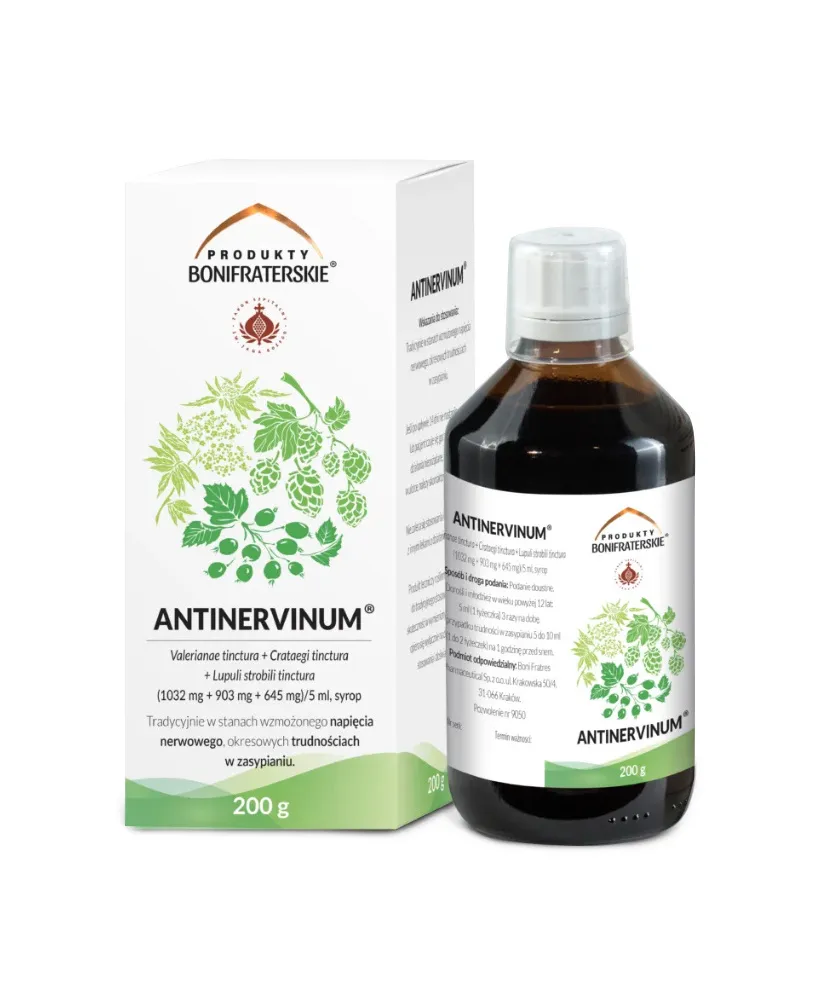
Table of Contents
Package leaflet: Information for the patient
Antinervinum
Valerianae tinctura + Crataegi tinctura + Lupuli strobili tinctura
syrup, (1032 mg + 903 mg + 645 mg) /5 ml
Please read all of this leaflet carefully before taking this medicine, because it contains
important information for the patient.
This medicine should always be used exactly as described in this patient leaflet or
as directed by the doctor or pharmacist.
- Keep this leaflet so that you can read it again if necessary.
- If you need advice or further information, consult your pharmacist.
- If you experience any adverse reactions, including any possible adverse reactions not listed in this leaflet, inform your doctor or pharmacist.
- If there is no improvement after 14 days of treatment, or if your condition worsens, consult your doctor.
Contents of the leaflet
- What Antinervinum is and what it is used for
- Important information before taking Antinervinum
- How to take Antinervinum
- Possible side effects
- How to store Antinervinum
- Contents of the pack and other information
1. What Antinervinum is and what it is used for
Antinervinum is a herbal medicinal product intended for traditional use, the effectiveness of which in the indications mentioned is based solely on long-standing use and experience.
Antinervinum is traditionally used in states of increased nervous tension and occasional sleep disturbances.
If there is no improvement after 14 days of treatment, or if your condition worsens, consult your doctor.
2. Important information before using Antinervinum
When not to use Antinervinum
- if the patient is allergic to the active substances or to any of the excipients listed in section 6,
- if the patient has poor tolerance to valerian.
Warnings and precautions
Before starting to take Antinervinum, consult your doctor, pharmacist, or nurse.
If symptoms worsen during treatment with this medicinal product, consult a doctor or other qualified healthcare professional.
Antinervinum contains ethanol and sorbitol 70% (E 420).
Antinervinum contains 28–34% v/v ethanol, up to 1.3 g per 5 ml dose, equivalent to 34 ml of beer or 14 ml of wine per dose. It may be harmful for individuals with alcohol-related disorders. This should be considered in pregnant or breastfeeding women and in high-risk groups such as patients with liver disease or epilepsy.
A single 5 ml dose of Antinervinum contains 1.5 g of sorbitol. Patients previously diagnosed with intolerance to certain sugars should consult their doctor.
Children and adolescents
Due to its ethanol content and lack of safety data, Antinervinum is not recommended for children under 12 years of age. Further details on the use of Antinervinum in children and adolescents are provided in section 3.
Antinervinum with other medicines
Interactions with other medicinal products are not known. Concomitant use of Antinervinum with other centrally acting sedative medicines is not recommended.
Inform your doctor or pharmacist about any other medicines you are currently taking or have recently taken, as well as any medicines you plan to take.
Antinervinum with food, drink, and alcohol
Interactions with food or alcohol are not known.
Pregnancy, breastfeeding, and fertility
If the patient is pregnant or breastfeeding, suspects she may be pregnant, or is planning to become pregnant, she should consult her doctor or pharmacist before using this medicine. The effect of the medicine on fertility has not been established. Use of this medicine is not recommended during pregnancy and breastfeeding.
Driving and operating machinery
Antinervinum contains alcohol—see section "Warnings and precautions"—and may therefore impair the ability to drive or operate machinery, as well as psychomotor performance (e.g. swimming, working at heights, and others). Patients who experience such effects should refrain from driving or operating machinery. A single dose of the medicine (5 ml) is equivalent to approximately 34 ml of beer or 14 ml of wine. For this reason, it is not recommended to perform the above activities for a period of up to two hours after taking the medicine.
3. How to use Antinervinum
Antinervinum must always be used exactly as described in the patient information leaflet or
as advised by a physician. If in doubt, consult a doctor or pharmacist.
Recommended dose for adults and adolescents over 12 years of age: 5 ml (1 teaspoon) three times daily.
In case of occasional sleep difficulties: 5–10 ml (1–2 teaspoons) one hour before bedtime.
Children under 12 years of age: use is not recommended.
Do not use in children under 6 years of age; in children aged 6–12 years, the product may be used
only after consultation with a doctor.
Use of a higher than recommended dose of Antinervinum
Symptoms of overdose have not been reported to date. Valerian root in an amount
equivalent to 250 g of the product caused mild symptoms (fatigue, cramp-like abdominal pain,
chest pressure, feeling of emptiness in the head, hand tremor, and pupil dilation), which
resolved within 24 hours. If symptoms worsen, symptomatic treatment should be applied.
Due to the sorbitol content, the preparation may cause loose stools. Sorbitol in doses
exceeding 10 g may have a mild laxative effect.
Missed dose of Antinervinum
Do not take a double dose to make up for a missed dose.
If you have any further doubts regarding the use of this medicine, consult your
doctor or pharmacist.
4. Possible adverse reactions
Like any medicinal product, Antinervinum may cause adverse reactions. Rarely, cases of poor tolerance to preparations containing valerian may occur, characterized by a feeling of discomfort and belching. The presence of sorbitol may cause loose stools.
Reporting of adverse reactions
If any adverse reactions occur, including any adverse reactions not listed in this leaflet, consult a doctor or pharmacist. Adverse reactions can be reported directly to the Department of Monitoring Adverse Drug Reactions at the Office for Registration of Medicinal Products, Medical Devices and Biocidal Products, Al. Jerozolimskie 181C, 02-222 Warsaw, tel.: +48 22 49 21 301, fax: +48 22 49 21 309, website: https://smz.ezdrowie.gov.pl
Adverse reactions can also be reported to the marketing authorization holder.
Reporting adverse reactions helps to provide more information on the safety of the medicinal product.
5. How to store Antinervinum
Keep this medicine at a temperature not exceeding 25°C.
Keep the medicine in a place out of sight and reach of children.
Do not use this medicine after the expiry date stated on the label and carton. The expiry date refers to the last day of the stated month.
Medicines must not be disposed of via the sewage system or household waste. Ask your pharmacist what to do with medicines no longer in use. This will help protect the environment.
6. Contents of the packaging and other information
What Antinervinum contains
1 ml [corresponding to 1.051 g] of syrup contains:
0.23 ml of tincture from Valeriana officinalis L.s.l radix (valerian root) (1:4.0–4.5), extraction solvent:
70% V/V ethanol.
0.20 ml of tincture from Crataegus monogyna Jacq. (Lindm.), Crataegus laevigata (Poir.) D.C., or their
mixtures, less frequently C. pentagyna Waldst. et Kit. ex Willd. or C. azarolus L. folium cum flore
(hawthorn flowering tops) (1:3.25–3.75), extraction solvent: 60% V/V ethanol.
0.14 ml of tincture from Humulus lupulus L. flos (hop cone) (1:5), extraction solvent:
60% V/V ethanol.
The other ingredients are: sorbitol 70% and purified water.
Antinervinum contains ethanol: 28.0–34.0% V/V.
What Antinervinum looks like and contents of the pack
Brown, transparent liquid with a characteristic hoppy odour; may become slightly cloudy during storage.
The immediate packaging of Antinervinum consists of 200 ml and 300 ml amber glass bottles containing 200 g or 300 g of the medicinal product, respectively. The 200 ml bottles are closed with white polyethylene caps made of high-density polyethylene (HDPE), 22 mm in diameter, with a conical seal. The 300 ml bottles are closed with white HDPE caps, 28 mm in diameter, with a tamper-evident ring and a conical liner. The outer packaging (a cardboard box) contains the package leaflet and a measuring device made of polypropylene with a CE marking 1434, with a capacity of 12.5 ml and scale markings at 1.0; 2.5; 5.0; 7.5; 10.0 ml.
Not all pack sizes may be marketed.
Marketing Authorisation Holder and Manufacturer
Marketing Authorisation Holder:
Farmaceutyczne Produkty Bonifraterskie Sp. z o.o.
ul. Krakowska 50/4
31-066 Kraków
tel.: +48 12 357 65 98
e-mail: [email protected]
Manufacturer:
PHYTOPHARM Klęka SA
Klęka 1, 63-040 Nowe Miasto nad Wartą
tel.: +48 61 28 68 700
fax: +48 61 28 68 709