Anidulafungin fresenius kabi
Poland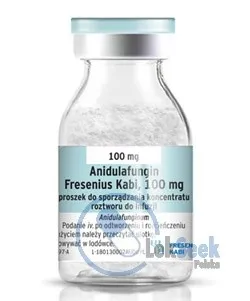
Table of Contents
- Package leaflet: Information for the user
- 1. What Anidulafungin Fresenius Kabi is and what it is used for
- 2. Important information before using Anidulafungin Fresenius Kabi in adults
- 3. How to use Anidulafungin Fresenius Kabi
- 4. Possible adverse reactions
- 5. How to store Anidulafungin Fresenius Kabi
- 6. Contents of the pack and other information
- Information intended solely for healthcare professionals and applies only to
Package leaflet: Information for the user
Anidulafungin Fresenius Kabi, 100 mg,
powder for solution for infusion concentrate
Anidulafunginum
Please read this leaflet carefully before using this medicine in adult patients
or children and adolescents, because it contains important information for the patient.
- Keep this leaflet as you may need to read it again.
- If you have any further questions, please consult your doctor, pharmacist or nurse.
- If any adverse reactions occur in adult patients or children and adolescents, including any adverse reactions not listed in this leaflet, inform your doctor, pharmacist or nurse. See section 4.
Leaflet contents
- What Anidulafungin Fresenius Kabi is and what it is used for
- Important information before using Anidulafungin Fresenius Kabi in adult patients or children and adolescents
- How to use Anidulafungin Fresenius Kabi
- Possible side effects
- How to store Anidulafungin Fresenius Kabi
- Contents of the pack and other information
1. What Anidulafungin Fresenius Kabi is and what it is used for
Anidulafungin Fresenius Kabi contains the active substance anidulafungin and is prescribed to adult patients and children and adolescents aged 1 month to 18 years for the treatment of fungal blood infection or internal organ infection, known as invasive candidiasis. This infection is caused by fungal cells (yeasts) called Candida.
Anidulafungin Fresenius Kabi belongs to a group of medicines called echinocandins. Medicines in this group are used to treat serious fungal infections.
Anidulafungin Fresenius Kabi inhibits the formation of the normal fungal cell wall. Fungal cells exposed to Anidulafungin Fresenius Kabi have incomplete or damaged cell walls, making them susceptible to damage or unable to grow.
2. Important information before using Anidulafungin Fresenius Kabi in adults
patients or children and adolescents
When not to use Anidulafungin Fresenius Kabi
- if the patient is allergic to anidulafungin, other echinocandins (e.g. caspofungin acetate) or any of the other ingredients of this medicine (listed in section 6).
Warnings and precautions
Before starting treatment with Anidulafungin Fresenius Kabi, discuss this with your doctor,
pharmacist or nurse.
The doctor may decide to monitor:
- liver function more closely if the patient develops liver function abnormalities during treatment;
- signs of allergic reactions such as itching, wheezing, skin rash;
- if the patient is receiving anaesthetic agents during treatment with Anidulafungin Fresenius Kabi;
- occurrence of infusion-related symptoms, which may include rash, urticaria, itching, redness;
- occurrence of shortness of breath or difficulty breathing, dizziness or feeling faint.
Children and adolescents
Anidulafungin Fresenius Kabi must not be used in patients under 1 month of age.
Anidulafungin Fresenius Kabi and other medicines
Tell your doctor or pharmacist about all medicines currently used or recently used by adult
patients or children and adolescents, as well as any medicines the patient plans to take.
Pregnancy and breastfeeding
If the patient is pregnant or breastfeeding, suspects she may be pregnant, or is planning to have a
child, she should consult her doctor before using this medicine.
The effect of Anidulafungin Fresenius Kabi in pregnant women is unknown. Therefore, use of
Anidulafungin Fresenius Kabi during pregnancy is not recommended. Women of childbearing age should
use effective methods of contraception. If pregnancy occurs during treatment with Anidulafungin
Fresenius Kabi, the doctor must be informed immediately.
The effect of Anidulafungin Fresenius Kabi in breastfeeding women is unknown.
Anidulafungin Fresenius Kabi contains sodium and fructose
The medicine contains less than 1 mmol (23 mg) of sodium per vial, meaning the medicine is considered "sodium-free".
The medicine contains 100 mg of fructose in each vial.
If hereditary fructose intolerance (HFI) has been diagnosed previously in adult patients (or children and adolescents), a rare genetic disorder, adult patients (or children and adolescents) must not take this medicine. In patients with hereditary fructose intolerance, the body cannot break down the fructose contained in this medicine, which may lead to severe adverse effects. Before taking this medicine, inform the doctor if adult patients or children and adolescents have HFI or cannot consume sweet foods or drinks due to experiencing nausea, vomiting or symptoms such as bloating, stomach cramps or diarrhoea.
3. How to use Anidulafungin Fresenius Kabi
Anidulafungin Fresenius Kabi will always be prepared and administered by a doctor or other medical personnel (further information on the preparation of the medicinal product can be found at the end of this leaflet, in the section intended exclusively for medical personnel).
In adult patients, treatment is initiated with a dose of 200 mg administered on the first day (loading dose). This is followed by a daily dose of 100 mg (maintenance dose).
In children and adolescents (aged 1 month to 18 years), treatment is initiated with a dose of 3.0 mg/kg body weight (not exceeding 200 mg) on the first day (loading dose). This is followed by a dose of 1.5 mg/kg body weight/day (not exceeding 100 mg) (maintenance dose). The administered dose depends on the patient's body weight.
Anidulafungin Fresenius Kabi should be administered once daily as a slow intravenous infusion.
In adult patients, the infusion should last at least 1.5 hours for the maintenance dose and 3 hours for the loading dose. In children and adolescents, the infusion may be shorter, depending on the patient's body weight.
The doctor will determine the duration of treatment and the daily dose of Anidulafungin Fresenius Kabi, and will monitor the patient's response to treatment and clinical condition.
Generally, treatment should continue for at least 14 days after the last day on which Candida fungi were detected in the patient's blood.
Use of a higher than recommended dose of Anidulafungin Fresenius Kabi
If it is suspected that the dose of Anidulafungin Fresenius Kabi was too high, the doctor or other medical personnel should be informed immediately.
Missed dose of Anidulafungin Fresenius Kabi
Since the medicinal product is administered under strict medical supervision, it is unlikely that a dose will be missed. However, if it is suspected that a dose has been missed, the doctor or nurse should be informed.
Do not administer a double dose to make up for a missed dose.
Discontinuation of Anidulafungin Fresenius Kabi treatment
If treatment with Anidulafungin Fresenius Kabi is discontinued by the doctor, no symptoms are expected to occur.
After treatment with Anidulafungin Fresenius Kabi, the doctor may prescribe another medicinal product to continue treatment of the fungal infection or to prevent recurrence of fungal infections.
If the original symptoms return, the doctor or other medical personnel should be informed immediately.
If there are any further doubts regarding the use of this medicinal product, consult the doctor, pharmacist, or nurse.
4. Possible adverse reactions
Like all medicines, this medicine can cause adverse reactions, although not everybody will experience them.
Some of these adverse reactions will be monitored by the doctor during assessment of the patient's response to treatment and the patient's condition.
Life-threatening allergic reactions, such as difficulty breathing, wheezing or worsening of existing rash, have been rarely reported during administration of Anidulafungin Fresenius Kabi.
Serious adverse reactions – if any of the following adverse reactions occur,
inform your doctor or healthcare professional immediately:
- convulsions (seizures);
- sudden facial flushing;
- rash, itching (pruritus);
- hot flushes;
- urticaria;
- sudden bronchospasm causing wheezing and cough;
- difficulty breathing.
Other adverse reactions
Very common (may affect more than 1 in 10 people):
- low blood potassium levels (hypokalaemia);
- diarrhoea;
- nausea.
Common (may affect up to 1 in 10 people):
- convulsions (seizures);
- headache;
- vomiting;
- abnormalities in blood tests assessing liver function;
- rash, itching (pruritus);
- abnormalities in blood tests assessing kidney function;
- impaired bile flow from the gallbladder to the intestines (cholestasis);
- high blood glucose levels;
- high blood pressure;
- low blood pressure;
- sudden bronchospasm causing wheezing and cough;
- difficulty breathing.
Uncommon (may affect up to 1 in 100 people):
- coagulation disorders;
- sudden facial flushing;
- hot flushes;
- abdominal pain;
- urticaria;
- pain at injection site.
Frequency not known (cannot be estimated from available data):
- life-threatening allergic reactions.
Reporting of adverse reactions
If any adverse reactions occur, including any adverse reactions not listed in this leaflet, inform your doctor, pharmacist or nurse. Adverse reactions can be reported directly to the Department of Monitoring Adverse Drug Reactions at the Office for Registration of Medicinal Products, Medical Devices and Biocidal Products
Al. Jerozolimskie 181C, 02-222 Warsaw
Tel: +48 22 49 21 301, Fax: +48 22 49 21 309
Website: https://smz.ezdrowie.gov
Adverse reactions can also be reported to the marketing authorization holder.
Reporting adverse reactions helps provide more information on the safety of the medicine.
5. How to store Anidulafungin Fresenius Kabi
Keep this medicine out of sight and reach of children.
Do not use this medicine after the expiry date stated on the label. The expiry date refers to the last day of the stated month.
Store in a refrigerator (2°C – 8°C).
After reconstitution, the solution may be stored at temperatures up to 25°C for no longer than 24 hours. The infusion solution may be stored at 25°C for 48 hours.
Do not freeze.
Medicines must not be disposed of via the sewage system or household waste. Ask your pharmacist how to dispose of medicines no longer required. Such measures will help protect the environment.
6. Contents of the pack and other information
What Anidulafungin Fresenius Kabi contains
- The active substance is anidulafungin. Each vial of powder contains 100 mg of anidulafungin.
- The other ingredients are: fructose, mannitol, polysorbate 80, tartaric acid, sodium hydroxide (for pH adjustment), hydrochloric acid (for pH adjustment).
What Anidulafungin Fresenius Kabi looks like and contents of the pack
Anidulafungin Fresenius Kabi is available in a pack containing 1 vial with 100 mg of powder
for concentrate for solution for infusion.
The powder is white or almost white.
Marketing Authorisation Holder
Fresenius Kabi Polska Sp. z o.o.
Al. Jerozolimskie 134
02-305 Warsaw
Manufacturer
Laboratori FUNDACIO DAU
C/ De la letra C, 12-14
Polígono Industrial de la Zona Franca
08040 Barcelona
Spain
For further information, please contact the Marketing Authorisation Holder:
Fresenius Kabi Polska Sp. z o.o.
Al. Jerozolimskie 134
02-305 Warsaw
Tel.: +48 22 345 67 89
This medicinal product is authorised in the European Economic Area and the United Kingdom (Northern Ireland)
under the following names:
| Member State | Medicinal product name |
| Austria | Anidulafungin Fresenius Kabi 100 mg Powder for a concentrate for solution for infusion |
| Belgium | Anidulafungine Fresenius Kabi 100 mg powder for concentrate for solution for infusion / powder for solution for infusion / Powder for a concentrate for solution for infusion |
| Croatia | Anidulafungin Fresenius Kabi 100 mg powder for concentrate for infusion solution |
| Czech Republic | Anidulafungin Fresenius Kabi |
| Denmark | Anidulafungin Fresenius Kabi |
| Finland | Anidulafungin Fresenius Kabi 100 mg powder for concentrate for infusion solution, solution |
| Germany | Anidulafungin Fresenius Kabi 100 mg Powder for a concentrate for solution for infusion |
| Member State | Medicinal product name |
| Hungary | Anidulafungin Fresenius Kabi 100 mg powder for concentrate for infusion solution |
| Ireland | Anidulafungin Fresenius Kabi 100 mg powder for concentrate for solution for infusion |
| Netherlands | Anidulafungine Fresenius Kabi 100 mg powder for concentrate for solution for infusion |
| Norway | Anidulafungin Fresenius Kabi |
| Poland | Anidulafungin Fresenius Kabi |
| Portugal | Anidulafungina Fresenius Kabi |
| Romania | Anidulafungină Fresenius Kabi 100 mg powder for concentrate for perfusion solution |
| Slovakia | Anidulafungin Fresenius Kabi 100 mg |
| Slovenia | Anidulafungin Fresenius Kabi 100 mg powder for concentrate for infusion solution |
| Spain | Anidulafungina Fresenius Kabi 100 mg powder for concentrate for solution for perfusion |
| Sweden | Anidulafungin Fresenius Kabi 100 mg powder to make concentrate for infusion solution |
| United Kingdom (Northern Ireland) | Anidulafungin Fresenius Kabi 100 mg powder for concentrate for solution for infusion |
Information intended solely for healthcare professionals and applies only to
a single vial of the medicinal product Anidulafungin Fresenius Kabi, 100 mg, powder for
concentrate for solution for infusion:
The contents of the vial must be dissolved in water for injections and subsequently diluted ONLY
with 9 mg/mL (0.9%) sodium chloride solution for infusion or 50 mg/mL (5%) glucose solution for infusion. Compatibility of reconstituted Anidulafungin Fresenius Kabi with other intravenous medicinal products, excipients, or substances has not been established, except for 9 mg/mL (0.9%) sodium chloride solution for infusion or 50 mg/mL (5%) glucose solution for infusion.
Reconstitution
Under aseptic conditions, dissolve the contents of each vial in 30 mL of water for injections to obtain a concentrate with a concentration of 3.33 mg/mL. The dissolution process may take up to 2 minutes. If visible particles or discoloration are observed after dilution, the solution must be discarded. The reconstituted solution should be clear, colorless to slightly yellow.
After reconstitution, the solution may be stored at a temperature not exceeding 25°C for no longer than 24 hours prior to dilution.
Dilution and infusion
Medicinal products intended for parenteral administration must be visually inspected for
particulate matter and discoloration prior to administration, whenever solution and container
permit. If particulate matter or discoloration is observed, the solution must be discarded.
Adult patients
Under aseptic conditions, transfer the dissolved contents from the vial(s) into an intravenous infusion bag (or bottle) containing 9 mg/mL (0.9%) sodium chloride solution for infusion or 50 mg/mL (5%) glucose solution for infusion to achieve the appropriate anidulafungin concentration. The table below provides dilution instructions to achieve a final infusion solution concentration of 0.77 mg/mL and infusion instructions for each dose.
Dilution requirements for the medicinal product Anidulafungin Fresenius Kabi prior to
administration
| Dose | Number of vials with powder | Total volume of concentrate | Volume of diluent for infusionA | Total volume of infusion solutionB | Infusion rate | Minimum infusion duration |
| 100 mg | 1 | 30 mL | 100 mL | 130 mL | 1.4 mL/min or 84 mL/h | 90 min |
| 200 mg | 2 | 60 mL | 200 mL | 260 mL | 1.4 mL/min or 84 mL/h | 180 min |
0.9% sodium chloride infusion solution 9 mg/mL or 5% glucose infusion solution 50 mg/mL
Concentration of the infusion solution: 0.77 mg/mL
The infusion rate should not exceed 1.1 mg/min (corresponding to 1.4 mL/min or 84 mL/h, if the
medicinal product has been reconstituted and diluted according to the instructions).
Children and adolescents
In children and adolescents aged 1 month to <18 years, the volume of infusion solution required to administer the appropriate dose will vary depending on the patient's body weight.
After reconstitution, the solution must be further diluted to a concentration of 0.77 mg/mL to obtain the final infusion solution. The use of a programmable syringe or infusion pump is recommended.
The infusion rate should not exceed 1.1 mg/min (corresponding to 1.4 mL/min or 84 mL/h,
if the medicinal product has been reconstituted and diluted according to the instructions).
- Calculate the patient's dose and reconstitute the required vial(s) according to the reconstitution instructions to obtain a concentration of 3.33 mg/mL.
- Calculate the required volume (mL) of reconstituted anidulafungin:
- volume of anidulafungin (mL) = anidulafungin dose (mg) ÷ 3.33 mg/mL
- Calculate the total volume (mL) of the dosing solution required to achieve the final concentration of 0.77 mg/mL:
- total volume of solution to be administered (mL) = anidulafungin dose (mg) ÷ 0.77 mg/mL
- Calculate the volume of diluent (5% glucose infusion solution 50 mg/mL or 0.9% sodium chloride infusion solution 9 mg/mL) required to prepare the administration solution:
- volume of diluent (mL) = total volume of solution to be administered (mL) – volume of anidulafungin (mL)
- Aseptically transfer the required volumes (mL) of anidulafungin and 5% glucose infusion solution 50 mg/mL or 0.9% sodium chloride infusion solution 9 mg/mL into an infusion syringe or infusion bag required for administration of the medicinal product.
For single use only. Waste must be disposed of in accordance with local regulations.