Anagrelide sandoz
Poland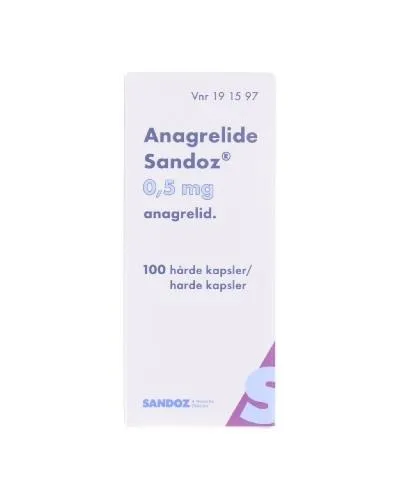
Table of Contents
Package leaflet: Information for the user
Anagrelide Sandoz, 0.5 mg, hard capsules
Anagrelidum
Please read all of this leaflet carefully before taking this medicine because it contains
important information for you.
- Keep this leaflet as you may need to read it again.
- If you have any questions, ask your doctor or pharmacist.
- This medicine has been prescribed for a specific individual. Do not pass it on to others. It may harm them even if their symptoms are the same.
- If you experience any side effects, including any not listed in this leaflet, tell your doctor or pharmacist. See section 4.
Contents of the leaflet
- What Anagrelide Sandoz is and what it is used for
- What you need to know before taking Anagrelide Sandoz
- How to take Anagrelide Sandoz
- Possible side effects
- How to store Anagrelide Sandoz
- Contents of the pack and other information
1. What Anagrelide Sandoz is and what it is used for
Anagrelide Sandoz contains the active substance anagrelide. Anagrelide Sandoz is a medicine
that inhibits the production of blood platelets. It reduces the number of platelets produced by the
bone marrow, thereby decreasing their number in the blood to a more normal level. For this
reason, the medicine is used in the treatment of patients with essential thrombocythaemia.
Essential thrombocythaemia is a disease in which the bone marrow produces too many blood
cells known as platelets. A high number of platelets may cause serious circulatory and blood
clotting disorders.
2. Important information before using Anagrelide Sandoz
When not to use Anagrelide Sandoz
- if the patient is allergic to anagrelide or any of the other ingredients of this medicine (listed in section 6). Signs of an allergic reaction may include: rash, itching, swelling of the face or lips, or difficulty breathing.
- if the patient has moderate or severe liver function impairment.
- if the patient has moderate or severe kidney function impairment.
Warnings and precautions
Before taking Anagrelide Sandoz, discuss with the doctor if:
- the patient has been diagnosed with or is suspected of having heart disease;
- the patient has congenital QT prolongation (seen on ECG – electrocardiogram) or such a condition has occurred in family members, or the patient is taking other medicines that cause changes in the ECG, or the patient has low blood levels of electrolytes (e.g. potassium, magnesium or calcium) (see section “Anagrelide Sandoz and other medicines”);
- the patient has impaired liver or kidney function.
When Anagrelide Sandoz is used concomitantly with acetylsalicylic acid
(acetylsalicylic acid, commonly known as "aspirin", found in many medicines used to relieve pain and reduce fever, and also to prevent blood clots), there is an increased risk of serious bleeding (haemorrhage), see section “Anagrelide Sandoz and other medicines”.
When taking Anagrelide Sandoz, the patient must take the medicine exactly as prescribed by the doctor. Do not stop taking the medicine without first informing the doctor.
Do not suddenly stop taking this medicine without consulting the doctor. Abrupt discontinuation of the medicine may increase the risk of stroke.
Symptoms of stroke may include sudden numbness or weakness in the face, arm or leg, especially on one side of the body; sudden confusion, trouble speaking or understanding speech; sudden vision problems in one or both eyes; sudden difficulty walking, dizziness, loss of balance or lack of coordination; or sudden severe headache with no known cause.
In such a case, seek immediate medical help.
Children and adolescents
Due to limited information on the use of Anagrelide Sandoz in children and adolescents, caution is advised in this patient group.
Anagrelide Sandoz and other medicines
Inform the doctor or pharmacist about all medicines the patient is currently taking or has recently taken, as well as any medicines the patient plans to take.
Inform the doctor or pharmacist if the patient is taking any of the following medicines:
- medicines that may affect heart rhythm, e.g. sotalol, amiodarone;
- fluvoxamine (a medicine used to treat depression);
- certain types of antibiotics, such as enoxacin, used to treat infections;
- theophylline (a medicine used to treat severe asthma and breathing disorders);
- medicines used to treat heart conditions, e.g. milrinone, enoximone, amrinone, olprinone and cilostazol;
- acetylsalicylic acid (a substance found in many medicines used to relieve pain and reduce fever, and also to prevent blood clotting, commonly known as "aspirin");
- other medicines used in conditions affecting platelet function, e.g. clopidogrel;
- omeprazole (a medicine used to reduce gastric acid secretion);
- oral contraceptives: if the patient experiences severe diarrhoea while taking Anagrelide Sandoz, this may reduce the effectiveness of oral contraceptives. An additional method of contraception (e.g. condoms) is recommended. Women taking oral contraceptives should read the patient information leaflet included in the packaging.
If Anagrelide Sandoz or any of the listed medicines are taken at the same time, they may not work properly.
In case of doubt, consult the doctor or pharmacist.
Pregnancy and breastfeeding
If a woman is pregnant or planning to become pregnant, she should inform her doctor. Anagrelide Sandoz must not be used during pregnancy. Women of childbearing potential must use effective contraception during treatment with Anagrelide Sandoz. If a patient needs advice on contraception, she should consult her doctor.
If a woman is breastfeeding or planning to breastfeed, she should inform her doctor. Anagrelide Sandoz must not be used during breastfeeding. Women taking Anagrelide Sandoz must discontinue breastfeeding.
Driving and using machines
Some people taking Anagrelide Sandoz have reported dizziness. If the patient experiences dizziness, he or she should not drive or operate machinery.
Anagrelide Sandoz contains lactose
If the patient has previously been diagnosed with intolerance to certain sugars, consult the doctor before taking this medicine.
3. How to use Anagrelide Sandoz
This medicine should always be taken as prescribed by the doctor. In case of any doubts, consult
your doctor or pharmacist.
The dose of Anagrelide Sandoz used in patients may vary depending on the disease condition.
Your doctor will prescribe a dose tailored to your individual needs.
The usual starting dose is 1 mg per day. This may be taken as one 0.5 mg capsule twice daily for
at least one week. After this time, your doctor may increase or decrease the number of capsules
to determine the best and most effective dose for you.
The capsules should be taken orally, swallowed whole, with a glass of water. The capsules must
not be crushed or their contents dissolved in liquids. The medicine can be taken independently
of meals, preferably at the same time each day.
Do not take more or fewer capsules than prescribed by your doctor. Do not stop taking this
medicine without first consulting your doctor. Do not suddenly discontinue taking this medicine on
your own.
Your doctor will schedule regular blood tests to monitor whether the medicine is working
effectively and to check liver and kidney function.
Taking more Anagrelide Sandoz than prescribed
If you have taken too much Anagrelide Sandoz or if someone else has taken this medicine, seek
immediate advice from a doctor or pharmacist. Show the medicine's packaging.
Missing a dose of Anagrelide Sandoz
If you miss a dose, take a capsule as soon as you remember, then take the next dose at the usual
scheduled time. Do not take a double dose to make up for a missed dose.
4. Possible adverse effects
Like all medicines, this medicine can cause adverse effects, although not everyone will experience them.
Serious adverse effects
Not common: heart failure (with symptoms such as breathlessness, chest pain, swelling of the legs due to fluid retention), severe disturbances in heart rate or heart rhythm (ventricular tachycardia, supraventricular tachycardia or atrial fibrillation), pancreatitis (causing severe abdominal and back pain), vomiting blood, blood in the stool or black, tarry stools, significant reduction in blood cells (which may cause weakness, bruising, bleeding or infections [pancytopenia]), pulmonary hypertension (with symptoms such as breathlessness, swelling of legs or ankles, bluish discoloration of lips and skin).
Rare: kidney failure (patient passes little or no urine), heart attack.
If any of these adverse effects occur, consult a doctor immediately.
Very common adverse effects: may affect more than 1 in 10 people
Headache.
Common adverse effects: may affect up to 1 in 10 people
Dizziness, fatigue, rapid heartbeat, irregular or forceful heartbeat (palpitations), nausea, diarrhoea, stomach pain, gas, vomiting, reduction in red blood cells (anaemia), fluid retention or rash.
Uncommon adverse effects: may affect up to 1 in 100 people
Feeling weak or generally unwell, high blood pressure, irregular heart function, fainting, chills or fever, indigestion, loss of appetite, constipation, bruising, bleeding, swelling, weight loss, muscle pain, joint pain, back pain, numbness or loss of sensation or sensations such as tingling (especially of the skin), abnormal sensations such as pins and needles, insomnia, depression, confusion, restlessness, dry mouth, memory loss, breathlessness, nosebleeds, severe lung infection with fever, shortness of breath, cough and mucus accumulation in the throat; hair loss, itching or skin discoloration, impotence, chest pain, reduction in platelet count, increasing the risk of bleeding or bruising (thrombocytopenia), fluid accumulation in the space around the lungs or increased liver enzyme activity (your doctor may recommend blood tests to monitor these).
Rare adverse effects: may affect up to 1 in 1000 people
Bleeding gums, weight gain, severe chest pain (angina), heart muscle disease (with symptoms such as fatigue, chest pain and palpitations), enlarged heart, fluid accumulation around the heart, painful spasm of blood vessels in the heart (at rest, usually at night or early morning [Prinzmetal's angina]), lack of coordination, speech disturbances, dry skin, migraine, visual disturbances or double vision, ringing in the ears, dizziness upon standing (from sitting or lying down), increased need to urinate at night, pain, flu-like symptoms, somnolence, blood vessel dilation, inflammation of the large intestine (with symptoms such as diarrhoea, usually with blood and mucus, stomach pain, fever), inflammation of the stomach lining (with symptoms such as pain, nausea, vomiting), appearance of areas of reduced density in the lungs, increased blood creatinine levels, which may indicate impaired kidney function.
Adverse effects with unknown frequency
- Potentially life-threatening, irregular heartbeat (arrhythmia of the torsade de pointes type);
- Liver inflammation (symptoms include nausea, vomiting, itching, yellowing of the skin and eyes, pale stools and dark urine);
- Lung inflammation (symptoms may include fever, cough, difficulty breathing, wheezing); which may lead to lung scarring (allergic alveolitis, including interstitial lung disease);
- Kidney inflammation (interstitial nephritis).
- Stroke (see section 2)
Reporting of adverse effects
If any adverse effects occur, including any not listed in this leaflet, inform your doctor, pharmacist or nurse. Adverse effects can be reported directly to the Department of Monitoring Adverse Drug Reactions, Office for Registration of Medicinal Products, Medical Devices and Biocidal Products: Al. Jerozolimskie 181C, 02-222 Warsaw
Tel: +48 22 49 21 301 / Fax: +48 22 49 21 309 / Website: https://smz.ezdrowie.gov.pl
Adverse effects can also be reported to the responsible entity.
Reporting adverse effects helps to provide more information on the safety of this medicine.
5. How to store Anagrelide Sandoz
Keep this medicine out of the sight and reach of children.
Do not use this medicine after the expiry date stated on the cardboard box and bottle after "EXP". The expiry date refers to the last day of the stated month.
Do not store above 30°C. Keep in the original packaging to protect from moisture.
After first opening the bottle, use the medicine within 100 days. Keep the bottle tightly closed and store in a dry place to protect from moisture.
Medicines should not be disposed of via wastewater or household waste. Ask your pharmacist how to dispose of medicines no longer required. These measures will help protect the environment.
6. Contents of the packaging and other information
What Anagrelide Sandoz contains
The active substance is anagrelide. One capsule contains 0.5 mg anagrelide (in the form of anagrelide
hydrochloride monohydrate).
The other ingredients are: povidone (K30); lactose; lactose monohydrate; microcrystalline cellulose;
crospovidone (type A) and magnesium stearate.
Capsule shell: gelatin and titanium dioxide (E 171).
What Anagrelide Sandoz looks like and contents of the pack
Anagrelide Sandoz is a white, hard gelatin capsule (size 4; 14.4 mm), containing a white or almost white, fine powder.
The bottle with a desiccant contains 100 hard capsules.
Marketing Authorisation Holder and Manufacturer
Marketing Authorisation Holder
Sandoz GmbH
Biochemiestrasse 10
6250 Kundl, Austria
Manufacturers
Noucor Health, S.A. Avda. Camí Reial, 51-57, Palau-Solità i Plegamans,
08184 Barcelona, Spain
Galenicum Health S.L.U.
Sant Gabriel, 50,
Esplugues de Llobregat
08950 Barcelona, Spain
SAG Manufacturing, S.L.U.
Carretera A-1, Km 36
San Agustín del Guadalix
28750 Madrid, Spain
Salutas Pharma GmbH
Otto-von-Guericke-Allee 1
39179 Barleben, Germany
Lek Pharmaceuticals d.d.
Verovškova 57
1526 Ljubljana, Slovenia
For further information about this medicinal product and its names in the Member States of the
European Economic Area and in the United Kingdom (Northern Ireland), please contact:
Sandoz Polska Sp. z o.o.
ul. Domaniewska 50 C
02-672 Warsaw
tel. 22 209 70 00
The reference medicinal product containing anagrelide has been authorised under the "exceptional circumstances" procedure. This means that, due to the rarity of the disease, it has not been possible to obtain complete information about this medicinal product.
The European Medicines Agency will review any new information annually and, if necessary, update the product information.