Amylan
Poland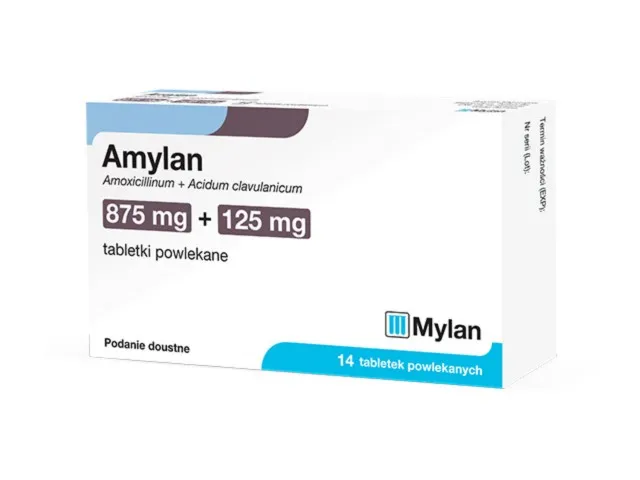
Table of Contents
Package leaflet: Information for the patient
Amylan, 875 mg + 125 mg, film-coated tablets
Amoxicillinum + Acidum clavulanicum
Please read this leaflet carefully before using the medicine, as it contains
important information for the patient.
- Keep this leaflet, as you may need to read it again.
- If you have any doubts, consult your doctor or pharmacist.
- This medicine has been prescribed for a specific individual. Do not pass it on to others. The medicine may harm another person, even if their symptoms are the same.
- If the patient experiences any adverse reactions, including any adverse reactions not listed in this leaflet, inform the doctor or pharmacist. See section 4.
Contents of the leaflet
- What Amylan is and what it is used for
- Important information before taking Amylan
- How to take Amylan
- Possible side effects
- How to store Amylan
- Contents of the package and other information
1. What Amylan is and what it is used for
Amylan is an antibiotic with bactericidal action against bacteria causing infections.
It contains two different active substances: amoxicillin and clavulanic acid. Amoxicillin belongs to a group of medicines known as "penicillins", whose action may sometimes be inhibited (inactivated). The second active component (clavulanic acid) counteracts this inactivation.
Amylan is used in adults and children to treat the following infections:
- Middle ear infections and sinusitis
- Respiratory tract infections
- Urinary tract infections
- Skin and soft tissue infections, including dental infections
- Bone and joint infections
2. Important information before using Amylan
When not to use Amylan
- If the patient has a known allergy to amoxicillin, clavulanic acid, penicillin, or any of the other ingredients of this medicine (listed in section 6).
- If the patient has ever experienced severe allergic reactions to any other antibiotic. These may include skin rash or swelling of the face, neck, or throat.
- If the patient has ever had liver problems or jaundice (yellowing of the skin) associated with taking an antibiotic.
If any of the above conditions apply, the patient should not take Amylan.
If in doubt, consult a doctor or pharmacist before starting treatment with Amylan.
Warnings and precautions
Before starting treatment with Amylan, consult a doctor or pharmacist if the patient:
- Has infectious mononucleosis,
- Is being treated for liver or kidney disease,
- Has irregular urination.
If in doubt whether any of the above conditions apply, consult a doctor or pharmacist before starting treatment with Amylan.
In some cases, the doctor may test which type of bacteria caused the infection. Depending on the results, the patient may receive Amylan at a different dose or another medicine.
Conditions to be aware of
Treatment with amoxicillin and clavulanic acid may worsen the course of certain diseases or cause serious adverse effects, including allergic reactions, seizures, and colitis. It is important to monitor for specific symptoms during treatment with amoxicillin and clavulanic acid to reduce the risk of complications. See section 4 "Possible adverse effects".
Blood and urine tests
If the patient is scheduled for blood tests (such as red blood cell count or liver function tests) or urine tests (for glucose), they should inform the doctor or nurse that they are taking Amylan. Amoxicillin with clavulanic acid may affect the results of these tests.
Interaction of Amylan with other medicines
Inform the doctor or pharmacist about all medicines currently taken or recently used, as well as any medicines planned for future use, including those available without a prescription and herbal medicines.
- Allopurinol (a medicine used to treat gout) – skin allergic reactions may be more likely.
- Probenecid (another medicine used to treat gout) – the doctor may decide to adjust the dose of Amylan. Concurrent use of probenecid may reduce the elimination of amoxicillin and is not recommended.
- Medicines that reduce blood clotting (such as acenocoumarol or warfarin) – additional blood tests may be required.
- Methotrexate (a medicine used to treat cancer, severe psoriasis, or rheumatic diseases) – penicillins may reduce methotrexate elimination, increasing the risk of adverse effects.
- Mycophenolate mofetil (a medicine used to prevent rejection of transplanted organs).
Pregnancy and breastfeeding
If the patient is pregnant, breastfeeding, suspects she may be pregnant, or is planning to have a child, she should consult a doctor or pharmacist before using this medicine.
Pregnancy
This medicine may harm the unborn child and should be avoided during pregnancy unless clearly necessary. The doctor will discuss this with the patient.
Breastfeeding
Amoxicillin and clavulanic acid may pass into human milk. If the patient is breastfeeding while taking this medicine, diarrhea or fungal infection may occur in the infant. In such cases, discontinuation of breastfeeding may be necessary. The patient should use this medicine during breastfeeding only if recommended by a doctor.
Driving and operating machinery
Amylan may cause adverse effects that could impair the ability to drive.
Do not drive or operate machinery unless the patient feels well.
The medicine contains less than 1 mmol of sodium (23 mg) per tablet, i.e. the medicine is considered "sodium-free".
3. How to use Amylan
This medicine should always be used as directed by the physician. If in doubt, consult your
doctor or pharmacist.
Adults and children with body weight 40 kg or more
- Recommended dose – 1 tablet twice daily.
- Higher recommended dose – 1 tablet three times daily.
Children with body weight less than 40 kg
- Children aged 6 years or younger should preferably be treated with amoxicillin with clavulanic acid in the form of an oral suspension or in sachets.
- Consult your doctor or pharmacist before using Amylan tablets in children with body weight less than 40 kg. The tablets are not suitable for children with body weight less than 25 kg.
Patients with kidney or liver disease
- If the patient has kidney disease, the dose of the medicine may be adjusted. The treating physician may prescribe a different dose or another medicine.
- If the patient has liver disease, blood tests may be performed more frequently to monitor liver function.
How to use Amylan
- Swallow the tablets whole, with a glass of water, at the beginning of a meal or immediately before a meal. The tablets may be divided along the break line to make swallowing easier. Both parts of the tablet should be taken at the same time.
- Maintain regular intervals between doses, with at least 4 hours between each dose throughout the day. Do not take 2 doses within 1 hour of each other.
- Maintain adequate hydration throughout the day by drinking large amounts of fluids, especially if the patient is taking high doses of this medicine, to reduce the possibility of crystal formation in the urine.
- Do not use Amylan for longer than 2 weeks. If the patient still does not feel better, they should contact their doctor again.
Use of a higher than recommended dose of Amylan
If the patient has taken more Amylan than recommended, symptoms such as gastrointestinal irritation (nausea, vomiting, or diarrhoea) or seizures may occur. Contact a doctor as soon as possible. Keep the cardboard packaging or the medicine bottle available to show to the doctor.
Missed dose of Amylan
If the patient forgets to take a dose, take it as soon as they remember. Do not take the next dose too soon; wait approximately 4 hours before taking the next dose. Do not take a double dose to make up for a missed dose.
Stopping treatment with Amylan
Continue taking Amylan for the full duration of treatment, even if the patient feels better. All doses are necessary to eliminate the infection. If some bacteria survive, they may cause a recurrence of infection.
If you have any further questions about the use of this medicine, consult your doctor or pharmacist.
4. Possible adverse reactions
Like any medicine, this medicinal product may cause adverse reactions, although not everyone experiences them.
Particular attention should be paid to the following symptoms:
- severe allergic reactions, such as:
- skin rash
- vasculitis, which may appear as red or purple raised spots on the skin, but may affect other organs
- fever, joint pain, swelling of glands in the neck, armpits, or groin
- swelling of the face or (angioedema), causing difficulty breathing or swallowing
- fainting
- red rash typically observed on both sides of the buttocks, inner upper thighs, armpits, and neck (symmetrical drug-related intertriginous and flexural exanthema, SDRIFE) (frequency cannot be determined from available data)
- chest pain associated with an allergic reaction, which may indicate an allergy leading to myocardial infarction (Kounis syndrome)
You should contact a doctor immediately if any of the following symptoms occur. You should discontinue use of Amylan.
Colitis
Inflammation of the large intestine, causing watery diarrhoea usually with blood and mucus, stomach pain, and (or) fever.
Acute pancreatitis
If you have severe and persistent pain in the abdominal area, it may be a sign of acute pancreatitis.
Drug-induced enterocolitis syndrome (DIES)
Drug-induced enterocolitis has occurred mainly in children receiving amoxicillin with clavulanic acid. This is a type of allergic reaction, the main symptom of which is recurrent vomiting (1 to 4 hours after taking the medicine). Further symptoms may include abdominal pain, lethargy, diarrhoea, and low blood pressure.
You should contact a doctor as soon as possible if any of the following symptoms occur.
Very common adverse reactions (may occur in more than 1 in 10 patients)
- diarrhoea (in adults)
Common adverse reactions (may occur in less than 1 in 10 patients)
- fungal infections (candidiasis – yeast infections of the vagina, mouth, or skin folds)
- nausea, especially when high doses are used. If nausea occurs, take Amylan before meals
- vomiting
- diarrhoea (in children)
Uncommon adverse reactions (may occur in not more than 1 in 100 patients)
- skin rash, itching
- raised, itchy rash (urticaria)
- indigestion
- dizziness
- headache
Uncommon adverse reactions that may be detected in blood tests:
- increased activity of certain substances (enzymes) produced in the liver
Rare adverse reactions (may occur in not more than 1 in 1000 patients)
- skin rash, which may present with blisters and resemble small targets (dark spot in the center surrounded by a lighter ring and a dark ring around the edge – erythema multiforme)
You should contact a doctor immediately if these symptoms occur.
Rare adverse reactions that may be detected in blood tests:
- low number of platelets (thrombocytopenia)
- low number of white blood cells (leukopenia)
Frequency unknown (frequency cannot be determined from available data)
- allergic reactions (see above)
- colitis (see above)
- blistering rash arranged in a ring-like pattern or resembling a string of pearls (linear IgA dermatosis)
- inflammation of the membranes surrounding the brain and spinal cord (aseptic meningitis)
- other serious skin reactions, such as:
- widespread blistering rash with skin peeling, especially around the mouth, nose, eyes, and genitals (Stevens-Johnson syndrome), and a more severe form causing extensive skin peeling (over 30% of body surface – toxic epidermal necrolysis)
- widespread red rash on the skin with small pustules filled with pus (bullous exfoliative dermatitis)
- red, scaly rash with subcutaneous nodules and blisters (acute generalized exanthematous pustulosis)
- flu-like symptoms with rash, fever, swollen glands, and abnormal blood test results (including increased white blood cells (eosinophilia) and liver enzymes (drug reaction with eosinophilia and systemic symptoms, DRESS))
You should contact a doctor immediately if any of the following symptoms occur:
- inflammation of the liver
- jaundice caused by increased bilirubin (a substance produced in the liver), which may cause yellowing of the skin and whites of the eyes
- inflammation of the renal tubules
- prolonged blood clotting time
- motor hyperactivity
- seizures (in patients taking high doses of Amylan or with kidney problems)
- black hairy tongue
Adverse reactions that may be detected in blood tests:
- decreased number of white blood cells
- low number of red blood cells (hemolytic anaemia)
- crystals in urine leading to acute kidney injury
Reporting of adverse reactions
If you experience any adverse symptoms, including any adverse reactions not listed in this leaflet, you should inform your doctor or pharmacist. Adverse reactions can be reported directly to the Department of Monitoring Adverse Drug Reactions of the Office for Registration of Medicinal Products, Medical Devices and Biocidal Products
Al. Jerozolimskie 181C
02-222 Warsaw
Tel: 22 49 21 301
Fax: 22 49 21 309
Website: https://smz.ezdrowie.gov.pl
Adverse reactions may also be reported to the marketing authorization holder.
By reporting adverse reactions, more information on the safety of the medicine can be collected.
5. How to store Amylan
Do not store above 25°C. Keep in the original packaging to protect from moisture.
The medicine should be stored in a place out of sight and out of reach of children.
Do not use this medicine after the expiry date stated on the carton or blister pack after EXP.
The expiry date refers to the last day of the stated month.
Medicines must not be disposed of via wastewater or household waste. Ask your pharmacist how to dispose of medicines no longer required. Such measures help protect the environment.
6. Contents of the package and other information
What Amylan contains
- The active substances are amoxicillin and clavulanic acid.
- Each coated tablet contains amoxicillin trihydrate equivalent to 875 mg of amoxicillin and potassium clavulanate equivalent to 125 mg of clavulanic acid.
- Other ingredients are:
Tablet core – microcrystalline cellulose, crospovidone type A, sodium croscarmellose, colloidal anhydrous silica, magnesium stearate.
Tablet coating – basic butyl methacrylate copolymer, titanium dioxide (E 171), talc, macrogol 6000.
What Amylan looks like and contents of the pack
Amylan is a white to off-white, oblong, capsule-shaped, film-coated tablet with a division line.
Amylan is available in blisters in a carton pack containing 14 film-coated tablets.
Marketing Authorisation Holder
Viat游戏副本