Amoxiclav
Poland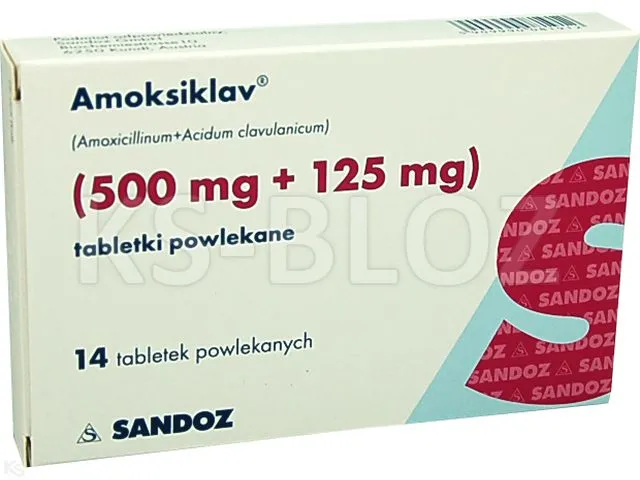
Table of Contents
PACKAGE LEAFLET: INFORMATION FOR THE PATIENT
Warning! Keep the leaflet; information on the immediate packaging is in a foreign language!
Amoksiklav
875 mg + 125 mg, film-coated tablets
Amoxicillinum + Acidum clavulanicum
Please read this leaflet carefully before using the medicine, as it contains
important information for the patient.
- Keep this leaflet, so that you can read it again if necessary.
- If you have any doubts, please consult your doctor or pharmacist.
- This medicine has been prescribed for a specific individual. Do not pass it on to others.
- The medicine may harm another person, even if their symptoms are the same.
- If you experience any adverse reactions, including any adverse reactions not listed in this leaflet, inform your doctor or pharmacist. See section 4.
Table of contents of the leaflet
- What Amoksiklav is and what it is used for
- Important information before taking Amoksiklav
- How to take Amoksiklav
- Possible side effects
- How to store Amoksiklav
- Contents of the pack and other information
1. What Amoksiklav is and what it is used for
Amoksiklav is an antibiotic that kills bacteria causing infections. It contains two different active substances: amoxicillin (in the form of amoxicillin trihydrate) and clavulanic acid (in the form of potassium clavulanate). Amoxicillin belongs to a group of medicines called penicillins, the action of which can sometimes be blocked (inactivated). The second active substance (clavulanic acid) counteracts this inactivation.
Amoksiklav is used in adults and children to treat the following infections:
- middle ear and sinus infections,
- respiratory tract infections,
- urinary tract infections,
- skin and soft tissue infections, including dental infections,
- bone and joint infections.
2. Important information before using Amoksiklav
When not to use Amoksiklav
- if the patient is allergic (hypersensitive) to amoxicillin, clavulanic acid, penicillin, or to any of the other ingredients of this medicine (listed in section 6);
- if the patient has ever experienced a severe allergic reaction (hypersensitivity) to any other antibiotic; such a reaction may include skin rash, swelling of the face or neck;
- if the patient has ever had liver function disorders or jaundice (yellowing of the skin) caused by taking an antibiotic.
If any of the above situations apply to the patient, the patient should not take
Amoksiklav. If in doubt, consult a doctor or pharmacist before using Amoksiklav.
Warnings and precautions
Before using this medicine, discuss with a doctor or pharmacist if the patient:
- has infectious mononucleosis;
- is being treated for liver or kidney function disorders;
- does not urinate regularly.
If in doubt whether any of these conditions apply to the patient, consult a doctor or pharmacist before using the medicine.
In some cases, the doctor may test which type of bacteria caused the infection. Depending on the test results, the patient may be given a different strength of Amoksiklav or another medicine.
Side effects to watch for
Taking Amoksiklav may worsen certain existing medical conditions or cause serious side effects (such as allergic reactions, seizures, and inflammation of the large intestine). To reduce the risk of any problems, it is important to monitor for specific symptoms while taking Amoksiklav (see "Side effects to watch for" in section 4).
Blood and urine tests
If the patient is due to have blood tests (e.g. red blood cell count or liver function tests) or urine tests (for glucose), inform the doctor or nurse that the patient is taking Amoksiklav. This medicine may affect the results of such tests.
Amoksiklav and other medicines
Tell the doctor or pharmacist about all medicines the patient is currently taking or has recently taken, including medicines the patient plans to take, even those available without a prescription, as well as herbal medicines.
If the patient takes allopurinol (used to treat gout) together with Amoksiklav, the risk of developing a skin allergic reaction increases.
If the patient takes probenecid (used to treat gout), the doctor may decide to adjust the dose of Amoksiklav. Concomitant use of probenecid may reduce the elimination of amoxicillin and is not recommended.
If the patient takes medicines that reduce blood clotting (such as warfarin) together with Amoksiklav, additional blood tests may be necessary.
Amoksiklav may affect the action of methotrexate (a medicine used in the treatment of cancer and severe psoriasis).
If the patient is receiving mycophenolate mofetil (a medicine used to prevent rejection of a transplanted organ), the doctor will closely monitor the patient's health during treatment with Amoksiklav.
Pregnancy and breastfeeding
If the patient is pregnant or breastfeeding, suspects she may be pregnant, or is planning to have a baby, she should consult a doctor or pharmacist before using this medicine.
Driving and operating machinery
Amoksiklav may cause side effects and symptoms that may impair the ability to drive. Do not drive or operate machinery unless the patient feels well.
Amoksiklav contains sodium and potassium
This medicine contains less than 1 mmol (23 mg) of sodium per coated tablet, meaning the medicine is considered "sodium-free".
This medicine contains less than 1 mmol (39 mg) of potassium per dose, meaning the medicine is considered "potassium-free".
3. How to take Amoksiklav
This medicine should always be taken exactly as your doctor has instructed. If you are unsure, you should consult your doctor or pharmacist.
Adults and children weighing 40 kg or more
- Usual dose: 1 tablet twice daily
- Higher dose: 1 tablet three times daily
Children weighing less than 40 kg
Children up to 6 years of age should preferably receive Amoksiklav as an oral suspension.
Before administering Amoksiklav tablets to children weighing less than 40 kg, consult your doctor or pharmacist.
Patients with kidney or liver disease
- For patients with impaired kidney function, the dose may need to be adjusted. Your doctor may recommend taking a different strength or another medicine.
- Patients with impaired liver function may require more frequent blood tests to monitor liver function.
How to take Amoksiklav
- Swallow the tablets whole with a glass of water, at the beginning of a meal or just before a meal.
- Maintain regular intervals of at least 4 hours between doses taken during the day. Do not take 2 doses within 1 hour.
- Do not use Amoksiklav for longer than 2 weeks. If the patient still feels unwell, contact the doctor again.
Taking more Amoksiklav than prescribed
If a patient takes more Amoksiklav than prescribed, symptoms such as stomach and intestinal irritation (nausea, vomiting, or diarrhoea) or seizures may occur. Contact a doctor as soon as possible. Take the medicine packaging along to show the doctor.
If you forget to take Amoksiklav
If the patient forgets to take a dose, they should take it as soon as they remember. Do not take the next dose too soon, but wait approximately 4 hours before taking it.
Stopping Amoksiklav treatment
Continue taking Amoksiklav for the full duration of treatment, even if you start to feel better. All doses are needed to fully eliminate the infection. If some bacteria survive, they may cause the infection to return.
If you have any further questions about the use of this medicine, consult your doctor or pharmacist.
4. Possible adverse effects
Like all medicines, this medicine can cause adverse effects, although not everyone experiences them.
Symptoms that require attention
Allergic reactions:
- Skin rash
- Vasculitis, which may appear as red or purple raised spots on the skin, but may also affect other parts of the body
- Fever, joint pain, swelling of lymph nodes in the neck, underarm, or groin
- Swelling, sometimes of the face or mouth (angioedema), causing difficulty in breathing
- Fainting
- Chest pain related to an allergic reaction, which may be a sign of an allergy leading to heart attack (Kounis syndrome)
If any of these symptoms occur, contact a doctor immediately.
Stop taking Amoksiklav.
Inflammation of the large intestine
Inflammation of the large intestine causing watery diarrhoea, usually with blood and mucus, stomach pain and (or) fever.
Acute pancreatitis
If the patient experiences severe and persistent pain in the abdominal area, this may be a sign of acute pancreatitis.
Drug-induced enterocolitis syndrome (DIES)
Drug-induced enterocolitis has occurred mainly in children receiving amoxicillin with clavulanic acid. This is a type of allergic reaction, the main symptom of which is repeated vomiting (1 to 4 hours after taking the medicine). Further symptoms may include abdominal pain, lethargy, diarrhoea, and low blood pressure.
If any of these symptoms occur, seek medical advice as soon as possible.
Very common adverse effects (occurring in more than 1 in 10 people)
- Diarrhoea
Common adverse effects (occurring in up to 1 in 10 people)
- Candidiasis – fungal infection of the vagina, mouth (oral thrush), or skin folds
- Nausea, especially when high doses of the medicine are taken → If nausea occurs, take Amoksiklav before meals.
- Vomiting
Uncommon adverse effects (occurring in up to 1 in 100 people)
- Skin rash, itching
- Raised, itchy rash (urticaria)
- Indigestion
- Dizziness
- Headache
Uncommon adverse effects that may appear in blood test results:
- Increased activity of certain substances (enzymes) produced in the liver
Rare adverse effects (occurring in less than 1 in 1,000 people)
- Skin rash that may develop into blisters and resemble target-like lesions (dark spot in the center surrounded by a lighter ring with a dark border at the edge – erythema multiforme). If the patient notices any of these symptoms, contact a doctor urgently.
Rare adverse effects that may appear in blood test results:
- Low number of cells involved in blood clotting (platelets)
- Low number of white blood cells
Other adverse effects
Other adverse effects occurred in a very small number of people, but their exact frequency is unknown:
- Allergic reactions (see above)
- Inflammation of the large intestine (see above)
- Severe skin reactions:
- Widespread skin rash with blisters and peeling of the skin, especially around the mouth, nose, eyes, and genital organs (Stevens-Johnson syndrome), and a more severe form causing extensive skin peeling (affecting more than 30% of the body surface – toxic epidermal necrolysis [Lyell's syndrome])
- Widespread red rash with small pustules filled with pus (pustular exanthematous dermatosis)
- Red, scaly rash with subcutaneous nodules and blisters (bullous pemphigoid)
- Influenza-like symptoms with rash, fever, swollen lymph nodes, and abnormal blood test results [including increased white blood cell count (eosinophilia) and increased liver enzyme activity]; drug reaction with eosinophilia and systemic symptoms (DRESS)
- Crystals in urine leading to acute kidney injury
- Blistering rash arranged in ring-like patterns with crusts in the center or resembling a string of pearls (linear IgA dermatosis)
- Inflammation of the membranes surrounding the brain and spinal cord (aseptic meningitis)
- Liver inflammation
- Jaundice due to increased blood levels of bilirubin (a substance produced in the liver), which may cause yellowing of the skin and whites of the eyes
- Interstitial nephritis
- Prolonged blood clotting time
- Motor hyperactivity
- Seizures (in people receiving high doses of Amoksiklav or with kidney disease)
- Black, hairy-looking tongue
- Development of infection caused by overgrowth of resistant bacteria
Adverse effects that may appear in blood or urine test results:
- Marked decrease in white blood cell count
- Low number of red blood cells (haemolytic anaemia)
- Crystals in urine
Reporting of adverse effects
If any adverse effects occur, including any not listed in this leaflet, inform your doctor or pharmacist. Adverse effects can be reported directly to the Department of Monitoring Adverse Drug Reactions, Office for Registration of Medicinal Products, Medical Devices and Biocidal Products: Al. Jerozolimskie 181C, 02-222 Warsaw
Tel: +48 22 49 21 301
Fax: +48 22 49 21 309
Website: https://smz.ezdrowie.gov.pl
Reporting adverse effects helps provide more information on the safety of the medicine.
5. How to store Amoksiklav
- Keep this medicine out of sight and reach of children.
- Store below 25ºC in the original packaging.
- Do not use this medicine after the expiry date stated on the packaging. The expiry date refers to the last day of the stated month.
- Medicines must not be disposed of via wastewater or household waste. Ask your pharmacist how to dispose of medicines no longer required. This will help protect the environment.
6. Package contents and other information
What Amoksiklav contains
The active substances are amoxicillin and clavulanic acid.
Each coated tablet contains 875 mg of amoxicillin (as amoxicillin trihydrate) and 125 mg of clavulanic acid (as potassium clavulanate).
The other ingredients are: colloidal anhydrous silica, crospovidone type A, magnesium stearate, microcrystalline cellulose PH-112, talc, povidone K 25.
Coating: hypromellose 2910, ethylcellulose, cetyl alcohol, sodium lauryl sulfate, triethyl citrate, talc, titanium dioxide (E 171).
What Amoksiklav looks like and contents of the pack
White or almost white, oval coated tablets, with a scored line on both sides, approximately 22.5 mm in length and 10.5 mm in width, packed in Al/Al blisters placed in a cardboard box containing 14 coated tablets.
The scored line is not intended for dividing the tablet into equal doses – it is only intended to facilitate breaking the tablet for easier swallowing.
For more detailed information, please contact the marketing authorization holder or the parallel importer.
Marketing authorization holder in Romania, country of export:
Lek Pharmaceuticals d.d.
Verovškova 57
1526 Ljubljana
Slovenia
Manufacturer:
Sandoz GmbH
Biochemiestraße 10
6250 Kundl
Austria
Parallel importer:
Medezin Sp. z o.o.
ul. Zbąszyńska 3
91-342 Łódź
Repackaged in:
Medezin Sp. z o.o.
ul. Zbąszyńska 3
91-342 Łódź
Marketing authorization number in Romania, country of export: 14523/2022/02
Parallel import authorization number: 45/21
Medical education
Antibiotics are used to treat bacterial infections. They are ineffective in treating viral infections.
Sometimes bacterial infections do not respond to antibiotic treatment.
One of the most common reasons for this is that bacteria are resistant to the prescribed antibiotic.
This means that bacteria can survive or multiply despite the use of the antibiotic.
Bacteria may become resistant to antibiotics for various reasons. Careful use of antibiotics may help reduce the development of bacterial resistance.
The antibiotic prescribed by your doctor is intended solely for the treatment of your current illness. Paying attention to the following advice will help prevent the development of resistant bacteria that could interfere with the effectiveness of antibiotics.
- It is very important to take the antibiotic at the correct dose, at the right time, and for the prescribed number of days. Please read the instructions provided in the package leaflet, and if any of them are unclear, ask your doctor or pharmacist for clarification.
- The patient should not take an antibiotic that was not specifically prescribed for them. It should be taken only to treat the infection for which the antibiotic was prescribed.
- The patient should not take an antibiotic prescribed for another person, even if that person had a similar infection.
- Do not give antibiotics prescribed for you to other people.
- If any antibiotic remains after completing the treatment as directed by your doctor, return it to a pharmacy, which will ensure its proper disposal.