Aminoven infant 10%
Poland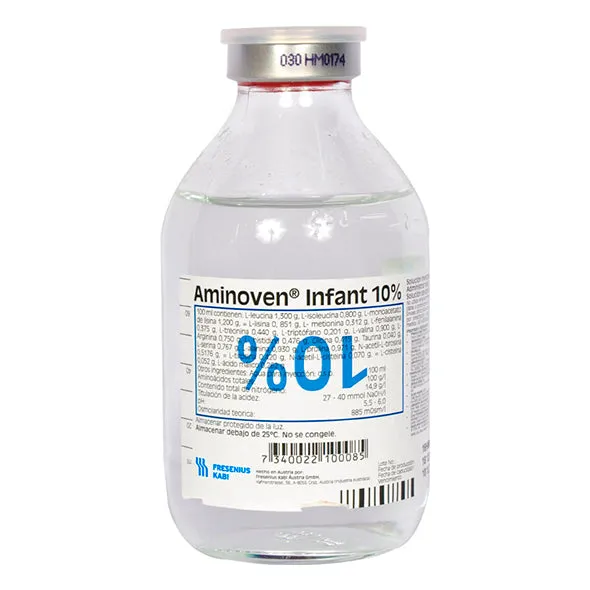
Table of Contents
- Package leaflet: Information for the user
- 1. What Aminoven Infant 10% is and what it is used for
- 2. Important information before using Aminoven Infant 10%
- 3. How to use Aminoven Infant 10%
- 4. Possible adverse reactions
- 5. How to store Aminoven Infant 10%
- 6. Contents of the pack and other information
- Information intended exclusively for medical professionals:
Package leaflet: Information for the user
Aminoven Infant 10%, solution for infusion
Please read all of this leaflet carefully before the medicine is administered, because it contains
important information for the patient.
- Keep this leaflet as you may need to read it again.
- If you have any further questions, please ask your doctor, pharmacist, or nurse.
- This medicine has been prescribed for a specific individual. Do not pass it on to others. It may harm them, even if their symptoms are the same.
- If the patient experiences any adverse reactions, including any adverse reactions not listed in this leaflet, inform the doctor, pharmacist, or nurse immediately. See section 4.
Table of contents
- What Aminoven Infant 10% is and what it is used for
- Important information before using Aminoven Infant 10%
- How to use Aminoven Infant 10%
- Possible side effects
- How to store Aminoven Infant 10%
- Contents of the pack and other information
1. What Aminoven Infant 10% is and what it is used for
Aminoven Infant 10% is an amino acid solution intended for parenteral nutrition in children. It should be used as a component of parenteral nutrition in combination with appropriate amounts of carbohydrate solutions, fat emulsions, electrolytes, vitamins, and trace elements.
The medicine is administered by intravenous infusion.
Indications:
Aminoven Infant 10% is indicated as a source of amino acids in parenteral nutrition of children.
2. Important information before using Aminoven Infant 10%
When not to use Aminoven Infant 10%
Do not use the medicine:
- if the patient has amino acid metabolism disorders (protein component metabolism disorders);
- if the patient has metabolic acidosis (accumulation in the blood of excessive amounts of acidic substances or decreased concentration of alkaline substances);
- if the patient is overhydrated (excess water in the body);
- if the patient has decreased potassium levels in the blood (hypokalaemia).
Warnings and precautions
The medicine should be used with caution in patients with decreased sodium levels in the blood (hyponatraemia).
During administration of Aminoven Infant 10%, the doctor will order blood tests (measurement of blood urea nitrogen, ammonia, electrolytes, glucose, triglycerides, liver enzymes, and serum osmolality).
The doctor will order monitoring of fluid balance (amount of fluids taken in and excreted from the body) and acid-base balance (appropriate ratio of acidic and alkaline substances in the body).
When administering the medicine via a peripheral vein (especially during infusions at a rate higher than recommended), vein irritation and thrombophlebitis may occur. Therefore, frequent checks of the infusion site are recommended.
The doctor will ensure the appropriate method of administration of this medicine.
When used in newborns and children under 2 years of age, the solution (in the bag and infusion set) must be protected from light until the end of administration. Exposure of Aminoven Infant 10% to light, particularly after addition of trace elements and (or) vitamins, leads to the formation of peroxides and other degradation products, which can be minimized by protecting from light.
Aminoven Infant 10% and other medicines
Inform the doctor or pharmacist about all medicines the patient is currently taking or has recently taken, as well as any medicines the patient plans to take.
No interaction of Aminoven Infant 10% with other medicines has been reported.
Pregnancy and breastfeeding
This information does not apply to Aminoven Infant 10%, as it is intended for use in children.
Driving and operating machinery
Not applicable.
3. How to use Aminoven Infant 10%
This medicine is administered only by medical personnel.
You must not use this medicine yourself.
If you have any doubts, consult your doctor.
The dosage is determined individually by the doctor for each patient, depending on age, body weight, laboratory test results, and taking into account the presence of renal or hepatic insufficiency.
When administering to neonates and children under 2 years of age, the solution (in the bag and infusion set) must be protected from light until the end of administration (see section 2).
Use of a higher than recommended dose of Aminoven Infant 10%
If a higher dose of the medicine is used, inform the doctor or nurse immediately.
In case of overdose or administration at a rate higher than recommended, symptoms such as nausea, vomiting, chills, and increased renal excretion of amino acids may occur.
If you have any further doubts regarding the use of this medicine, consult your doctor or nurse.
4. Possible adverse reactions
Like all medicines, this medicine can cause adverse reactions, although not everybody gets them.
If the medicine is administered at a faster rate than recommended, nausea, vomiting, chills,
disturbances in amino acid balance in the body, and increased excretion of amino acids through the
kidneys may occur.
When the medicine is administered correctly, no other adverse reactions are known.
Reporting of adverse reactions
If any adverse reactions occur, including any not listed in this leaflet, inform your doctor, pharmacist, or nurse. Adverse reactions can be reported directly to the Department of Monitoring Adverse Drug Reactions of the Office for Registration of Medicinal Products, Medical Devices and Biocidal Products
Al. Jerozolimskie 181C, 02-222 Warsaw
tel.: +48 22 49 21 301, fax: +48 22 49 21 309
website: https://smz.ezdrowie.gov.pl
Adverse reactions can also be reported to the marketing authorization holder.
Reporting adverse reactions helps provide more information on the safety of the medicine.
5. How to store Aminoven Infant 10%
Keep the medicine out of sight and reach of children.
Store below 25°C. Keep in the original packaging to protect from light.
The packaging must not be stored after opening. Any unused portion of the medicine is not suitable for further use.
Do not use this medicine after the expiry date stated on the packaging. The expiry date refers to the last day of the month indicated.
Do not use this medicine if visible solid particles are present or if the packaging is damaged.
When used in newborns and children under 2 years of age, the solution (in the bag and administration set) must be protected from light until the end of administration (see section 2).
Medicines must not be disposed of via wastewater or household waste. Ask your pharmacist how to dispose of medicines no longer required. Such measures will help protect the environment.
6. Contents of the pack and other information
What Aminoven Infant 10% contains
- The active substances in the medicine are:
1000 ml of solution contains:
L-isoleucine 8.00 g
L-leucine 13.00 g
L-lysine acetate 12.00 g
(corresponds to L-lysine 8.51 g)
L-methionine 3.12 g
L-phenylalanine 3.75 g
L-threonine 4.40 g
L-tryptophan 2.01 g
L-valine 9.00 g
L-arginine 7.50 g
L-histidine 4.76 g
Glycine 4.15 g
L-alanine 9.30 g
L-proline 9.71 g
L-serine 7.67 g
Taurine 0.40 g
N-acetyl-L-tyrosine 5.176 g
(corresponds to L-tyrosine 4.20 g)
N-acetyl-L-cysteine 0.70 g
(corresponds to L-cysteine 0.52 g)
L-malic acid 2.62 g
- Other component (excipient): water for injections.
Theoretical osmolarity 885 mOsm/l
Acidity of the solution 27 – 40 mmol NaOH/l
pH 5.5 – 6.0
What Aminoven Infant 10% looks like and contents of the pack
The medicine is a solution for infusion.
The pack consists of a colourless glass bottle containing 100 ml, 250 ml or 1000 ml of solution.
Marketing Authorisation Holder and Manufacturer
Marketing Authorisation Holder
Fresenius Kabi Deutschland GmbH
D-61346 Bad Homburg v.d.H.
Germany
Manufacturer
Fresenius Kabi Austria GmbH
Hafnerstrasse 36
A-8055 Graz
Austria
For further information, please contact the representative of the Marketing Authorisation Holder:
Fresenius Kabi Polska Sp. z o.o.
Al. Jerozolimskie 134
02-305 Warsaw
tel.: +48 22 345 67 89
Information intended exclusively for medical professionals:
Dosage and administration
Aminoven Infant 10% must be administered by continuous intravenous infusion into central veins.
Maximum infusion rate:
up to 0.1 g of amino acids/kg body weight/hour = 1.0 ml/kg body weight/hour.
Maximum daily dose:
- children aged 0–2 years: 1.5 to 2.5 g amino acids/kg body weight/day = 15 to 25 ml per kg body weight/day;
- children aged 2–5 years: 1.5 g amino acids/kg body weight/day = 15 ml per kg body weight/day;
- children aged 6–14 years: 1.0 g amino acids/kg body weight/day = 10 ml per kg body weight/day.
The medicinal product may be administered for as long as parenteral nutrition is required.
When used in neonates and children under 2 years of age, the solution (in the bag and administration set) must be protected from light until the end of administration.
Overdose
As with other amino acid solutions, administration of Aminoven Infant 10% in overdose or at a rate exceeding the recommended may result in chills, nausea, vomiting, and increased renal loss of amino acids. In such cases, infusion should be immediately discontinued. Infusion may be resumed at a reduced dose. In case of hyperkalemia, an infusion of 200 to 500 ml of 10% glucose solution with the addition of 1 to 3 units of modified insulin per 3–5 g of glucose is recommended.
Preparation of the medicinal product for use
After opening, the contents of the bottle should be used immediately.
Do not use Aminoven Infant 10% after the expiry date.
Only clear, particle-free solutions in undamaged containers should be used.
Keep out of the sight and reach of children.
When Aminoven Infant 10% is used in long-term parenteral nutrition, essential fatty acids, vitamins, and trace elements should also be administered to the patient.
Pharmaceutical compatibility data are available upon request from the responsible person's representative.
Special warnings and precautions for use
Exposure of parenteral nutrition solutions to light, particularly after addition of trace elements and/or vitamins, may lead to undesirable effects on clinical response in neonates due to the formation of peroxides and other degradation products. When used in neonates and children under 2 years of age, Aminoven Infant 10% must be protected from light until the end of administration.
Pharmaceutical incompatibilities
Do not mix this medicinal product with other medicinal products except those intended for parenteral nutrition, due to the risk of microbiological contamination and pharmaceutical incompatibility.
If it is necessary to add other nutritional components such as carbohydrates, fat emulsions, electrolytes, vitamins, or trace elements to Aminoven Infant 10% to provide complete parenteral nutrition, aseptic techniques must be observed during addition, thorough mixing ensured, and compatibility specifically verified.
Aminoven Infant 10% must not be stored after addition of other components.
Storage conditions
Store below 25°C.
Store in the original packaging to protect from light.
Disposal of unused medicinal product
Any unused residues or waste material should be disposed of in accordance with local regulations.
Special precautions for disposal and preparation of the medicinal product for use
When used in neonates and children under 2 years of age, protect from light until the end of administration. Exposure of Aminoven Infant 10% to light, particularly after addition of trace elements and/or vitamins, leads to the formation of peroxides and other degradation products, which can be minimized by ensuring protection from light.