Aminoplasmal 15%
Poland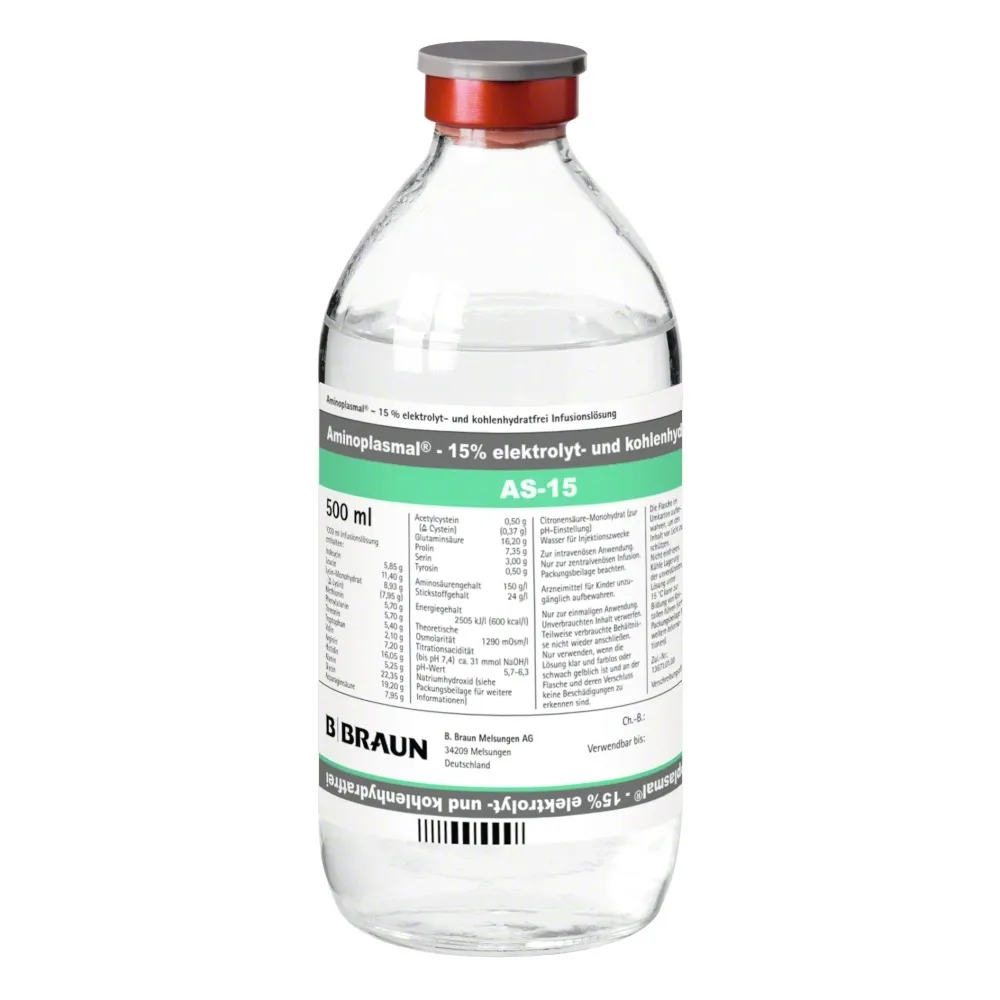
Table of Contents
Package leaflet: Information for the user
Aminoplasmal 15% infusion solution
Amino acids
Please read all of this leaflet carefully before using this medicine, because it contains
important information for the patient.
- Keep this leaflet, so that you can read it again if necessary.
- If you have any questions, please consult your doctor or pharmacist.
- If you experience any adverse reactions, including any adverse reactions not listed in this leaflet, tell your doctor or pharmacist. See section 4.
Contents of the leaflet
- What Aminoplasmal 15% is and what it is used for
- Important information before using Aminoplasmal 15%
- How to use Aminoplasmal 15%
- Possible side effects
- How to store Aminoplasmal 15%
- Contents of the package and other information
1. What Aminoplasmal 15% is and what it is used for
Aminoplasmal 15% is a solution administered to the patient via a small tube with a needle inserted into a vein (intravenous infusion).
The solution contains amino acids essential for the body's growth or recovery.
This medicine will be given to you if you are unable to take food normally or cannot receive nutrition through a tube inserted into the stomach. This solution may be administered to adults, adolescents, and children over the age of 2 years.
2. Important information before using Aminoplasmal 15%
When not to use Aminoplasmal 15%:
- if the patient is allergic to the active substances or to any of the other ingredients of this medicine (listed in section 6);
- if the patient has congenital disorders of protein and amino acid metabolism;
- if the patient has severe (i.e. life-threatening) circulatory disorders (shock);
- if the patient has inadequate oxygen supply (hypoxia);
- if acidic substances accumulate in the patient's blood (metabolic acidosis);
- if the patient has severe liver disease (severe liver failure);
- if the patient has severe kidney dysfunction (severe renal failure) not adequately treated with renal replacement therapy or similar therapies;
- if the patient has untreated or inadequately treated heart failure with significant circulatory impairment (decompensated heart failure);
- if the patient has fluid in the lungs (pulmonary edema);
- if the patient has excess body fluids and limb swelling (fluid overload);
- if the patient's fluid balance, electrolyte levels, or blood pH are abnormal (disturbances in water and electrolyte balance).
This solution must not be administered to newborns, infants, and young children under the age of two years, because the composition of the solution does not meet the specific nutritional requirements of children in this age group.
Warnings and precautions
Before starting treatment with Aminoplasmal 15%, discuss this with your doctor, pharmacist, or nurse.
If the patient has acquired protein metabolism disorders, the doctor will carefully consider whether the patient should not receive, may receive, or even must receive this medicine.
If the patient has impaired heart function, daily fluid intake will be closely monitored to avoid circulatory overload.
If the overall concentration of dissolved substances in the patient's blood is too high, the doctor will exercise particular caution to avoid worsening this condition.
If the patient's liver or kidneys are not functioning properly, the daily dose of the medicine will be carefully adjusted according to the degree of liver or kidney dysfunction and the type of treatment.
If the patient has a simultaneous deficiency of water and salts, appropriate replacement will be given first to correct this deficiency.
If the patient has a deficiency of potassium or sodium, appropriate doses of these electrolytes will be administered.
During treatment with this medicine, blood electrolyte levels, blood glucose levels, fluid balance, acid-base balance, blood protein levels, and liver and kidney function will be closely monitored. For this purpose, blood and urine samples will be taken for analysis.
The patient will also receive carbohydrate solutions and likely lipid emulsions to ensure complete parenteral nutrition. Additionally, if necessary, the patient will receive essential fatty acids, vitamins, fluids, trace elements, and electrolytes.
Children and adolescents
Due to its composition, this solution is not suitable for use in children under 2 years of age and should not be administered to them.
Other medicines and Aminoplasmal 15%
Inform your doctor or pharmacist about all medicines the patient is currently taking or has recently taken, as well as any medicines the patient plans to take.
Pregnancy and breastfeeding
If the patient is pregnant or breastfeeding, suspects she may be pregnant, or is planning to have a child, she should consult her doctor or pharmacist before using this medicine.
Pregnancy
There are no data available on the use of Aminoplasmal 15% in pregnant women. If the patient is pregnant, this medicine will be used only if the doctor considers it absolutely necessary. Aminoplasmal 15% should be administered to pregnant women only after careful consideration of the benefit-risk ratio.
Breastfeeding
When Aminoplasmal 15% is used at therapeutic doses, no effect on the breastfed newborn/infant is expected. However, breastfeeding is not recommended during periods when the patient requires parenteral nutrition.
Driving and operating machinery
This medicine has no effect on the ability to drive or operate machinery.
Aminoplasmal 15% contains sodium
This medicine contains 121.9 mg of sodium (the main component of table salt) in 1000 ml of solution.
This corresponds to 6.095% of the recommended maximum daily sodium intake for an adult.
3. How to use Aminoplasmal 15%
Aminoplasmal 15% is administered by healthcare professionals.
The physician will decide how much of the medicine is required and for how long it will be given to the patient.
The solution is administered through a small plastic tube inserted directly into a vein.
Dosage
The amount of solution a patient receives depends on individual amino acid requirements, as well as the patient's current condition and disease.
Adults
The usual dose is 6.7 ml to a maximum of 13.3 ml per kg of body weight per day.
This corresponds to a dose of 1.0–2.0 g of amino acids per kg of body weight per day.
The solution should be administered at a maximum rate of 0.67 ml per kg of body weight per hour.
Use in children
Aminoplasmal 15% must not be given to children under 2 years of age (see section 2, “Important information before using Aminoplasmal 15%”).
Dosage in children is determined individually depending on age, stage of development, and clinical condition.
The following information may be used as a guideline for daily dosage:
- For children aged 2 to 4 years: 10 ml per kg of body weight per day, corresponding to a dose of 1.5 g of amino acids per kg of body weight per day.
- For children aged 5 to 13 years: 6.7 ml per kg of body weight per day, corresponding to a dose of 1.0 g of amino acids per kg of body weight per day.
- Critically ill children: in critically ill children, the required amino acid dose may be higher (up to 3.0 g amino acids/kg body weight per day).
The infusion rate should not exceed 0.67 ml per kg of body weight per hour.
Patients with kidney or liver disease
If the patient has kidney or liver disease, the dose will be adjusted according to individual requirements.
Duration of treatment
This medicine may be administered as long as the patient requires parenteral nutrition.
Method of administration
This medicine is administered to the patient as an intravenous infusion (drip) into a large central vein.
Overdose of Aminoplasmal 15%
Overdose or infusion administered too rapidly may be poorly tolerated, and the patient may experience nausea, vomiting, chills, and headache. Additionally, excessive acidic substances may accumulate in the patient's blood, and amino acids may be lost in the urine.
In such a case, the infusion will be stopped and resumed after a certain time at a slower rate.
If you have any further questions concerning the use of this medicine, please consult your doctor, pharmacist, or nurse.
4. Possible adverse reactions
Like all medicines, this medicine can cause adverse reactions, although not everyone will experience them.
The following adverse reactions may be serious. If any of the following adverse reactions occur,
you must immediately inform your doctor, who will discontinue administration of this medicine:
Frequency unknown (frequency cannot be determined from available data):
- allergic reactions
Other adverse reactions include:
Not common (affects 1 to 10 users per 1,000):
- nausea, vomiting
Reporting of adverse reactions
If any adverse reactions occur, including any adverse reactions not listed in this leaflet, you should inform your doctor or nurse. Adverse reactions can be reported directly to the Department of Monitoring Adverse Drug Reactions of the Office for Registration of Medicinal Products, Medical Devices and Biocidal Products
Al. Jerozolimskie 181C
02-222 Warsaw
Phone: +48 22 49 21 301
Fax: +48 22 49 21 309
website: https://smz.ezdrowie.gov.pl
Adverse reactions can also be reported to the marketing authorization holder.
Reporting adverse reactions enables continued monitoring of the medicine's safety and helps to gather more information on its safe use.
5. How to store Aminoplasmal 15%
Keep this medicine out of the sight and reach of children.
Do not use this medicine after the expiry date stated on the label and the outer carton following "EXP". The expiry date refers to the last day of the stated month.
Do not store above 30°C.
Do not freeze.
Use the product only if the solution is clear and colourless or slightly yellowish, and the bottle and its closure are undamaged.
Bottles are intended for single use only. After use, any volume of solution remaining after infusion, as well as the container, must be discarded.
6. Contents of the pack and other information
What Aminoplasmal 15% contains
The active substances in the medicine are amino acids.
The solution contains:
per 1 ml per 500 ml per 1000 ml
Isoleucine 5.850 mg 2.925 g 5.850 g
Leucine 11.400 mg 5.700 g 11.400 g
Lysine monohydrate 8.930 mg 4.465 g 8.930 g
(corresponding to lysine) (7.950 mg) (3.975 g) (7.950 g)
Methionine 5.700 mg 2.850 g 5.700 g
Phenylalanine 5.700 mg 2.850 g 5.700 g
Threonine 5.400 mg 2.700 g 5.400 g
Tryptophan 2.100 mg 1.050 g 2.100 g
Valine 7.200 mg 3.600 g 7.200 g
Arginine 16.050 mg 8.025 g 16.050 g
Histidine 5.250 mg 2.625 g 5.250 g
Alanine 22.350 mg 11.175 g 22.350 g
Glycine 19.200 mg 9.600 g 19.200 g
Aspartic acid 7.950 mg 3.975 g 7.950 g
Glutamic acid 16.200 mg 8.100 g 16.200 g
Proline 7.350 mg 3.675 g 7.350 g
Serine 3.000 mg 1.500 g 3.000 g
Tyrosine 0.500 mg 0.250 g 0.500 g
Acetylcysteine 0.500 mg 0.250 g 0.500 g
(corresponding to cysteine) (0.370 mg) (0.185 g) (0.370 g)
The other ingredients are: sodium hydroxide, citric acid monohydrate and water for injections.
1000 ml of solution contains:
Amino acid content 150 g/l
Nitrogen content 24 g/l
Sodium 5.3 mmol/l
Energy value [kJ/l (kcal/l)] 2505 (600)
Theoretical osmolarity [mOsm/l] 1290
Acidity (titration to pH 7.4) approximately 31
[mmol NaOH/l]
pH 5.7–6.3
What Aminoplasmal 15% looks like and contents of the pack
Aminoplasmal 15% is an infusion solution. The solution is clear, colourless to slightly yellowish.
Aminoplasmal 15% is supplied in glass bottles sealed with a rubber stopper:
- Volume: 500 ml, 1000 ml
- Pack sizes: 1 × 500 ml, 10 × 500 ml, 1 × 1000 ml, 6 × 1000 ml
Not all pack sizes may be marketed.
Marketing Authorisation Holder and Manufacturer
B. Braun Melsungen AG
Carl-Braun-Str. 1
34212 Melsungen
Germany
Postal address:
34209 Melsungen
Germany
Telephone: +49-5661-71-0
Fax: +49-5661-71-4567
This medicinal product is authorised in the Member States of the European Economic Area under the following names:
France AMINOPLASMAL 25, solution for infusion
Germany AMINOPLASMAL – 15 % electrolyte- and carbohydrate-free
Poland Aminoplasmal 15 %
Spain AMINOPLASMAL B.BRAUN 15% solution for infusion
United Kingdom Aminoplasmal 15% solution for infusion
<------------------------------------------------------------------------------------------------------------------------
Information intended for healthcare professionals only:
AMINOPLASMAL 15% should only be mixed with other intravenous solutions if compatibility has been previously confirmed. Information on compatibility with various added substances (e.g. glucose, lipids, electrolytes, trace elements, vitamins) and the appropriate shelf-lives of such mixtures can be provided upon request by the manufacturer.
From a microbiological standpoint, mixtures should be administered immediately after preparation. If not administered immediately, responsibility for the storage time and conditions prior to use lies with the user and should generally not exceed 24 hours at a temperature of 2°C – 8°C, unless mixing was carried out under controlled and validated aseptic conditions.
It is essential that such nutrient mixtures are prepared under strict aseptic conditions, as such mixtures support microbial growth.
Storage of the undiluted solution at temperatures below 15°C may lead to crystallisation; however, the crystals can be easily redissolved by gently warming the solution to 25°C until complete dissolution. Gently shake the container to ensure solution homogeneity.