Ambrosan
Poland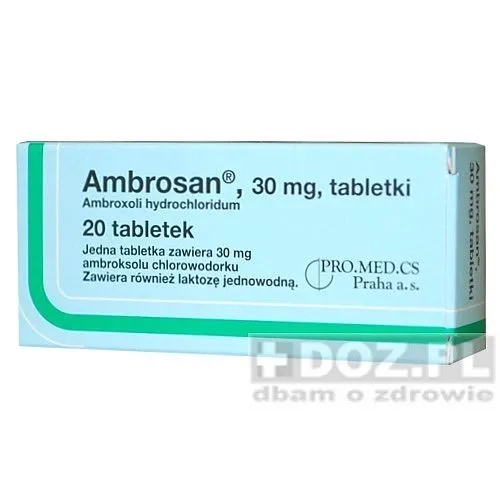
Table of Contents
Patient Information Leaflet
AMBROSAN
30 mg, tablets
ambroxoli hydrochloridum
Please read the entire leaflet carefully before taking the medicine, as it contains
important information for the patient.
This medicine should always be used exactly as described in this patient leaflet or as directed by
your doctor or pharmacist.
- Keep this leaflet, so that you can read it again if necessary.
- If you need advice or further information, please consult your pharmacist.
- If you experience any adverse reactions, including any not listed in this leaflet, inform your doctor or pharmacist. See section 4.
- If there is no improvement within 4 to 5 days, or if you feel worse, you should contact your doctor.
Table of contents:
- What Ambrosan is and what it is used for
- Important information before taking Ambrosan
- How to take Ambrosan
- Possible side effects
- How to store Ambrosan
- Contents of the pack and other information
1. What Ambrosan is and what it is used for
Ambroxol hydrochloride, the active substance in Ambrosan, increases mucus secretion
in the respiratory tract. It also stimulates the production of pulmonary surfactant (a substance that facilitates lung expansion) and the ciliary activity of the respiratory epithelium. This enhances mucus transport, thereby facilitating expectoration and relieving cough.
Therapeutic indications
The medicine is used in patients with acute and chronic lung and bronchial diseases associated with impaired mucus secretion and difficulties in mucus clearance.
2. Important information before using Ambrosan
When not to use Ambrosan:
if the patient is allergic to ambroxol hydrochloride or any of the other
components of this medicine (listed in section 6).
Warnings and precautions
Before starting to use Ambrosan, discuss this with your doctor or pharmacist:
- If the patient has peptic ulcer disease of the stomach and/or duodenum.
- If the patient has renal function disorders or severe hepatic insufficiency, medical advice should be sought before using Ambrosan.
- Severe skin reactions associated with ambroxol hydrochloride have been reported. If a rash occurs (including lesions of mucous membranes, e.g. oral cavity, throat, nose, eyes, genital organs), treatment with Ambrosan must be discontinued and the patient should contact a doctor immediately.
Ambrosan and other medicines
Tell your doctor or pharmacist about all medicines the patient is currently taking or has recently taken, as well as any medicines the patient plans to take.
Ambroxol increases the concentration of antibiotics (amoxicillin, cefuroxime, erythromycin) in bronchopulmonary secretion and sputum.
Ambrosan should not be administered simultaneously with antitussive medicines (e.g. codeine), as this may lead to dangerous accumulation of bronchial secretions due to suppressed cough reflex. Antitussive medicines impair expectoration of liquefied mucus by suppressing the cough reflex.
Clinically significant adverse interactions with other medicines have not been demonstrated.
Ambrosan with food and drink
Tablets may be taken with or without food, with plenty of fluid.
Pregnancy, breastfeeding and fertility
If the patient is pregnant or breastfeeding, suspects she may be pregnant, or is planning to have a child, she should consult a doctor or pharmacist before using this medicine.
Use of Ambrosan is not recommended during pregnancy, especially during the first three months of pregnancy.
Use of Ambrosan is not recommended in breastfeeding women, as ambroxol hydrochloride passes into breast milk.
Non-clinical studies have not shown a direct or indirect harmful effect of the medicine on fertility. There are no clinical studies on the effect of the medicine on fertility.
Driving and operating machinery
There is no evidence of an effect of the medicine on the ability to drive or operate machinery.
No studies have been conducted on the effect of the medicine on the ability to drive or operate machinery.
Ambrosan contains monohydrate lactose
If the patient has previously been diagnosed with intolerance to certain sugars, the patient should contact a doctor before taking this medicine.
One tablet contains 125 mg of monohydrate lactose, corresponding to 500 mg of monohydrate lactose in the maximum recommended daily dose of the medicine, i.e. 4 tablets. Patients with galactose intolerance, lactase deficiency or glucose-galactose malabsorption syndrome should not take this medicine.
3. How to use Ambrosan
This medicine should always be used exactly as described in this patient leaflet or as directed by
your doctor or pharmacist. If in doubt, consult your doctor or pharmacist.
Recommended dose
Adults and adolescents aged 12 years and older: 1 tablet three times daily.
The effect of the medicine may be enhanced by taking 2 Ambrosan tablets twice daily.
Use in children
Children aged 6 to 12 years: half a tablet two or three times daily.
The tablet may be divided into equal doses.
Tablets may be taken with or without food, accompanied by a large amount of liquid.
This medicine should not be taken before going to sleep.
If symptoms do not improve during treatment with Ambrosan for acute respiratory tract diseases,
consult a doctor.
If there is no improvement after 4 to 5 days, or if the patient feels worse, contact a doctor.
Use of a higher than recommended dose of Ambrosan
If more than the recommended dose has been taken, consult a doctor or pharmacist.
Specific symptoms of overdose have not been observed in humans so far. Based on cases of accidental
overdose and (or) reports of improper use, symptoms corresponding to the known adverse effects of
the medicine when used at recommended doses have been observed, which may require symptomatic
treatment.
Missed dose of Ambrosan
If a dose has been missed, take it as soon as possible.
Do not take a double dose to make up for the missed dose. Take the next dose at the usual time.
Stopping Ambrosan treatment
Ambrosan should only be taken when necessary, and treatment should be discontinued once symptoms
have resolved.
If you have any further doubts regarding the use of this medicine, consult your doctor or pharmacist.
4. Possible adverse reactions
Like all medicines, this medicine can cause adverse reactions, although not everyone experiences them.
Common (may occur in fewer than 1 in 10 people):
- nausea
Uncommon (may occur in fewer than 1 in 100 people):
- diarrhoea
- vomiting
- indigestion
- abdominal pain
Rare (may occur in fewer than 1 in 1000 people):
- hypersensitivity reactions
- rash
- urticaria
Frequency not known (frequency cannot be estimated from available data):
- anaphylactic reactions, including anaphylactic shock, angioedema (rapidly progressive swelling of the skin, subcutaneous tissue, mucosa or submucosal tissue), and pruritus
- severe skin-related adverse reactions (including erythema multiforme, Stevens-Johnson syndrome, toxic epidermal necrolysis, and acute generalised exanthematous pustulosis).
If any of the above adverse reactions occur, discontinue use of
Ambrosan and seek immediate medical advice.
Reporting of adverse reactions
If any adverse reactions occur, including any possible adverse reactions not listed in this leaflet, inform your doctor or pharmacist. Adverse reactions can be reported directly to the Department of Monitoring Adverse Drug Reactions of the Office for Registration of Medicinal Products, Medical Devices and Biocidal Products:
Al. Jerozolimskie 181C, 02-222 Warsaw, tel.: + 48 22 49 21 301, fax: + 48 22 49 21 309
website: https://smz.ezdrowie.gov.pl
Adverse reactions can also be reported to the marketing authorisation holder.
Reporting adverse reactions helps provide more information on the safety of this medicine.
5. How to store Ambrosan
Store below 25°C. Keep in the original packaging to protect from light and moisture.
Keep the medicine out of the sight and reach of children.
Do not use this medicine after the expiry date stated on the carton and blister pack after
“EXP”. The expiry date refers to the last day of the stated month.
Medicines should not be disposed of via wastewater or household waste. Ask your pharmacist how to dispose of medicines no longer required. This will help protect the environment.
6. Contents of the pack and other information
What Ambrosan contains
- The active substance is ambroxol hydrochloride. Each tablet contains 30 mg of ambroxol hydrochloride.
- The other ingredients (excipients) are: monohydrate lactose, magnesium stearate, copovidone, microcrystalline cellulose.
What Ambrosan looks like and contents of the pack
Ambrosan is available as nearly white, smooth, biconvex tablets, with bevelled edges and a division line on one side. The tablet can be divided into equal doses.
PVC/Al blisters containing 10 tablets, packed in a cardboard box.
Pack sizes:
- 20 tablets (2 blisters of 10 tablets) in a cardboard box,
- 30 tablets (3 blisters of 10 tablets) in a cardboard box.
Marketing Authorisation Holder and Manufacturer
PRO.MED.CS Praha a.s.
Telčská 377/1, Michle
140 00 Praha 4
Czech Republic
For further information on this medicinal product, please contact the local representative of the Marketing Authorisation Holder:
PRO.MED.PL Sp. z o.o.
e-mail: [email protected]