Alyostal
Poland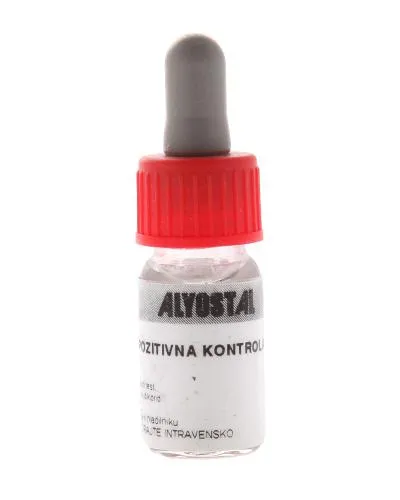
Table of Contents
Package leaflet: Information for the user
ALYOSTAL, 100 IR/ml or 100 IC/ml skin prick test solution
Allergen extracts – diagnostic allergens for skin prick tests
Please read all of this leaflet carefully before using this medicine, as it contains
important information for the patient.
- Keep this leaflet, as you may need to read it again.
- If you have any questions, please consult your doctor.
- If you experience any adverse reactions, including any adverse reactions not listed in this leaflet, inform your doctor. See section 4.
This diagnostic product is for use only by qualified medical personnel.
Leaflet contents
- What ALYOSTAL is and what it is used for
- Important information before using ALYOSTAL
- How to use ALYOSTAL
- Possible side effects
- How to store ALYOSTAL
- Contents of the pack and other information
1. WHAT ALYOSTAL IS AND WHAT IT IS USED FOR
ALYOSTAL is intended for diagnostic use only.
ALYOSTAL skin prick tests are performed to diagnose the causes of allergic conditions in children, adolescents, and adults.
2. IMPORTANT INFORMATION BEFORE USING ALYOSTAL
When not to use ALYOSTAL
- if the patient is allergic to any of the other ingredients listed in section 6.
Warnings and precautions
Before starting treatment with ALYOSTAL, inform your doctor or nurse:
- if the patient is taking beta-adrenergic receptor blockers (beta-blockers), regardless of formulation (including eye drops), or certain antidepressant medications (tricyclic antidepressants or monoamine oxidase inhibitors - MAO inhibitors). See section "ALYOSTAL with other medicines"
- if the patient develops fever or a clinically confirmed asthma attack and (or) a measured decrease in peak expiratory flow, the doctor will consider what actions should be taken
- if the patient feels unwell, the doctor will decide when tests should be performed
- if the patient experiences an acute phase of an allergic disease, the doctor may reschedule the skin testing
- if the patient has skin disorders. The doctor may postpone testing to avoid uninterpretable results or exacerbation of existing skin conditions
- if the patient suffers from conditions such as dermographism, urticaria, atopic dermatitis, eczema, or psoriasis
- if a lymph node has been removed from one axilla, because skin prick testing should be performed on the opposite forearm.
Page 1 of 5
Inform your doctor immediately if, during skin prick testing, systemic allergic reactions occur (e.g.: intense itching of the palms and soles, urticaria, swelling of lips or throat leading to difficulty swallowing or breathing, voice changes, nausea and vomiting). See section 4. Possible side effects.
ALYOSTAL should generally not be used in children under 4 years of age. Use in children from 1 year of age may be considered by the doctor with caution.
ALYOSTAL with other medicines
Tell your doctor about all medicines the patient is currently taking or has recently taken, as well as any medicines the patient plans to take.
Before undergoing skin prick testing, inform your doctor:
- if the patient is taking antiallergic medications (antihistamines, corticosteroids). These may significantly reduce the skin prick test response. The doctor will advise the patient on the appropriate course of action
- if the patient is taking beta-adrenergic receptor blockers (beta-blockers). The doctor will assess the risks associated with using these drugs, as they may interfere with the treatment of potential allergic reactions
- if the patient is taking certain antidepressants (tricyclic antidepressants or monoamine oxidase inhibitors [MAO inhibitors]), because the risk of adverse effects increases if epinephrine is required due to severe allergic reactions (with potentially fatal outcome).
Pregnancy and breastfeeding
If the patient is pregnant or breastfeeding, or suspects she may be pregnant, she should consult her doctor before undergoing the ALYOSTAL diagnostic test.
Pregnancy
There are no clinical data on the use of ALYOSTAL in pregnant women.
Skin allergy tests are generally not performed in pregnant women because they may expose the pregnant woman to the risk of generalized allergic reactions.
Breastfeeding
Skin tests may be performed during breastfeeding.
There are no clinical data on the use of ALYOSTAL tests during breastfeeding.
Driving and operating machinery
ALYOSTAL has no effect on the ability to drive or operate machinery.
3. HOW TO USE ALYOSTAL
ALYOSTAL may be administered only by trained healthcare personnel who
will inform the patient about the method and principles of performing skin tests.
Diagnostic tests are performed on the inner surface of the forearm. The patient should
place their relaxed arm on a table.
The skin area where tests will be performed should be cleaned and disinfected with
alcohol and dried.
One drop of each prick test solution will be applied to the skin, at an appropriate distance
from each other.
After placing the drops, the skin will be pricked using a Stallerpoint needle.
A new sterile, single-use needle must be used for each test solution.
Page 2 of 5
Positive and negative control tests should be performed under the same conditions to assess
skin reactivity.
The skin reaction appears within 20 minutes after pricking. A positive result is the appearance of a
wheal (swelling), with or without redness (erythema).
The physician or nurse will read the results, outline each skin reaction, and optionally transfer the
reaction borders onto adhesive tape.
The patient should remain under medical supervision for at least 30 minutes after the prick skin tests.
4. POSSIBLE ADVERSE REACTIONS
Like all medicines, this product may cause adverse reactions, although not everyone will experience them.
During testing with ALYOSTAL, patients are exposed to allergens
which may cause allergic reactions at the injection site and (or) systemic symptoms.
The patient should immediately inform the physician if intense itching or
rash, difficulty in breathing, abdominal pain, or symptoms related to low blood pressure occur, such as
dizziness, malaise, since these symptoms may indicate severe allergic
reactions.
A patient's tolerance to allergens may change over time, depending on the patient's health status and
environmental factors.
The following adverse reactions were observed in clinical trials:
Uncommon (affecting less than 1 in 100 patients)
Itching
After marketing authorization, the following adverse reactions have been reported spontaneously, for which frequency cannot be estimated (frequency unknown):
- Local reactions: pain, swelling, redness, urticaria
- Systemic allergic reactions: anaphylactic reactions
Reporting of adverse reactions
If any adverse reactions occur, including any adverse reactions not listed
in this leaflet, inform your doctor or pharmacist.
Adverse reactions can be reported directly to the Department of Monitoring Adverse Drug Reactions at the Office for Registration of Medicinal Products, Medical Devices and Biocidal Products:
Al. Jerozolimskie 181C, 02-222 Warsaw
Tel: + 48 22 49 21 301
Fax: + 48 22 49 21 309
Website: https://smz.ezdrowie.gov.pl
Adverse reactions can also be reported to the marketing authorization holder.
Reporting adverse reactions helps provide more information on the safety of this medicinal product.
Page 3 of 5
5. HOW TO STORE ALYOSTAL
Keep out of the sight and reach of children.
ALYOSTAL should be stored in a refrigerator (2°C - 8°C). Do not use ALYOSTAL after
the expiry date (EXP) stated on the packaging (label of the vial).
6. CONTENTS OF THE PACKAGE AND OTHER INFORMATION
What ALYOSTAL contains
The active substances are allergen extracts at a concentration of 100 IR/ml or 100 IC/ml (according to
Annex No. 1), combined with mannitol. The amount of mannitol does not exceed 40 mg/ml.
Excipients: glycerol, sodium chloride, phenol, water for injections.
Negative control solution contains: glycerol, sodium chloride, phenol, water for injections.
Positive control solution contains: histamine dihydrochloride, glycerol, sodium chloride, phenol, water
for injections.
What ALYOSTAL looks like and contents of the pack
ALYOSTAL is a clear, colourless solution in vials made of Type I glass with a plastic cap and a dropper.
One vial (3 ml) of solution contains:
- a single standardized allergen extract or a mixture of standardized allergen extracts
- a single non-standardized allergen extract or a mixture of non-standardized allergen extracts
The list of allergens registered in Poland is provided in Annex No. 1.
The package contains:
vials with allergen extracts of 3 ml each + one vial with positive control solution of 3 ml + one vial with negative control solution of 3 ml.
Marketing Authorisation Holder and Manufacturer
STALLERGENES
6 rue Alexis de Tocqueville, 92160 ANTONY, France
For further information, please contact the local representative of the Marketing Authorisation Holder:
STALLERGENES Sp. z o.o.
tel. 22 620 29 98
Page 4 of 5
ANNEX
ALYOSTAL ANNEX 1
I. Plant-derived allergen extracts
Weeds
605 Mugwort ( Artemisia vulgaris ) IR/ml
604 Ragweed ( Ambrosia elatior ) IR/ml
Trees
609 Black alder ( Alnus glutinosa ) IR/ml
615 Silver birch ( Betula alba ) IR/ml
649 Hazel (hazelnut) ( Corylus avellana ) IR/ml
651 Olive tree ( Olea europaea ) IR/ml
II. Animal-derived allergen extracts
Animals
507 Cat IR/ml
509 Dog IC/ml
III. House dust mite allergen extracts
314 Dermatophagoides farinae IR/ml
315 Dermatophagoides pteronyssinus IR/ml
VI. Mixtures of allergen extracts
* Plant-derived
Grasses
688 5 grasses – (meadow foxtail, meadow fescue, perennial ryegrass, sweet vernal grass, timothy grass)
IR/ml
* Fungi
400 Alternaria ( alternata , longipes ) IC/ml
Page 5 of 5