Altabactin
Poland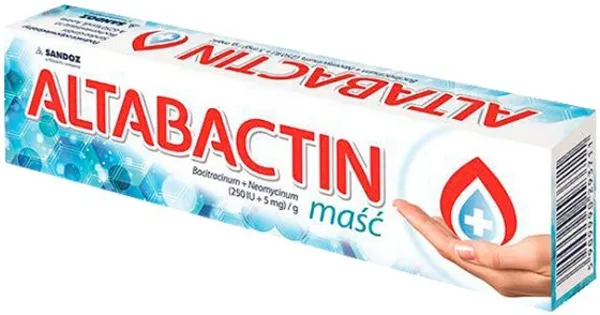
Table of Contents
Package leaflet: Information for the patient
ALTABACTIN, (250 IU + 5000 IU)/g, ointment
Bacitracinum + Neomycinum
Please read the entire leaflet carefully before using the medicine, as it contains important information for the patient.
This medicine should always be used exactly as described in this patient leaflet or as directed by the physician or pharmacist.
- Keep this leaflet for possible future reference.
- If advice or further information is needed, consult a pharmacist.
- If any adverse reactions occur, including any possible adverse reactions not listed in this leaflet, inform a physician or pharmacist. See section 4.4.
- If there is no improvement after 7 days of treatment, or if the patient feels worse, consult a physician.
Table of contents:
- What Altabactin is and what it is used for
- Important information before using Altabactin
- How to use Altabactin
- Possible adverse effects
- How to store Altabactin
- Contents of the pack and other information
1. What Altabactin is and what it is used for
Altabactin is an ointment for topical application to the skin.
The medicine contains two active substances with antibacterial properties – bacitracin and neomycin.
Due to the combined action of these substances, the medicine has a broad spectrum of activity.
Bacitracin primarily kills Gram-positive bacteria, while neomycin acts against both Gram-positive and Gram-negative bacteria.
Altabactin has no effect against fungi and viruses.
Altabactin is indicated for local treatment of bacterial infections of small skin areas (e.g., infection of minor wounds, skin infection associated with frostbite and burns).
2. Important information before using Altabactin
When not to use Altabactin
if the patient is allergic to bacitracin, neomycin, other aminoglycoside antibiotics, or to
any of the other ingredients of this medicine (listed in section 6);
on large skin areas, in severe skin injuries, or for prolonged periods, due to the
risk of toxic effects on the kidneys and hearing, including hearing loss;
if the patient has severe heart or kidney function disorders;
if the patient has previously been diagnosed with damage to the hearing organ (vestibule or cochlea);
if the patient has a perforated eardrum (perforation), do not use the ointment in the external ear;
in the eyes or on mucous membranes;
on deep or puncture wounds, or on oozing lesions;
severe burns;
large areas of damaged skin.
Warnings and precautions
Before starting treatment with Altabactin, consult a doctor or pharmacist if any of the following information raises concerns.
If an allergic reaction or secondary infection occurs during treatment with Altabactin, discontinue use immediately and consult a doctor.
Patients allergic to any medicine in the aminoglycoside antibiotic group (such as streptomycin, gentamicin, tobramycin) may also be allergic to Altabactin.
If adverse effects occur, especially irritation at the site of application, or if the patient notices no improvement, discontinue use and contact a doctor.
This medicine should only be used on small areas of skin or wounds. Do not use in large amounts, as the active substances absorbed into the bloodstream may cause kidney and hearing damage.
If the patient has hearing organ disorders or hearing impairment, consult a doctor before using this medicine.
If the patient has liver or kidney function disorders, consult a doctor before using this medicine.
If other medicines that may damage the kidneys or hearing are used concomitantly, consult a doctor before using this medicine.
During treatment, superinfection with drug-resistant microorganisms (especially fungi) may occur; therefore, if symptoms worsen, consult a doctor.
Avoid sun exposure and tanning (including in solariums) during treatment, as the medicine may cause photosensitivity and phototoxic reactions.
Children
Do not use in children under 12 years of age.
Altabactin and other medicines
Inform the doctor or pharmacist about all medicines currently used or recently used, as well as any medicines the patient plans to take.
In particular, inform the doctor if:
- the patient is to receive general anaesthetics;
- the patient is using:
- other antibiotics (medicines used for bacterial infections);
- diuretics (medicines that increase urine production);
- opioid analgesics;
- muscle relaxants.
Do not use this medicine simultaneously with:
- medicines that may damage the kidneys and hearing organ, such as potent diuretics (e.g. furosemide, ethacrynic acid);
- medicines that may damage the kidneys, such as cephalosporins or aminoglycoside antibiotics.
If in doubt whether the patient is taking any of the above-mentioned medicines, consult a doctor or pharmacist.
Pregnancy and breastfeeding
If a woman is pregnant or breastfeeding, suspects she may be pregnant, or is planning to have a child, she should consult a doctor or pharmacist before using this medicine.
Driving and operating machinery
The effect of Altabactin on driving and operating machinery is unknown.
Altabactin contains lanolin
Due to the presence of lanolin, this medicine may cause local skin reactions (e.g. contact dermatitis).
3. How to use Altabactin
This medicine should always be used exactly as described in the patient leaflet or as directed by a doctor or pharmacist. If in doubt, consult a doctor or pharmacist.
Apply 2 to 3 times daily.
A thin layer of ointment should be applied to the affected area of skin. If necessary, it may be covered with a dressing.
Do not use for longer than 7 days.
If there is no improvement after 7 days, or if the patient feels worse, consult a doctor.
Do not use more than 1 g of neomycin per day (equivalent to 200 g of Altabactin medicine).
Use of more than the recommended dose of Altabactin
If more Altabactin than recommended is applied, or if it is accidentally ingested orally, contact a doctor immediately.
Altabactin used in large doses over large areas of skin, wounds, or damaged skin may have toxic effects on the kidneys, auditory organ, and nervous system.
Missed dose of Altabactin
Continue using the medicine as scheduled without increasing the next dose.
Do not use a double dose to make up for a missed dose.
If you have any further doubts about using this medicine, consult your doctor or pharmacist.
4. Possible adverse reactions
Like all medicines, this product may cause adverse reactions, although not everyone experiences them.
Bacitracin with neomycin, when used topically on the skin and mucous membranes, is generally well tolerated.
Rare adverse reactions (may affect fewer than 1 in 1,000 people):
allergic reactions, mainly in the form of contact dermatitis; 50% of individuals sensitized to neomycin also develop sensitivity to other aminoglycoside antibiotics.
Adverse reactions with unknown frequency (frequency cannot be estimated from available data):
hypersensitivity reactions such as erythema (red-purple skin patches, sometimes with blisters), excessive dryness and peeling of the skin, skin rash and itching; harmful effects on the kidneys, auditory organ, or nervous system (vestibular nerve damage, neuromuscular blockade).
Allergic reactions may lead to the expansion of pathological lesions or lack of treatment response with Altabactin.
There is a risk of photosensitization or phototoxic reactions when exposed to sunlight or tanning in solariums (UV radiation).
Reporting of adverse reactions
If any adverse reactions occur, including those not listed in this leaflet, inform your doctor, pharmacist, or nurse. Adverse reactions can be reported directly to the Department of Monitoring Adverse Drug Reactions at the Office for Registration of Medicinal Products, Medical Devices and Biocidal Products: Al. Jerozolimskie 181C, 02-222 Warsaw
tel.: + 48 22 49 21 301/fax: + 48 22 49 21 309/https://smz.ezdrowie.gov.pl.
Adverse reactions can also be reported to the marketing authorization holder.
Reporting adverse reactions helps to obtain further information on the safety of the medicine.
5. How to store Altabactin
Keep the medicine out of the sight and reach of children.
Store at a temperature not exceeding 25 °C. Protect from light.
Do not use this medicine after the expiry date stated on the packaging following EXP.
The expiry date refers to the last day of the specified month.
The batch number on the packaging is indicated by "Lot".
Medicines must not be disposed of via wastewater or household waste. Ask your pharmacist how to dispose of medicines no longer required. Such measures will help protect the environment.
6. Contents of the pack and other information
What Altabactin contains
- The active substances are: bacitracin and neomycin. 1 g of ointment contains 250 IU of bacitracin and 5000 IU of neomycin.
- Other components: lanolin and liquid paraffin.
What Altabactin looks like and contents of the pack
The medicine is an ointment.
Pack: aluminium tube containing 5 g or 20 g of ointment, placed in a cardboard box
together with the leaflet.
Marketing Authorisation Holder
Sandoz GmbH
Biochemiestrasse 10
A-6250 Kundl, Austria
Manufacturer
Sandoz GmbH
Biochemiestrasse 10
A-6250 Kundl, Austria
Lek Pharmaceuticals d.d.
Verovškova 57
1526 Ljubljana, Slovenia
Salutas Pharma GmbH
Address:
Lange Goehren 3
39171 Osterweddingen, Germany
For further information, please contact:
Sandoz Polska Sp. z o.o.
ul. Domaniewska 50 C
02-672 Warsaw
tel.: 22 209 70 00
e-mail: [email protected]