Allertec
Poland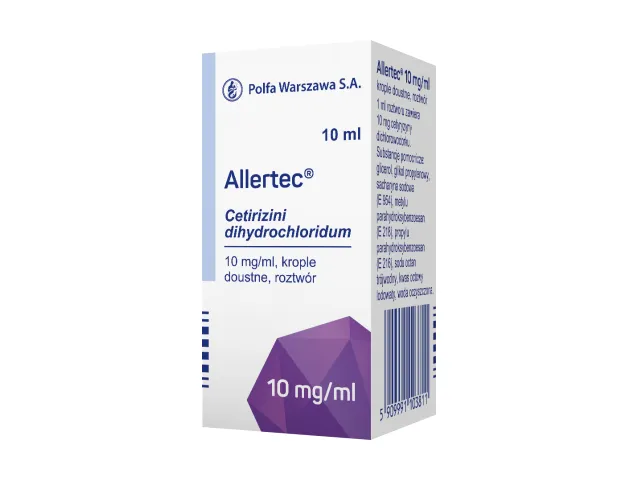
Table of Contents
Patient Information Leaflet
ALLERTEC, 10 mg/ml, oral drops, solution
Cetirizini dihydrochloridum
Please read the entire leaflet carefully before using the medicine, as it contains important information for the patient.
- Keep this leaflet for future reference.
- If you have any questions, consult your doctor or pharmacist.
- This medicine has been prescribed for a specific individual. Do not share it with others. The medicine may harm another person, even if their symptoms are the same.
- If you experience any adverse reactions, including any not listed in this leaflet, inform your doctor or pharmacist. See section 4.
Table of Contents
- What Allertec is and what it is used for
- Important information before taking Allertec
- How to take Allertec
- Possible side effects
- How to store Allertec
- Contents of the pack and other information
1. What Allertec is and what it is used for
Allertec is an antiallergic medicine containing cetirizine, used in adults and children aged 2 years and older:
- to relieve nasal and ocular symptoms associated with seasonal and perennial allergic rhinitis (such as nasal congestion, watery nasal discharge, nasal itching, frequent sneezing, red eyes, tearing, and eye itching);
- to relieve symptoms of chronic idiopathic urticaria (persistent, intensely itchy skin rash).
2. Important information before using Allertec
When not to use Allertec
- If the patient is allergic to cetylhydrogen dichloride, hydroxyzine, or any piperazine derivatives (substances similar in structure to cetylhydrogen, included in other medicines), or to any of the other ingredients of this medicine (listed in section 6).
- If the patient has severe kidney disease (severe renal impairment with creatinine clearance less than 10 ml/min).
Warnings and precautions
Before starting treatment with Allertec, consult your doctor or pharmacist.
If the patient has impaired kidney function, a lower dose of the medicine may be required. The doctor will determine the appropriate dosage.
If the patient suffers from epilepsy or has experienced seizures, medical advice should be sought before using this medicine.
If the patient has difficulty urinating (in conditions such as spinal cord injury or benign prostatic hyperplasia), consult a doctor before using this medicine.
No clinically significant interactions between alcohol (at a blood concentration of 0.5 per mille (g/l), equivalent to the level after drinking one glass of wine) and cetylhydrogen administered at recommended doses have been observed. However, there are no data on the safety of concomitant use of higher doses of cetylhydrogen and alcohol. Therefore, during treatment with Allertec, as with other antihistamines, the patient should avoid consuming alcohol.
If the patient has planned allergy testing, ask the doctor whether Allertec should be discontinued a few days before the test. Allertec may affect the results of allergy tests.
Allertec and other medicines
Tell your doctor about all medicines the patient is currently taking or has recently taken, as well as any medicines the patient plans to take.
No interactions of this medicine with other medicines are expected.
Use of Allertec with food and drink
Food does not noticeably affect the absorption of the medicine.
Pregnancy and breastfeeding
If the patient is pregnant or breastfeeding, suspects she may be pregnant, or is planning to become pregnant, she should consult a doctor before using this medicine.
The use of Allertec should be avoided in pregnant women. A single dose taken during pregnancy is not expected to have harmful effects on the fetus. However, the medicine may be used only if necessary and after consultation with a doctor.
Cetylhydrogen passes into breast milk. Therefore, Allertec should not be used during breastfeeding unless otherwise decided by the doctor.
Driving and operating machinery
Clinical studies have not shown any impairment of reaction ability, concentration, or ability to drive vehicles after administration of Allertec at the recommended dose.
If the patient plans to drive, perform potentially hazardous activities, or operate machinery after taking Allertec, the patient should carefully observe the body's response to the medicine. Do not exceed the recommended dose of the medicine.
Allertec contains methyl parahydroxybenzoate (E218), propyl parahydroxybenzoate (E216), propylene glycol, and sodium
The medicine contains methyl parahydroxybenzoate and propyl parahydroxybenzoate, which may cause allergic reactions (including delayed-type reactions).
The medicine contains 350 mg of propylene glycol in 1 ml of solution.
The medicine contains less than 1 mmol (23 mg) of sodium per 1 ml of solution, meaning the medicine is considered "sodium-free".
3. How to use Allertec
This medicine should always be used as directed by the physician. If in doubt, consult your
doctor or pharmacist.
The medicine may be taken before, during, or after a meal.
The drops should be measured using a spoon or diluted in water and taken orally.
When preparing the solution, take into account that the volume of water used to mix the drops should be adjusted to the amount that the patient (particularly a child) is able to swallow. The solution should be taken immediately after preparation.
The usual recommended doses are given below.
One drop contains 0.5 mg of cetyryzine dihydrochloride.
Children aged 2 to 6 years: 2.5 mg (5 drops) twice daily.
Children aged 6 to 12 years: 5 mg (10 drops) twice daily.
Adults and adolescents over 12 years of age: 10 mg (20 drops) once daily.
Patients with renal impairment
The physician will determine the individual dose for children and adults based on the degree of renal impairment, age, and body weight of the patient.
The usual recommended doses for adults are as follows:
- Mild renal impairment – 10 mg (20 drops) once daily.
- Moderate renal impairment – 5 mg (10 drops) once daily.
- Severe renal impairment – 5 mg (10 drops) every other day. Do not use the medicine in cases of severe renal failure with creatinine clearance less than 10 ml/min.
Patients with hepatic impairment
Dosage adjustment is not necessary.
Elderly patients
If renal function is normal, dosage adjustment is not necessary.
If you feel that the effect of Allertec is too strong or too weak, consult your doctor.
Duration of treatment
The duration of treatment depends on the type, duration, and course of symptoms, and is determined by the physician.
Use of a higher than recommended dose of Allertec
If a higher than recommended dose is taken, consult a doctor immediately. The doctor will decide on further management.
After taking a dose higher than the recommended daily dose, the following may occur: disorientation, diarrhea, dizziness, fatigue, headache, malaise, pupil dilation, itching, restlessness (especially motor restlessness), sedation, drowsiness, stupor, rapid heartbeat, tremor, and urinary retention.
Missed dose of Allertec
Do not take a double dose to make up for a missed dose.
Discontinuation of Allertec
In rare cases, itching (intense pruritus) and/or urticaria may reappear after discontinuation of Allertec.
If you have any further questions about the use of this medicine, consult your doctor or pharmacist.
4. Possible adverse reactions
Like all medicines, this medicine can cause adverse reactions, although not everyone will experience them.
The adverse reactions listed below, together with their frequency of occurrence, are based on data
from the post-marketing surveillance period of cetirizine.
The following adverse reactions are rare or very rare, but you must stop taking the medicine and
contact your doctor immediately if any of them occur:
- allergic reactions, including severe reactions and angioedema (a serious allergic reaction causing swelling of the face and throat). These reactions may occur immediately after the first dose or may appear later.
Common (less frequent than in 1 out of 10 people):
- fatigue,
- dry mouth, nausea, diarrhoea,
- dizziness, headache,
- drowsiness,
- sore throat, pharyngitis, nasal mucosal inflammation (in children).
Uncommon (less frequent than in 1 out of 100 people):
- abdominal pain,
- asthenia (severe weakness), malaise,
- paresthesia (sensory disturbances),
- restlessness,
- itching, rash.
Rare (less frequent than in 1 out of 1,000 people):
- tachycardia (rapid heartbeat),
- swelling,
- allergic reactions, sometimes severe (very rare),
- liver function abnormalities,
- weight gain,
- seizures,
- aggressive behaviour, disorientation, depression, hallucinations, insomnia,
- urticaria.
Very rare (less frequent than in 1 out of 10,000 people):
- thrombocytopenia (reduced number of blood platelets),
- accommodation disorders (eye's inability to adjust to viewing objects at different distances), blurred vision, nystagmus (involuntary, rhythmic eye movements),
- fainting, tremor, taste disturbances, dystonia (prolonged muscle contractions), dyskinesia (involuntary movements),
- tics (habitual muscle spasms),
- urinary disorders (nocturnal enuresis, pain and/or difficulty in urination),
- angioedema (serious allergic reaction causing swelling of the face or throat), drug eruption.
Frequency unknown (frequency cannot be estimated from available data):
- increased appetite,
- suicidal behaviour (recurrent suicidal thoughts or interest in suicide), nightmares,
- memory loss, memory disturbances,
- dizziness (sensation of spinning or loss of balance),
- urinary retention (inability to completely empty the bladder),
- itching (intense pruritus) and/or urticaria after discontinuation of the medicine,
- joint pain,
- pustular rash (rash with blisters containing purulent fluid),
- hepatitis.
Reporting of adverse reactions
If any adverse reactions occur, including those not listed in this leaflet, inform your doctor or pharmacist.
Adverse reactions can be reported directly to the Department of Monitoring Adverse Drug Reactions
at the Office for Registration of Medicinal Products, Medical Devices and Biocidal Products
Al. Jerozolimskie 181C
02-222 Warsaw
Tel.: +48 22 49 21 301
Fax: +48 22 49 21 309
Website: https://smz.ezdrowie.gov.pl
Adverse reactions can also be reported to the marketing authorization holder.
Reporting adverse reactions helps to provide more information on the safety of the medicine.
5. How to store Allertec
Keep this medicine out of sight and reach of children.
Store below 25°C. Protect from light.
Do not use this medicine after the expiry date stated on the carton and bottle after: EXP.
The expiry date refers to the last day of the stated month.
The marking on the packaging after the abbreviation EXP indicates the expiry date, and after the abbreviation Lot indicates the batch number.
The shelf life of the medicine after first opening the bottle is 3 months.
Medicines must not be disposed of via wastewater or household waste. Ask your pharmacist how to dispose of medicines no longer in use. Such measures help protect the environment.
6. Contents of the packaging and other information
What Allertec contains
- The active substance is cetirizine dihydrochloride. 1 ml of solution contains 10 mg of cetirizine dihydrochloride.
- Other ingredients are: glycerol, propylene glycol, sodium saccharin (E954), methyl parahydroxybenzoate (E218), propyl parahydroxybenzoate (E216), sodium acetate trihydrate, glacial acetic acid, purified water.
What Allertec looks like and contents of the pack
Allertec is a colourless or almost colourless, clear liquid.
The packaging contains a glass bottle with a dropper and a tamper-evident cap, containing 10 ml or 20 ml of solution, packed in a cardboard box.
Marketing Authorisation Holder
Zakłady Farmaceutyczne POLPHARMA S.A.
ul. Pelplińska 19, 83-200 Starogard Gdański
tel. + 48 22 364 61 01
Manufacturer
Zakłady Farmaceutyczne POLPHARMA S.A.
Medana Branch in Sieradz
ul. Władysława Łokietka 10, 98-200 Sieradz