Allergodil
Poland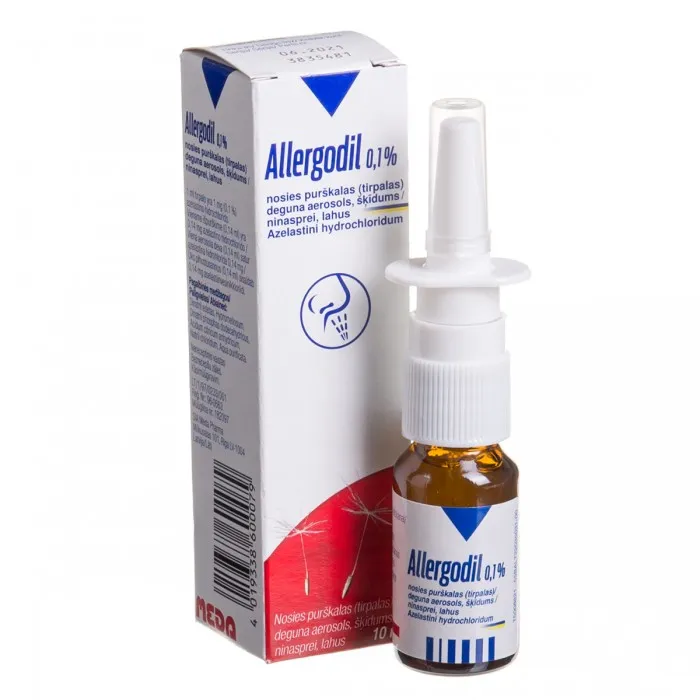
Table of Contents
- Package leaflet: Information for the patient
- 1. What Allergodil nasal spray is and what it is used for
- 2. Important information before using Allergodil nasal spray
- 3. How to use Allergodil nasal spray
- 4. Possible adverse reactions
- 5. How to store Allergodil nasal spray
- 6. Contents of the pack and other information
Package leaflet: Information for the patient
ALLERGODIL, 1 mg/ml (0.1%), nasal spray, solution
Azelastini hydrochloridum
Please read the entire leaflet carefully before use, as it contains
important information for the patient.
This medicine should always be used exactly as described in this patient leaflet or as directed by
the physician or pharmacist.
- Keep this leaflet, so it can be consulted again if necessary.
- If advice or additional information is needed, please consult a pharmacist.
- If any adverse reactions occur, including any adverse reactions not listed in this leaflet, inform the physician or pharmacist. See section 4.
- If there is no improvement after 3 days, or if the patient feels worse, consult a physician.
Table of contents
- What Allergodil nasal spray is and what it is used for
- Important information before using Allergodil nasal spray
- How to use Allergodil nasal spray
- Possible side effects
- How to store Allergodil nasal spray
- Contents of the pack and other information
1. What Allergodil nasal spray is and what it is used for
Allergodil nasal spray, solution belongs to a group of medicines called antihistamines.
Antihistamines work by preventing the action of histamine, a substance produced by the body during an allergic reaction.
Allergodil nasal spray is indicated for:
- Symptomatic treatment of seasonal allergic rhinitis (hay fever);
- Symptomatic treatment of perennial (year-round) allergic rhinitis.
Symptoms of allergic rhinitis occur following exposure to a specific allergen. In the early phase of the allergic reaction, watery nasal discharge, paroxysmal sneezing, itching, and nasal congestion appear.
The onset of action of Allergodil nasal spray occurs within 15 minutes after administration. Symptoms of allergic rhinitis should begin to subside within this time, and the effect should last for approximately 12 hours.
Allergic rhinitis may be considered chronic when symptoms persist for more than 4 days per week and for more than 4 weeks.
2. Important information before using Allergodil nasal spray
When not to use Allergodil nasal spray
- if the patient is allergic to azelastine hydrochloride or any of the other ingredients of this medicine (listed in section 6),
- in children under 6 years of age.
Warnings and precautions
Allergodil nasal spray should not be used for colds, flu, or
other infections.
Children
Allergodil nasal spray must not be used in children under 6 years of age.
Allergodil nasal spray and other medicines
Tell your doctor or pharmacist about all medicines the patient is currently taking or has recently taken, as well as any medicines the patient plans to use.
No interactions with other medicines are known.
Use of Allergodil nasal spray with alcohol
As a general rule, individuals taking medicines should avoid consuming alcoholic beverages.
Pregnancy and breastfeeding
If the patient is pregnant or breastfeeding, suspects she might be pregnant, or is planning to have a child, she should consult a doctor before using this medicine.
Due to insufficient data and lack of experience regarding safety during pregnancy and breastfeeding, Allergodil nasal spray should not be used during these periods.
Driving and operating machinery
When using Allergodil nasal spray, symptoms such as fatigue, exhaustion, dizziness, or weakness may occur in individual cases. In such cases, the ability to drive and operate machinery may be impaired; therefore, driving and operating machinery should be avoided. Consumption of alcohol may additionally intensify this adverse effect.
Allergodil nasal spray contains disodium edetate, which may cause allergic reactions in sensitive individuals.
3. How to use Allergodil nasal spray
This medicine should always be used exactly as described in this patient leaflet or as directed by your doctor or pharmacist. If in doubt, consult your doctor or pharmacist.
Allergodil is intended for nasal use.
Adults, adolescents and children aged above 6 years:
Unless otherwise prescribed, administer one dose of Allergodil nasal spray into each nostril twice daily (morning and evening), corresponding to a daily dose of 0.56 mg of azelastine hydrochloride.
This medicine may be used until symptoms subside. The longest observation period in clinical trials during which azelastine hydrochloride nasal spray was used was 12 months in adults and 6 months in children. The duration of treatment depends on the type, duration and course of symptoms, and should be determined by a doctor. Do not use this medicine for longer than 4 weeks without consulting a doctor. If symptoms worsen or do not improve within 3 days despite using the medicine, consult your doctor. Allergodil nasal spray may only be used by individuals diagnosed by a doctor with seasonal or chronic allergic rhinitis and in accordance with the doctor's instructions.
If you have any doubts regarding the use of this medicine, consult your doctor or pharmacist.
Allergodil nasal spray should be administered with the head held upright (as shown in the instructions below).
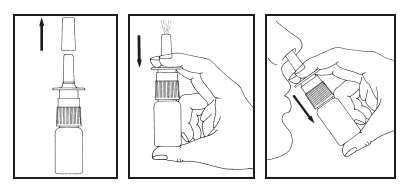
- Remove 2. Before first 3. Spray one dose into each the protective use, press the nozzle nose, keeping the head cap. several times until a in an upright position. uniform "mist" appears.
- Replace the protective cap.
Use of more than the recommended dose of Allergodil nasal spray
No cases of overdose with azelastine hydrochloride have been reported in humans. However, if an excessive dose is administered nasally or if accidentally ingested orally, adverse effects on the central nervous system may be expected (such as drowsiness, confusion, coma, tachycardia (rapid heartbeat), hypotension), similar to those observed in animal studies. In such cases, consult a doctor who will provide symptomatic treatment.
Missed dose of Allergodil nasal spray
If you miss a dose of Allergodil nasal spray, no special action is required. Continue treatment by taking the next dose at the usual time.
Stopping treatment with Allergodil nasal spray
If possible, use Allergodil nasal spray regularly until symptoms resolve.
If treatment with Allergodil nasal spray is discontinued, there is a risk of recurrence of typical symptoms of the disease.
If you have any further doubts about the use of this medicine, consult your doctor or pharmacist.
4. Possible adverse reactions
Like any medicine, this medicine can cause adverse reactions, although not everyone experiences them.
If the first symptoms of hypersensitivity reactions occur (these may include: facial swelling,
swelling of the tongue or throat, difficulty swallowing, hives, wheezing or breathing difficulties),
the use of Allergodil nasal spray must be stopped immediately and medical advice must be sought.
The doctor will then assess the severity of the symptoms and decide whether further action is required.
The adverse reactions listed below are categorized according to their frequency of occurrence.
Common (may occur in fewer than 1 in 10 patients): a bitter taste in the mouth due to incorrect
administration of the medicine (with the head tilted backwards, see section 3), which rarely may
cause nausea.
Uncommon (may occur in fewer than 1 in 100 patients): irritation of inflamed nasal mucosa
(e.g. burning, itching), sneezing and nosebleeds.
Rare (may occur in fewer than 1 in 1,000 patients): nausea.
Very rare (may occur in fewer than 1 in 10,000 patients): hypersensitivity, fatigue (tiredness, exhaustion),
dizziness, weakness (which may also be caused by the underlying disease), rash, itching, urticaria.
If any of the adverse reactions listed above occur, a doctor should be informed.
Management of adverse reactions
Usually, the adverse reactions listed above are transient. Therefore, no special measures are required.
In case of a bitter taste in the mouth after using Allergodil nasal spray, drink a non-alcoholic beverage
(such as juice or milk) to neutralize the taste.
Reporting of adverse reactions
If any adverse reactions occur, including any not listed in this leaflet, inform your doctor or pharmacist.
Adverse reactions can be reported directly to the Department of Monitoring Adverse Drug Reactions
at the Office for Registration of Medicinal Products, Medical Devices and Biocidal Products,
Al. Jerozolimskie 181 C, 02-222 Warsaw,
tel. + 48 22 49 21 301, fax + 48 22 49 21 309
website: https://smz.ezdrowie.gov.pl
Adverse reactions may also be reported to the marketing authorization holder.
Reporting adverse reactions helps to provide more information on the safety of the medicine.
5. How to store Allergodil nasal spray
Keep the medicine out of the sight and reach of children.
Do not use this medicine after the expiry date stated on the label and the outer carton. The expiry date refers to the last day of the stated month.
Storage conditions
Store Allergodil nasal spray at a temperature below 8°C (do not store in the refrigerator). Do not freeze.
Do not use this medicine if crystals are observed:
If Allergodil nasal spray has been accidentally stored for a prolonged period at temperatures below 8°C (e.g. in a refrigerator), the active substance may partially crystallize. When viewed through the bottle against the light, crystals (clumps) may become visible. Do not use such a solution.
However, after several hours of storage at room temperature, the crystals will completely disappear. The clear solution may then be used again (clumps are no longer visible).
Period of use after first opening the bottle
Do not use Allergodil nasal spray for more than 6 months after first opening the bottle.
Medicines must not be disposed of via wastewater or household waste. Ask your pharmacist how to dispose of medicines no longer required. These measures will help protect the environment.
6. Contents of the pack and other information
What Allergodil nasal spray contains
- The active substance is azelastine hydrochloride. 1 spray (0.14 ml) contains 0.14 mg of azelastine hydrochloride. 1 ml of solution contains 1 mg of azelastine hydrochloride. 10 ml of solution contains 10 mg of azelastine hydrochloride.
- Other ingredients: disodium edetate, hypromellose, sodium hydrogen phosphate dodecahydrate, citric acid, sodium chloride, water for injections.
What Allergodil nasal spray looks like and contents of the pack
Allergodil nasal spray is a solution.
Allergodil nasal spray is available in a bottle with a nasal applicator containing 10 ml of solution. The bottle is placed in a cardboard box.
Marketing Authorisation Holder
Cooper Consumer Health B.V.
Verrijn Stuartweg 60
1112AX Diemen
The Netherlands
Manufacturer
Madaus GmbH
51101 Cologne
Germany