Allefin
Poland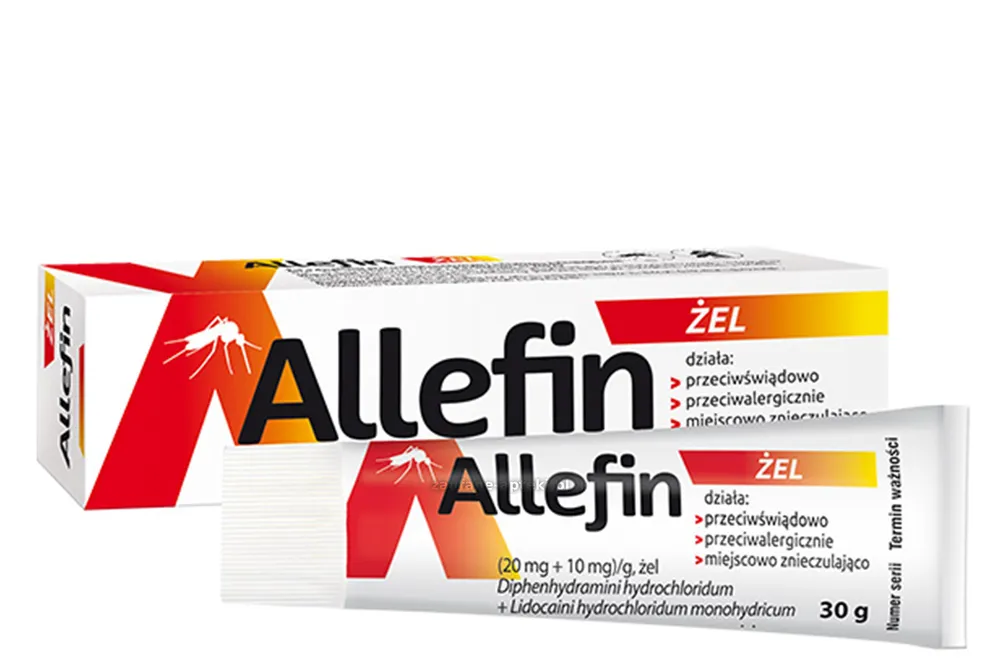
Table of Contents
Package leaflet: information for the patient
Allefin, (20 mg + 10 mg)/g, gel
Diphenhydramini hydrochloridum + Lidocaini hydrochloridum
Please read this leaflet carefully before using the medicine, as it contains important information for the patient.
This medicine should always be used exactly as described in this patient leaflet or as directed by a doctor, pharmacist, or nurse.
- Keep this leaflet for possible future reference.
- If you need advice or further information, please consult your pharmacist.
- If you experience any adverse reactions, including any not listed in this leaflet, inform your doctor, pharmacist, or nurse. See section 4.
- If there is no improvement or if you feel worse, contact your doctor.
Leaflet contents
- What Allefin is and what it is used for
- Important information before using Allefin
- How to use Allefin
- Possible side effects
- How to store Allefin
- Contents of the package and other information
1. What Allefin is and what it is used for
Allefin contains two active substances: diphenhydramine hydrochloride and lidocaine hydrochloride. Diphenhydramine inhibits the action of histamine (responsible for allergic reactions) and has antipruritic effects. Lidocaine exerts local anaesthetic action. The medicine reduces redness, swelling, and skin exudation.
Indications
Allefin is indicated for symptomatic treatment of allergic and inflammatory skin reactions with accompanying itching, responsive to antihistamine therapy, in adults, adolescents, and children over 2 years of age, caused by external agents such as bites and stings (e.g. insects, arachnids), contact with certain plants (e.g. nettles, ivy), or jellyfish stings.
2. Important information before using Allefin
When not to use Allefin:
- if the patient is allergic to the active substances (diphenhydramine hydrochloride, lidocaine hydrochloride) or to any of the other ingredients of this medicine (listed in section 6);
- in cases of exudative or bullous dermatoses;
- in children under 2 years of age.
Warnings and precautions
Before starting treatment with Allefin, discuss it with your doctor, pharmacist, or nurse.
Allefin should be used with caution after previous neurological disorders and in heart failure.
Do not expose skin treated with Allefin to sunlight.
Children and adolescents
Do not use in children under 2 years of age.
Allefin and other medicines
Tell your doctor or pharmacist about all medicines the patient is currently using, has recently used, or plans to use.
In particular, inform your doctor or pharmacist if you are using:
- drugs metabolized by the CYP2D6 enzyme, e.g. metoprolol and venlafaxine (diphenhydramine inhibits the activity of the CYP2D6 enzyme, which may affect the metabolism of these drugs);
- antibacterial sulfonamide drugs (lidocaine reduces their effectiveness);
- antiarrhythmic drugs of class IB or other local anesthetics (risk of additive adverse effects);
- drugs from the group of so-called MAO inhibitors (used in the treatment of depression or Parkinson's disease);
- tricyclic antidepressants;
- antipsychotic drugs from the phenothiazine derivatives group;
- anticoagulant drugs.
Pregnancy and breastfeeding
If the patient is pregnant or breastfeeding, suspects she may be pregnant, or is planning to become pregnant, she should consult a doctor or pharmacist before using this medicine.
Pregnancy
Lidocaine crosses the placenta, but animal studies have not shown harmful effects on the fetus. Due to the lack of studies confirming the safety of using the medicine during pregnancy, use of Allefin should be avoided during pregnancy.
Breastfeeding
Lidocaine passes into breast milk in very small amounts, which generally does not pose a risk to the infant. However, due to the lack of studies confirming the safety of using the medicine during breastfeeding, use of Allefin should be avoided during breastfeeding.
Driving and operating machinery
Allefin has no effect or a negligible effect on the ability to drive and operate machinery.
Allefin contains propylene glycol
This medicine contains 60 mg of propylene glycol in 1 g of gel.
3. How to use Allefin
This medicine should always be used exactly as described in this patient information leaflet or as directed by a doctor, pharmacist, or nurse. If in doubt, consult a doctor, pharmacist, or nurse.
Allefin is intended for topical application to the skin.
Dosage
Apply a small amount of gel to the affected area of skin and gently spread it. Use 2 or 3 times daily, as needed.
Use in children
Do not use in children under 2 years of age.
Use of a higher than recommended dose of Allefin
If used in a manner not consistent with recommendations, reactions related to lidocaine overdose may occur. Lidocaine may disturb the function of the central nervous system and the cardiovascular system. Symptoms of overdose may include dizziness and numbness around the mouth, difficulty focusing vision, tinnitus, nausea, vomiting, and decreased arterial blood pressure.
If such symptoms occur, discontinue use of the medicine and contact a doctor.
Missed dose of Allefin
Do not apply a double dose to make up for a missed dose.
If you have any further doubts regarding the use of this medicine, consult your doctor, pharmacist, or nurse.
4. Possible adverse reactions
Like all medicines, this medicine can cause adverse reactions, although not everyone will experience them.
No significant adverse reactions have been observed following the topical administration of
diphenhydramine and lidocaine.
Frequency unknown (cannot be estimated based on available data):
- erythema, allergic reaction.
Reporting of adverse reactions
If any adverse reactions occur, including any adverse reactions not listed
in this leaflet, inform your doctor, pharmacist, or nurse. Adverse reactions
can be reported directly to the Department of Monitoring Adverse Drug Reactions of the Office for Registration of Medicinal Products, Medical Devices and Biocidal Products:
Al. Jerozolimskie 181 C, 02-222 Warsaw,
tel.: + 48 22 49 21 301, fax: + 48 22 49 21 309,
Website: https://smz.ezdrowie.gov.pl
Adverse reactions can also be reported to the marketing authorization holder.
Reporting adverse reactions helps to provide more information on the safety of the medicine.
5. How to store the medicine Allefin
Keep the medicine out of the sight and reach of children.
Store below 25°C. Do not store in the refrigerator or freeze.
Shelf life after first opening the tube: 3 years, but not beyond the expiry date stated on the
packaging.
Do not use this medicine after the expiry date stated on the packaging. The expiry date refers to the last day of the stated month.
Medicines must not be disposed of via wastewater or household waste. Ask your pharmacist how to dispose of medicines no longer required. This will help protect the environment.
6. Package contents and other information
What Allefin contains
- The active substances in the medicine are diphenhydramine hydrochloride and lidocaine hydrochloride. 1 g of gel contains 20 mg of diphenhydramine hydrochloride and 10 mg of lidocaine hydrochloride.
- The other components (excipients) are: propylene glycol (E 1520), hydroxyethylcellulose, citronella essential oil, disodium edetate, purified water.
What Allefin looks like and contents of the pack
The medicine is a clear to slightly opalescent gel, colourless to whitish, with a characteristic
citronella odour.
Pack sizes: 20 g, 30 g
The container is an aluminium tube internally coated with epoxy-phenolic lacquer, closed with a HDPE cap with a plug, packed in a cardboard box.
Pack size: 5 g,
The container is an aluminium tube internally coated with epoxy-phenolic lacquer, closed with a HDPE cap, packed in a cardboard box.
Marketing Authorisation Holder and Manufacturer
„PRZEDSIĘBIORSTWO PRODUKCJI FARMACEUTYCZNEJ HASCO-LEK” S.A.
ul. Żmigrodzka 242 E, 51-131 Wrocław
Medicine information
tel.: 22 742 00 22
e-mail: [email protected]