Alkeran
Poland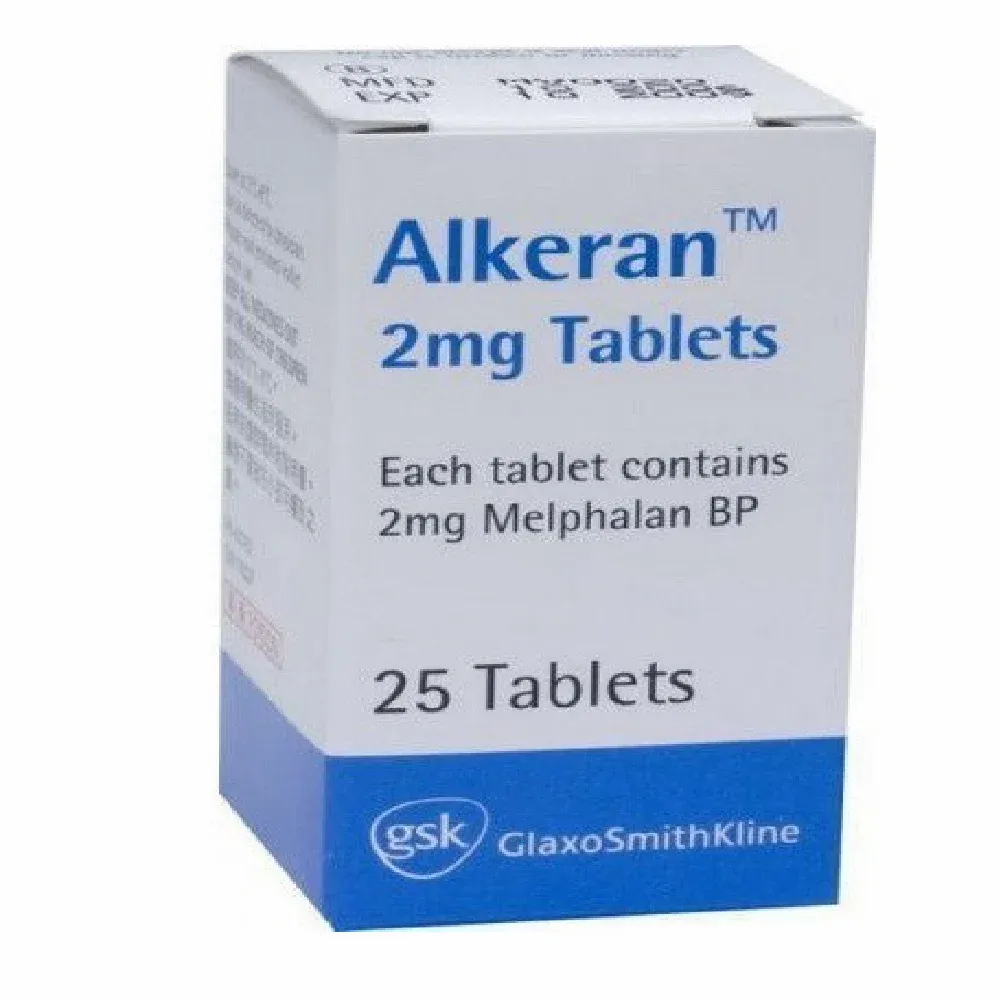
Table of Contents
- Package leaflet: Information for the user
- 1. What Alkeran is and what it is used for
- 2. Important information before using Alkeran
- 3. How to use Alkeran
- 4. Possible adverse reactions
- 5. How to store Alkeran
- 6. Contents of the pack and other information
- Information intended exclusively for medical professionals:
Package leaflet: Information for the user
Alkeran, 2 mg, coated tablets
Melphalan
Please read all of this leaflet carefully before taking this medicine, because it contains
important information for the patient.
- Keep this leaflet, as you may need to read it again. If you have any further questions, please consult your doctor or nurse.
- This medicine has been prescribed for a specific individual and must not be given to others, even if their symptoms appear similar, as it may harm them.
- If any adverse reactions occur in the patient, including any adverse reactions not listed in this leaflet, inform your doctor or nurse immediately. See section 4.
Leaflet contents
- What Alkeran is and what it is used for
- Important information before taking Alkeran
- How to take Alkeran
- Possible side effects
- How to store Alkeran
- Contents of the pack and other information
1. What Alkeran is and what it is used for
Alkeran tablets contain a medicine called melphalan, which belongs to a group of medicines known as cytotoxics (also called chemotherapy), and is used to treat certain types of cancer. It works by reducing the number of abnormal cells produced by the body.
Alkeran tablets are used in the treatment of multiple myeloma, a type of cancer that arises from cells in the bone marrow called plasma cells. Plasma cells help fight infections and diseases by producing antibodies.
If there is no improvement or if the patient's condition worsens, consult a doctor.
2. Important information before using Alkeran
When not to take Alkeran
- if the patient is allergic to melphalan or any of the other ingredients of this medicine (listed in section 6),
- if the patient is breastfeeding.
If in doubt, talk to your doctor or pharmacist before taking melphalan.
Warnings and precautions
Before starting treatment with Alkeran, discuss with your doctor or nurse:
-
if the patient is currently undergoing or has recently undergone radiotherapy or chemotherapy,
-
if the patient has impaired kidney function,
-
if the patient intends to receive a vaccine or has recently been vaccinated. This is because certain vaccines (e.g. against polio, measles, mumps and rubella) may cause infections if administered during treatment with Alkeran,
-
if the patient is taking combined oral contraceptives (so-called "birth control pills"). This is due to an increased risk of developing venous thromboembolic disease in patients with multiple myeloma. In such cases, the patient should start using ovulation-inhibiting tablets containing only progestogen (e.g. desogestrel). The increased risk of venous thromboembolic disease persists for 4 to 6 weeks after discontinuation of the combined oral contraceptive.
-
if the patient (male or female) plans to have children, because there is a risk of genetic toxicity (damage to genetic material) and infertility (see section "Pregnancy, breastfeeding and effects on fertility").
Alkeran may increase the risk of developing other types of cancer (e.g. secondary leukaemias) in a small number of patients, particularly when used in combination with lenalidomide, thalidomide and prednisone. Before prescribing Alkeran, the doctor should carefully evaluate the benefits and risks associated with its use.
If in doubt whether any of the above apply to the patient, talk to your doctor or pharmacist before taking Alkeran.
Alkeran with other medicines
Tell your doctor about all medicines the patient is currently taking or has recently taken, including over-the-counter medicines and herbal supplements.
In particular, inform your doctor if the patient is taking:
- vaccines containing live organisms (see Warnings and precautions),
- nalidixic acid (an antibiotic used for urinary tract infections),
- cyclosporine (used to prevent organ or tissue transplant rejection or to treat certain skin diseases such as psoriasis or eczema, or rheumatoid arthritis),
- in children – busulfan (an anticancer medicine).
Pregnancy, breastfeeding and effects on fertility
Pregnancy and breastfeeding
If the patient is pregnant or breastfeeding, suspects she may be pregnant, or is planning to have a child, she should consult her doctor before using this medicine.
Melphalan should not be taken if planning to have a child, in both women and men. Reliable and effective contraceptive methods should be used to prevent pregnancy during treatment with this medicine by either partner.
Women should use effective and reliable contraception during treatment and for six months after completion of treatment.
Men should use effective and reliable contraception during treatment and for three months after completion of treatment.
Pregnant women must talk to their doctor before taking Alkeran.
Breastfeeding must not be undertaken during treatment with Alkeran. Consult your doctor for advice.
Fertility
Alkeran may affect the ovaries or sperm, potentially leading to infertility (inability to have children). In women, absence of menstruation (amenorrhoea) may occur; in men, complete absence of sperm (azoospermia). Due to the possibility of azoospermia resulting from treatment with Alkeran, men should seek advice regarding sperm banking before starting treatment.
Driving and using machines
The effect of this medicine on the ability to drive vehicles or operate machinery has not been studied in patients receiving this medicine.
3. How to use Alkeran
Melphalan should only be prescribed by a specialist doctor experienced in the treatment of cancers.
Alkeran is an actively cytotoxic agent and should only be administered under the supervision of a physician experienced in using this type of medication.
Alkeran must always be taken exactly as directed by the doctor. It is important to take the medicine at the correct times. The label on the package contains information on how many tablets to take and how often to take them. If the label does not contain this information or if the patient has any doubts, they should consult their doctor, nurse, or pharmacist.
- Tablets should be swallowed whole, with a glass of water.
- Do not break, crush, or chew the tablets.
The dose of Alkeran depends on the type of blood disorder or cancer (see section 1).
- The doctor may also adjust the dose during treatment, depending on the patient's needs.
- The dose may sometimes be adjusted in elderly patients or in patients with impaired kidney function.
- While taking Alkeran, the doctor will perform regular blood tests to monitor blood cell counts. As a result, the doctor may occasionally modify the dose being administered.
Multiple myeloma
- The usual dose is typically 0.15 mg per kilogram of body weight per day for 4 days. This regimen is repeated every 6 weeks.
Children
Alkeran is rarely indicated for the treatment of children. Dosing guidelines for children are not available.
Taking more Alkeran than recommended
If more Alkeran is taken than recommended, the patient should immediately contact a doctor or go to hospital, taking the medicine packaging along. Symptoms of overdose may include nausea, vomiting, and diarrhoea.
Thromboembolic events
The patient should receive prophylaxis for venous thromboembolic disease for at least the first 5 months of treatment, especially in patients with additional risk factors for thrombosis. The doctor will decide what additional measures are necessary after carefully assessing all the patient's individual risk factors.
If any thromboembolic events occur, the patient must immediately inform their doctor, as it may be necessary to discontinue the medicine and initiate standard antithrombotic treatment. After completion of treatment for the thromboembolic event, the doctor will decide whether to resume melphalan in combination with lenalidomide and prednisone or thalidomide with prednisone or dexamethasone. The patient should continue antithrombotic treatment during the course of melphalan therapy.
Missing a dose of Alkeran
Contact the doctor. Do not take a double dose to make up for a missed dose.
Stopping Alkeran
If you have any further questions about using this medicine, consult your doctor or nurse.
4. Possible adverse reactions
Like all medicines, this medicine can cause adverse reactions, although not everyone experiences them.
If any of the following symptoms occur, seek immediate medical attention from a specialist doctor or go to hospital:
- allergic reaction, symptoms may include:
- skin rash, lumps or hives,
- swelling of the face, eyelids or lips,
- sudden breathlessness and chest tightness,
- collapse (due to cardiac arrest),
- any signs of fever or infection (sore throat, mouth pain or urinary problems),
- any unexpected bruising or bleeding, or feeling extremely tired, dizzy or short of breath, as this may mean that too few blood cells of a certain type are being produced,
- in case of sudden worsening of general condition (even with normal body temperature).
Talk to your doctor if any of the following adverse reactions occur,
which may also occur during treatment with this medicine:
Very common (affects more than 1 in 10 people)
- reduced number of blood cells and platelets,
- nausea, vomiting and diarrhoea,
- mouth ulceration – with high doses of melphalan,
- hair loss – with high doses of melphalan.
Common (affects less than 1 in 10 people)
- hair loss – with normal doses of melphalan,
- high levels of a chemical substance called urea in the blood – in people with kidney function disorders being treated for myeloma.
Rare (affects less than 1 in 1,000 people)
- a condition in which there is a low number of red blood cells due to their premature destruction – this may cause extreme fatigue, shortness of breath, dizziness, headaches or yellowing of the skin or eyes,
- lung function disorders, which may cause cough or breathlessness and difficulty breathing,
- liver function disorders, which may show up in blood test results or cause jaundice (yellowing of the whites of the eyes and skin),
- mouth ulceration – with normal doses of melphalan,
- skin rashes or itchy skin.
Frequency not known (frequency cannot be estimated from available data)
- leukaemia – a blood cancer,
- in women: absence of menstruation,
- in men: absence of sperm in semen (azoospermia),
- deep vein thrombosis (a condition in which a blood clot forms in one of the deep veins, usually in the legs) and pulmonary embolism (a condition in which one of the pulmonary arteries or its branches becomes blocked by a blood clot fragment that has travelled to the lungs from another part of the body),
- acute kidney injury – kidney failure (significant worsening of kidney function) developing rapidly.
If any adverse reaction becomes serious or if any adverse reactions not listed in this leaflet occur, inform your doctor or pharmacist.
Reporting of adverse reactions
If any adverse reactions occur, including any adverse reactions not listed in this leaflet, inform your doctor or nurse. Adverse reactions can be reported directly to the Department of Monitoring of Adverse Drug Reactions of the Office for Registration of Medicinal Products, Medical Devices and Biocidal Products
Al. Jerozolimskie 181 C
02-222 Warsaw
Tel.: + 48 22 49 21 301
Fax: + 48 22 49 21 309
Website: https://smz.ezdrowie.gov.pl
Adverse reactions can also be reported to the marketing authorisation holder.
Reporting adverse reactions helps provide more information on the safety of the medicine.
5. How to store Alkeran
Keep this medicine out of the sight and reach of children.
Do not use this medicine after the expiry date stated on the container. The expiry date refers to the last day of the stated month.
Store in a refrigerator (2 °C to 8 °C).
Medicines must not be disposed of via wastewater or household waste. Ask your pharmacist how to dispose of medicines no longer required. Such measures help protect the environment.
If your doctor decides you should stop taking these tablets, it is important to return any remaining medicine to the pharmacist, who will destroy it according to the guidelines for the disposal of hazardous substances. Tablets should be kept only on the explicit instruction of a doctor.
6. Contents of the pack and other information
What Alkeran contains
- The active substance is melphalan. Each tablet contains 2 mg of melphalan.
- Other components of the medicine are microcrystalline cellulose, crospovidone, colloidal anhydrous silica, magnesium stearate, hypromellose, titanium dioxide, macrogol.
What Alkeran looks like and contents of the pack
Alkeran is in the form of white or almost white, round, biconvex coated tablets
with the imprint “GX EH3” on one side and “A” on the other side.
The pack contains 25 coated tablets in an amber glass bottle with a cap,
housed in a cardboard box.
Marketing Authorisation Holder
Aspen Pharma Trading Limited
3016 Lake Drive
Citywest Business Campus
Dublin 24, Ireland
Tel: +48 22 104 2100
Manufacturer
EXCELLA GmbH & Co. KG
Nürnberger Strasse 12
90537 Feucht
Germany
Information intended exclusively for medical professionals:
Safety precautions necessary when handling the medicinal product Alkeran
Prior to using the medicinal product Alkeran, it is recommended to review the applicable guidelines for handling cytotoxic drugs.
Contact with Alkeran tablets does not pose a hazard provided the outer coating remains intact.
Alkeran tablets must not be divided.
Disposal of unused portions of the medicinal product
Any unused Alkeran tablets should be destroyed appropriately, in accordance with current regulations for the disposal of hazardous substances.
{Aspen logo}