Alfabax
Poland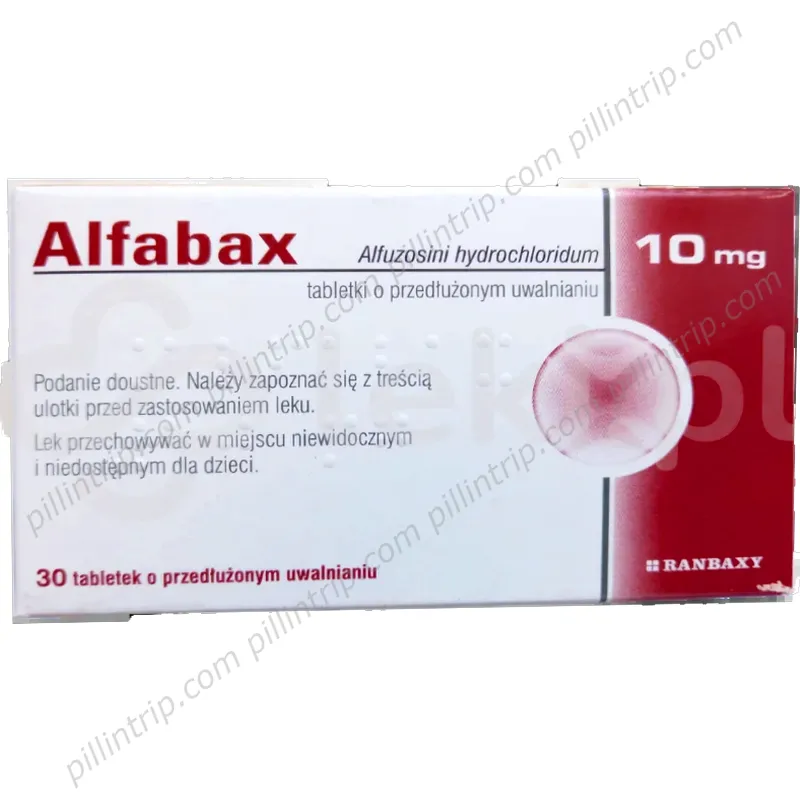
Table of Contents
Patient Information Leaflet
Alfabax, 10 mg, prolonged-release tablets
Alfuzosini hydrochloridum
Please read all of this leaflet carefully before taking this medicine, because it contains
important information for you.
- Keep this leaflet, as you may need to read it again.
- If you have any further questions, ask your doctor or pharmacist.
- This medicine has been prescribed for you personally. Do not share it with others. It may harm them, even if their symptoms are the same as yours.
- If you experience any side effects, including any not listed in this leaflet, tell your doctor or pharmacist. See section 4.
Leaflet Contents
- What Alfabax is and what it is used for
- What you need to know before taking Alfabax
- How to take Alfabax
- Possible side effects
- How to store Alfabax
- Contents of the pack and other information
1. What Alfabax is and what it is used for
Alfabax is a medicine that comes in the form of tablets to be taken orally.
Alfuzosin belongs to a group of medicines used in prostate gland disorders known as
alpha-1-adrenolytics. It causes relaxation of the muscles in the prostate gland and the urethra,
making it easier for urine to flow from the bladder.
Alfuzosin is used to treat symptoms of benign prostatic hyperplasia.
Benign prostatic hyperplasia
The prostate gland is located below the bladder. The urethra passes through the prostate and exits
the body. In addition to glandular tissue (which produces seminal fluid), the prostate also contains
muscle tissue. Muscle tissue is also present in the urethra. In benign prostatic hyperplasia, the
muscle tone in the prostate and urethra increases, causing narrowing of the urethra. As a result,
urine flow from the bladder is impaired, leading to lower urinary tract symptoms.
Acute urinary retention
In some patients with benign prostatic hyperplasia, the prostate becomes so enlarged that it
completely blocks the flow of urine. This condition is called acute urinary retention.
- This is very painful and may require a short hospital stay.
- A thin, flexible tube (catheter) is inserted into the bladder. This helps empty the bladder and relieve pain.
- During this time, treatment with alfuzosin may be initiated to help restore normal urine flow from the bladder.
2. Important information before using Alfabax
When not to use Alfabax
- if the patient is allergic to alfuzosin or any of the other ingredients of this medicine (listed in section 6). Symptoms of allergic reaction include: rash, difficulty swallowing or breathing, swelling of lips, throat or tongue.
- if the patient has experienced drops in blood pressure upon changing position to sitting or standing;
- if the patient is taking another alpha-1 blocker medicine;
- if the patient has liver function disorders;
Warnings and precautions
Before starting treatment with Alfabax, discuss with your doctor or pharmacist:
- if the patient has coronary artery disease. Treatment aimed at improving blood supply to the heart muscle should be continued.
- if chest pain (angina pectoris) recurs or worsens. Treatment with Alfabax should be discontinued.
- if the patient has kidney impairment.
- if the patient has heart problems or if the heart has suddenly stopped pumping blood (acute heart failure).
- if the patient has inherited heart rhythm disorders (congenital QTc prolongation).
- if the patient is elderly, has increased sensitivity to alpha-1 blockers, or is being treated for high blood pressure.
- if, within a few hours after taking the tablet, blood pressure drops upon changing position to sitting or standing. This may be accompanied by symptoms such as dizziness, fatigue or sweating. In such a case, the patient should lie down and remain lying until symptoms have completely subsided. These symptoms are usually transient and may occur at the beginning of treatment. Treatment can usually be continued.
- if the patient is scheduled for cataract surgery (removal of the clouded lens), the patient should inform the ophthalmologist about current or previous use of Alfabax. This is because this medicine may cause complications during surgery, and the ophthalmologist can prevent them if informed prior to the procedure.
- if the patient experiences prolonged erection without sexual stimulation. This is a serious condition which may lead to permanent erectile dysfunction (impotence) if not properly treated.
Consult a doctor if any of the above warnings apply to the patient or if such a situation occurred in the past.
Children
Alfuzosin is not intended for use in children.
Alfabax with other medicines
Tell your doctor or pharmacist about all medicines the patient is currently taking or has recently taken, as well as any medicines the patient plans to take.
This also includes medicines taken without a prescription.
Some medicines may affect the action of other medicines or cannot be used at the same time for other reasons.
Do not take Alfabax if:
- The patient is concurrently taking other alpha-1 blockers (used in the treatment of benign prostatic hyperplasia), such as doxazosin, indoramin, prazosin, terazosin, tamsulosin or phenoxybenzamine.
Contact your doctor before taking the medicine:
- When combining with medicines used for high blood pressure, dosage adjustment may be necessary due to the risk of blood pressure drop.
- If the patient is scheduled for surgery, the patient should inform the doctor about taking Alfabax.
- When combining with nitrates (medicines used to relieve chest pain), dosage adjustment may be necessary due to the risk of blood pressure drop.
- If the patient is taking medicines commonly used to treat erectile dysfunction (impotence).
- If the patient is taking medicines used to treat premature ejaculation (dapoxetine).
- If the patient is taking medicines used in the treatment of hepatitis C virus (such as telaprevir and boceprevir).
- If the patient is taking medicines used to treat bacterial infections (such as clarithromycin, erythromycin, telithromycin).
- If the patient is taking medicines used to treat depression (such as nefazodone).
- If the patient is taking ketoconazole tablets (used in the treatment of Cushing's syndrome – a condition in which the body produces too much of a hormone called cortisol).
- When used concomitantly with medicines that inhibit the activity of the liver enzyme CYP3A4, such as itraconazole, posaconazole, voriconazole, cobicistat, nelfinavir and ritonavir, dose adjustment may be necessary.
Taking Alfabax with food and drink
- Alfabax should be taken immediately after a meal.
- Alcohol may worsen the adverse effects of the medicine. Dizziness and general weakness may occur during treatment with Alfabax. If these symptoms occur, alcohol should not be consumed.
Pregnancy and breastfeeding
Not applicable. Alfabax is prescribed exclusively for men.
Driving and operating machinery
There are no data available on the effect of this medicine on the ability to drive or operate machinery. Dizziness or general weakness may occur. This should be taken into account when driving or operating machinery.
Alfabax contains lactose
This medicine contains lactose. If the patient has previously been diagnosed with intolerance to certain sugars, the patient should consult a doctor before taking this medicine.
3. How to take Alfabax
This medicine should always be taken exactly as directed by your doctor. If in doubt, consult your doctor or pharmacist.
Oral administration.
Benign prostatic hyperplasia
The usual dose is one tablet daily.
Acute urinary retention
Alfabax will be administered by the doctor on the day of catheter insertion.
Continue taking Alfabax once daily.
Take one Alfabax tablet after the evening meal. Swallow the tablet with a large amount of liquid (for example, a glass of water). Do not crush, chew or divide prolonged-release tablets.
The best effect is achieved by taking the tablet at the same time each day. This also helps to remember to take the tablet.
Elderly patients (over 65 years of age) and patients with renal impairment
There is no need to adjust the dose in cases of mild or moderate renal impairment. However, in severe renal impairment, this medicine is not prescribed by the doctor.
Patients with hepatic impairment
Alfabax tablets should not be used in patients with hepatic impairment.
However, in mild to moderate hepatic impairment, other products containing alfuzosin in a lower dose may be used according to an appropriate dosing regimen. Your doctor will inform you about this.
Use in children and adolescents
The efficacy of Alfabax has not been established in children aged 2 to 16 years. Therefore, Alfabax is not recommended for use in children and adolescents (aged 2 to 16 years).
Taking more Alfabax than prescribed
If you take too much of this medicine, contact your doctor or pharmacist immediately.
Missing a dose of Alfabax
It may happen that a patient forgets to take the medicine. In such a case, there is no need to take the missed tablet. The prescribed dose can be taken the next day.
Do not take a double dose to make up for a missed tablet.
Stopping Alfabax treatment
Do not stop or discontinue taking Alfabax without first consulting your doctor. Tablets should be taken as directed and for as long as your doctor recommends. Do not stop taking them even if you feel better, as symptoms may return.
If you have any further questions about the use of this medicine, consult your doctor or pharmacist.
4. Possible adverse effects
Like all medicines, this medicine can cause adverse effects, although not everybody will experience them.
Serious adverse effects:
If any of the following adverse effects occur, stop taking Alfabax
and contact your doctor immediately or go to the nearest hospital emergency department:
Very rare (less than 1 in 10,000 people)
- Sudden onset of swelling of the eyelids, face, lips, mouth and tongue, difficulty breathing or swallowing, rash, hives and itching. These are symptoms of a very severe allergic reaction. (The medical term for these symptoms is angioedema.)
- Feeling of pressure, tightness, discomfort or crushing pain in the chest area, which may radiate to the arms, neck and jaw (these may be symptoms of angina pectoris). This usually occurs only in people who have previously experienced angina pectoris.
Unknown frequency (frequency cannot be estimated from available data):
- Prolonged and painful erection of the penis, unrelated to sexual activity (this may be caused by a medical condition called priapism).
Other adverse effects:
Common (less than 1 in 10 people)
- Feeling sick (nausea);
- Abdominal pain;
- Dry mouth;
- Feeling weak or tired;
- Feeling unwell (malaise);
- Headache;
- Dizziness or fainting;
- Generalised weakness (asthenia).
Uncommon (less than 1 in 100 people)
- Loose stools (diarrhoea);
- Visual disturbances;
- Rapid heartbeat (tachycardia);
- Sensation of fast or irregular heartbeat (palpitations);
- Sudden loss of consciousness;
- Drop in blood pressure, for example when standing up quickly from a sitting or lying position, sometimes accompanied by dizziness (orthostatic hypotension);
- Flushing (redness of the face);
- Runny or blocked nose, sneezing, facial pressure or pain (rhinitis);
- Skin rash;
- Itching;
- Fluid retention in the body (may cause swelling of the hands or feet);
- Chest pain;
- Drowsiness;
- Sensation of spinning or dizziness despite remaining still (vestibular vertigo).
Very rare (less than 1 in 10,000 people)
- Liver damage caused by the medicine or a chemical substance (hepatotoxicity);
- Itchy, lumpy rash also known as hives (urticaria).
Unknown frequency (frequency cannot be estimated from available data)
- Liver cell damage;
- Certain liver diseases caused by narrowing or blockage of the bile duct (cholestatic liver disease). Symptoms may include yellowing of the skin or whites of the eyes;
- Vomiting;
- In cataract surgery (when the eye lens is clouded) and when currently taking or having previously taken Alfabax, the pupil may dilate poorly and the iris may become floppy during the procedure. It is important that the ophthalmologist is aware of this, as the surgery may require a different approach (see section “Warnings and precautions”);
- Irregular and often rapid heart rhythm in the atria (atrial fibrillation);
- Decreased number of white blood cells (neutropenia), which may lead to more frequent infections;
- Increased risk of bleeding (including nosebleeds and/or bleeding gums) and occurrence of bruising. This may be a blood disorder called thrombocytopenia, characterised by a reduced number of platelets.
Reporting of adverse effects
If you experience any adverse effects, including any not listed
in this leaflet, tell your doctor, pharmacist, or nurse. Adverse effects
can be reported directly to the Department of Monitoring Adverse Drug Reactions of the Office for Registration of Medicinal Products, Medical Devices and Biocidal Products:
Al. Jerozolimskie 181C, 02-222 Warsaw, tel.: 22 49-21-301, fax: 22 49-21-309.
Website: https://smz.ezdrowie.gov.pl.
Adverse effects can also be reported to the marketing authorisation holder.
By reporting adverse effects, additional information on the safety of this medicine can be collected.
5. How to store Alfabax
Keep this medicine out of the sight and reach of children.
There are no special storage instructions.
Do not use this medicine after the expiry date stated on the outer carton and blister after: "Expiry date". The expiry date refers to the last day of the stated month.
Medicines must not be disposed of via wastewater or household waste. Ask your pharmacist what to do with medicines no longer required. Such measures help protect the environment.
6. Contents of the packaging and other information
What Alfabax contains
The active substance is alfuzosin hydrochloride.
Each prolonged-release tablet contains 10 mg of alfuzosin hydrochloride.
Other ingredients are: anhydrous lactose, anhydrous colloidal silicon dioxide (E551), povidone (E1201),
talc (E553B), magnesium stearate (E572), hypromellose (E464), hydroxypropylcellulose (E463).
The tablet has a prolonged-release action, meaning that after administration, the active substance is not released immediately, but gradually, allowing the medicine to have a longer duration of action.
What Alfabax looks like and contents of the pack
Alfabax tablets are white to off-white, round, uncoated, biconvex tablets with smoothed edges, marked 'RY 10' on one side.
Alfabax is available in packs containing 30 or 90 tablets.
Not all pack sizes may be marketed.
Marketing Authorisation Holder and Manufacturer
Marketing Authorisation Holder:
Ranbaxy (Poland) Sp. z o.o.
ul. Idzikowskiego 16
00-710 Warsaw
tel. 22 642 07 75
Manufacturer:
Sun Pharmaceutical Industries Europe BV
Polarisavenue 87
2132 JH Hoofddorp
The Netherlands
Terapia S.A.
Str. Fabricii Nr. 124
Cluj-Napoca 400 632
Romania
For any information regarding this medicinal product or the package leaflet in another format, please contact the Marketing Authorisation Holder.
This medicinal product is authorised for sale in the European Economic Area and the United Kingdom (Northern Ireland) under the following names:
France: ALFUZOSINE CRISTERS PHARMA LP 10 mg comprimés à libération prolongée
Italy: Profuzo
The Netherlands: Alfuzosine HC1 SUN 10 mg tabletten, tabletten met verlengde afgifte
United Kingdom (Northern Ireland): Vasran XL 10 mg Prolonged-release Tablets