Alcaine
Poland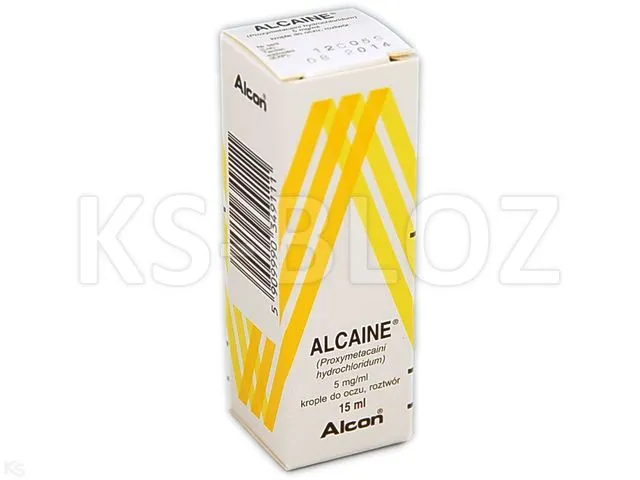
Table of Contents
PACKAGE LEAFLET: INFORMATION FOR THE USER
Warning! Keep the leaflet. Information on the immediate packaging in a foreign language!
Alcaine
5 mg/ml, eye drops, solution
Proxymetacaini hydrochloridum
Please read carefully all the information in this leaflet before using this medicine, as it contains
important information for the patient.
- Keep this leaflet, so that you can read it again if necessary.
- If you have any doubts, consult your doctor or pharmacist.
- This medicine has been prescribed for a specific individual. Do not pass it on to others. The medicine may harm another person, even if their symptoms are the same.
- If you experience any adverse reactions, including any adverse reactions not listed in this leaflet, inform your doctor or pharmacist. See section 4.
Table of contents of the leaflet
- What Alcaine is and what it is used for
- Important information before using Alcaine
- How to use Alcaine
- Possible side effects
- How to store Alcaine
- Contents of the pack and other information
1. What Alcaine is and what it is used for
Alcaine contains the active substance proxymetacaine hydrochloride, which acts as a local
anaesthetic.
Alcaine is used for topical anaesthesia prior to ophthalmic procedures requiring rapid and short-acting anaesthesia, such as: preparation for removal of cataractous lens, removal of corneal sutures, tonometric measurement of intraocular pressure, gonioscopic examination, removal of foreign bodies, collection of conjunctival scrapings for diagnostic purposes, and other procedures when topical anaesthesia is required.
2. Important information before using Alcaine
When not to use Alcaine
- if the patient is allergic to proparacaine hydrochloride or to any of the other ingredients of this medicine (listed in section 6),
- without medical supervision,
- for prolonged periods, as this may cause corneal damage, loss of vision, and delayed healing,
- while wearing contact lenses, because Alcaine contains benzalkonium chloride.
Warnings and precautions
Before starting to use Alcaine, discuss this with your doctor or pharmacist.
- Alcaine is intended for local ocular administration only by a healthcare professional. It must not be injected.
- The medicine should be used only for instillation into the eye(s).
- Repeated use or misuse of this medicine may lead to infections and corneal damage.
- Due to its anaesthetic effect, the eyes will lose sensation; therefore, caution must be taken to avoid accidental eye injury. Do not touch or rub the eye and take precautions to protect it from everyday contaminants (such as dust, dirt, etc.).
- Repeated use of this medicine may result in shorter duration of anaesthetic effect.
- Proparacaine hydrochloride may cause contact allergic dermatitis. Avoid contact of Alcaine with the skin.
- If you are using other medicines, please also refer to the section Alcaine with other medicines.
- Exercise caution when using Alcaine in patients:
- with epilepsy, heart disease, hyperthyroidism, or respiratory disorders,
- with myasthenia gravis, as they are particularly sensitive to the effects of local anaesthetics,
- with low plasma cholinesterase enzyme activity, and in patients treated with cholinesterase inhibitors, because there is an increased risk of systemic adverse effects following local administration of ester-type local anaesthetics. Patients should avoid touching or rubbing the eye until the local anaesthetic effect has worn off.
If symptoms of hypersensitivity or irritation occur or worsen,
consult a doctor immediately.
Alcaine with other medicines
Inform your doctor or pharmacist about all medicines the patient is currently taking or has recently taken, as well as any medicines the patient plans to take.
Pregnancy, breastfeeding and fertility
If the patient is pregnant or breastfeeding, suspects she might be pregnant, or is planning to become pregnant, she should consult a doctor before using this medicine.
The use of Alcaine during pregnancy and breastfeeding is not recommended.
Driving and operating machinery
Blurred vision may occur temporarily after using Alcaine. Do not drive or operate machinery until this symptom has resolved.
Alcaine contains benzalkonium chloride
The medicine contains 0.0035 mg benzalkonium chloride per drop, equivalent to 0.1 mg/mL.
Benzalkonium chloride may be absorbed by soft contact lenses and may alter their colour. Contact lenses must be removed before instillation and at least 15 minutes should elapse before reinserting them. Benzalkonium chloride may also cause eye irritation, especially in individuals with dry eye syndrome or corneal disorders (the transparent layer at the front of the eye). If abnormal sensations, stinging, or eye pain occur after using the medicine, contact your doctor.
3. How to use Alcaine
Alcaine is intended for administration only by a healthcare professional.
Recommended dose
For preparing a patient for a simple procedure, such as tonometry or other short-term examinations, usually one to two drops are instilled immediately before the procedure.
Prior to minor surgical procedures, such as removal of a foreign body or sutures, one to two drops should be administered once to three times, every five to ten minutes.
For prolonged anaesthesia, for example during cataract lens removal, one to two drops of Alcaine should be instilled into the eye(s) every five to ten minutes, three to five times.
It should be noted that local anaesthetic effect appears within 30 seconds and may last up to 15 minutes.
Method of administration
Alcaine must be administered only into the eye(s).
Unscrew the cap. If the safety collar is loose after removing the cap, it should be discarded before using the medicine.
To prevent contamination of the dropper tip or solution, care should be taken not to touch the dropper tip to the eyelids or surrounding tissues. The bottle should be kept tightly closed when not in use.
Systemic absorption of the drug can be reduced by applying the following measures after instillation of eye drops:
- closing the eyelids for 2 minutes;
- pressing with a finger on the nasolacrimal duct for 2 minutes.
Do not use the solution if it is cloudy or has changed colour.
Note: Since blinking reflex may temporarily disappear after administration of the drug, eye dressing is recommended after completion of the procedure.
If the patient is using other eye drops or eye ointments simultaneously, at least a 5-minute interval should be maintained between the administration of each medication. Eye ointments should be used last.
Use of a higher than recommended dose of Alcaine
If a higher than recommended dose is administered, Alcaine should be flushed from the eye with lukewarm water.
In case of overdose or accidental ingestion, seek immediate medical advice from a doctor, pharmacist, or poison control centre, as serious nervous or respiratory system reactions may occur.
Missed dose of Alcaine
Do not double the dose to make up for a missed dose.
If you have any further questions about the use of this medicine, consult your doctor or pharmacist.
4. Possible adverse reactions
Like all medicines, this medicine can cause adverse reactions, although not everyone experiences them.
The following adverse reactions have been observed with the use of Alcaine; however, their frequency cannot be determined from the available data:
- Eye-related reactions: corneal damage, corneal surface clouding, eye surface swelling, eye surface inflammation, blurred vision, photophobia, pupil dilation, eye pain, eye irritation, eye swelling, sensation of eye discomfort, eye redness, increased lacrimation.
- General adverse reactions: hypersensitivity (allergy), fainting, dizziness. Transient symptoms such as prickling sensation, burning, or conjunctival redness may occur. In rare cases, an early-type allergic reaction of the cornea may occur (characterized by acute, diffuse keratoepitheliitis with filament formation and/or detachment of large areas of epithelial necrosis, diffuse stromal edema, posterior lamellar keratitis, and iritis).
In very rare cases, after topical ocular administration, systemic toxic effects may occur, manifesting as central nervous system stimulation, followed by depression of its functions.
Additionally, uncontrolled use or abuse of Alcaine may lead to permanent corneal disorders and/or eye damage.
Reporting of adverse reactions
If any adverse reactions occur, including those not listed in this leaflet, inform your doctor or pharmacist. Adverse reactions can be reported directly to the Department of Monitoring Adverse Drug Reactions of the Office for Registration of Medicinal Products, Medical Devices and Biocidal Products, Al. Jerozolimskie 181C, 02-222 Warsaw, tel.: +48 22 49 21 301, fax: +48 22 49 21 309, website: https://smz.ezdrowie.gov.pl
Reporting adverse reactions enables the collection of further information on the safety of the medicine.
5. How to store Alcaine
Keep the medicine out of the sight and reach of children.
Protect from light.
Store in the refrigerator, at a temperature between 2°C and 8°C.
After each use, close the bottle tightly.
Do not use this medicine after the expiry date stated on the packaging.
The expiry date refers to the last day of the stated month.
Do not use this medicine if cloudiness or a change in colour is observed.
Medicines must not be disposed of via wastewater or household waste. Ask your pharmacist how to dispose of medicines no longer required. Such measures help protect the environment.
Shelf life after first opening the bottle: 4 weeks.
6. Contents of the pack and other information
What Alcaine contains
- The active substance is proxymetacaine hydrochloride. 1 ml of solution contains 5 mg of proxymetacaine hydrochloride.
- The other ingredients (excipients) are: glycerol, hydrochloric acid and/or sodium hydroxide, benzalkonium chloride, purified water.
What Alcaine looks like and contents of the pack
The medicine is available as a sterile, isotonic aqueous solution.
A white, opaque bottle (DROP-TAINER) made of low-density polyethylene (LDPE), with a dropper and a white polypropylene cap, containing 15 ml of solution, packed in a cardboard box.
For more detailed information, please contact the responsible party or the parallel importer.
Marketing Authorisation Holder in Bulgaria, the country of export:
Alcon Farmaceutika d.o.o.
Avenija Dubrovnik 16
10160 Zagreb
Croatia
Manufacturer:
S.A. ALCON – COUVREUR N.V.
Rijksweg 14
B-2870 Puurs
Belgium
Alcon Laboratories Belgium
Lichterveld 3
2870 Puurs-Sint-Amands
Belgium
Parallel importer:
Medezin Sp. z o.o.
ul. Zbąszyńska 3
91-342 Łódź
Repackaged in:
Medezin Sp. z o.o.
ul. Zbąszyńska 3
91-342 Łódź
CEFEA Sp. z o.o. Sp. komandytowa
ul. Działkowa 56
02-234 Warsaw
SHIRAZ PRODUCTIONS Sp. z o.o.
ul. Tymiankowa 24/28
95-054 Ksawerów
Marketing Authorisation Number in Bulgaria, the country of export: 20000223
Parallel Import Licence Number: 110/24