Albiomin 20%
Poland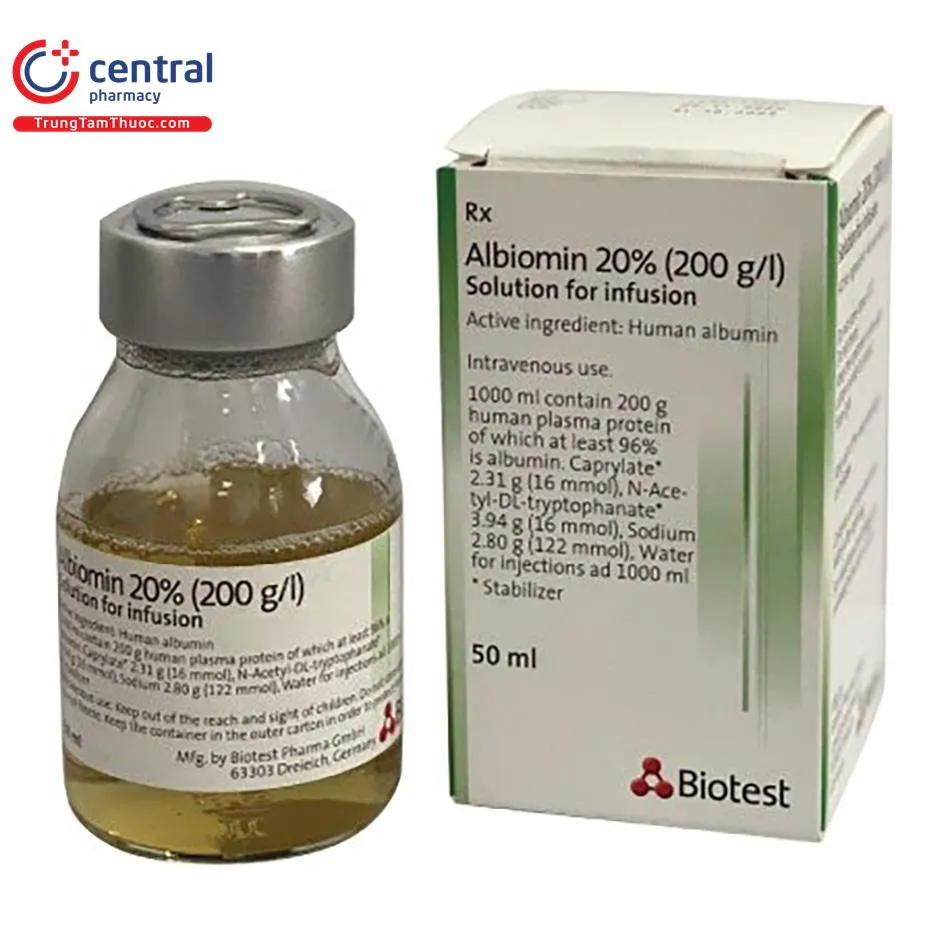
Table of Contents
- Package leaflet: Information for the user
- 2. What you need to know before receiving Albiomin 20% (200 g/l)
- 3. How to use Albiomin 20% (200 g/l)
- 4. Possible adverse reactions
- 5. How to store Albiomin 20% (200 g/l)
- 6. Contents of the package and other information
- THE FOLLOWING INFORMATION IS INTENDED FOR PROFESSIONAL
Package leaflet: Information for the user
Albiomin 20% (200 g/l), solution for infusion
Human Albumin
Please read all of this leaflet carefully before this medicine is administered, because it contains
important information for you.
- Keep this leaflet, as you may need to read it again.
- If you have any further questions, please ask your doctor or nurse.
- If you get any side effects, including any not listed in this leaflet, tell your doctor or nurse. See section 4.
Contents of the leaflet:
- What Albiomin 20% (200 g/l) is and what it is used for
- What you need to know before receiving Albiomin 20% (200 g/l)
- How Albiomin 20% (200 g/l) is given
- Possible side effects
- How to store Albiomin 20% (200 g/l)
- Contents of the pack and other information
1. What Albiomin 20% (200 g/l) is and what it is used for
Albiomin 20% (200 g/l) is a solution for infusion (intravenous administration). Each litre of solution contains 200 g of human plasma protein, of which at least 96% is human albumin.
Albiomin 20% (200 g/l) is used to restore and maintain circulating blood volume when a volume deficit has been diagnosed and when the use of colloids such as albumin is appropriate.
2. What you need to know before receiving Albiomin 20% (200 g/l)
Do not use Albiomin 20% (200 g/l):
- if you are allergic to albumin preparations or to any of the other ingredients of this medicine (listed in section 6).
Warnings and precautions
If an allergic or anaphylactic reaction is suspected, the infusion must be stopped immediately. In case of shock, treatment should be carried out according to current guidelines for shock management.
The infusion must also be discontinued if any of the following symptoms of cardiovascular overload (hypervolemia) occur:
- headache
- dyspnoea (difficulty in breathing)
- jugular vein distension (fluid accumulation in the jugular vein)
- increased blood pressure
- elevated venous pressure (increased pressure in the veins)
- pulmonary edema (fluid in the lungs)
Please discuss with your doctor if you have any of the following conditions:
- heart failure (uncompensated heart failure)
- high blood pressure (hypertension)
- oesophageal varices (enlarged veins in the oesophagus)
- pulmonary edema (fluid in the lungs)
- tendency to abnormal or spontaneous bleeding (bleeding tendency)
- low red blood cell count (severe anaemia)
- reduced or absent urine production (renal and post-renal anuria)
Your doctor will take appropriate precautions. Your doctor will also monitor circulatory parameters, including electrolyte balance and the patient's blood volume.
Information on transmission of infectious agents
When medicines are produced from human blood or plasma, measures are taken to prevent passive transmission of infectious agents to patients. These include:
- careful selection of blood and plasma donors to ensure that donors at risk of transmitting infectious agents are excluded,
- testing of individual donations and pooled plasma for the presence of viruses/infections,
- inclusion of effective viral inactivation or removal steps during the manufacturing process.
Despite these measures, the possibility of transmitting infectious agents cannot be completely ruled out when administering medicinal products derived from human blood or plasma. This includes unknown or newly emerging viruses and other types of infections.
There have been no reports of virus transmission associated with albumin preparations manufactured using a process compliant with the requirements of the European Pharmacopoeia.
It is recommended that the name and batch number of each Albiomin 20% (200 g/l) administration be recorded in the patient's medical record to allow identification of the batch administered in the future.
Albiomin 20% (200 g/l) with other medicines
Tell your doctor about all medicines you are currently taking, have recently taken, or plan to take.
Pregnancy, breast-feeding and fertility
If you are pregnant, breast-feeding, think you may be pregnant or are planning to become pregnant, you should consult your doctor before receiving this medicine. Your doctor will decide whether Albiomin 20% (200 g/l) can be administered during pregnancy and breast-feeding.
Driving and using machines
The effect of Albiomin 20% (200 g/l) on the ability to drive and use machines is unknown.
Albiomin 20% (200 g/l) contains sodium
This medicine contains approximately 140 mg of sodium (the main component of table salt) in each 50 ml vial. This corresponds to 7.0% of the maximum daily recommended dietary intake of sodium for adults.
This medicine contains approximately 280 mg of sodium (the main component of table salt) in each 100 ml vial. This corresponds to 14.0% of the maximum daily recommended dietary intake of sodium for adults.
3. How to use Albiomin 20% (200 g/l)
Albiomin 20% (200 g/l) is usually administered in a hospital by a doctor or nurse.
Human albumin may be given directly into a vein or may be diluted in 0.9%
sodium chloride.
Dosage and frequency of administration
The amount of Albiomin 20% (200 g/l) that a patient will receive depends on body weight,
the type of disease, and the amount of fluid or protein lost.
The doctor will determine the appropriate dose of Albiomin 20% (200 g/l) and how often it
should be administered in order to achieve the correct blood level.
Use of a higher than recommended dose of Albiomin 20% (200 g/l)
This is unlikely, but if such a situation occurs, the doctor will know how to proceed.
If you have any further doubts regarding the use of this medicine, consult your doctor or nurse.
4. Possible adverse reactions
Like all medicines, this medicine can cause adverse reactions, although not everyone will experience them.
If any of the following symptoms occur, contact your doctor immediately:
- Rash
- Itching
- Wheezing
- Breathing difficulties
- Swelling of the eyelids, face, lips, throat or tongue
- Very low blood pressure with symptoms such as dizziness, confusion, fainting, rapid pulse
This may be an allergic reaction or, in rare cases, a severe allergic reaction (anaphylactic shock) or hypersensitivity reaction.
The following adverse reactions have been reported for Albiomin 20% (200 g/l) or are known for other human albumin products:
Frequency unknown (frequency cannot be estimated from available data):
- Hypersensitivity, anaphylactic reaction, anaphylactic shock
- Chest tightness (bronchospasm)
- Increased heart rate (tachycardia)
- Shock
- Nausea
- Skin reactions (flushing, urticaria, itching, erythema, rash)
- Chills
- Fever
- Low arterial blood pressure (hypotension)
- Reduced oxygen saturation
- Leakage at injection site (extravasation)
Reporting of adverse reactions
If any adverse reactions occur, including any adverse reactions not listed in this leaflet, inform your doctor or nurse. Adverse reactions can be reported directly to the Department for Monitoring Adverse Drug Reactions at the Office for Registration of Medicinal Products, Medical Devices and Biocidal Products
Al. Jerozolimskie 181C
PL-02 222 Warsaw
Phone: + 48 22 49 21 301
Fax: + 48 22 49 21 309
Website: https://smz.ezdrowie.gov.pl
Adverse reactions can also be reported to the marketing authorization holder.
Reporting adverse reactions helps to provide more information on the safety of this medicine.
5. How to store Albiomin 20% (200 g/l)
Keep the medicine out of the sight and reach of children.
Do not use this medicine after the expiry date stated on the label and carton.
Store the vial in its outer packaging to protect from light.
Do not store above 25°C.
Do not freeze.
After opening, the medicine should be used immediately.
Immediately before administration, check whether the solution is clear.
Do not use solutions that are cloudy or contain sediment at the bottom.
Medicines must not be disposed of via wastewater or household waste. Ask your pharmacist how to dispose of medicines no longer required. Such measures help protect the environment.
6. Contents of the package and other information
What Albiomin 20% (200 g/l) contains:
Each 50 ml vial contains 10 g of human plasma protein, of which at least 96% is human albumin.
Each 100 ml vial contains 20 g of human plasma protein, of which at least 96% is human albumin.
Other ingredients: sodium caprylate (16 mmol/l), sodium chloride (63 mmol/l), N-acetyltryptophanate (16 mmol/l), water for injections.
What Albiomin 20% (200 g/l) looks like and contents of the pack:
A clear, slightly viscous liquid; nearly colorless, yellow, amber, or green.
Glass vial of 50 ml
Glass vial of 100 ml
Marketing Authorisation Holder and Manufacturer:
Biotest Pharma GmbH
Landsteinerstrasse 5
63303 Dreieich
Germany
Tel. +49 6103 801 – 0
Fax +49 6103 801- 150
E-mail: [email protected]
THE FOLLOWING INFORMATION IS INTENDED FOR PROFESSIONAL
MEDICAL PERSONNEL ONLY:
Special warnings and precautions for use
The colloid-osmotic effect of 200 g/l human albumin is approximately four times higher than
that of human plasma. Therefore, when administering concentrated albumin, caution must be exercised to
ensure adequate hydration of the patient. The patient must be closely monitored to
prevent circulatory overload and fluid overload.
Albumin solutions must not be diluted with water for injections, as this may
cause hemolysis in recipients.
If there is a need to replace relatively large volumes of body fluids, coagulation parameters and hematocrit should be monitored. Attention should be paid to appropriate replacement of other blood components (clotting factors, electrolytes, platelets, and erythrocytes).
Hyperhydration may occur if the dose and infusion rate are not adjusted to the patient's circulatory status.
Interactions with other medicines and other types of interactions
No specific interactions between human albumin and other medicinal products have been reported.
Dosage and method of administration
Dosage
The appropriate dose should be determined based on the required circulating fluid volume, not
on serum albumin levels.
When administering human albumin, hemodynamic parameters should be monitored regularly, including:
- arterial blood pressure and pulse rate,
- central venous pressure,
- pulmonary artery wedge pressure,
- urine output,
- electrolyte levels,
- hematocrit/hemoglobin levels.
Method of administration
Intravenous administration
Human albumin may be administered directly intravenously or may be diluted
with an isotonic solution (e.g., 0.9% sodium chloride solution).
During plasma exchange, the infusion rate should be adjusted to the plasma removal rate.
Information on preparation of the medicinal product for administration
Albumin solutions must not be diluted with water for injections, as this may
cause hemolysis in recipients.
When large volumes of albumin are administered, the product should be warmed to room temperature or body temperature before administration.
The solution should be clear or slightly opalescent. Turbid solutions or those containing precipitate must not be used, as this may indicate protein instability or contamination of the solution.
The contents should be used immediately after opening the vial. Any unused portion should be discarded according to local regulations.