Alacare
Poland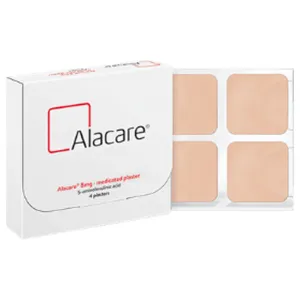
Table of Contents
- Package leaflet: Information for the user
- 1. What Alacare medicated patch is and what it is used for
- 2. Important information before using Alacare medicated plaster
- 3. How to use the Alacare medicated patch
- 4. Possible adverse effects
- 5. How to store the Alacare medicated patch
- 6. Contents of the pack and other information
Package leaflet: Information for the user
Alacare, 8 mg, medicated patch
5-Aminolevulinic acid
Please read all of this leaflet carefully before using this medicine, because it contains
important information for the patient.
- Keep this leaflet, as you may need to read it again.
- If you have any further questions, please ask your doctor or pharmacist.
- This medicine has been prescribed for a specific individual. Do not pass it on to others. It may harm other people, even if their symptoms are the same.
- If you experience any adverse effects, including any not listed in this leaflet, tell your doctor or pharmacist. See section 4.
Table of contents
- What Alacare medicated patch is and what it is used for
- Important information before using Alacare medicated patch
- How to use Alacare medicated patch
- Possible side effects
- How to store Alacare medicated patch
- Contents of the pack and other information
1. What Alacare medicated patch is and what it is used for
Alacare medicated patch is used to treat mild skin lesions on the scalp or face known as actinic keratosis. These are small, rough patches that appear on the skin. They are caused by prolonged exposure of the skin to sunlight. These lesions are also referred to as solar or senile keratosis.
Treatment with Alacare patches is a two-step process known as "photodynamic therapy". It involves applying the Alacare patch to the skin lesions and leaving it in place for 4 hours. This is followed by illumination with red light for several minutes. The red light illumination initiates a chemical reaction within the diseased skin cells, leading to their destruction. This reaction is known as a "phototoxic reaction".
2. Important information before using Alacare medicated plaster
The Alacare plaster is applied by a doctor, nurse, or other healthcare professional during a single
treatment session.
When not to use Alacare medicated plaster
- if the patient is allergic to 5-aminolevulinic acid or any of the other ingredients of this medicine (listed in section 6).
- if the patient has a blood metabolism disorder called porphyria.
- if the patient has been treated with preparations containing 5-aminolevulinic acid and the treatment was unsuccessful.
- if the patient has other light-induced diseases or conditions that may worsen upon light exposure.
The treatment outcome and assessment of treatment efficacy may be reduced if, on the treated
skin area:
- there is inflammation, infection, psoriasis, eczema, or a tumorous skin disease
- tattoos are present
Warnings and precautions
Before starting treatment with Alacare medicated plaster, discuss this with your doctor.
- if the patient has dark brown or black skin, or if skin lesions are very pronounced, because there is a lack of clinical data on treatment with Alacare plaster in such cases.
- if the patient may be pregnant, because treatment with Alacare plaster is not recommended during pregnancy.
- if the patient is undergoing ultraviolet (UV) radiation therapy, this treatment should be discontinued before applying Alacare plaster.
The doctor or nurse must ensure that the Alacare plaster does not come into contact with the patient's eyes.
As part of general safety measures, the treated skin area and surrounding tissue should not be exposed to sunlight for 48 hours after treatment.
Alacare medicated plaster and other medicines
Inform the doctor about medications that may enhance allergic reactions or other adverse reactions that may occur during light-based therapy:
- St. John's wort and its preparations: medicines used to treat depression
- griseofulvin: medicines used to treat fungal infections
- diuretics, whose active substance names most commonly end in "thiazide" or "thiazid"
- some medicines used to treat diabetes, such as glibenclamide, glimepiride
- medicines used to treat psychiatric disorders, nausea, or vomiting, whose active substance names most commonly end in "azine"
- medicines used to treat bacterial infections, whose active substance names start with "sulfa" or end in "oxacin" or "cycline"
Tell the doctor about all medicines the patient is currently taking or has recently taken, as well as any medicines the patient plans to take.
Pregnancy and breastfeeding
If the patient is pregnant or breastfeeding, suspects she might be pregnant, or is planning to have a child, she should consult a doctor or pharmacist before using this medicine.
A harmful effect and risk to pregnancy and the unborn child cannot be completely ruled out.
Alacare plaster should not be used during pregnancy unless absolutely necessary.
Breastfeeding should be discontinued for 48 hours after application of Alacare plaster.
Always consult a doctor before using any medicine.
Driving and operating machinery
The use of Alacare medicated plaster does not affect the ability to drive or operate machinery.
3. How to use the Alacare medicated patch
This medicine is administered exclusively by medical personnel.
It is important not to apply any cream to the skin of the head or face on the day of the procedure before visiting the doctor.
Adults (including elderly patients)
Alacare patches will be applied to the skin affected by actinic keratosis for 4 hours during a single treatment session. Subsequently, these areas will be exposed for several minutes to red light (photodynamic therapy). To protect the eyes from intense light, the patient will receive protective glasses, which must be worn during light exposure.
After application of the patch and light exposure, the skin must be protected from sunlight for 48 hours.
The doctor should examine the lesions after three months.
Use in children and adolescents
Use of the Alacare medicated patch is not recommended, as there are no clinical data available on use in children and adolescents under 18 years of age.
Interrupting use of the Alacare medicated patch
Treatment efficacy may be reduced if:
- the patch was removed prematurely from the skin, or
- light exposure was interrupted too early.
4. Possible adverse effects
Like all medicines, this medicine can cause adverse effects, although they do not occur in everyone.
Adverse effects at the treatment site (local adverse reactions)
Adverse effects at the treatment site (local adverse reactions) occurred in almost all patients (99%).
They may occur during application of the Alacare patch, during illumination of the treated area, and (or) after the procedure. Symptoms are usually mild or moderate in intensity. They rarely require premature termination of illumination. To alleviate symptoms during illumination, cooling of the treated area may be applied, for example using a fan. After completion of treatment, local adverse effects may persist for 1 or 2 weeks, and sometimes longer.
Very common (in more than 1 out of 10 patients):
- skin peeling
- irritation
- itching
- pain
- redness
- scab formation
Common (in more than 1 out of 100 patients, but less than 1 out of 10 patients)
- areas of lighter or darker skin pigmentation
- bleeding
- skin blister
- discomfort
- erosion
- swelling (fluid accumulation in tissue)
- skin peeling
- pustules
- skin reaction
- exudate
- swelling (edema)
Uncommon (in more than 1 out of 1000 patients, but less than 1 out of 100 patients)
- burn
- discoloration
- infection
- inflammation
- ulcer
- superficial skin damage
Adverse effects not affecting the treatment site:
Common
- headache
Uncommon
- anxiety
- increased alanine aminotransferase enzyme activity
- nosebleed
- pustular rash
- skin discoloration
Reporting adverse effects
If any adverse effects occur, including any adverse effects not listed in this leaflet, inform your doctor or pharmacist. Adverse effects can be reported directly to the Department for Monitoring Adverse Drug Reactions, Office for Registration of Medicinal Products, Medical Devices and Biocidal Products, Al. Jerozolimskie 181 C, 02-222 Warsaw, Poland
Tel.: +48 22 49 21 301
Fax: +48 22 49 21 309
Website: https://smz.ezdrowie.gov.pl
Adverse effects may also be reported to the marketing authorization holder.
Reporting adverse effects helps to provide more information on the safety of the medicine.
5. How to store the Alacare medicated patch
Keep this medicine out of sight and reach of children.
Do not use this medicine after the expiry date stated on the carton and sachet after "Expiry date". The expiry date refers to the last day of the stated month.
The medicine is suitable for use within 3 months of first opening. After opening, store in the sachet to protect from light.
After use, fold used patches in half with the adhesive side inwards, then dispose of safely.
Medicines must not be disposed of via wastewater or household waste. Ask your pharmacist how to dispose of medicines no longer in use. This will help protect the environment.
6. Contents of the pack and other information
What Alacare medicated patch contains
- The active substance is 5-aminolevulinic acid hydrochloride. One medicated patch with a surface area of 4 cm² contains 8 mg of 5-aminolevulinic acid, equivalent to 2 mg/cm².
- Other components are:
- Adhesive layer: Acrylate-vinyl acetate copolymer (Duro-Tak 387-2353/87-2353)
- Outer protective layer: Polyethylene/Polyester/Aluminium (3M ScotchPak 1109)
- Protective liner (to be removed): Silicone-coated polyethylene terephthalate
What Alacare medicated patch looks like and contents of the pack
One medicated patch with a surface area of 4 cm² is square-shaped with rounded corners and consists of a skin-coloured backing film and an adhesive matrix covered by a protective layer which is removed before application. Four patches are contained in a protective pouch.
Alacare patches are available in packs containing 4 or 8 patches (1 or 2 protective pouches), packed in a cardboard box.
Marketing Authorisation Holder and Manufacturer
photonamic GmbH & Co. KG
Eggerstedter Weg 12
25421 Pinneberg
Germany
This medicinal product is authorised in the Member States of the European Economic Area and in the United Kingdom (Northern Ireland) under the following names:
Austria, Denmark, Finland, Ireland, Germany, Norway, Poland, Portugal, Sweden, United Kingdom (Northern Ireland), Italy – ALACARE
France - EFFALA