Akistan
Poland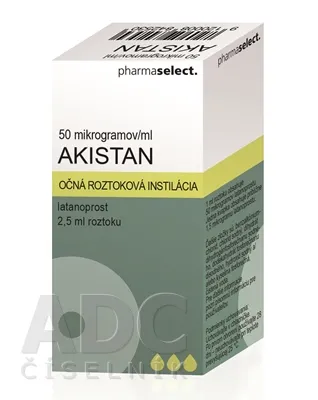
Table of Contents
Patient Information Leaflet: Instructions for Use
Akistan, 50 micrograms/ml, eye drops, solution
Latanoprost
Please read the entire leaflet carefully before using this medicine, as it contains important information for the patient.
- Keep this leaflet for future reference.
- If you have any questions, consult your doctor or pharmacist.
- This medicine has been prescribed for a specific individual. Do not share it with others. This medicine may harm other people, even if their symptoms are similar.
- If you experience any adverse reactions, including those not listed in this leaflet, inform your doctor or pharmacist. See section 4.
Table of Contents:
- What Akistan is and what it is used for
- Important information before using Akistan
- How to use Akistan
- Possible side effects
- How to store Akistan
- Contents of the package and other information
1. What Akistan is and what it is used for
Akistan contains the active substance latanoprost. Latanoprost belongs to a group of medicines known as prostaglandin analogues. The medicine works by increasing the natural outflow of fluid from inside the eye into the bloodstream.
Akistan is used in the treatment of open-angle glaucoma and elevated intraocular pressure.
Both conditions are associated with increased pressure inside the eye and may affect vision.
Akistan is also used in the treatment of elevated intraocular pressure and glaucoma in children of all ages.
2. Information before using Akistan
Akistan can be used in adult women and men (including elderly patients) and in children from birth to 18 years of age. The use of Akistan has not been studied in preterm infants (born before week 36 of gestation).
When not to use Akistan:
- if the patient is allergic to latanoprost or to any of the other ingredients of this medicine (listed in section 6).
Warnings and precautions
Before starting to use Akistan, consult your doctor or pharmacist if the patient has any of the following conditions:
- if the patient has no lens, the posterior lens capsule was ruptured during implantation of an artificial lens, the artificial lens was implanted in the anterior chamber of the eye, or if risk factors for macular edema (fluid accumulation in the back of the eye) are present (e.g. retinal damage or retinal vein thrombosis).
- if the patient is due to have or has undergone eye surgery.
- if the patient has severe asthma or unstable bronchial asthma.
- if the patient has dry eye.
- if the patient has eye problems such as eye pain, eye irritation, eye inflammation, blurred vision, or wears contact lenses (Akistan may still be used, following the instructions in section 3 of the leaflet for contact lens wearers).
- if the patient has had or currently has a viral eye infection caused by herpes simplex virus (HSV). In this case, Akistan may still be used, following the instructions in section 3 of the leaflet for contact lens wearers.
Akistan and other medicines
Akistan may interact with other medicines. Inform your doctor or pharmacist about all medicines the patient is currently taking or has recently taken, including over-the-counter medicines (including eye drops).
Pregnancy and breastfeeding
Akistan should not be used during pregnancy. If the patient is pregnant, suspects she may be pregnant, or is planning to become pregnant, she should consult her doctor immediately.
Akistan should not be used during breastfeeding.
Driving and using machines
Blurred vision may occur temporarily after using Akistan. In such cases, do not drive or operate tools or machines until vision returns to normal.
Akistan contains benzalkonium chloride
Akistan contains a preservative – benzalkonium chloride. This substance may cause eye surface changes and eye irritation. Benzalkonium chloride may be absorbed by soft contact lenses and may change their color. Therefore, contact between the medicine and soft contact lenses should be avoided.
Contact lenses should be removed before instilling Akistan and at least 15 minutes should pass before reinserting them. Further information for contact lens wearers is provided in section 3.
3. How to use Akistan
This medicine should always be used as directed by the physician. In case of doubt, consult your doctor or pharmacist.
The usual dose for adults (including elderly patients) and children is one drop administered into the affected eye(s) once daily.
The best time to administer the eye drops is in the evening.
Instructions for use
When using Akistan, follow these instructions carefully. Wash your hands before applying the eye drops.
When using Akistan, follow the steps below precisely:
- Wash your hands and sit or stand in a comfortable position.
- Unscrew the cap.
- Gently pull down the lower eyelid of the affected eye with your finger.
- Hold the top part of the dropper close to the eye, making sure it does not touch the eye.
- Gently squeeze the dropper to release only one drop of the medicine into the eye. Then release the lower eyelid.
- Press with your finger on the inner corner of the eye toward the nose. Keep the eye closed for 1 minute.
- To administer the drops into the second eye, if prescribed by the doctor, repeat all the steps.
Close the bottle tightly with the cap immediately after use. Do not overtighten, as this may damage the cap or bottle. The dispenser tip is designed to measure the drops of medicine, so do not enlarge the hole at its end. An excess amount of Akistan has been intentionally added to ensure that the prescribed amount of Akistan can be fully used as directed by the physician. Therefore, do not attempt to squeeze out the excess medicine from the bottle.
Contact lens wearers
If the patient wears contact lenses, they should be removed before using Akistan. After using Akistan, wait at least 15 minutes before reinserting contact lenses.
Using Akistan with other eye drops
Allow at least a 5-minute interval between administering Akistan and using any other eye drops.
Accidental overdose of Akistan
Instilling a larger amount of the medicine into the eye may cause mild eye irritation, tearing, and redness. These effects should resolve. In case of any doubts, consult your doctor.
If Akistan is accidentally swallowed, contact a doctor as soon as possible.
Missed dose of Akistan
Take the dose at the usual time. Do not use a double dose to make up for a missed dose. If you have any further questions about the use of this medicine, consult your doctor or pharmacist.
Stopping Akistan treatment
If the patient wishes to discontinue using Akistan, they should contact their doctor.
4. Possible adverse reactions
Like all medicines, this medicine can cause adverse reactions, although not everyone will experience them.
During the use of Akistan the following have been observed:
Very common (occur in more than 1 in 10 patients):
-
gradual change in eye colour due to increased concentration of brown pigment in the coloured part of the eye called the iris. This effect is more frequently observed in patients with mixed-colour irises (blue-brown, grey-brown, yellow-brown or green-brown) than in patients with uniformly coloured eyes (blue, grey, green or brown). The change in eye colour may develop over several years but usually occurs within 8 months of treatment. The change in eye colour may be permanent and may be more noticeable when Akistan is administered to only one eye. No associated symptoms have been reported with iris pigmentation changes. These changes resolve after discontinuation of the medicine.
-
eye redness,
-
eye irritation (burning sensation, grittiness, itching, stinging, foreign body sensation),
-
gradual changes in the appearance of eyelashes and vellus hair of the eyelid of the treated eye, such as darkening, lengthening, thickening and increased number.
Common (occur in 1 to 10 in 100 patients):
- eye surface irritation and disruption, blepharitis, eye pain.
Uncommon (occur in 1 to 10 in 1,000 patients):
- eyelid oedema, dry eyes, inflammation or irritation of the eye surface (keratitis), blurred vision, conjunctivitis,
- angina pectoris,
- skin rash.
Rare (occur in 1 to 10 in 10,000 patients):
iritis, inflammation of the coloured part of the eye or uveitis, macular oedema, symptomatic oedema, sensation of scratching or damage to the eye surface, periorbital oedema, changes in the direction of eyelash growth, development of an additional row of eyelashes, skin reactions on the eyelids; darkening of eyelid skin,
asthma, exacerbation of asthma, shortness of breath (dyspnoea),
skin itching (pruritus).
Very rare (occur in fewer than 1 in 10,000 patients):
unstable angina (sudden chest pain). Chest pain.
Adverse reactions occurring with unknown frequency (frequency cannot be estimated from available data):
- herpes simplex virus (HSV) keratitis,
- fluid accumulation within the coloured part of the eye (iris cyst),
- sunken appearance of the eye (deepening of the orbital sulcus),
- corneal surface scarring,
- photophobia,
- headache,
- dizziness,
- palpitations,
- muscle pain,
- joint pain.
In children, itching, nasal discharge and fever occur more frequently than in adults.
Reporting of adverse reactions
If any adverse symptoms occur, including any possible adverse reactions not listed in this leaflet, consult a doctor or pharmacist.
Adverse reactions can be reported directly to the Department of Monitoring of Adverse Drug Reactions, Office for Registration of Medicinal Products, Medical Devices and Biocidal Products
Al. Jerozolimskie 181C
02-222 Warsaw
Tel.: + 48 22 49 21 301
Fax: + 48 22 49 21 309
e-mail: [email protected]
Adverse reactions can also be reported to the marketing authorisation holder.
Reporting adverse reactions helps provide more information on the safety of this medicine.
5. How to store Akistan
Keep this medicine out of the sight and reach of children.
Do not use Akistan after the expiry date stated on the bottle after: EXP. The expiry date refers to the last day of the specified month.
Before first opening: store in a refrigerator (at a temperature from 2 °C to 8 °C).
Keep the bottle in the outer packaging to protect from light.
After first opening: do not store at temperatures above 25 °C. Do not use Akistan more than 28 days after first opening. After this period, the medicine should be discarded.
Medicines must not be disposed of via wastewater or household waste. Ask your pharmacist how to dispose of medicines no longer required. Such measures help protect the environment.
6. Contents of the package and other information
What Akistan contains
- The active substance is latanoprost at a concentration of 50 micrograms/ml. 1 ml of solution contains 50 micrograms of latanoprost. One drop contains approximately 1.5 micrograms of latanoprost.
- The other ingredients are: benzalkonium chloride, sodium chloride, sodium dihydrogen phosphate dihydrate, disodium phosphate dodecahydrate, sodium hydroxide and (or) phosphoric acid (to adjust pH), purified water.
What Akistan looks like and contents of the pack
Akistan is a clear, colourless, aqueous solution for ocular administration. The medicine is supplied in a sterile bottle with a dropper and a plastic cap. Each bottle contains 2.5 ml of ophthalmic solution.
Akistan is available in packs containing 1 x 2.5 ml, 3 x 2.5 ml and 6 x 2.5 ml.
Not all pack sizes may be marketed.
Marketing Authorisation Holder and Manufacturer
Pharmaselect International Beteiligungs GmbH
Ernst-Melchior-Gasse 20
1020 Vienna
Austria
This medicinal product is authorised in the European Economic Area member states under the following names:
| Sweden | Akistan, 50 microgram/ml eye drops, solution |
| Austria | Akistan 50 microgram/ml eye drops, solution |
| Bulgaria | Akistan 50 microgram/ml, eye drops, solution |
| Czech Republic | Akistan 50 microgram/ml eye drops, solution |
| Germany | Akistan 50 microgram/ml eye drops, solution |
| Hungary | Akistan 0.05 mg/ml eye drops, solution |
| Poland | Akistan, 50 microgram/ml, eye drops, solution |
| Romania | Akistan 50 microgram/ml, ophthalmic drops, solution |
| Slovakia | Akistan 50 microgram/ml, ophthalmic solution |
| Slovenia | Akistan 50 microgram/ml, eye drops, solution |