Agapurin sr 600
Poland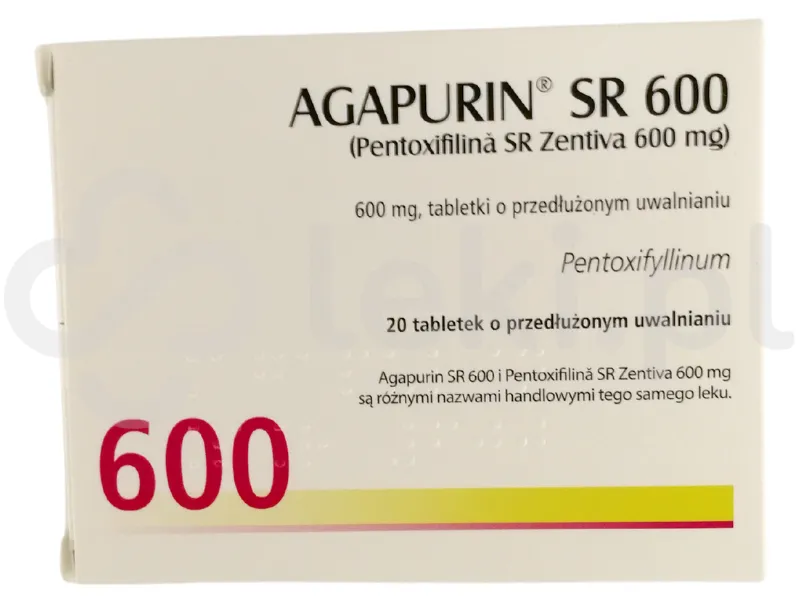
Table of Contents
Package leaflet: Information for the user
Warning! Keep this leaflet! The information on the immediate packaging is in a foreign language.
AGAPURIN SR 600 (AGAPURIN SR 600)
600 mg, prolonged-release tablets
Pentoxifyllinum
AGAPURIN SR 600 and AGAPURIN SR 600 are the same brand names of the same medicine
written in Polish and Bulgarian.
Please read the leaflet carefully before using the medicine, as it contains
important information for the patient.
- Keep this leaflet, as you may need to read it again.
- If you have any questions, please consult your doctor or pharmacist.
- This medicine has been prescribed for a specific individual. Do not share it with others. The medicine may harm another person, even if their symptoms are the same.
- If you experience any adverse reactions, including those not listed in this leaflet, inform your doctor or pharmacist. See section 4.
Contents of the leaflet
- What Agapurin SR 600 is and what it is used for
- Important information before taking Agapurin SR 600
- How to take Agapurin SR 600
- Possible side effects
- How to store Agapurin SR 600
- Contents of the pack and other information
1. What Agapurin SR 600 is and what it is used for
Indications for Agapurin SR 600:
- Peripheral arterial and arteriovenous circulation disorders caused by atherosclerosis, diabetes, inflammatory or functional conditions; intermittent claudication or rest pain, diabetic angiopathy, obliterative vascular disease, trophic changes (phlebostatic syndrome, leg ulcers, gangrene), angioneuropathies;
- Circulatory disturbances in the eyeball (acute and chronic disturbances of retinal and choroidal circulation);
- Inner ear function disorders (hearing disturbances, sudden hearing loss, etc.) caused by circulatory disorders;
- Cerebral ischemia states (post-stroke conditions, cerebrovascular disorders with symptoms such as lack of concentration, dizziness, memory disturbances, etc.).
Agapurin SR 600 is intended for use in adult patients.
2. Important information before using Agapurin SR 600
When not to use Agapurin SR 600
- if the patient is allergic to pentoxifylline, other methylxanthines, or to any of the other ingredients of this medicine (listed in section 6);
- if the patient has recently suffered a myocardial infarction or stroke;
- if the patient has significant bleeding disorders or diseases associated with a high risk of haemorrhage;
- if the patient has experienced a retinal haemorrhage.
Warnings and precautions
Before starting treatment with Agapurin SR 600, discuss this with your doctor or pharmacist.
Your doctor should consider the benefit-risk ratio of using Agapurin SR 600 in patients with hypotension, severe cardiac arrhythmias, advanced atherosclerosis of the coronary and cerebral vessels, acute myocardial infarction, diabetes, or severe renal impairment.
If symptoms of anaphylactic or pseudoallergic reactions occur, treatment with Agapurin SR 600 must be discontinued immediately and the patient should contact their doctor without delay.
Patients with severe cardiac arrhythmias, advanced atherosclerosis of the coronary and cerebral vessels, hypotension, or history of myocardial infarction should be under continuous medical supervision during treatment with Agapurin SR 600.
Renal impairment (creatinine clearance < 30 ml/min) and severe hepatic dysfunction may delay the elimination of pentoxifylline. In such cases, the dose should be reduced and the patient must remain under continuous medical supervision.
Patients with an increased tendency to bleed who are using Agapurin SR 600 concomitantly with vitamin K antagonists, antiplatelet agents, or antidiabetic drugs should be under continuous medical supervision.
Patients using Agapurin SR 600 together with antidiabetic drugs should be under continuous medical supervision (see "Agapurin SR 600 with other medicines", below).
In patients with low blood pressure or heart disease, administration of Agapurin SR 600 may result in a sudden drop in arterial blood pressure and, rarely, back pain or retrosternal pain. Therefore, blood pressure should be monitored during treatment.
Patients using Agapurin SR 600 concomitantly with ciprofloxacin should be under continuous medical supervision (see "Agapurin SR 600 with other medicines", below).
Patients using pentoxifylline concomitantly with theophylline should be under continuous medical supervision (see "Agapurin SR 600 with other medicines").
Agapurin SR 600 with other medicines
Inform your doctor about all medicines currently or recently taken, as well as any medicines you plan to use.
Agapurin SR 600 may enhance the effect of antihypertensive drugs (including angiotensin-converting enzyme inhibitors) or other drugs that lower arterial blood pressure (e.g. nitrates).
In patients treated with insulin or oral antidiabetic drugs, administration of Agapurin SR 600 may intensify the reduction in blood glucose concentration. Therefore, diabetic patients should be under continuous medical supervision.
In patients using pentoxifylline concomitantly with vitamin K antagonists, increased antithrombotic effects have been reported. Close monitoring of antithrombotic activity is recommended when initiating or modifying the dose of Agapurin SR 600 in these patients.
Due to increased risk of bleeding, caution is advised in patients using pentoxifylline concomitantly with antiplatelet agents such as: clopidogrel, eptifibatide, tirofiban, epoprostenol, iloprost, abciximab, anagrelide, non-selective non-steroidal anti-inflammatory drugs (other than selective COX-2 inhibitors), acetylsalicylates (acetylsalicylic acid or lysine acetylsalicylate), ticlopidine, dipyridamole.
In some patients, concomitant use of pentoxifylline and theophylline may increase plasma theophylline concentrations and intensify adverse effects associated with theophylline.
In some patients, concomitant use of pentoxifylline and ciprofloxacin may lead to increased serum concentrations of pentoxifylline. Therefore, the frequency and severity of adverse reactions associated with concomitant use of these two active substances may increase.
Concomitant use of Agapurin SR 600 with cimetidine may increase plasma concentrations of pentoxifylline and its active metabolite.
Agapurin SR 600 with food and drink
See section 3.
Pregnancy and breastfeeding
If the patient is pregnant or breastfeeding, suspects she may be pregnant, or is planning to become pregnant, she should consult her doctor before using this medicine.
Use of this medicine is not recommended in pregnant women or in women who are breastfeeding.
In women who are breastfeeding, the doctor will decide whether the potential benefits outweigh the risks to the infant.
Driving and operating machinery
This medicine has no influence on the ability to drive vehicles or operate machinery.
3. How to use Agapurin SR 600
This medicine should always be used as directed by the physician. In case of doubt, consult your doctor or pharmacist.
The usual dose is 1 tablet once or twice daily.
Patients with low or fluctuating blood pressure may require a special dosing regimen.
Dosing in patients with renal impairment
In patients with impaired renal function (creatinine clearance < 30 ml/min), the physician will reduce the dose to 50–70% of the normally recommended dose, depending on individual tolerance to treatment.
Dosing in patients with hepatic impairment
In patients with severe liver dysfunction, dose reduction is necessary. The treating physician will determine the appropriate dose based on the severity of liver impairment and individual tolerance to treatment.
Use in children and adolescents
There is no experience regarding use in children.
Method of administration
Tablets should be swallowed whole during or immediately after a meal, with an adequate amount of water.
Taking more Agapurin SR 600 than prescribed
If you take more than the prescribed dose, contact your doctor or pharmacist immediately.
Initial symptoms may include nausea, dizziness, tachycardia, hypotension, followed by fever, agitation, hot flushes, loss of consciousness, areflexia, seizures, and coffee-ground vomiting (indicative of gastrointestinal bleeding). Treatment of overdose is symptomatic. The patient may require intensive medical care in hospital.
In case of overdose or accidental ingestion by a child, contact a physician immediately.
Missed dose of Agapurin SR 600
If you accidentally miss a dose, take it as soon as possible. If it is almost time for the next dose, take only that dose at the scheduled time. Do not take a double dose to make up for the missed dose.
Stopping treatment with Agapurin SR 600
Do not discontinue treatment without consulting your doctor.
If you have any further questions about the use of this medicine, consult your doctor or pharmacist.
4. Possible adverse effects
Like all medicines, this medicine can cause adverse effects, although not everyone experiences them.
Immediate medical attention must be sought if the patient experiences:
- symptoms of anaphylactic shock, disorientation and fainting (due to circulatory disturbances and drop in blood pressure) or anaphylactic reactions, such as raised, itchy rash (urticaria), facial swelling, swelling of the eyelids, lips, oral cavity, or breathing difficulties. These conditions may be life-threatening.
- retinal haemorrhage.
The patient should immediately consult a doctor if bruising or bleeding tendencies occur, as these may be symptoms of thrombocytopenia (reduced platelet count). In such cases, blood morphology should be regularly monitored during treatment with Agapurin SR 600.
Gastrointestinal adverse effects are dose-dependent and usually resolve after discontinuation of treatment.
Adverse effects may occur with the following frequency:
Common (occurring in 1 to 10 patients out of 100): nausea, vomiting, bloating, abdominal pain, diarrhoea.
Uncommon (occurring in 1 to 10 patients out of 1,000): dizziness, headache, blurred vision, hot flushes.
Rare (occurring in 1 to 10 patients out of 10,000): skin allergic reactions, erythema (reddening of the skin), pruritus (itching), urticaria, increased sweating, cholestasis (bile stasis), increased liver enzyme activity (aminotransferases), hypotension (low blood pressure), tachycardia (increased heart rate), palpitations (awareness of heartbeats), cardiac arrhythmias, angina pectoris (chest pain), restlessness, sleep disturbances, hallucinations, hypoglycaemia (low blood glucose levels), anaphylactic shock.
Very rare (occurring less frequently than in 1 out of 10,000 patients): aplastic anaemia, thrombocytopenia, haemorrhages (e.g. into the skin, mucous membranes, stomach, intestines).
Not known (frequency cannot be estimated from available data): anaphylactic reaction, pseudoanaphylactic reaction, leukopenia or neutropenia, agitation, angioedema (swelling of various body parts, most commonly in the face), rash, aseptic meningitis, gastrointestinal disorder, discomfort in the epigastrium, feeling of fullness in the abdomen (feeling of satiety), constipation, excessive salivation, decrease in blood pressure, bronchospasm.
Reporting of adverse effects
If any adverse symptoms occur, including any adverse effects not listed in this leaflet, the patient should inform their doctor or pharmacist. Adverse effects can be reported directly to the Department of Monitoring Adverse Drug Reactions of the Office for Registration of Medicinal Products, Medical Devices and Biocidal Products, Al. Jerozolimskie 181C, 02-222 Warsaw, tel.: +48 22 49 21 301, fax: +48 22 49 21 309, website: https://smz.ezdrowie.gov.pl.
Reporting adverse effects helps to provide more information on the safety of the medicine.
5. How to store Agapurin SR 600
Keep this medicine out of the sight and reach of children.
There are no special storage instructions.
Do not use this medicine after the expiry date stated on the packaging. The expiry date refers to the last day of the stated month.
Medicines must not be disposed of via wastewater or household waste. Ask your pharmacist how to dispose of medicines no longer required. Such measures help protect the environment.
6. Contents of the pack and other information
What Agapurin SR 600 contains
The active substance is pentoxifylline in an amount of 600 mg.
The other ingredients are:
core: hypromellose 2208/15000, povidone 30, talc, magnesium stearate;
coating: Sepifilm 752 white (hypromellose, microcrystalline cellulose, polyoxyl 40 stearate,
titanium dioxide), simethicone emulsion SE4, macrogol 6000.
What Agapurin SR 600 looks like and contents of the pack
White or almost white, oval, biconvex tablets with a dividing score line.
Pack size: 20, 50 or 100 prolonged-release tablets in blister packs within a cardboard box.
For more detailed information, please contact the responsible party or parallel importer.
Marketing Authorisation Holder in Bulgaria, country of export:
Zentiva, k.s.
U kabelovny 130
Dolní Měcholupy
102 37, Prague 10
Czech Republic
Manufacturer:
Zentiva, k.s.
U kabelovny 130
Dolní Měcholupy
102 37, Prague 10
Czech Republic
Saneca Pharmaceuticals a.s.
Nitrianska 100
92027 Hlohovec
Slovakia
Parallel Importer:
InPharm Sp. z o.o.
ul. Strumykowa 28/11
03-138 Warsaw
Repackaged in:
InPharm Sp. z o.o. Services sp. k.
ul. Chełmżyńska 249
04-458 Warsaw
Marketing Authorisation Number in Bulgaria, country of export: 20010389
Parallel Import Authorisation Number: 345/24