Afastural
Poland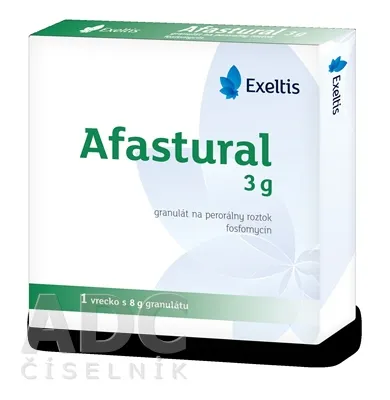
Table of Contents
Package leaflet: Information for the user
Afastural, 3 g, granules for oral solution
Fosfomycin
Please read all of this leaflet carefully before taking this medicine because it
contains important information for you.
- Keep this leaflet, as you may need to read it again.
- If you have any further questions, please ask your doctor or pharmacist.
- This medicine has been prescribed for a specific individual. Do not pass it on to others. It may harm someone else, even if their symptoms are the same.
- If you experience any adverse effects, including any not listed in this leaflet, tell your doctor or pharmacist. See section 4.
Leaflet contents:
- What Afastural is and what it is used for
- What you need to know before taking Afastural
- How to take Afastural
- Possible side effects
- How to store Afastural
- Contents of the pack and other information
1. What Afastural is and what it is used for
Afastural contains the active substance fosfomycin (in the form of fosfomycin trometamol).
It is an antibiotic that works by killing bacteria that may cause infections.
Afastural is used to treat uncomplicated bladder infections in women and adolescent girls.
Afastural is also used as prophylactic antibiotic therapy in adult men undergoing transrectal prostate biopsy.
2. Information before using Afastural
When not to take Afastural:
if the patient is allergic to fosfomycin or any of the other ingredients
of this medicine (listed in section 6).
Warnings and precautions
Before starting to take Afastural, discuss with your doctor, pharmacist, or
nurse if the patient has:
- chronic bladder infections,
- diarrhoea that occurred in the past after taking other antibiotics.
Considerations
Afastural may cause serious adverse effects. These include allergic reactions
and inflammation of the large intestine. During treatment, patients should be aware of specific
symptoms to reduce the risk of problems. See "Serious adverse effects" in section 4.
Children and adolescents
This medicine should not be given to children under 12 years of age, as safety and efficacy have not been established in this age group.
Afastural and other medicines
Tell your doctor or pharmacist about all medicines the patient is currently taking or has recently taken, as well as any medicines the patient plans to take, including
those available without a prescription.
This is particularly important when taking:
- metoclopramide or other medicinal products that increase gastric and intestinal motility, as they may reduce the absorption of fosfomycin by the body,
- anticoagulants, because fosfomycin and other antibiotics may affect their ability to prevent blood clot formation.
Afastural and food
Food may delay the absorption of fosfomycin. Therefore, this medicine should be taken on
an empty stomach (2–3 hours before or 2–3 hours after a meal).
Pregnancy, breastfeeding, and fertility
If the patient is pregnant or breastfeeding, suspects she may be pregnant, or is planning to have a child, she should consult her doctor or pharmacist before using this
medicine.
The doctor will prescribe this medicine during pregnancy only if clearly necessary.
Breastfeeding mothers may take a single oral dose of this medicine.
Driving and using machines
Adverse effects such as dizziness may occur, which could affect the ability to drive or
operate machinery.
Afastural contains sucrose
If the patient has previously been diagnosed with intolerance to certain sugars, the patient should
consult a doctor before taking this medicine.
3. How to use Afastural
This medicine should always be taken as directed by a doctor or pharmacist. In case of
doubt, consult a doctor or pharmacist.
For the treatment of uncomplicated bladder infections in women and adolescent girls,
the recommended dose is one sachet of Afastural (3 g of fosfomycin).
When used as prophylactic antibiotic therapy prior to transrectal prostate biopsy,
the recommended dose is one sachet of Afastural (3 g of fosfomycin) three hours before
the procedure and one sachet of Afastural (3 g of fosfomycin) 24 hours after completion
of the procedure.
Use in patients with renal function impairment
This medicine should not be used in patients with severe renal impairment (creatinine clearance
<10 ml/min).
Use in children and adolescents
This medicine should not be used in children under 12 years of age.
Method of administration
Oral administration.
This medicine should be taken orally on an empty stomach (2–3 hours before or 2–3 hours after
a meal), preferably before going to bed and after emptying the bladder.
Dissolve the contents of one sachet in a glass of water and drink immediately.
Accidental overdose of Afastural
If a larger than recommended dose has been taken by accident, contact a doctor or pharmacist.
If you have any further doubts regarding the use of this medicine, consult a doctor or pharmacist.
4. Possible adverse reactions
Like all medicines, this medicine can cause adverse reactions, although not everyone experiences them.
Serious adverse reactions
Immediately discontinue use of the medicine and contact a doctor if the following symptoms occur during treatment with Afastural:
- Anaphylactic shock, a life-threatening allergic reaction (frequency unknown). Symptoms include sudden onset of rash, itching or hives on the skin, or shortness of breath, wheezing or difficulty breathing,
- Swelling of the face, lips, tongue or throat and difficulty breathing – angioedema (frequency unknown),
- Diarrhea ranging from moderate to severe, abdominal cramps, bloody stools and/or fever may indicate infection of the large intestine – antibiotic-associated colitis (frequency unknown). Do not take antidiarrheal medicines that reduce intestinal motility (antiperistaltic agents).
Other adverse reactions
Common (may affect up to 1 in 10 people):
- Headache
- Dizziness
- Diarrhea
- Nausea
- Indigestion
- Abdominal pain
- Infection of female genital organs manifesting as inflammation, irritation, itching (vulvovaginal inflammation).
Uncommon (may affect up to 1 in 100 people):
- Vomiting
- Rash
- Urticaria
- Itching.
Unknown (frequency cannot be estimated from available data):
- Allergic reactions.
Reporting of adverse reactions
If any adverse reactions occur, including any adverse reactions not listed in this leaflet, inform your doctor or pharmacist. Adverse reactions can be reported directly to the Department of Monitoring of Adverse Drug Reactions at the Office for Registration of Medicinal Products, Medical Devices and Biocidal Products, Al. Jerozolimskie 181 C, 02-222 Warsaw, Tel.: +48 22 49 21 301, Fax: +48 22 49 21 309, website: https://smz.ezdrowie.gov.pl. Adverse reactions can also be reported to the Marketing Authorisation Holder. Reporting adverse reactions helps provide more information on the safety of the medicine.
5. How to store Afastural
Keep this medicine out of the sight and reach of children.
Do not use this medicine after the expiry date stated on the carton after:
"Expiry date:" or "EXP". The expiry date refers to the last day of the specified month.
No special storage conditions are required for this medicine.
Medicines must not be disposed of via wastewater or household waste. Ask your pharmacist how to dispose of medicines no longer required. Such measures help protect the environment.
6. Contents of the package and other information
What Afastural contains
The active substance is fosfomycin. Each sachet contains 5631 mg of fosfomycin with trometamol, corresponding to 3,000 g of fosfomycin.
Other ingredients are:
orange flavour consisting of maltodextrin, monohydrate dextrose, arabic gum (E 414), anhydrous citric acid (E 330), butylhydroxyanisole (E 320);
sodium saccharin, sucrose, calcium hydroxide.
What Afastural looks like and contents of the pack
White or greyish granules in a single-dose sachet.
Afastural is available in the following pack sizes:
Sachet made of paper/LDPE/Aluminium/LDPE in a cardboard box.
1 sachet of 8 g (3 g fosfomycin)
2 sachets of 8 g each (each containing 3 g fosfomycin)
Not all pack sizes may be marketed.
Marketing Authorisation Holder and Manufacturer
Marketing Authorisation Holder
Exeltis Poland Sp. z o.o.
ul. Szamocka 8
01-748 Warsaw
Poland
Manufacturer
SPECIAL PRODUCT’S LINE S.p.A.
Via Fratta Rotonda Vado Largo, 1
03012 Anagni (FR)
Italy
This medicinal product is authorised in the European Economic Area countries under the following names:
United Kingdom: Fosfomycin 3g granules for oral solution
Czech Republic: Urifos 3g
Estonia: Fosfomycin LadeePharma 3g
Hungary: Fosfomycin Exeltis 3g granulátum belsőleges oldathoz
Lithuania: Fosfomycin LadeePharma 3g granulės geriamajam tirpalui
Latvia: Fosfomycin LadeePharma 3g granulas iekšķīgi lietojama šķīduma pagatavošanai
Poland: Afastural
Slovakia: Afastural 3g
09.06.2020