Aescin
Poland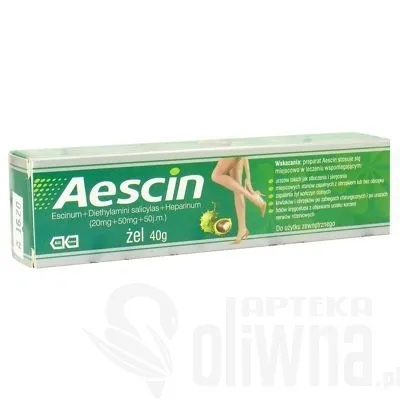
Table of Contents
Package leaflet: information for the user
AESCIN, 20 mg + 50 mg + 50 IU, gel
(Escinum + Diethylamine salicylate + Heparinum)
Please read this leaflet carefully before using the medicine, as it contains
important information for the patient.
- This medicine should always be used exactly as described in the patient leaflet or as directed by a physician or pharmacist.
- Keep this leaflet, as you may need to read it again.
- If you need advice or further information, consult your pharmacist.
- If you experience any adverse reactions, including any possible adverse reactions not listed in this leaflet, inform your doctor or pharmacist. See section 4.
- If there is no improvement or if you feel worse, contact your doctor.
Leaflet contents:
- What Aescin is and what it is used for
- Important information before using Aescin
- How to use Aescin
- Possible side effects
- How to store Aescin
- Contents of the package and other information
1. What Aescin is and what it is used for
Aescin is used topically as supportive treatment for:
- injuries such as contusions and sprains
- local inflammatory conditions with or without swelling
- inflammation of veins in the lower limbs
- haematomas and oedema following surgical procedures or trauma
- spinal pain associated with symptoms of spinal nerve root compression.
Aescin gel is a medicine with anti-oedematous, anti-inflammatory and venous-protective properties.
It normalizes capillary membrane permeability, strengthens capillary endothelium, and reduces lymphatic exudation.
It is also used supportively to reduce other adverse symptoms such as leg pain and heaviness, skin itching, lower limb oedema, and calf muscle cramps occurring in venous circulation disorders of the lower limbs.
Escin is the main saponin derived from horse chestnut seeds. Escin has anti-oedematous and anti-inflammatory effects and improves vascular tone, although its efficacy following topical application cannot be fully confirmed. It reduces permeability of blood vessel walls. Escin demonstrates anti-oedematous and anti-inflammatory activity. It normalizes capillary membrane permeability, strengthens capillary endothelium, and reduces lymphatic exudation.
Heparin is a natural polyanionic polysaccharide. It exerts inhibitory effects on all stages of blood coagulation. When applied topically, it acts antithrombotically and anti-inflammatorily.
Diethylamine salicylate, when used topically, exerts analgesic and anti-inflammatory effects.
If there is no improvement or if you feel worse, contact your doctor.
2. Important information before using Aescin
When not to use Aescin
- if the patient is allergic to the active substances or to any of the other ingredients of this medicine (listed in section 6).
- if the patient has chronic kidney disease or renal failure
- in women during the first three months of pregnancy
- locally on mucous membranes, open wounds, or in cases of skin necrosis
- on skin areas exposed to radiation.
Warnings and precautions
If any of the following symptoms occur after using Aescin, contact a doctor immediately:
- skin inflammation,
- thrombophlebitis,
- subcutaneous indurations (lumps under the skin),
- skin ulcers,
- acute pain related to skin conditions,
- sudden swelling of one or both legs,
- heart or kidney failure.
When using anticoagulant drugs concomitantly, blood coagulation parameters should be monitored frequently.
It is important to follow all other non-invasive measures recommended by the physician, such as leg bandaging, wearing compression stockings, or cold water compresses.
Renal function should be monitored during treatment with Aescin.
Note: The use of Aescin does not replace other preventive measures such as cold compresses or wearing compression stockings.
Children and adolescents
Aescin is not recommended for use in children and adolescents under 18 years of age due to insufficient data on safety in this age group.
Aescin and other medicines
There is no data available on interactions with other medicines.
Inform your doctor about all medicines you are currently taking, including those obtained without a prescription.
Pregnancy and breastfeeding
If the patient is pregnant or breastfeeding, suspects she may be pregnant, or is planning to become pregnant, she should consult a doctor or pharmacist before using this medicine.
Pregnancy
There are no clinical data on the use of Aescin during pregnancy. Animal studies do not indicate a direct or indirect harmful effect of alpha-aescin on pregnancy course or fetal development.
Prolonged use and application over large skin areas should be avoided in pregnant women (maximum 3 weeks following consultation with a doctor).
Caution should be exercised when using Aescin during pregnancy.
Breastfeeding
There are no data on the safety of using Aescin during breastfeeding.
Aescin should not be applied to the breast area in breastfeeding women.
Driving and operating machinery
There are no data on adverse effects affecting the ability to drive or operate machinery.
This medicine contains methyl parahydroxybenzoate (E 218) and propyl parahydroxybenzoate (E 216)
Due to the presence of methyl parahydroxybenzoate (E 218) and propyl parahydroxybenzoate (E 216), this medicine may cause allergic reactions (delayed-type reactions possible).
3. How to use Aescin
This medicine should always be used as directed by a physician or pharmacist. If in doubt,
consult your doctor or pharmacist again.
Aescin gel is for external use only, applied locally to the skin.
The gel should be applied on average 3 to 5 times daily, spread in a thin layer and then
gently rubbed into the affected area and surrounding tissue.
A massage prior to applying the gel accelerates the absorption of the active substance.
Use in children and adolescents
The use of Aescin is not recommended in children and adolescents under 18 years of age.
If you have any doubts regarding the use of this medicine, consult your doctor or pharmacist.
4. Possible adverse reactions
Like all medicines, this medicinal product may cause adverse reactions, although not everybody will experience them.
The frequency of adverse reactions is defined as follows:
- very common – more than 1 in 10 people
- common – 1 to 10 in 100 people
- uncommon – 1 to 10 in 1,000 people
- rare – 1 to 10 in 10,000 people
- very rare – less than 1 in 10,000 people
- unknown – frequency cannot be estimated from the available data
Rare: allergic skin reactions (itching, rash, erythema, dermatitis, urticaria)
Very rare: severe allergic reactions (in some cases with bleeding); tachycardia,
arterial hypertension; hypersensitivity reactions
Uncommon: dizziness, headache
If any of the above reactions occur, particularly bleeding or first signs of hypersensitivity (skin rash), the medicinal product should be discontinued and medical advice should be sought immediately.
Reporting of adverse reactions
If any adverse reactions occur, including any adverse reactions not listed in this leaflet, inform your doctor or pharmacist.
Adverse reactions can also be reported directly to the Department of Monitoring Adverse Drug Reactions, Office for Registration of Medicinal Products, Medical Devices and Biocidal Products, Al. Jerozolimskie 181 C, 02-222 Warsaw
Tel.: +48 22 49 21 301
Fax: +48 22 49 21 309
Website: https://smz.ezdrowie.gov.pl
Reporting adverse reactions enables better assessment of the benefit-risk balance of the medicinal product and contributes to its safe use.
5. How to store Aescin
Store below 25°C.
Keep in a place out of sight and reach of children.
Do not use this medicine after the expiry date stated on the packaging. The expiry date refers to the last day of the stated month.
Medicines should not be disposed of via wastewater or household waste. Ask your pharmacist how to dispose of medicines no longer required. This will help protect the environment.
6. Contents of the pack and other information
What Aescin contains
- The active substances are: alpha-aescin, diethylamine salicylate, and heparin.
- The other components are: carbomers, tromethamine, isopropyl alcohol, methyl parahydroxybenzoate (E 218), propyl parahydroxybenzoate (E 216), disodium edetate, purified water.
What Aescin looks like and contents of the pack
Gel.
Metal tube containing 40 g of gel, in a cardboard box.
Marketing Authorisation Holder and Manufacturer
Marketing Authorisation Holder
Teva Pharmaceuticals Polska Sp. z o.o.
ul. Emilii Plater 53
00-113 Warsaw
Tel. (22) 345 93 00
Manufacturer
Nobilus Ent
ul. Zegrzyńska 22A
05-110 Jabłonna
Poland