Adrenaline wzf 0,1%
Poland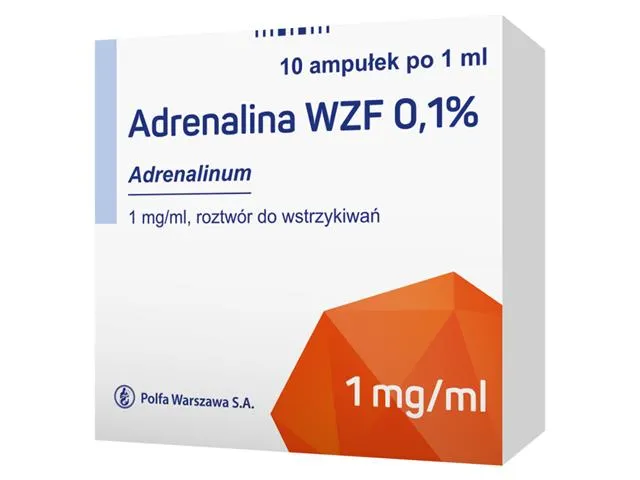
Table of Contents
- Package leaflet: Information for the patient
- 1. What Adrenalina WZF 0.1% is and what it is used for
- 2. Important information before using Adrenalina WZF 0.1%
- 3. How to use Adrenalina WZF 0,1%
- in the section "Information intended exclusively for healthcare professionals".
- 4. Possible adverse effects
- 5. Storage of Adrenalina WZF 0.1%
- 6. Contents of the pack and other information
Package leaflet: Information for the patient
ADRENALINA WZF 0.1%, 1 mg/ml, solution for injection
Adrenalinum
Please read all of this leaflet carefully before this medicine is administered, because it contains
important information for the patient.
- Keep this leaflet, as you may need to read it again.
- If you have any further questions, please ask your doctor or pharmacist.
- This medicine has been prescribed for a specific individual. Do not pass it on to others. It may harm other people, even if their symptoms are the same.
- If you experience any adverse reactions, including any not listed in this leaflet, tell your doctor or pharmacist. See section 4.
Contents of the leaflet
- What Adrenalina WZF 0.1% is and what it is used for
- Important information before using Adrenalina WZF 0.1%
- How to use Adrenalina WZF 0.1%
- Possible side effects
- How to store Adrenalina WZF 0.1%
- Contents of the pack and other information
1. What Adrenalina WZF 0.1% is and what it is used for
The active substance in this medicine is adrenaline. Adrenaline constricts blood vessels, increases heart rate, and dilates the airways. This medicine is administered by a doctor in life-threatening situations, including:
- acute cardiac arrest – cardiopulmonary resuscitation (i.e. life-saving procedures involving measures that temporarily replace heart and lung function);
- anaphylactic shock and other severe allergic reactions;
- acute bronchial asthma attack – to relieve bronchospasm;
- severe bradycardia (slowing of the heart);
- cardiogenic shock – as a vasopressor (a medicine that constricts blood vessels).
2. Important information before using Adrenalina WZF 0.1%
When not to use Adrenalina WZF 0.1%
- if the patient is allergic to adrenaline or to any of the other ingredients of the medicine (listed in section 6). However, in life-threatening situations, there are no absolute contraindications to the use of this medicine.
Warnings and precautions
Before starting treatment with Adrenalina WZF 0.1%, discuss this with your doctor or
pharmacist.
Exercise particular caution when using Adrenalina WZF 0.1% in the following cases:
- heart diseases (e.g. coronary artery disease, cardiac arrhythmias, right ventricular hypertrophy);
- hyperthyroidism;
- arterial hypertension;
- diabetes;
- increased intraocular pressure;
- pheochromocytoma;
- prostatic adenoma (leading to urinary retention);
- elevated calcium levels in the blood;
- decreased potassium levels in the blood;
- severe renal insufficiency;
- in elderly patients.
Adrenalina WZF 0.1% and other medicines
Inform your doctor or pharmacist about all medicines currently used, recently used, or planned for use.
- Adrenaline may be used with other medicines, but its effects may be enhanced by:
- medicines used in the treatment of depression (e.g. venlafaxine, milnacipran, and monoamine oxidase inhibitors);
- medicines used in the treatment of Parkinson's disease (e.g. entacapone, an enzyme inhibitor known as catechol-O-methyltransferase inhibitor; levodopa);
- thyroid hormones;
- theophylline (an anti-asthmatic medicine);
- oxytocin (a hormonal medicine used in obstetrics);
- parasympatholytics (e.g. atropine);
- certain antihistamines, such as diphenhydramine, chlorpheniramine;
- sympathomimetic medicines (e.g. inhaled bronchodilators).
- Alcohol intensifies the effects of adrenaline.
- When adrenaline is administered together with drugs such as propranolol, sotalol (and other non-selective β-adrenolytics), severe arterial hypertension and bradycardia may occur.
- The medicine should be used with caution in patients receiving digitalis glycosides, quinidine, or halogenated anaesthetic agents, as these medicines may increase the risk of cardiac arrhythmias.
- The increase in arterial blood pressure caused by adrenaline may be counteracted by rapidly acting vasodilating medicines or α-adrenergic receptor blockers.
- The effects of adrenaline may be reversed by β-adrenergic receptor blockers, particularly non-selective ones (e.g. propranolol).
- Adrenaline inhibits insulin secretion; therefore, in patients with diabetes, it may be necessary to increase the dose of insulin or other antidiabetic medicines.
Pregnancy and breastfeeding
If the patient is pregnant or breastfeeding, suspects she may be pregnant, or is planning to have a
child, she should consult a doctor or pharmacist before using this medicine.
This medicine may be used in pregnant women if, in the physician's opinion, the benefit to the mother outweighs the potential risk to the fetus.
Due to negligible passage of adrenaline into breast milk, it is unlikely that the medicine will affect the breastfed infant.
Driving and operating machinery
After administration of adrenaline, the patient should not drive or operate machinery until symptoms
that were the reason for administering the medicine have resolved.
Adrenalina WZF 0.1% contains sodium metabisulfite (E 223) and sodium
Adrenalina WZF 0.1% contains sodium metabisulfite (E 223) – the medicine may rarely cause severe hypersensitivity reactions and bronchospasm.
The medicine contains 3.39 mg of sodium (the main component of table salt) in each ampoule (1 ml of solution).
This corresponds to 0.17% of the maximum recommended daily dietary sodium intake for adults.
The medicine may be diluted – see below "Information intended exclusively for healthcare professionals". The sodium content from the diluent should be taken into account when calculating the total sodium content in the prepared diluted solution. For precise information on the sodium content in the solution used for dilution, refer to the package leaflet of the diluent used.
3. How to use Adrenalina WZF 0,1%
This medicine should always be used according to the instructions given by the doctor or pharmacist. If in doubt,
consult your doctor.
Adrenalina WZF 0,1% is administered by a doctor subcutaneously, intramuscularly, or intravenously.
The doctor adjusts the dose according to the patient's condition. Detailed information is provided
in the section "Information intended exclusively for healthcare professionals".
Use of a higher dose of Adrenalina WZF 0.1% than recommended
If a large dose of the medicine is administered or if accidental intravascular injection occurs, a
sudden increase in arterial blood pressure, peripheral vasoconstriction, and cardiac stimulation may result.
Slowing or acceleration of heart function, cardiac arrhythmias, and breathing difficulties may
occur. Appropriate management should be initiated by healthcare personnel.
4. Possible adverse effects
Like any medicine, this medicine can cause adverse effects, although not everyone experiences them.
The occurrence of adverse effects depends on the patient's sensitivity to adrenaline and the dose administered.
Frequently occurring adverse effects (less than 1 in 10 people), even after administration of small
doses of adrenaline, include: palpitations, tachycardia, sweating, nausea, vomiting,
breathing difficulties, pallor, dizziness, weakness, tremor, headache, nervousness, anxiety,
restlessness, and cold sensation in the hands and feet.
Rarely (less than 1 in 100 people), the following have been reported:
hallucinations, fainting, increased blood glucose levels, decreased blood potassium levels,
metabolic acidosis, pupillary dilation, difficulty in urination including urinary retention, and muscle tremors.
Adverse effects observed after administration of high doses of adrenaline or in sensitive individuals include:
cardiac arrhythmias (atrial fibrillation or cardiac arrest), sudden increase in arterial blood pressure (sometimes leading to cerebral hemorrhage), and vasoconstriction (e.g., in the skin, mucous membranes, kidneys).
The medicine contains sodium metabisulfite, which may cause allergic reactions, including anaphylactic symptoms and bronchospasm, in sensitive individuals, particularly those with asthma.
Reporting of adverse effects
If any adverse effects occur, including those not listed in this leaflet, inform a doctor, pharmacist, or nurse. Adverse effects can be reported directly to the Department of Monitoring of Adverse Drug Reactions at the Office for Registration of Medicinal Products, Medical Devices
and Biocidal Products
Al. Jerozolimskie 181C
02-222 Warsaw
Tel.: +48 22 49 21 301
Fax: +48 22 49 21 309
Website: https://smz.ezdrowie.gov.pl
Adverse effects can also be reported to the marketing authorization holder.
Reporting adverse effects helps to gather more information on the safety of the medicine.
5. Storage of Adrenalina WZF 0.1%
Store in a refrigerator (2°C–8°C). Keep ampoules in the outer packaging to protect from light. Do not freeze.
Storage of the medicine at temperatures below 25°C for up to 6 months is permitted.
The medicine should be stored out of sight and reach of children.
Do not use this medicine after the expiry date stated on the label and carton. The expiry date refers to the last day of the stated month.
The marking on the packaging following the abbreviation EXP indicates the expiry date, and following the abbreviation Lot indicates the batch number.
Medicines should not be disposed of via the sewage system or household waste. Ask a pharmacist how to dispose of medicines no longer in use. This will help protect the environment.
6. Contents of the pack and other information
- The active substance is adrenaline. Each ml of injection solution contains 1 mg adrenaline (as adrenaline bitartrate).
- Other ingredients: sodium metabisulfite (E223), sodium chloride, water for injections.
What Adrenalina WZF 0.1% looks like and contents of the pack
Adrenalina WZF 0.1% is a colourless or almost colourless, clear liquid.
Pack: 10 ampoules of 1 ml in a cardboard box.
Marketing authorization holder and manufacturer
Zakłady Farmaceutyczne POLPHARMA S.A.
ul. Pelplińska 19, 83-200 Starogard Gdański
tel. +48 22 364 61 01
Information intended exclusively for healthcare professionals:
ADRENALINA WZF 0.1%, 1 mg/ml, solution for injection
Adrenalinum
Instructions for opening the ampoule
Before opening the ampoule, ensure that all the solution is in the lower part of the ampoule.
Gently shake the ampoule or tap it with a finger to help the solution flow down.
Each ampoule has a coloured dot (see Figure 1) indicating the score mark located beneath it.
- To open the ampoule, hold it vertically with both hands, with the coloured dot facing towards you – see Figure 2. The upper part of the ampoule should be held so that the thumb is positioned above the coloured dot.
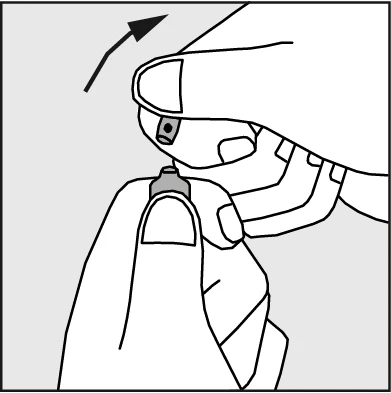
- Press in the direction of the arrow shown in Figure 3.
Ampoules are intended for single use only and should be opened immediately before use. Any unused portion of the product should be destroyed in accordance with applicable regulations.
Figure 1.
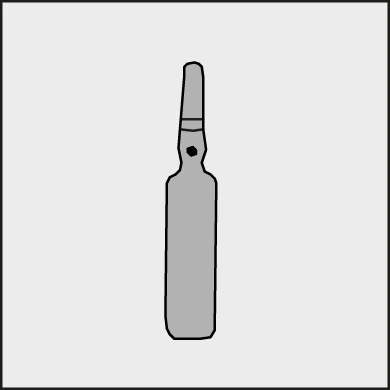
Figure 2.
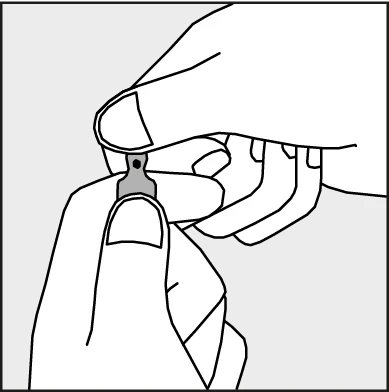
Figure 3.
Adrenalina WZF 0.1% may be administered subcutaneously, intramuscularly, or intravenously.
In the initial treatment of anaphylaxis, intramuscular administration of adrenaline is recommended. Intravenous administration is intended for use in intensive care or emergency departments. The 1 mg/ml (1:1000) adrenaline solution is not suitable for intravenous use. If adrenaline 1:10,000 (0.1 mg/ml) solution for injection is not available, the 1:1000 solution must be diluted to 1:10,000 before intravenous administration – dilution preparation instructions are provided below. Extreme caution must be exercised when administering adrenaline intravenously; this route is reserved exclusively for experienced specialists.
Adults
Cardiac arrest – cardiopulmonary resuscitation
- Intravenously: 1 mg adrenaline, either diluted 10-fold or undiluted followed by a 10 ml bolus of 0.9% NaCl solution. Doses may be repeated every 3 to 5 minutes if necessary.
After restoration of a perfusing cardiac rhythm, if continued use of adrenaline is required, administer slowly intravenously in small doses (50 to 100 µg boluses) until the desired arterial blood pressure is achieved.
Anaphylactic shock and other acute allergic reactions
-
Intramuscularly or subcutaneously: 0.3 to 0.5 mg. In severe cases, 1 mg as a single dose. Intramuscular administration is preferred in anaphylactic shock. Doses may be repeated every 10 to 15 minutes if necessary, and every 5 minutes in justified cases.
-
Slowly intravenously: 0.3 to 1 mg after dilution (10-fold or greater). Intravenous administration is reserved exclusively for patients with severe, life-threatening shock or in special circumstances, e.g., during general anesthesia.
Bronchial asthma attack – to relieve bronchospasm
- Subcutaneously or intramuscularly: 0.3 mg. Doses may be repeated three times every 20 minutes.
Severe bradycardia
- If atropine is ineffective, consider administering adrenaline as an intravenous infusion at a rate of 2 to 10 µg/min. Administer the medicine until the desired effect is achieved.
Cardiogenic shock – as a vasopressor
- As a second-line agent – intravenous infusion of 0.05 to 0.5 µg/kg body weight/min.
Children
Cardiac arrest – cardiopulmonary resuscitation
- Intravenously: 10 µg/kg body weight. Doses may be repeated every 3 to 5 minutes if necessary.
After restoration of spontaneous circulation, if adrenaline is still required, administer as an intravenous infusion of 0.05 to 1.0 µg/kg body weight/min. The infusion should be continued until the desired effect is achieved. Individual responses to adrenaline in children may vary significantly.
Anaphylactic shock and other acute allergic reactions
Intramuscularly or subcutaneously: 10 µg/kg body weight, up to a maximum single dose of 0.5 mg.
In anaphylactic shock, intramuscular administration is preferred.
| Age | Epinephrine dose 1 mg/ml (1:1000 solution) |
| Over 12 years | 0.5 mg im. (0.5 ml of 1:1000 solution) |
| 6 to 12 years | 0.3 mg im. (0.3 ml of 1:1000 solution) |
| 6 months to 6 years | 0.15 mg im. (0.15 ml of 1:1000 solution) |
| Below 6 months | 0.01 mg/kg b.w. im. (0.01 ml/kg b.w. of 1:1000 solution) |
If necessary, the above doses may be repeated several times, maintaining intervals of 5 to 15 minutes, taking into account arterial pressure, pulse, and respiratory function.
Use of small-volume syringes is recommended.
Slow intravenous administration: 10 µg/kg body weight after dilution (at least 10-fold or more). Intravenous administration is reserved exclusively for patients with severe, life-threatening shock or in special circumstances, e.g., during general anesthesia.
Bronchial asthma attack - to relieve bronchospasm
- Subcutaneously or intramuscularly: 10 µg/kg body weight, maximum single dose up to 0.5 mg. Doses may be repeated twice every 20 minutes, then if necessary every 4 hours.
Severe bradycardia
- Intravenous infusion: 0.05 to 1.0 µg/kg body weight/min.
Cardiogenic shock - as a vasopressor
- As second-line therapy, intravenous infusion: 0.05 to 1.0 µg/kg body weight/min.
IN LIFE-THREATENING CONDITIONS!
Adults
- If intravenous access cannot be obtained, the drug may be administered intrathecally (intraosseously) at doses equivalent to intravenous doses.
- Endotracheal administration: 3 mg after dilution. To prepare, dilute 3 ml of adrenaline to 10 ml with 0.9% NaCl solution or water for injections and administer through the endotracheal tube. Dilution with water for injections results in better drug absorption.
Children
- If intravenous access cannot be obtained, the drug may be administered intraosseously at intravenous doses or endotracheally at a dose of 100 µg/kg body weight after prior dilution in 5 ml of 0.9% NaCl solution.
WARNING: Adrenaline undergoes accelerated degradation in alkaline environments. The drug must not be mixed with bicarbonates.
The drug may be diluted in the following infusion solutions: 0.9% NaCl solution, water for injections, or 5% glucose solution. Solutions must be prepared immediately before administration.
Adrenaline is most commonly used at the following concentrations:
1:1000 (1 mg adrenaline/1 ml solution) – ready-to-use preparation,
1:10,000 (1 mg adrenaline/10 ml solution),
1:100,000 (1 mg adrenaline/100 ml solution).
See also section "Adrenalina WZF 0.1% contains sodium metabisulfite (E 223) and sodium".
Sodium content originating from the diluent should be taken into account when calculating the total sodium content in the prepared drug dilution. For accurate information regarding sodium content in the solution used for dilution, refer to the leaflet of the diluent used.