Adenocor
Poland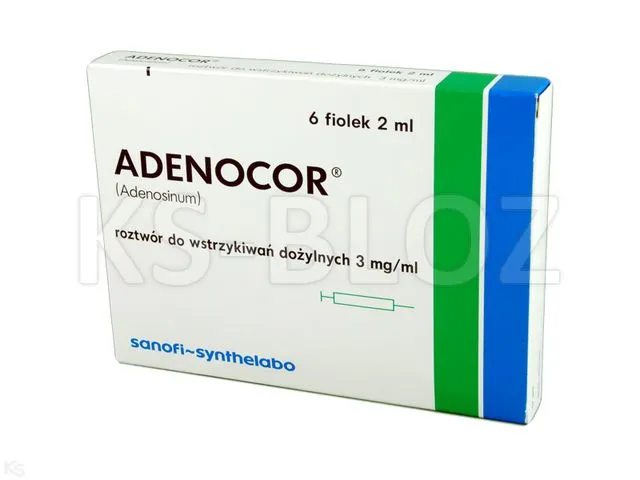
Table of Contents
Package leaflet: Information for the user
Warning! Keep this leaflet! Information on the immediate packaging in a foreign language.
Adenocor
3 mg/ml, solution for injection
Adenosinum
Please read all of this leaflet carefully before the medicine is administered, because it contains important information for the patient.
- Keep this leaflet so that you can read it again if necessary.
- If you have any further questions, please ask your doctor or nurse.
- This medicine has been prescribed for a specific individual. Do not pass it on to others. It may harm other people, even if their symptoms are the same.
- If any side effects occur, including any not listed in this leaflet, inform your doctor or nurse. See section 4.
Contents of the leaflet:
- What Adenocor is and what it is used for
- What you need to know before receiving Adenocor
- How to use Adenocor
- Possible side effects
- How to store Adenocor
- Contents of the pack and other information
1. What Adenocor is and what it is used for
Adenosine is a purine nucleoside present in all cells of the body.
It belongs to the group of antiarrhythmic medicines.
Adenocor works by slowing down electrical impulses between the atria and ventricles (upper and lower chambers) of the heart. This slows down rapid or irregular heartbeat known as arrhythmia.
Indications
- Rapid restoration of sinus rhythm in paroxysmal supraventricular tachycardia, including cases involving an accessory conduction pathway (Wolff-Parkinson-White syndrome).
- Aid in the differential diagnosis of supraventricular tachycardia with either narrow or wide QRS complexes. Although adenosine is not effective in treating atrial flutter, atrial fibrillation, or ventricular tachycardia, slowing conduction through the atrioventricular node facilitates assessment of atrial electrical activity.
Children and adolescents
- Rapid restoration of normal heart rhythm in paroxysmal supraventricular tachycardia in children and adolescents aged 0 to 18 years.
2. Important information before using Adenocor
When not to use Adenocor:
- if the patient is allergic to adenosine or any of the other ingredients of this medicine (listed in section 6). An allergic reaction may present as rash, itching, breathing difficulties, or swelling of the lips, face, throat or tongue;
- if the patient has chronic obstructive pulmonary disease with bronchospasm symptoms – breathing difficulties (e.g. bronchial asthma);
- if the patient has very low blood pressure (severe hypotension);
- if the patient has a certain type of heart failure in which the heart is unable to pump sufficient blood;
- if the patient has heart rhythm disorders, except in patients with a cardiac pacemaker (second- and third-degree atrioventricular block, sick sinus syndrome);
- if the patient has long QT syndrome. This is a rare heart condition that may lead to rapid heartbeat and fainting.
Do not take this medicine if any of the above conditions apply.
If you are uncertain whether any of these conditions are present, consult your doctor before starting
treatment with Adenocor.
Warnings and precautions
Before starting treatment with Adenocor, discuss with your doctor if:
- the patient has certain types of irregular heart rhythm (atrial fibrillation and flutter), particularly with an "accessory conduction pathway";
- the patient has a heart condition in which electrical impulses in a part of the heart responsible for depolarization and repolarization (discharging and recharging) last longer than usual (prolonged QT interval);
- the patient has low blood volume (hypovolemia) not corrected by appropriate treatment;
- the patient has problems with part of the nervous system called the autonomic nervous system;
- the patient has carotid artery stenosis. This means insufficient blood flow to the brain (cerebral vascular insufficiency);
- the patient has ever had seizures or convulsions;
- the patient has chronic obstructive pulmonary disease;
- the patient has heart disease caused by narrowing of heart valves;
- the patient has inflammation of the membrane surrounding the heart (pericarditis) or fluid accumulation around the heart (pericardial effusion);
- the patient has a left-to-right shunt of the heart. This means blood flows directly from the left side of the heart to the right;
- the patient has narrowing of the main left artery supplying blood to the heart;
- the patient has recently had a heart attack, severe heart failure, or heart transplantation within the past year;
- the patient has mild heart problems (first-degree atrioventricular block or bundle branch block). Symptoms of these conditions may temporarily worsen during treatment with Adenocor;
- the patient is taking dipyridamole (see below).
If the patient has very slow heart rate (severe bradycardia), respiratory failure, life-threatening heart problems (asystole), severe chest pain (angina pectoris), or very low blood pressure (severe hypotension), treatment with Adenocor must be stopped immediately.
Children and adolescents
In children with Wolff-Parkinson-White (WPW) syndrome (a condition characterized by abnormal heart rhythm), Adenocor may cause severe heart rhythm disturbances.
Adenocor and other medicines
Tell your doctor about all medicines the patient is currently taking or has recently taken, including those obtained without a prescription, as well as herbal preparations. Adenocor and other medicines taken simultaneously may affect each other's actions.
In particular, inform your doctor or pharmacist if the patient is taking any of the following medicines:
-
dipyridamole (a medicine used to thin the blood). Inform your doctor if dipyridamole is being taken. The doctor will decide either not to administer Adenocor or to discontinue dipyridamole 24 hours before starting Adenocor and to reduce the dose of Adenocor;
-
aminophylline or theophylline (medicines used to improve breathing). The doctor will decide to discontinue these medicines 24 hours before starting Adenocor;
-
caffeine (sometimes used in headache treatment).
Adenocor with food and drink
Do not consume food or drinks containing caffeine (e.g. coffee, tea, chocolate, cola) for 12 hours before administration of Adenocor.
Pregnancy and breastfeeding
Do not take Adenocor if the patient is pregnant (or suspects she may be pregnant) or is breastfeeding, unless absolutely necessary. Therefore, inform your doctor about pregnancy or breastfeeding before starting treatment with Adenocor.
Driving and using machines
Not applicable.
Adenocor contains sodium
Adenocor contains 3.54 mg of sodium in 1 ml (in the form of 9 mg of sodium chloride per 1 ml). This should be taken into account in patients with impaired kidney function and in patients on a controlled sodium diet.
The medicine contains less than 1 mmol (23 mg) of sodium per vial, meaning the medicine is considered "sodium-free".
3. How to use Adenocor
- Adenocor is intended for use in hospital settings with immediate access to equipment for cardiopulmonary resuscitation.
- Adenocor is administered by a doctor or nurse as an intravenous injection or via a venous catheter. After administration via a venous catheter, the doctor or nurse will immediately flush the catheter with 0.9% sodium chloride solution.
- During administration of Adenocor, the doctor or nurse will monitor heart function and arterial blood pressure.
If you have any further questions or uncertainties regarding the use of this medicine,
please consult your doctor or nurse.
Dosage for rapid restoration of sinus rhythm in paroxysmal supraventricular tachycardia
Adults (including elderly patients):
- Initial dose: 3 mg administered as a rapid intravenous injection (within 2 seconds), followed immediately by a saline flush;
- Second dose: if supraventricular tachycardia has not terminated within 1 to 2 minutes after the first dose, administer 6 mg as a rapid intravenous injection, followed immediately by a saline flush;
- Third dose: if supraventricular tachycardia has not terminated within 1 to 2 minutes after the second dose, administer 12 mg as a rapid intravenous injection.
- Further doses or doses exceeding 12 mg are not recommended.
Elderly patients:
Recommended dosage is the same as for adults.
Use in children and adolescents:
Adenocor is intended for use in hospitals where cardiopulmonary resuscitation equipment must be available. The decision on using the medicine and the dose administered is made by the doctor based on the child's body weight. The doctor will also decide whether additional injections are needed.
During administration of Adenocor, the patient will be continuously monitored, including continuous electrocardiographic (ECG) recording.
Adenocor is administered intravenously by a doctor or nurse.
Recommended dosage for treatment of paroxysmal supraventricular tachycardia in children and adolescents:
- First bolus: 0.1 mg/kg body weight (maximum dose 6 mg)
- Increments of 0.1 mg/kg body weight as needed until termination of supraventricular tachycardia (maximum dose 12 mg).
Dosage used in differential diagnosis of supraventricular tachycardia
The above dosing regimen may be used by the doctor until sufficient data are obtained to determine the type of arrhythmia the patient has.
Use in children and adolescents:
Currently available data do not support the use of adenosine in children and adolescents for diagnostic purposes.
Patients with hepatic and/or renal impairment
The efficacy of Adenocor is not altered in cases of renal or hepatic insufficiency.
Overdose of Adenocor
It is unlikely that a patient would receive an excessive dose, as Adenocor is administered by a doctor or nurse.
The doctor will carefully assess the appropriate dose for the patient.
If an overdose occurs, the following adverse effects may occur:
- Severely low blood pressure (severe hypotension)
- Slowed heart rate (bradycardia)
- Heart problems (asystole).
The doctor will monitor heart function during treatment.
Adenosine remains in the blood for a short period of time. Therefore, any adverse effects following an overdose are likely to resolve quickly after discontinuation of Adenocor.
Intravenous administration of aminophylline or theophylline may be necessary.
If an overdose is suspected, seek immediate medical advice from a doctor.
If you have any further questions or uncertainties regarding the use of this medicine, please consult your doctor.
4. Possible side effects
Like all medicines, this medicine can cause side effects, although not everyone will experience them.
The following side effects may occur during treatment with Adenocor.
If any of the following side effects worsen, inform your doctor or nurse, as it may be necessary to discontinue the medicine:
Side effects usually resolve within a few seconds or minutes after the injection has ended, but you should inform your doctor or nurse if any of them occur.
Very common (affects more than 1 in 10 patients)
- slow heart rate (bradycardia)
- sinus arrest
- heart problem called atrioventricular block
- extra atrial contractions
- ventricular excitability disturbances such as: extra ventricular contractions, ventricular tachycardia
- sensation of irregular heartbeat
- shortness of breath or difficulty breathing
- chest pain and/or pressure or squeezing sensation in the chest
- facial flushing with sensation of warmth
Common (affects less than 1 in 10 patients)
- dizziness or feeling faint
- headache
- nausea
- burning sensation
- anxiety
Uncommon (affects less than 1 in 100 patients)
- sensation of pressure in the head
- blurred vision
- palpitations, sinus tachycardia
- metallic taste in the mouth
- breathing faster and deeper than usual (hyperventilation)
- sensation of heaviness in the arms
- general discomfort, weakness and pain
- excessive sweating
Rare (affects less than 1 in 10,000 patients)
- severe shortness of breath and breathing problems due to bronchospasm
- redness, pain or itching at the injection site
- increased intracranial pressure
- severe bradycardia (slow heart rate)
- life-threatening irregular heartbeat (torsade de pointes – ventricular arrhythmia)
- ventricular fibrillation, atrial fibrillation
Frequency not known (cannot be estimated from the available data)
- loss of consciousness
- fainting
- seizures, particularly in patients with a history of seizures
- hypotension
- absence of ventricular contractions
- cardiac arrest (asystole), sometimes fatal, particularly in patients with coexisting ischaemic heart disease or other heart conditions
- myocardial infarction
- coronary artery spasm, which may lead to myocardial infarction
- stroke or transient ischaemic attack
- vomiting
- respiratory failure
- apnoea and/or respiratory arrest
- anaphylactic reaction (angioedema manifested by swelling of the lips, face, tongue or throat, and breathing or swallowing difficulties; urticaria; rash)
Reporting of side effects
If you experience any side effects, including any not listed in this leaflet, tell your doctor or nurse. Side effects can also be reported directly to the Department of Monitoring Adverse Drug Reactions of the Office for Registration of Medicinal Products, Medical Devices and Biocidal Products, Al. Jerozolimskie 181C, 02-222 Warsaw, phone: +48 22 49 21 301, fax: +48 22 49 21 309, website: https://smz.ezdrowie.gov.pl.
Reporting side effects helps provide more information on the safety of this medicine.
5. How to store Adenocor
Keep this medicine out of the sight and reach of children.
Do not use this medicine after the expiry date stated on the container. The expiry date refers to the last day of the stated month.
Do not freeze.
This medicine is intended for single use only and should be used immediately after opening.
Any unused portion of the vial contents after opening must be discarded.
If the doctor or nurse observes any particles in the solution or discoloration before injection, Adenocor must not be used.
If the appearance of the medicine has changed, the vial should be discarded.
Medicines should not be disposed of via wastewater or household waste. Ask your pharmacist how to dispose of medicines no longer in use. This will help protect the environment.
6. Contents of the pack and other information
What Adenocor contains:
- The active substance is adenosine. One ml of injection solution contains 3 mg of adenosine.
- The other components are: sodium chloride, water for injections.
One 2 ml vial contains 6 mg of adenosine.
Available pack sizes:
6 vials of 2 ml in a cardboard box.
For more detailed information, please contact the responsible party or the parallel importer.
Marketing Authorisation Holder in the Netherlands, country of export:
Sanofi B.V.
Paasheuvelweg 25
1105 BP Amsterdam
The Netherlands
Manufacturer:
FAMAR HEALTHCARE SERVICES MADRID, S.A.U.
Avenida de Leganés, 62
28923 Alcorcón (Madrid)
Spain
CENEXI HSC
Hérouville-Saint-Clair
2 rue Louis Pasteur,
14200 Herouvillesaint-Clair
France
Parallel Importer:
InPharm Sp. z o.o.
ul. Strumykowa 28/11
03-138 Warsaw
Repackaged in:
InPharm Sp. z o.o. Services sp. k.
ul. Chełmżyńska 249
04-458 Warsaw
Marketing Authorisation Number in the Netherlands, country of export: RVG 16617
Parallel Import Licence Number: 300/22