Actikerall
Poland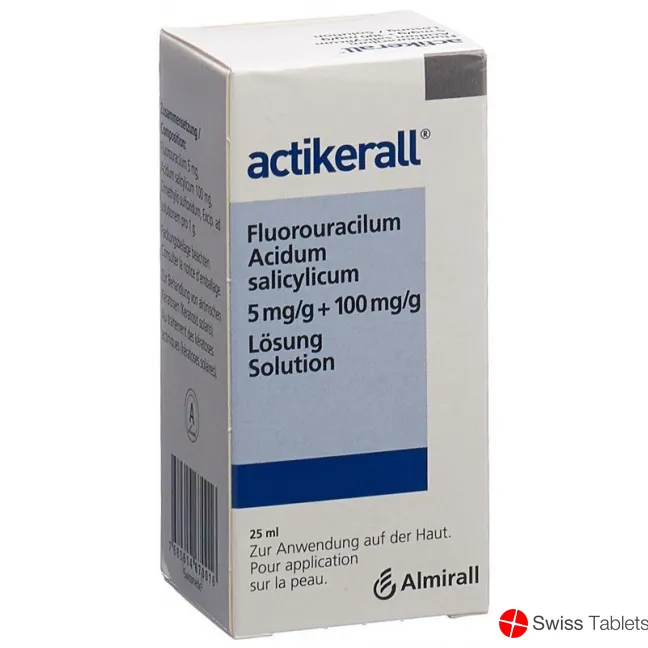
Table of Contents
Patient Information Leaflet
Actikerall
(5 mg + 100 mg)/g, solution for skin application
Fluorouracil + Salicylic Acid
Please read this leaflet carefully before using the medicine, as it contains
important information for the patient.
- Keep this leaflet, so that you can read it again if necessary.
- If you have any questions, please consult your doctor or pharmacist.
- This medicine has been prescribed for a specific individual. Do not pass it on to others. The medicine may harm someone else, even if their symptoms are the same.
- If you experience any adverse reactions, including any not listed in this leaflet, inform your doctor or pharmacist. See section 4.
Table of contents:
- What Actikerall is and what it is used for
- Important information before using Actikerall
- How to use Actikerall
- Possible side effects
- How to store Actikerall
- Contents of the pack and other information
1. What Actikerall is and what it is used for
Actikerall contains two active substances: fluorouracil and salicylic acid. Fluorouracil
belongs to a group of medicines called antimetabolites, which inhibit cell growth (cytostatic agent). Salicylic acid softens hardened skin.
Actikerall is a topical solution used in the treatment of actinic (senile) keratosis (type I/II) in immunocompetent adult patients.
Skin lesions known as actinic (senile) keratosis are small, brittle, flaking skin areas with a tendency to break down.
They may be red, light brown, or the same color as the surrounding skin. The lesions may be dry or rough to the touch and are sometimes easier to feel than to see.
Such skin changes commonly occur in people who have had significant exposure to sunlight.
2. Important information before using Actikerall
When not to use Actikerall
- if the patient is allergic to fluorouracil, salicylic acid, or any of the other ingredients of this medicine (listed in section 6),
- during breastfeeding,
- during pregnancy or in women in whom pregnancy cannot be definitively excluded,
- if the patient has impaired kidney function,
- if there is a risk of contact of the medicine with the eyes, oral or nasal mucosa, or genital organs.
Some other medicines may increase the adverse effects of Actikerall or lead to other unwanted effects. See section "Actikerall with other medicines" below.
Warnings and precautions
Before starting treatment with Actikerall, discuss this with your doctor or pharmacist.
- If the patient has been diagnosed with deficiency of dihydropyrimidine dehydrogenase (DPD) enzyme activity (complete DPD deficiency). It is important not to use a higher dose of Actikerall than indicated in section 3 of this leaflet.
- If the patient has disturbances in sensation, pain, or temperature (e.g. due to diabetes). In such cases, the treated skin areas must be closely monitored by a doctor.
- Do not apply Actikerall to bleeding skin lesions.
- During treatment with Actikerall, treated areas must be protected from direct sunlight exposure. The patient must not use sunlamps or tanning beds.
- There is no data on the use of Actikerall in the treatment of skin cancers such as basal cell carcinoma or Bowen's disease; therefore, it should not be used for treatment of these conditions.
- When treating areas affected by actinic keratosis and another coexisting skin disorder, it should be considered that treatment outcomes may differ from those expected.
- There is limited experience with the use of Actikerall in repeated treatment cycles for actinic keratosis or for retreatment in case of recurrence of skin lesions.
Children and adolescents
Actikerall should not be used in children and adolescents under 18 years of age. Actinic keratosis (senile keratosis) usually does not occur in children.
Actikerall with other medicines
Tell your doctor or pharmacist about all medicines the patient is currently using, has recently used, or plans to use.
The effects of individual medicines may be increased or reduced when several different medicines are used simultaneously.
In particular, tell your doctor if the patient is taking:
- medicines used to treat chickenpox or shingles (brivudine, sorivudine, or similar medicines). Actikerall must not be used if the patient is or has been treated with any of these medicines within the last 4 weeks, as this may increase the risk of adverse effects.
- a medicine used for epilepsy (phenytoin). Use of Actikerall may lead to increased blood levels of phenytoin.
- a medicine used in cancer and autoimmune diseases (methotrexate). Methotrexate may interact with Actikerall, causing adverse effects.
- medicines used in diabetes therapy (sulfonylurea derivatives). Sulfonylurea derivatives may interact with Actikerall, causing adverse effects.
Pregnancy, breastfeeding, and fertility
Actikerall must not be used during breastfeeding, during pregnancy, or in women in whom pregnancy cannot be definitively excluded.
Driving and operating machinery
No special precautions are required.
Actikerall contains dimethyl sulfoxide and ethanol.
Dimethyl sulfoxide may cause skin irritation.
This medicine contains 160 mg of alcohol (ethanol) per gram. It may cause stinging on damaged skin.
3. How to use Actikerall
This medicine should always be used as directed by the physician. If in doubt, consult
your doctor or pharmacist.
Dosage
Actikerall should be applied once daily, unless otherwise instructed by your doctor.
If treating skin lesions located on areas of skin with a thin epidermal layer
(e.g. around the eyes, on the temples), your doctor may recommend less frequent application of Actikerall.
In the event of severe adverse reactions, reduce the frequency of application to
three times per week until adverse reactions subside.
Your doctor may decide to monitor therapy more frequently, if deemed necessary.
Method of administration
For topical use only (application to the skin).
- Before each application, gently wipe off the white film remaining from the previous application of Actikerall (unless this is the first use of the medicine). Using warm water may help remove the film.
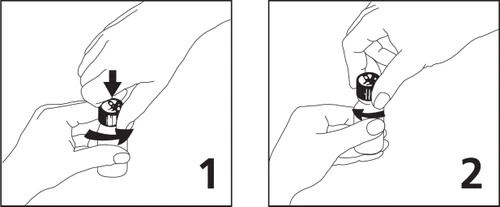
- To open the bottle, press down on the cap and turn it (Fig. 1).
- Before use, wipe the brush against the inner neck of the bottle to remove excess solution. The amount applied should be sufficient to form a film after drying.
- Apply the solution once daily to the surface of actinic (solar) keratosis lesions.
- Multiple actinic (solar) keratosis lesions may be treated simultaneously (up to 10 lesions), but the medicine should not be applied to large skin areas.
- The total skin surface area treated at one time with Actikerall should not exceed 25 cm² (5 cm x 5 cm).
- Allow the applied solution to dry completely, which will result in the formation of a film at the application site.
- Do not cover the treated area with a dressing.
- After use, close the bottle tightly to prevent the medicine from drying out (Fig. 2). If the medicine dries out, it is no longer suitable for use. Do not use Actikerall if crystals appear in the solution.
- Do not apply Actikerall to hairy skin surfaces. This may cause hair matting at the treatment site, making film removal difficult. If application to hairy skin is necessary, first shave the area or use other appropriate hair removal methods.
Additional information
Avoid contact of Actikerall with the eyes, inside of the mouth or nose, or genital organs (mucous membranes).
Actikerall may cause permanent stains on clothing, fabrics, or acrylic objects (such as acrylic bathtubs); therefore, avoid contact with these items.
Warning – the medicine is flammable. Store away from fire and do not use near open flames, lit cigarettes, or certain devices (e.g. hair dryers).
During treatment, maintain regular contact with your doctor.
Duration of treatment
Actikerall should be applied once daily to actinic (solar) keratosis lesions until complete resolution or for no longer than 12 weeks. Improvement may become visible after 4 weeks of treatment and progressively increase over time up to 12 weeks. Resolution of actinic (solar) keratosis lesions may continue to be observed for up to 8 weeks after treatment ends.
Continue treatment even if no effects are observed during the first four weeks.
If you feel that the effect of Actikerall is too strong or too weak, consult your doctor or pharmacist.
Use of more than the recommended dose of Actikerall
If Actikerall is applied more frequently than once daily, skin reactions are more likely to occur and may be more severe. In such cases, contact your doctor.
Missed dose of Actikerall
Do not apply a double dose to make up for a missed dose. Continue treatment as directed by your doctor or as described in this leaflet.
Discontinuation of Actikerall
If the patient wishes to discontinue use of the medicine, they should consult their doctor.
If you have any further questions about the use of this medicine, consult your doctor or pharmacist.
4. Possible adverse reactions
Like any medicine, this medicine may cause adverse reactions, although not everyone experiences them.
In most patients using Actikerall, mild to moderate irritation and inflammation occur at the site of application.
If these reactions are severe, contact your treating physician.
Due to its very strong keratolytic effect, the medicine may cause the appearance of whitish discolorations and peeling of the skin.
Because of the presence of salicylic acid, use of this medicine may cause mild irritation, such as skin inflammation and contact allergic reactions in patients with sensitive skin or hypersensitivity to salicylic acid. Symptoms of contact allergic reactions may include: itching, redness, and small blisters, even outside the area where the medicine was applied.
Adverse reactions may occur with the frequencies listed below:
Very common – may affect more than 1 in 10 people
- reactions at the site of application
- skin redness (erythema), inflammation, irritation (including burning sensation), pain, itching.
Common – may affect up to 1 in 10 people
- headache,
- skin peeling,
- reactions at the site of application
- mild bleeding, erosion, crust formation.
Uncommon – may affect up to 1 in 100 people
- dry eye, eye itching, excessive tearing,
- reactions at the site of application
- skin inflammation, swelling (edema), ulceration.
The frequency of such adverse reactions as mild bleeding, loss of the upper layer of skin (erosion), crust formation, swelling (edema), ulceration, and skin inflammation was one category higher in one study after application of Actikerall to a diseased area of 25 cm².
Reporting of adverse reactions
If any adverse symptoms occur, including any adverse effects not listed in this leaflet, inform your doctor or pharmacist. Adverse reactions can be reported directly to the Department of Monitoring of Adverse Drug Reactions of the Office for Registration of Medicinal Products, Medical Devices and Biocidal Products:
Al. Jerozolimskie 181C, 02-222 Warsaw, tel.: 22 49-21-301, fax: 22 49-21-309, website: https://smz.ezdrowie.gov.pl .
Adverse reactions can also be reported to the marketing authorization holder.
Reporting adverse reactions helps to provide more information on the safety of the medicine.
5. How to store Actikerall
Keep the medicine out of the sight and reach of children.
Do not use this medicine after the expiry date stated on the carton and on the label,
following the words "Expiry date". The expiry date refers to the last day of the stated month.
Do not store above 25°C. Do not store in the refrigerator or freeze.
Keep the bottle tightly closed to prevent drying out of the contents.
Warning – the medicine is flammable. Store away from fire and do not use near open
flames, lit cigarettes, or certain devices (e.g. hair dryers).
Period of use after first opening the bottle: 3 months.
Do not use Actikerall if crystals appear in the solution.
Medicines should not be disposed of via wastewater or household waste. Ask your
pharmacist how to dispose of medicines no longer required. This will help protect
the environment.
6. Contents of the pack and other information
What Actikerall contains
The active substances are: fluorouracil and salicylic acid.
1 g (= 1.05 ml) of cutaneous solution contains: 5 mg fluorouracil and 100 mg salicylic acid.
Other components: ethyl acetate, absolute ethanol, dimethyl sulfoxide 70, butyl methacrylate and methyl methacrylate copolymer, piroxicam.
What Actikerall looks like and contents of the pack
Actikerall is a clear, colourless to slightly orange-white solution for topical use.
Packaging of Actikerall:
a brown glass bottle with a child-resistant closure made of white polypropylene, placed in a cardboard box.
The bottle closure contains a brush applicator made of HDPE/LDPE/nylon for applying the product.
Pack size: bottle containing 25 ml of cutaneous solution.
Marketing authorisation holder and manufacturer
Almirall Hermal GmbH
Scholtzstrasse 3
21465 Reinbek
Germany
For further information, contact the representative of the marketing authorisation holder:
Egis Pharmaceuticals PLC
Telephone number: +48 22 417 92 00
This medicinal product is authorised in the Member States of the European Economic Area under the following names:
| Member State | Medicinal product name |
| Austria | Actikerall 5 mg/g + 100 mg/g Lösung zur Anwendung auf der Haut |
| Czech Republic | Actikerall 5 mg/g + 100 mg/g |
| Luxembourg | Actikerall 5 mg/g + 100 mg/g Lösung zur Anwendung auf der Haut |
| Germany | Actikerall 5 mg/g + 100 mg/g Lösung zur Anwendung auf der Haut |
| Poland | Actikerall |
| Slovakia | Actikerall 5 mg/ + 100 mg/g |
| United Kingdom | Actikerall 5 mg/g + 100 mg/g Cutaneous Solution |