Act-hib
Poland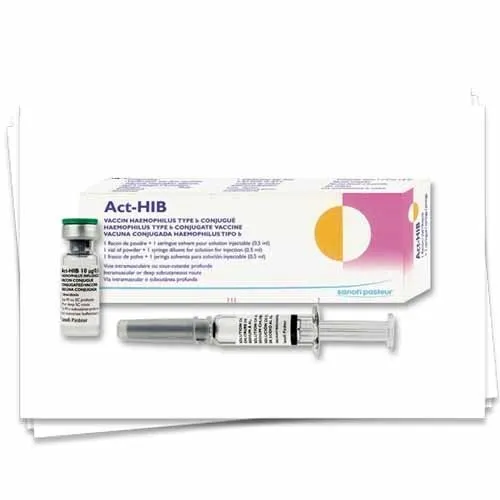
Table of Contents
- Package leaflet: Information for the user
- 1. What Act-HIB is and what it is used for
- 2. Important information before administering the Act-HiB vaccine
- 3. How to use the Act-HiB vaccine
- 4. Possible adverse reactions
- 5. How to store Act-HIB vaccine
- Information intended exclusively for healthcare professionals:
Package leaflet: Information for the user
Act-HIB
10 micrograms/0.5 ml, powder and solvent for solution for injection
Haemophilus influenzae type b conjugate vaccine
Please read all of this leaflet carefully before the vaccine is administered, as it contains
important information for the patient.
- Keep this leaflet, as you may need to read it again.
- If you have any further questions, please ask your doctor, pharmacist or nurse.
- This vaccine has been prescribed for a specific individual. Do not pass it on to others.
- If any side effects occur in the patient, including any not listed in this leaflet, inform the doctor, pharmacist or nurse. See section 4.
Table of contents of the leaflet
- What Act-HIB is and what it is used for
- Important information before vaccination with Act-HIB
- How to use Act-HIB vaccine
- Possible side effects
- How to store Act-HIB vaccine
- Contents of the pack and other information
1. What Act-HIB is and what it is used for
Act-HIB (Hib) is a vaccine. Vaccines are used to protect against infectious diseases.
After administration of Act-HIB vaccine (against invasive infections caused by Haemophilus influenzae type b), the body's natural defence system produces its own protection against these diseases.
This vaccine is indicated for the prevention of invasive diseases caused by Haemophilus influenzae type b (meningitis, sepsis, cellulitis, arthritis, epiglottitis and others) in infants from the age of 2 months.
The vaccine does not provide protection against infections caused by other types of Haemophilus influenzae or against meningitis caused by other microorganisms. Under no circumstances can the tetanus toxoid contained in this vaccine replace routine tetanus vaccination.
2. Important information before administering the Act-HiB vaccine
When not to use the Act-HiB vaccine:
- if the child is allergic (hypersensitive) to any of the components of the vaccine (listed in section 6), to tetanus toxoid, formaldehyde, or if an allergic reaction occurred after administration of a vaccine containing these substances,
- if the child has had an allergic reaction following previous administration of a Haemophilus influenzae type b conjugate vaccine,
- if the child has a fever or an acute illness, vaccination should be postponed.
Warnings and precautions
Talk to your doctor before using the Act-HiB vaccine.
When to exercise special caution when using the Act-HiB vaccine:
- in children with immune deficiencies or undergoing treatment with corticosteroids, cytotoxic drugs, radiotherapy, or other medications that may suppress the immune system, the immune response to the vaccine may be weakened. The doctor may decide to delay vaccination until completion of treatment,
- if the child has blood disorders such as low platelet count (thrombocytopenia) or coagulation disorders, due to the risk of bleeding following intramuscular injection,
- if the child has an allergic reaction to latex. The tip caps of the syringes contain natural rubber latex derivative, which may cause an allergic reaction.
Fainting may occur after, or even before, any injection. Therefore, inform the
doctor or nurse if the patient has previously fainted during injections.
Act-HiB vaccine and other medicines
When this vaccine is administered simultaneously with measles, mumps, and rubella vaccine,
and with diphtheria, tetanus, pertussis, poliomyelitis, and hepatitis B vaccines,
two separate injections will be given at two different sites on the body, such as the other arm or other leg.
Tell your doctor or pharmacist about all medicines currently being taken by the child,
or recently taken, including any medicines planned for future use.
Pregnancy and breastfeeding
Not applicable.
Consult your doctor before using any medicine.
The Act-HiB vaccine contains sodium.
The Act-HiB vaccine contains less than 1 mmol (23 mg) of sodium per dose, meaning the vaccine is considered "sodium-free".
3. How to use the Act-HiB vaccine
Dosage
Under 6 months of age:
3 consecutive doses of 0.5 ml administered at intervals of 1 or 2 months, and a booster dose (0.5 ml) one year after the third dose.
Between 6 and 12 months of age:
2 doses of 0.5 ml administered one month apart, and a booster dose (0.5 ml) at 18 months of age.
From 1 to 5 years of age:
1 dose of vaccine of 0.5 ml.
In case of exposure to a person suffering from invasive disease caused by Haemophilus influenzae type b (e.g. siblings or other children who had contact with the infected person), the vaccine should be administered according to the schedule appropriate for the age of the child who had contact with the infected person.
The infected person (in English: index case – the first identified case of invasive disease caused by Haemophilus influenzae type b) should also be vaccinated.
Method of administration
This vaccine will be administered to the child by a healthcare professional into the muscle (im.) or deeply under the skin (sc.), in the thigh or the arm.
This vaccine must never be administered into a blood vessel.
Missed dose of Act-HiB vaccine:
If a dose of the vaccine is missed, the doctor will decide when the dose should be administered.
If you have any further doubts regarding the use of this medicinal product, consult your doctor or pharmacist.
4. Possible adverse reactions
Like all medicines, the Act-HiB vaccine may cause adverse reactions, although not everyone experiences them.
Very common adverse reactions (reported in more than 1 in 10 people):
- reactions at the injection site such as pain, redness, swelling and (or) inflammation, induration
- irritability
Common adverse reactions (reported in less than 1 in 10 people but more than 1 in 100 people):
- crying (unsoothable or unusual)
- fever
- vomiting
Uncommon adverse reactions (reported in less than 1 in 100 people but more than 1 in 1,000 people):
- fever (above 39°C)
Adverse reactions occurring with unknown frequency (because they are voluntarily reported and very rare):
- extensive swelling (large swelling) of the limb into which the vaccine was administered, which may extend to the entire arm or leg
- large injection site reactions greater than 5 centimeters, such as pain, redness (erythema), swelling (edema), and (or) inflammation or skin induration
- swelling of legs and feet (edematous reactions in the lower limbs). These reactions may be accompanied by crying, bluish discoloration of the skin (cyanosis), or redness and small transient red spots (petechiae) appearing within a few hours after vaccination and resolving rapidly without treatment (within 24 hours) and without sequelae
- swelling of the face and (or) neck, allergic reactions (hypersensitivity reactions)
- seizures with or without fever
- skin rashes, sometimes swollen and itchy (urticaria, rash, generalized rash, pruritus)
In preterm infants (born at 28 weeks of gestation or earlier), prolonged breathing pauses may occur within 2–3 days after vaccination.
Reporting of adverse reactions
If any adverse reactions occur, including any not listed in this leaflet, inform a doctor, pharmacist, or nurse. Adverse reactions can be reported directly to the Department of Monitoring Adverse Drug Reactions of the Office for Registration of Medicinal Products, Medical Devices and Biocidal Products
Al. Jerozolimskie 181C
02-222 Warsaw
Tel.: +48 22 49 21 301
Fax: +48 22 49 21 309
Website: https://smz.ezdrowie.gov.pl
Adverse reactions can also be reported to the marketing authorization holder.
Reporting adverse reactions helps to provide more information on the safety of the vaccine.
5. How to store Act-HIB vaccine
Keep the vaccine out of sight and reach of children.
Do not use Act-HIB vaccine after the expiry date stated on the carton after: Expiry date (EXP). The expiry date refers to the last day of the stated month.
Store in a refrigerator (2°C - 8°C). Do not freeze.
Medicines should not be disposed of via wastewater or household waste. Ask your pharmacist how to dispose of medicines no longer required. These measures will help protect the environment.
6. Package contents and other information
What Act-HIB contains
- The active substance in one dose (0.5 ml) is: Haemophilus influenzae type b capsular polysaccharide 10 micrograms conjugated to tetanus toxoid 18–30 micrograms
- Other components:
Powder: trometamol, sucrose, and hydrochloric acid concentrated (for pH adjustment)
Solvent: sodium chloride and water for injections
What Act-HIB looks like and contents of the pack
This vaccine is available as a powder in a vial and solvent for solution for injection in a pre-filled syringe (0.5 ml in a pre-filled syringe with or without needles). Pack size: 1. The powder is white. The solvent is clear and colourless.
Marketing Authorisation Holder
Sanofi Winthrop Industrie
82 Avenue Raspail
94250 Gentilly, France
Manufacturer
Sanofi Winthrop Industrie
1541 avenue Marcel Mérieux
69280 Marcy l’Etoile
France
Sanofi Winthrop Industrie
Voie de l’Institut - Parc Industriel d’Incarville
B.P 101
27100 Val de Reuil
France
Information intended exclusively for healthcare professionals:
Method of administration
Reconstitute the solution by injecting the contents of the syringe containing the solvent into the vial
with powder, or by injecting the contents of the syringe containing the combined diphtheria, tetanus, and pertussis vaccine, or diphtheria, tetanus, pertussis, and poliomyelitis vaccine.
Shake until the powder is completely dissolved.
A whitish, cloudy appearance of the suspension after reconstitution using the diphtheria, tetanus, and pertussis vaccine or diphtheria, tetanus, pertussis, and poliomyelitis vaccine contained in the syringe is normal.
For syringes not supplied with attached needles, a separate needle must be firmly attached to the syringe by turning it a quarter turn.
Do not administer intravenously.
Any unused medicinal product or waste material must be disposed of in accordance with local regulations.
Administer intramuscularly ( im. ) or deep subcutaneously ( sc. ): it is recommended to inject into the mid-anterolateral part of the quadriceps muscle in infants and young children, and into the deltoid muscle area in older children.
Effect on results of laboratory diagnostic tests
After vaccination, Hib capsular polysaccharide is excreted in urine; therefore, positive urine test results for Hib infection may be observed within 1–2 weeks.
During this period, other tests should be performed to confirm Hib infection.