Acodin 150 junior
Poland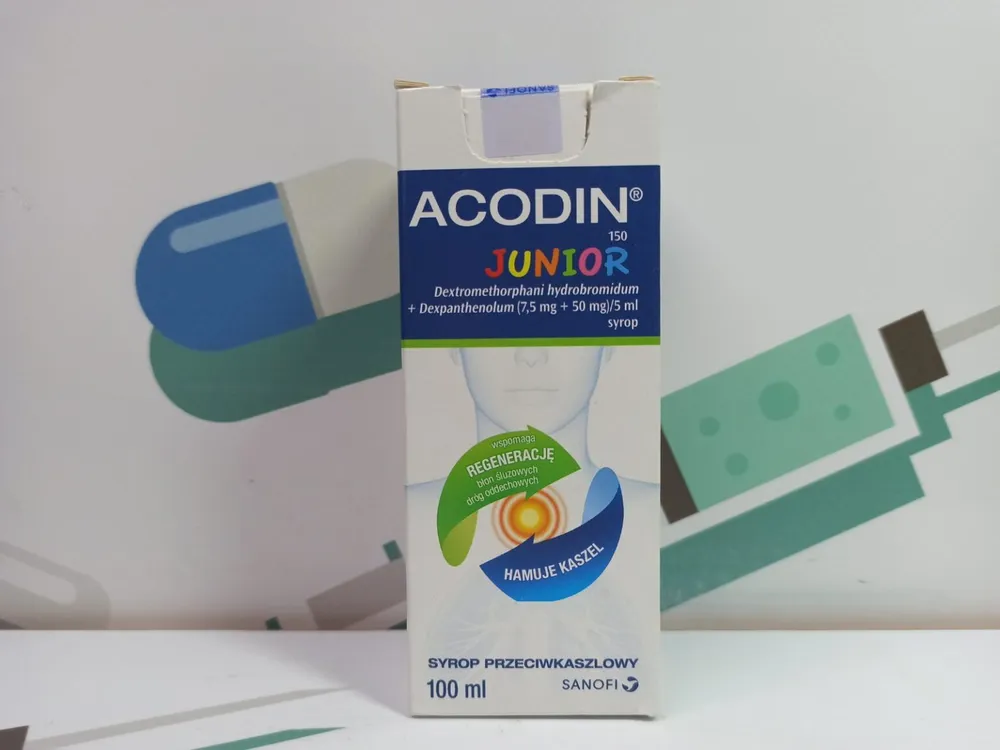
Table of Contents
Package leaflet: Information for the user
ACODIN 150 Junior, (7.5 mg + 50 mg)/5 ml, syrup
Dextromethorphani hydrobromidum + Dexpanthenolum
Please read this leaflet carefully before using the medicine, as it contains
important information for the patient.
- Keep this leaflet, so that you can read it again if necessary.
- If you have any doubts, please consult your doctor or pharmacist.
- This medicine has been prescribed for a specific individual. Do not pass it on to others. The medicine may harm another person, even if their symptoms are the same.
- If any adverse reactions occur in the patient, including any adverse reactions not listed in this leaflet, inform your doctor or pharmacist. See section 4.
Table of contents of the leaflet:
- What Acodin 150 Junior is and what it is used for
- Important information before taking Acodin 150 Junior
- How to take Acodin 150 Junior
- Possible side effects
- How to store Acodin 150 Junior
- Contents of the pack and other information
1. What Acodin 150 Junior is and what it is used for
Acodin 150 Junior is available as a syrup and contains the active substances: dextromethorphan hydrobromide and dexpanthenol.
Dextromethorphan acts as an antitussive by suppressing the cough reflex through direct action on the central nervous system. At the recommended doses, it does not impair the function of the bronchial ciliary apparatus (the structure responsible for mucus clearance from the airways).
Dexpanthenol plays an important role in metabolism, including in the regeneration of respiratory mucous membranes.
Acodin 150 Junior is indicated for the symptomatic treatment of dry cough of various origins (not associated with mucus accumulation in the airways).
2. Important information before using Acodin 150 Junior
This medicine should always be used as directed by a physician and according to the instructions contained in this patient leaflet. Do not exceed the recommended dose. Cases of misuse of this medicine have been reported, including in children and adolescents.
Use of this medicine may lead to dependence. Therefore, treatment should be short-term.
When not to use Acodin 150 Junior:
- if the patient is allergic to dextromethorphan, dexpanthenol, or any of the other ingredients of this medicine (listed in section 6).
- if the patient is currently taking, or has taken within the last 14 days, medicines from the group of monoamine oxidase inhibitors (some medicines used in depression or Parkinson's disease) (see also section "Acodin 150 Junior and other medicines").
- if the patient has respiratory insufficiency or is at risk of developing it.
- if the patient suffers from bronchial asthma.
Warnings and precautions
Before taking Acodin 150 Junior, speak with your doctor, pharmacist, or nurse:
- if the patient is taking medicines such as certain antidepressants or antipsychotics, Acodin 150 Junior may interact with them, causing changes in mental state (e.g. agitation, hallucinations, coma) and other symptoms such as body temperature above 38°C, increased heart rate, unstable blood pressure, as well as exaggerated reflex responses, muscle rigidity, lack of coordination, and/or gastrointestinal symptoms (e.g. nausea, vomiting, diarrhoea).
Dextromethorphan, the active substance in Acodin 150 Junior, has dependence-producing properties. The recommended duration of treatment should not be exceeded, as tolerance to dextromethorphan may develop, along with psychological and physical dependence. Particular caution is advised when using this product in adolescents and young adults, as well as in individuals with a history of misuse of medicinal products or psychoactive substances.
- This medicine suppresses coughing but does not eliminate its cause. If cough persists beyond 7 days, or if illness is accompanied by fever, headache, or rash, consult a doctor.
- Do not use in patients with respiratory disorders associated with increased mucus secretion, such as bronchitis.
- In patients with renal or hepatic impairment, doses should be reduced or dosing intervals extended.
- Dextromethorphan enhances the depressant effect of alcohol on the central nervous system (see section "Acodin 150 Junior with food, drink and alcohol").
Acodin 150 Junior and other medicines
Inform your doctor or pharmacist about all medicines currently taken, recently taken, or planned for use.
Acodin 150 Junior should not be used concurrently with the following medicines:
- monoamine oxidase inhibitors (certain medicines used in depression or Parkinson's disease, such as iproniazid, selegiline, moclobemide), or within 14 days after discontinuation of such treatment, due to increased risk of serotonin syndrome (a condition caused by excessive serotonin in the brain). Concomitant use of these medicines may cause central nervous system symptoms (dizziness, agitation, marked increase in body temperature, nausea, muscle tremors, elevated arterial blood pressure).
Concomitant use of Acodin 150 Junior and medicines that inhibit the CYP2D6 enzyme, responsible for dextromethorphan metabolism, may increase dextromethorphan concentration. These include, in particular, fluoxetine, paroxetine, quinidine, terbinafine, amiodarone, flecainide, propafenone, sertraline, bupropion, methadone, cinacalcet, haloperidol, perphenazine, and thioridazine.
Symptoms of overdose have been observed in such cases.
Acodin 150 Junior with food, drink and alcohol
Acodin 150 Junior syrup can be taken with or without food.
Do not consume alcoholic beverages during treatment with dextromethorphan. Dextromethorphan enhances the depressant effect of alcohol on the central nervous system.
Pregnancy, breastfeeding and fertility
If the patient is pregnant, breastfeeding, suspects she may be pregnant, or is planning to have a child, she should consult a doctor before using this medicine.
This medicine should not be used in breastfeeding women.
Driving and operating machinery
At therapeutic doses, this medicine does not impair psycho-physical performance, ability to drive or operate machinery. However, when used in doses higher than recommended, it exerts a depressant effect on the central nervous system.
Acodin 150 Junior contains sucrose and sodium benzoate
5 ml of syrup contains 2.625 g of sucrose. This should be taken into account in patients with diabetes.
If a patient has previously been diagnosed with intolerance to certain sugars, the patient should consult a doctor before taking this medicine.
The medicine contains 12.5 mg of sodium benzoate in 5 ml of syrup.
3. How to use Acodin 150 Junior
This medicine should always be used exactly as directed by a doctor or pharmacist. In case of doubts,
consult a doctor or pharmacist.
Children and adolescents
In the event of overdose in children, serious adverse effects may occur, including neurological disturbances.
Caregivers should not administer a dose higher than recommended.
The syrup bottle is equipped with a measuring device for dosing the medicine.
Adults and children over 12 years of age:
10 ml of Acodin 150 Junior syrup up to 4 times daily.
Children from 6 to 12 years of age:
5 ml of Acodin 150 Junior syrup up to 4 times daily.
Acodin 150 Junior syrup can be taken with or without food.
If the effect of Acodin 150 Junior seems too strong or too weak, consult a doctor.
Taking more Acodin 150 Junior than recommended
If a patient takes more than the recommended dose of Acodin 150 Junior, the following symptoms may occur:
nausea and vomiting, involuntary muscle spasms, agitation, confusion, drowsiness, disturbances of consciousness,
involuntary rapid eye movements, cardiac disorders (fast heartbeat), coordination disturbances, psychosis with visual hallucinations, and increased excitability.
Other symptoms of a significant overdose may include: coma, severe respiratory depression, and seizures.
If any of the above symptoms occur, seek immediate medical attention or go to a hospital.
In case of taking more than the recommended dose of the medicine, consult a doctor or pharmacist immediately.
Missed dose of Acodin 150 Junior
If a dose is missed, take it as soon as possible.
Do not take a double dose to make up for a missed dose.
If you have any further doubts regarding the use of this medicine, consult your doctor or pharmacist.
4. Possible adverse reactions
Like all medicines, this medicine can cause adverse reactions, although not everyone experiences them.
The following adverse reactions have been reported since the medicine was placed on the market:
Very common (occurs in more than 1 in 10 patients):
- drowsiness, mild dizziness
Common (occurs in less than 1 in 10 patients):
- disorientation, fatigue
Rare (occurs in less than 1 in 1,000 patients):
- gastrointestinal disorders
Frequency unknown (frequency cannot be estimated from the available data):
- skin allergic reactions such as itchy rash, urticaria, fixed drug eruptions, angioedema (swelling of the skin and mucous membranes, which may involve the airways and may be life-threatening), bronchospasm, breathing difficulties, and anaphylactic reaction (a severe, life-threatening allergic reaction). If any of these symptoms occur, seek immediate medical advice;
- psychotic disturbances, including hallucinations;
- involuntary movements, especially in children;
- neurological symptoms, including peripheral or central dizziness, feeling of emptiness in the head, fatigue, slurred speech, and nystagmus.
Reporting of adverse reactions
If any adverse reactions occur, including any adverse reactions not listed in this leaflet, inform your doctor or pharmacist. Adverse reactions can be reported directly to the Department of Monitoring Adverse Drug Reactions at the Office for Registration of Medicinal Products, Medical Devices and Biocidal Products
Al. Jerozolimskie 181C
02-222 Warsaw
Phone: +48 22 49 21 301
Fax: +48 22 49 21 309
Website: https://smz.ezdrowie.gov.pl
Adverse reactions can also be reported to the marketing authorization holder. Reporting adverse reactions helps to provide more information on the safety of the medicine.
5. How to store Acodin 150 Junior
No special storage instructions are required. Do not freeze.
Keep the medicine in a place inaccessible and out of sight of children.
Do not use this medicine after the expiry date stated on the carton.
The expiry date refers to the last day of the stated month.
Medicines should not be disposed of via wastewater or household waste. Ask your pharmacist
how to dispose of medicines no longer required. Such measures help protect the environment.
6. Contents of the package and other information
What Acodin 150 Junior contains
- The active substances in this medicine are dextromethorphan hydrobromide and dexpanthenol. 5 ml of syrup contains 7.5 mg of dextromethorphan hydrobromide and 50 mg of dexpanthenol.
- The other ingredients are: sodium carmellose, glycerol, sucrose, sodium benzoate, food caramel, citric acid, food raspberry flavour, purified water.
What Acodin 150 Junior looks like and contents of the pack
The pack contains 100 ml of syrup.
A 100 ml amber glass bottle containing the syrup, with a child-resistant cap and a dosing device, packaged in a cardboard box.
Marketing Authorisation Holder and Manufacturer
Marketing Authorisation Holder:
STADA Arzneimittel AG
Stadastrasse 2-18
6118 Bad Vilbel
Germany
Manufacturers:
- Sanofi-Aventis Sp. z o.o. Warsaw Branch, Rzeszów Site for Production and Distribution of Medicinal Products, ul. Lubelska 52, 35-233 Rzeszów, Poland
- Unither Liquid Manufacturing, 1-3 allee de la Neste, Z.I. d'En Sigal, 31770 Colomiers, France