Acnelec
Poland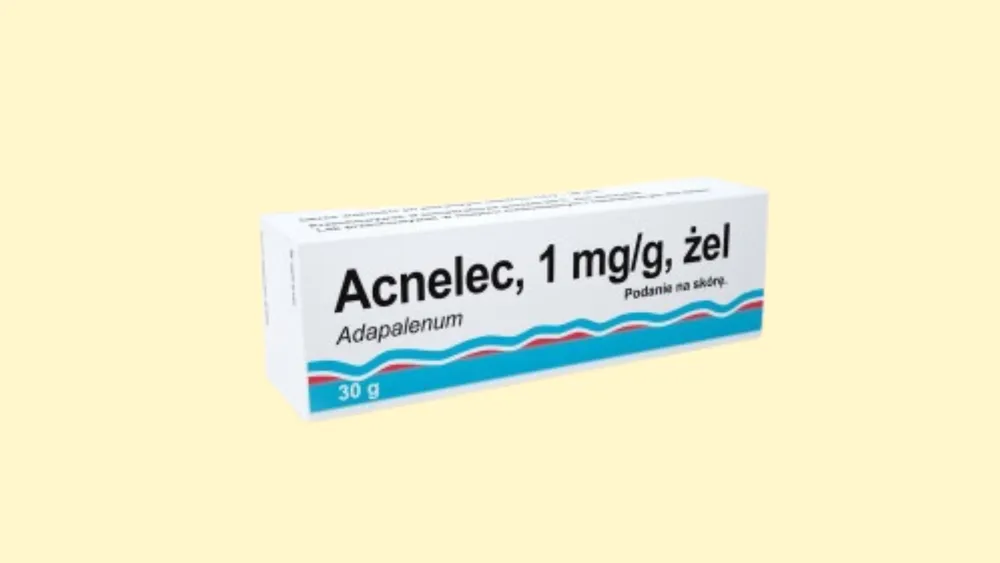
Table of Contents
Package leaflet: Information for the user
Acnelec, 1 mg/g, gel
Adapalene
Please read all of this leaflet carefully before using this medicine because it contains important information for you.
Keep this leaflet as you may need to read it again.
If you have any further questions, please ask your doctor or pharmacist.
This medicine has been prescribed for a specific individual. Do not pass it on to others. It may harm other people, even if their symptoms are the same.
If you experience any adverse effects, including any not listed in this leaflet, inform your doctor or pharmacist. See section 4.
Contents of the leaflet:
- What Acnelec gel is and what it is used for
- Important information before using Acnelec gel
- How to use Acnelec gel
- Possible side effects
- How to store Acnelec gel
- Contents of the pack and other information
1. What Acnelec gel is and what it is used for
Acnelec gel contains the active substance adapalene, which acts similarly to retinoids (a group of potent medicines used in skin disorders).
Topically applied adapalene normalizes keratinization and epidermal differentiation processes, prevents the formation of comedones, and reduces inflammatory lesions (papules and pustules). Adapalene has a stronger anti-inflammatory effect than retinoids.
Acnelec gel is indicated for the treatment of acne vulgaris (Acne vulgaris): mild to moderate, comedonal and papulopustular acne.
2. Important information before using Acnelec gel
When not to use Acnelec gel:
- in patients who are pregnant
- in patients planning to become pregnant
- if the patient is allergic (hypersensitive) to adapalene or to any of the other ingredients of this medicine (listed in section 6)
- if the patient has severe acne vulgaris or acne affecting a large area of skin
- in case of skin damage, when the skin is sunburned or has a non-acne rash
Warnings and precautions
Before starting treatment with Acnelec gel, consult a doctor or pharmacist.
Acnelec gel is intended for topical use only.
Avoid contact of the medicine with the mouth, eyes, and mucous membranes. In case of accidental contact with the mouth, eyes, or mucous membranes, rinse immediately with plenty of water.
Shortly after starting treatment, redness, irritation, and dryness of the face may occur. In such cases, treatment should be discontinued for several days until these symptoms subside.
During treatment, due to the reduction in the thickness of the stratum corneum, the skin becomes more sensitive to ultraviolet radiation and to topical medicines or cosmetics.
Therefore, during treatment with Acnelec gel, avoid excessive exposure to UV radiation and sunlight (e.g. by wearing a hat and using sun protection filters), and do not use cosmetics recommended for acne skin care or with astringent properties.
Children and adolescents
Acnelec gel should not be used in children under 12 years of age.
Acnelec gel and other medicines
Inform your doctor about all medicines the patient is currently using or has recently used, as well as any medicines the patient plans to use.
Pregnancy, breastfeeding, and fertility
Acnelec gel MUST NOT be used during pregnancy or if the patient plans to become pregnant.
Further information should be obtained from the attending physician.
Breastfeeding
Before using any medicine, consult a doctor.
If the doctor prescribes the use of this medicine during breastfeeding, to avoid exposing the infant to the medicine, do not apply Acnelec gel on the chest area.
Driving and operating machinery
No effect of Acnelec gel on the ability to drive or operate machinery and on psycho-physical performance has been observed.
Acnelec gel contains propylene glycol and methyl parahydroxybenzoate
The medicine contains 40 mg of propylene glycol in 1 g of gel.
Propylene glycol may cause skin irritation.
Due to the presence of methyl parahydroxybenzoate, the medicine may cause allergic reactions (delayed-type reactions are possible).
3. How to use Acnelec gel
This medicine should always be used as directed by a physician. If in doubt, consult your doctor.
Acnelec gel should be applied once daily, preferably in the evening. Treatment begins by applying small amounts of the medicine to the skin, avoiding the eye and mouth areas as well as the nasolabial folds, 10–15 minutes after washing and drying the skin with a towel. After application, hands should be thoroughly washed.
If no improvement is observed after three months, consult your doctor. Your doctor will decide whether treatment should continue.
Use in children
Acnelec gel is intended for use only in adults and adolescents over 12 years of age.
Use of more than the recommended dose of Acnelec gel
Using more than the recommended amount of this medicine will not speed up or improve treatment results and may cause significant redness, peeling, or other signs of skin irritation.
In case of accidental ingestion of the medicine, contact your doctor immediately.
Missed dose of Acnelec gel
Apply the missed dose as soon as possible. If it is almost time for the next dose, do not apply a double dose to make up for the missed one.
Stopping Acnelec gel
If you have any further questions about the use of this medicine, consult your doctor.
4. Possible adverse reactions
If any of the following symptoms occur, contact your doctor immediately,
as immediate medical assistance may be required:
swelling of the face, lips or throat causing difficulty in swallowing or breathing, rash, itching,
hives and dizziness. These may be signs of angioedema or a severe allergic reaction
(frequency unknown, cannot be estimated from available data).
Like all medicines, this medicine can cause adverse reactions, although not everybody gets them.
Common adverse reactions (affects less than 1 in 10 people):
- dry skin,
- skin irritation,
- burning sensation of the skin,
- skin redness (erythema).
Uncommon adverse reactions (affects less than 1 in 100 people):
- contact dermatitis, irritant rash,
- skin discomfort,
- sunburn,
- skin itching (pruritus),
- skin peeling,
- acne (worsening of acne).
Frequency not known (cannot be estimated from available data):
- allergic contact dermatitis,
- skin pain,
- skin swelling,
- eyelid itching,
- eyelid irritation,
- eyelid redness,
- eyelid swelling,
- darkening of light skin,
- lightening of dark skin,
- burning at the application site.
Cases of burning at the application site have been reported (mainly superficial burns, but also
second-degree burns or severe burns).
Reporting of adverse reactions
If any adverse reactions occur, including any adverse reactions not listed in this leaflet, inform your doctor or pharmacist. Adverse reactions can be reported directly to the Department of Monitoring Adverse Drug Reactions of the Office for Registration of Medicinal Products, Medical Devices and Biocidal Products:
Al. Jerozolimskie 181C, 02-222 Warsaw, Tel.: + 48 22 49 21 301, Fax: + 48 22 49 21 309,
Website: https://smz.ezdrowie.gov.pl
Adverse reactions can also be reported to the marketing authorization holder.
By reporting adverse reactions, additional information on the safety of this medicine can be collected.
5. How to store Acnelec gel
Keep the medicine out of the reach and sight of children.
Store below 25°C. Do not freeze.
Shelf life after first opening of the tube – 6 months.
Do not use this medicine after the expiry date stated on the packaging. The expiry date refers to the last day of the stated month.
Medicines must not be disposed of in wastewater or household waste. Ask your pharmacist how to dispose of medicines no longer required. Such measures help protect the environment.
6. Contents of the pack and other information
What Acnelec gel contains
- The active substance is adapalene. 1 g of gel contains 1 mg of adapalene.
- The other ingredients are: methyl parahydroxybenzoate (E 218), disodium edetate, carbomer 980, propylene glycol, poloxamer 182, phenoxyethanol, sodium hydroxide, purified water.
What Acnelec gel looks like and contents of the pack
Acnelec gel is a white or almost white, semi-transparent mass with a characteristic odour. The gel is packed in an aluminium tube with an internal lacquer coating, with a neck and a cap made of HDPE, containing 30 g of gel, in a cardboard box.
Marketing Authorisation Holder and Manufacturer
Marketing Authorisation Holder
Bausch Health Ireland Limited
3013 Lake Drive
Citywest Business Campus
Dublin 24, D24PPT3
Ireland
Manufacturer
Przedsiębiorstwo Farmaceutyczne Jelfa SA
ul. Wincentego Pola 21
58-500 Jelenia Góra
Poland