Acetylcysteine flegamina
Poland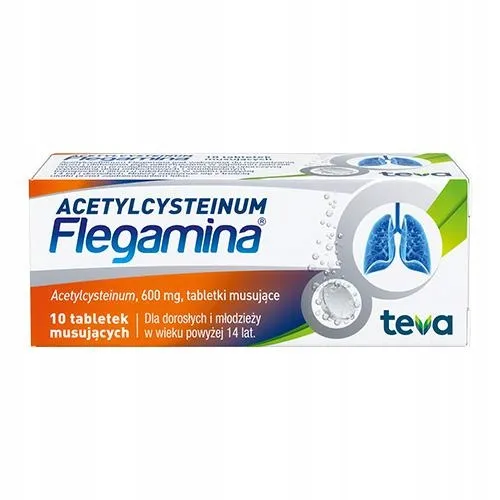
Table of Contents
- Package leaflet: Information for the patient
- 1. What Acetylcysteinum Flegamina is and what it is used for
- 2. Important information before using Acetylcysteinum Flegamina
- 3. How to use Acetylcysteinum Flegamina
- 4. Possible adverse reactions
- 5. How to store Acetylcysteinum Flegamina
- 6. Contents of the packaging and other information
Package leaflet: Information for the patient
Acetylcysteinum Flegamina, 600 mg, effervescent tablets
Acetylcysteinum
For adults and adolescents over 14 years of age
Read carefully the information in this leaflet before taking the medicine, as it contains
important information for the patient.
This medicine should always be taken exactly as described in the patient leaflet or as directed by
the physician or pharmacist.
- Keep this leaflet so that you can read it again if necessary.
- If you need advice or further information, please consult your pharmacist.
- If you experience any adverse reactions, including any possible adverse reactions not listed in this leaflet, inform your doctor or pharmacist. See section 4.
- If there is no improvement after 4-5 days, or if you feel worse, consult your doctor.
Contents of the leaflet
- What Acetylcysteinum Flegamina is and what it is used for
- Important information before taking Acetylcysteinum Flegamina
- How to take Acetylcysteinum Flegamina
- Possible side effects
- How to store Acetylcysteinum Flegamina
- Contents of the pack and other information
1. What Acetylcysteinum Flegamina is and what it is used for
Acetylcysteinum Flegamina contains the active substance acetylcysteine, which is a mucolytic agent that thins thick mucus in the respiratory tract.
Acetylcysteinum Flegamina is indicated in adolescents over 14 years of age and adults for thinning mucus and facilitating its expectoration in bronchitis caused by a cold, associated with persistent respiratory secretions and impaired mucus transport.
2. Important information before using Acetylcysteinum Flegamina
When not to use Acetylcysteinum Flegamina:
- if the patient is allergic to acetylcysteine or any of the other ingredients of this medicine (listed in section 6).
Due to the high content of the active substance, Acetylcysteinum Flegamina must not be used
in children under 14 years of age. Medicines with appropriate strength are available for this patient group.
Warnings and precautions
Before starting to use Acetylcysteinum Flegamina, discuss with a doctor or
pharmacist if:
- the patient develops skin changes. There have been very rare reports of severe skin reactions, such as Stevens-Johnson syndrome and Lyell's syndrome, associated with temporary use of acetylcysteine. If new skin or mucous membrane lesions occur, seek immediate medical advice and discontinue acetylcysteine.
- the patient has bronchial asthma.
- the patient has or has had peptic ulcer disease of the stomach or duodenum, especially when using other medicines that irritate the gastrointestinal mucosa at the same time.
- the patient has histamine intolerance. Prolonged use in such patients should be avoided, as Acetylcysteinum Flegamina affects histamine metabolism and may lead to symptoms of intolerance (e.g. headache, nasal discharge, itching).
- the patient is unable to effectively expectorate fluid secretions. Use of Acetylcysteinum Flegamina, especially at the beginning of treatment, may liquefy mucus, thus increasing the volume of bronchial secretions. If the patient is unable to expectorate adequately, the doctor will implement appropriate management.
Children and adolescents
Mucolytic agents may cause airway obstruction in children under 2 years of age due to the physiological characteristics of the respiratory tract in this age group. The ability to expectorate mucus may be limited. Therefore, mucolytic agents should not be used in children under 2 years of age.
Acetylcysteinum Flegamina and other medicines
Inform the doctor or pharmacist about all medicines currently used or recently used, as well as any medicines the patient plans to take. This includes all medicines, including those purchased without a prescription.
Interaction studies have been conducted exclusively in adults.
Inform the doctor or pharmacist if the patient is taking any of the following medicines:
- Cough medicines (antitussives), as they may cause dangerous accumulation of secretions due to impaired cough reflex.
- Activated charcoal, used in poisoning treatment, may reduce the effectiveness of acetylcysteine.
- Medicines used to treat bacterial infections (antibiotics), e.g. tetracyclines, aminoglycosides, penicillins. Clinical studies have shown that acetylcysteine may weaken the effect of antibiotics. For safety reasons, antibiotics should be taken separately, with at least a two-hour interval. This does not apply to medicines containing the active substances cefixime or loracarbef. These medicines may be taken simultaneously with acetylcysteine.
- Medicines used to treat angina attacks; chest, neck, and arm pain (e.g. nitroglycerin).
- Concomitant use of acetylcysteine and nitroglycerin may enhance the vasodilatory effect of glyceryl trinitrate (nitroglycerin) due to a possible blood-thinning effect. If the doctor considers concomitant treatment with nitroglycerin and acetylcysteine necessary, blood pressure will be monitored for hypotension, which may be severe and cause headaches.
- Medicines used to treat epilepsy and nerve pain (carbamazepine). Concomitant use of acetylcysteine and carbamazepine may reduce the effectiveness of carbamazepine due to decreased plasma concentrations of carbamazepine.
Effects on laboratory test results
Acetylcysteine may interfere with salicylate assays.
Acetylcysteine may affect urine ketone body test results.
It is not recommended to dissolve Acetylcysteinum Flegamina with other medicines.
Pregnancy, breastfeeding, and fertility
If the patient is pregnant or breastfeeding, suspects she may be pregnant, or is planning to have a
child, she should consult a doctor or pharmacist before using this medicine.
Pregnancy
As there is insufficient experience with the use of acetylcysteine in pregnant women, Acetylcysteinum Flegamina should be used during pregnancy only if the treating doctor considers it absolutely necessary.
Breastfeeding
There is no data on the excretion of acetylcysteine into human milk.
Therefore, Acetylcysteinum Flegamina should be used during breastfeeding only if the treating doctor considers it absolutely necessary.
Driving and operating machinery
There is no evidence that acetylcysteine has any influence on the ability to drive
or operate machinery.
Acetylcysteinum Flegamina contains sodium
This medicine contains 150 mg of sodium (main component of table salt) in each effervescent tablet.
This corresponds to 7.65% of the maximum recommended daily sodium intake in the adult diet. This should be taken into account in patients controlling dietary sodium intake.
Acetylcysteinum Flegamina contains aspartame
This medicine contains 20 mg of aspartame in each effervescent tablet.
Aspartame is a source of phenylalanine. It may be harmful to patients with phenylketonuria, a rare
genetic disorder in which phenylalanine accumulates in the body due to impaired excretion.
Acetylcysteinum Flegamina contains sucrose and glucose (component of maltodextrin)
If the patient has previously been diagnosed with intolerance to certain sugars, the patient should
consult a doctor before taking this medicine.
3. How to use Acetylcysteinum Flegamina
This medicine should always be taken exactly as described in this patient information leaflet, or as directed by your doctor, pharmacist, or nurse. If in doubt, consult your doctor, pharmacist, or nurse.
Follow the instructions below unless your doctor has advised a different dosing regimen. It is important to follow the administration instructions, otherwise Acetylcysteinum Flegamina may not work properly.
| Age | Total daily dose |
| Adolescents from 14 years of age and adults | 1 effervescent tablet once daily |
Method and duration of use
The effervescent tablet should be dissolved in a glass of water, and the entire contents of the glass should be drunk.
Acetylcysteinum Flegamina should be taken after a meal.
If symptoms worsen or there is no improvement after 4–5 days, consult a doctor.
If you feel that the effect of Acetylcysteinum Flegamina is too strong or too weak, consult a doctor or pharmacist.
Taking more Acetylcysteinum Flegamina than recommended
Overdose may lead to gastrointestinal irritation (e.g. abdominal pain, nausea, vomiting, diarrhoea). To date, no serious adverse effects indicating poisoning have been observed, even after significant overdose of acetylcysteine tablets. In case of suspected overdose of Acetylcysteinum Flegamina, inform a doctor.
Missing a dose of Acetylcysteinum Flegamina
Do not take a double dose to make up for a missed tablet. Continue taking the medicine as described in the instructions for use.
If you have any further doubts regarding the use of this medicine, consult a doctor or pharmacist.
4. Possible adverse reactions
Like all medicines, this medicine can cause adverse reactions, although not everyone experiences them.
If any of the following very rare symptoms occur in a patient, treatment with Acetylcysteinum Flegamina should be discontinued immediately and medical help must be sought without delay:
- Severe skin reactions, such as Stevens-Johnson syndrome and Lyell's syndrome associated with temporary use of acetylcysteine*. Symptoms include rash, difficulty swallowing or breathing, swelling of the lips, face, throat or tongue. *In most of the reported cases, at least one other medicinal substance was administered concurrently, which could potentially have exacerbated the described skin and mucosal reactions.
The following adverse reactions may occur:
Uncommon (may affect fewer than 1 in 100 people):
- Headache
- Tinnitus (ringing in the ears)
- Rapid heartbeat
- Vomiting, diarrhoea, oral mucosal inflammation, abdominal pain, nausea
- Allergic reactions: urticarial blisters, itching, rash, skin and mucosal swelling
- Fever
- Low blood pressure
Rare (may affect fewer than 1 in 1,000 people):
- Shortness of breath, bronchospasm – mainly in patients with hyperreactive bronchial system in bronchial asthma
- Heartburn
Very rare (may affect fewer than 1 in 10,000 people):
- Hypersensitivity reactions up to anaphylactic shock
- Bleeding
Frequency unknown (frequency cannot be estimated from available data):
- Fluid accumulation in the facial area (facial swelling)
Medical advice must be sought immediately and treatment with Acetylcysteinum Flegamina must be discontinued immediately if new skin or mucosal changes appear.
Continuation of treatment with Acetylcysteinum Flegamina is not permitted.
Various studies have confirmed reduced platelet aggregation (clumping of certain blood components) during administration of acetylcysteine. The clinical significance of this effect is still unclear.
Management measures
Acetylcysteinum Flegamina should be discontinued at the first signs of hypersensitivity reactions (see above). In such cases, contact a physician.
Reporting of adverse reactions
If any adverse reactions occur, including any not listed in this leaflet, inform a doctor or pharmacist. Adverse reactions can be reported directly to the Department of Monitoring Adverse Drug Reactions at the Office for Registration of Medicinal Products, Medical Devices and Biocidal Products:
Al. Jerozolimskie 181C, 02-222 Warsaw, Tel.: +48 22 4921 301, Fax: +48 22 4921 309,
Website: https://smz.ezdrowie.gov.pl.
Adverse reactions can also be reported to the marketing authorization holder.
Reporting adverse reactions helps to provide more information on the safety of the medicine.
5. How to store Acetylcysteinum Flegamina
Keep the medicine out of the sight and reach of children.
Do not use this medicine after the expiry date stated on the container and outer packaging following:
"Expiry date (EXP)" or "EXP". The expiry date refers to the last day of the stated month.
Storage conditions
Do not store above 25°C.
Keep the container tightly closed to protect from moisture.
Period of use after first opening of the container: 12 months.
Medicines must not be disposed of via the sewage system or household waste. Ask your pharmacist how to dispose of medicines no longer required. This will help protect the environment.
6. Contents of the packaging and other information
What Acetylcysteinum Flegamina contains
- The active substance is: acetylcysteine. One effervescent tablet contains 600 mg of acetylcysteine.
- Other components of the medicine are: citric acid, sodium hydrogen carbonate, adipic acid, povidone K-25, aspartame (E 951), lemon flavor (containing maltodextrin, sucrose, gum arabic (E 414), triacetin (E 1518), alpha-tocopherol (E 307)).
What Acetylcysteinum Flegamina looks like and contents of the pack
White to yellowish, round, effervescent tablets, flat on both sides and smooth, with a lemon scent.
The effervescent tablets are packed in polypropylene tubes with a white polyethylene cap,
containing a desiccant (60% molecular sieve and 40% silica gel).
Acetylcysteinum Flegamina is available in packs of 10 effervescent tablets.
Marketing Authorisation Holder:
Teva B.V., Swensweg 5, 2031GA Haarlem, The Netherlands
Manufacturer:
Merckle GmbH, Graf-Arco Str. 3, 89079 Ulm, Germany
For further information about the medicine and its names in other European Economic Area countries,
please contact the representative of the Marketing Authorisation Holder: Teva Pharmaceuticals Polska Sp. z o.o.,
ul. Emilii Plater 53, 00-113 Warsaw, Poland, tel.: (22) 345 93 00.
This medicine is authorised for marketing in the European Economic Area countries under the following names:
Germany: NAC AbZ 600 mg Brausetabletten
Spain: Notus Mucus 600mg comprimidos efervescentes sabor limón
Finland: Mucoratio 600 mg poretabletti
Poland: Acetylcysteinum Flegamina