Acetylcysteine
Poland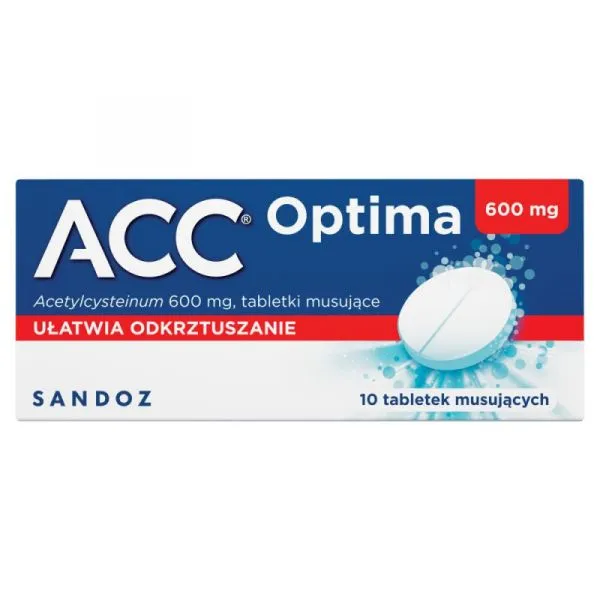
Instructions for Use
Package leaflet: Information for the patient
WARNING: Keep the leaflet, information on the immediate packaging in a foreign language.
ACC (ACC 200)
200 mg, effervescent tablets
Acetylcysteinum
ACC and ACC 200 are different trade names for the same medicine.
Please read this leaflet carefully before using the medicine, as it contains important information for the patient.
This medicine should always be used exactly as described in this patient leaflet or as directed by a doctor or pharmacist.
- Keep this leaflet, as you may need to read it again.
- If you need advice or further information, please consult your pharmacist.
- If you experience any adverse effects, including any possible side effects not listed in this leaflet, inform your doctor or pharmacist. See section 4.
- If there is no improvement after 4 to 5 days, or if you feel worse, contact your doctor.
Table of contents
- What ACC is and what it is used for
- Important information before taking ACC
- How to take ACC
- Possible side effects
- How to store ACC
- Contents of the pack and other information
1. What ACC is and what it is used for
ACC effervescent tablets contain the active substance acetylcysteine — a medicine which primarily reduces the viscosity of bronchial secretions and facilitates expectoration.
ACC is used as a mucolytic agent to thin respiratory tract secretions and assist in their expectoration in patients with bronchitis associated with the common cold.
2. Important information before taking ACC
When not to take ACC
Do not take ACC if you are allergic to acetylcysteine or to any of the other ingredients of this medicine (listed in section 6).
Symptoms of allergy may include: itching, urticaria, rash, bronchospasm (shortness of breath), rapid heartbeat, and low blood pressure. If any of these symptoms occur, stop taking ACC immediately and contact your doctor.
Do not take ACC if you have active peptic ulcer disease of the stomach or duodenum.
Do not take ACC during an acute asthmatic attack (exacerbation of bronchial asthma or chronic obstructive pulmonary disease).
This medicine must not be used in children under 6 years of age.
Warnings and precautions
Before taking ACC, consult your doctor or pharmacist if:
- you have had or currently suffer from bronchial asthma (as the medicine may cause bronchospasm and shortness of breath);
- you have previously been diagnosed with peptic ulcer disease;
- you currently have or have had respiratory insufficiency in the past;
- you have difficulty expectorating (respiratory physiotherapy may be necessary — your doctor will provide information on this);
- you have histamine intolerance (prolonged use of the medicine may lead to symptoms of intolerance such as headache, nasal discharge, itching);
- you are elderly (over 65 years of age).
If you develop skin or mucosal changes while taking this medicine, stop taking it immediately and consult your doctor (see section 4).
ACC with other medicines
Tell your doctor or pharmacist about all medicines you are currently taking, have recently taken, or plan to take.
Do not take ACC simultaneously with antitussive (cough suppressant) medicines, as they suppress the cough reflex and may hinder the expectoration of secretions thinned by ACC.
Acetylcysteine (the active substance in ACC) may reduce the effectiveness of certain antibiotics (particularly semi-synthetic penicillins, tetracyclines, cephalosporins, and aminoglycosides). To prevent this, take ACC at least 2 hours after taking an antibiotic. This does not apply to antibiotics such as cefixime, loracarbef, amoxicillin, doxycycline, erythromycin, thiamphenicol, and cefuroxime. In case of doubt, consult your doctor.
ACC may enhance the effect of nitroglycerin and other nitrates (medicines used in cardiovascular disorders and ischemic heart disease). When these medicines are used concomitantly, your doctor will monitor you for the development of hypotension.
Headache may occur. If you are taking nitroglycerin or another similarly acting nitrate medicine, consult your doctor before taking ACC.
Large amounts of activated charcoal may reduce the effectiveness of ACC.
It is not recommended to dissolve ACC in solutions containing other medicines.
Effect of ACC on laboratory tests
If you are scheduled for blood or urine salicylate tests or urine ketone body tests, inform your doctor and medical staff that you are taking ACC.
ACC with food and drink
Take this medicine after meals. During treatment, drink an adequate amount of fluids (at least 1.5 litres daily).
Pregnancy and breastfeeding
If you are pregnant or breastfeeding, think you may be pregnant, or are planning to have a baby, consult your doctor or pharmacist before taking this medicine.
ACC may be used during pregnancy and breastfeeding only if considered necessary by your doctor.
Driving and operating machinery
The effect of ACC on the ability to drive or operate machinery is unknown.
ACC contains lactose, sodium, and sorbitol
One effervescent tablet of ACC contains up to 20.0 mg of sorbitol.
ACC contains lactose
If you have previously been diagnosed with intolerance to certain sugars, consult your doctor before taking this medicine.
Information for diabetic patients:
One tablet contains less than 0.01 carbohydrate exchange unit (CEU).
The medicine contains 98.9 mg of sodium (the main component of table salt) per effervescent tablet.
This corresponds to 4.9% of the maximum recommended daily sodium intake in the diet of adults.
3. How to use ACC
This medicine should always be used exactly as described in this patient leaflet or as directed by a doctor or pharmacist. If in doubt, consult a doctor or pharmacist.
The usual dosage is as follows:
Adults and adolescents over 14 years of age
1 effervescent tablet of ACC twice or three times daily (corresponding to 400 mg to 600 mg of acetylcysteine per day in 2 or 3 divided doses).
Children aged 6 to 14 years
1 effervescent tablet of ACC twice daily (corresponding to 400 mg of acetylcysteine per day in 2 divided doses). If a daily dose of 300 mg of acetylcysteine is required, use ACC mini.
ACC should not be used in children under 6 years of age.
Without a doctor's recommendation, ACC should not be used for longer than 4 to 5 days.
Method of administration
The medicine should be taken after meals (see "ACC with food and drink"). The tablet should be dissolved in half a glass of water and taken immediately after dissolving.
Do not dissolve the effervescent tablet in solutions containing other medicines.
Do not use before bedtime due to difficulty in expectorating the liquefied mucus during sleep. The last dose of ACC should be taken no later than 4 hours before going to bed.
After dissolving the tablet, prolonged contact of the prepared solution with metals and rubber should be avoided.
Accidental overdose of ACC
If an excessive amount of medicine has been taken, seek advice from a doctor or pharmacist immediately. Gastrointestinal symptoms such as nausea, vomiting, and diarrhoea may occur.
Missed dose of ACC
If the medicine is taken regularly and only a short time has passed since the missed dose, take it as soon as possible. If it is almost time for the next dose, take the next dose at the usual time. Do not take a double dose to make up for a missed dose.
If you have any further doubts about the use of this medicine, consult your doctor or pharmacist.
4. Possible adverse reactions
Like all medicines, this medicine can cause adverse reactions, although not everyone will experience them.
If any of the symptoms listed below occur in a patient, discontinue use of ACC immediately and seek medical help at once:
anaphylactic reaction or anaphylactoid reaction (a type of sudden allergic reaction) with symptoms such as sudden wheezing, difficulty breathing or dizziness, eyelid, facial, lip or throat swelling, urticaria, itching;
angioedema (severe allergic reaction) with swelling of the skin and/or mucous membranes, e.g. in the face, limbs, joints;
skin and mucous membrane lesions, which may be accompanied by fever and joint pain;
bronchospasm (sudden shortness of breath).
Uncommon adverse reactions (may occur in fewer than 1 in 100 people):
hypersensitivity reactions (allergic reactions)
headache
tinnitus
increased heart rate (tachycardia)
low blood pressure
nausea, vomiting, diarrhoea, abdominal pain, stomatitis
urticaria, rash, itching, angioedema
fever
Rare adverse reactions (may occur in fewer than 1 in 1000 people):
dyspepsia
dyspnoea, bronchospasm
Very rare adverse reactions (may occur in fewer than 1 in 10,000 people):
anaphylactic reaction or anaphylactoid reaction up to anaphylactic shock (see above)
severe reaction affecting the skin and mucous membranes, which may indicate Stevens-Johnson syndrome or toxic epidermal necrolysis (see above)
bleeding
Adverse reactions with unknown frequency (frequency cannot be estimated from available data):
facial swelling
Reporting of adverse reactions
If any adverse reactions occur, including any adverse reactions not listed in this leaflet, inform a doctor, pharmacist, or nurse.
Adverse reactions can be reported directly to the Department of Monitoring Adverse Drug Reactions, Office for Registration of Medicinal Products, Medical Devices and Biocidal Products
Al. Jerozolimskie 181C, 02-222 Warsaw
Tel: +48 22 49 21 301
Fax: +48 22 49 21 309
Website: https://smz.ezdrowie.gov.pl
Reporting adverse reactions helps to provide more information on the safety of the medicine.
5. How to store the medicine ACC
Keep the medicine out of sight and reach of children.
Do not store above 25°C.
Keep the tube tightly closed to protect from moisture.
Do not use the ACC medicine after the expiry date stated on the packaging. The expiry date refers to the last day of the stated month.
Medicines must not be disposed of via wastewater or household waste. Ask your pharmacist how to dispose of medicines no longer in use. This will help protect the environment.
6. Contents of the pack and other information
What ACC contains
- The active substance is acetylcysteine. Each effervescent tablet contains 200 mg of acetylcysteine.
- Other ingredients are: citric acid, sodium hydrogen carbonate, sodium carbonate, mannitol, lactose, ascorbic acid, sodium citrate, sodium saccharin, raspberry flavour (contains sorbitol).
What ACC looks like and contents of the pack
ACC is a white, round tablet with a break line on one side. The container in the cardboard box contains 20 or 25 effervescent tablets.
For more detailed information, please contact the marketing authorisation holder or parallel importer.
Marketing Authorisation Holder in Germany, country of export:
HEXAL AG, Industriestraße 25, 83607 Holzkirchen, Germany
Manufacturer:
Salutas Pharma GmbH, Otto-von-Guericke-Allee 1, 39179 Barleben, Germany
Parallel Importer:
PharmaVitae Sp. z o.o. sp. k., ul. E. Orzeszkowej 3/35, 59-820 Leśna
Repackaged in:
CEFEA Sp. z o.o. Sp. komandytowa, ul. Działkowa 56, 02-234 Warszawa
SHIRAZ PRODUCTIONS Sp. z o.o., ul. Tymiankowa 24/28, 95-054 Ksawerów
Medezin Sp. z o.o., ul. Zbąszyńska 3, 91-342 Łódź
Pharma Innovations Sp. z o.o., ul. Jagiellońska 76, 03-301 Warszawa
Synoptis Industrial Sp. z o.o., ul. Szosa Bydgoska 58, 87-100 Toruń
Natur Produkt Zdrovit Sp. z o.o., ul. Nocznickiego 31, 01-918 Warszawa
Marketing Authorisation Number in Germany, country of export: 3003246.00.00
Parallel Import Authorisation Number: 264/17
Similar Medications
-
Acc mini
Form: tablets, effervescent
Active substance Dosage acetylcysteine 100 mg Manufacturer: Hermes Pharma Ges.m.b.H.
-
Acc optima
Form: tablets, effervescent
Active substance Dosage acetylcysteine 600 mg Manufacturer: Hexal AG
-
Acc optima
Form: tablets, effervescent
Active substance Dosage acetylcysteine 600 mg Manufacturer: Hexal AG
-
Acc optima
Form: tablets, effervescent
Active substance Dosage acetylcysteine 600 mg Manufacturer: Hexal AG
-
Acc optima
Form: tablets, effervescent
Active substance Dosage acetylcysteine 600 mg Manufacturer: Hexal Pharma GmbH
-
Acc optima
Form: tablets, effervescent
Active substance Dosage acetylcysteine 600 mg Manufacturer: Hexal AG
-
Aceflucil
Form: tablets, effervescent
Active substance Dosage acetylcysteine 600 mg Manufacturer: APL Swift Services (Malta) Ltd., Generis Farmaceutica S.A.
-
Acetylcysteine
Form: tablets, effervescent
Active substance Dosage acetylcysteine 200 mg Manufacturer: Hexal AG
-
Acetylcysteine
Form: tablets, effervescent
Active substance Dosage acetylcysteine 200 mg Manufacturer: Sandoz A/S
-
Acetylcysteine
Form: tablets, effervescent
Active substance Dosage acetylcysteine 200 mg Manufacturer: Sandoz d.d.
-
Acetylcysteine flegamina
Form: tablets, effervescent
Active substance Dosage acetylcysteine 600 mg Manufacturer: Merckle GmbH
-
Fluimucil forte
Form: tablets, effervescent
Active substance Dosage acetylcysteine 600 mg Manufacturer: Zambon N.V.
This page has been machine-translated and may contain inaccuracies. The original data is available in the manufacturing country's language.
Last data check: June 04, 2026 · Data source: Rejestr Produktów Leczniczych (URPL)