Acc optima active
Poland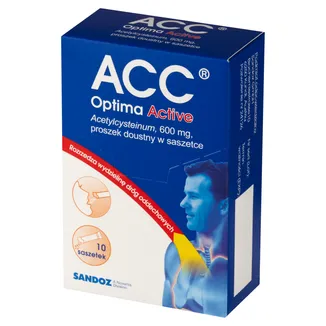
Table of Contents
Patient Information Leaflet
ACC Optima Active, 600 mg, effervescent powder for oral solution in sachet
Acetylcysteinum
Please read all of this leaflet carefully before taking this medicine, because it contains
important information for you.
This medicine should always be used exactly as described in this patient leaflet or as directed by
your doctor or pharmacist.
- Keep this leaflet so that you can read it again if necessary.
- If you need advice or further information, please contact your pharmacist.
- If you experience any side effects, including any possible side effects not listed in this leaflet, inform your doctor or pharmacist. See section 4.
- ACC Optima Active must not be used for longer than 14 days without medical advice.
- If there is no improvement after 4 to 5 days, or if you feel worse, consult your doctor.
Contents of the leaflet
- What ACC Optima Active is and what it is used for
- Important information before taking ACC Optima Active
- How to take ACC Optima Active
- Possible side effects
- How to store ACC Optima Active
- Contents of the pack and other information
1. What ACC Optima Active is and what it is used for
ACC Optima Active contains the active substance acetylcysteine, which liquefies thick mucus
in the respiratory tract.
ACC Optima Active is used to loosen mucus and facilitate its expectoration in patients with
respiratory diseases associated with the production of thick mucus.
This medicine should only be used in adults.
2. Important information before using ACC Optima Active
When not to use ACC Optima Active
Do not use this medicine if the patient is allergic to acetylcysteine or to any of the other ingredients of this
medicine (listed in section 6).
This medicine should not be used in children under 2 years of age.
Warnings and precautions
Before using ACC Optima Active, discuss with your doctor or pharmacist if the patient:
has skin lesions
Very rarely, severe skin reactions such as Stevens-Johnson syndrome and Lyell's syndrome have been reported during acetylcysteine treatment. If new skin or mucosal lesions occur, discontinue the medicine immediately and seek medical help.
has bronchial asthma
has current or past peptic ulcer of the stomach or intestines;
is allergic to histamine
Prolonged use of ACC Optima Active should be avoided in these patients, as the medicine affects histamine metabolism and may cause intolerance symptoms (e.g. headache, vasomotor rhinitis, itching).
does not tolerate fructose, because the medicine contains sorbitol
has phenylketonuria, because the medicine contains a component that is a source of phenylalanine
has difficulty expectorating secretions
Use of ACC Optima Active, especially at the beginning of treatment, may liquefy and increase bronchial secretion. If the patient is unable to expectorate sufficiently, the doctor should initiate appropriate management.
ACC Optima Active should not be used in patients with liver or kidney failure to avoid additional nitrogen load to the body.
Children and adolescents
In children under 2 years of age, mucolytics (medicines that liquefy and thin mucus in the respiratory tract) may cause airway narrowing due to anatomical and functional characteristics of the respiratory tract in this age group and limited ability to expectorate secretions. Therefore, mucolytics should not be used in children under 2 years of age.
ACC Optima Active is not intended for use in children and adolescents. Alternative pharmaceutical forms of the medicine are available for these patients.
ACC Optima Active with other medicines
Tell your doctor or pharmacist about all medicines the patient is currently taking or has recently taken, as well as any medicines the patient plans to use. This particularly applies to the following medicines:
cough suppressants (antitussives)
Concomitant use of ACC Optima Active and antitussive medicines may lead to dangerous accumulation of secretions due to reduced cough reflex. Using these medicines together requires careful assessment of the type of cough. Consultation with a doctor is necessary before combining these medicines.
antibiotics
To prevent antibiotics from interfering with the effectiveness of acetylcysteine, a minimum interval of 2 hours should be maintained between administration of the two medicines. This does not apply to medicines containing cefixime or loracarbef as active substances. Due to lack of interaction, these medicines may be taken at the same time as acetylcysteine.
activated charcoal
Activated charcoal may reduce the effectiveness of acetylcysteine.
glyceryl trinitrate (nitroglycerin)
Concomitant use of glyceryl trinitrate and acetylcysteine may enhance vasodilation and reduce antiplatelet effects. The doctor should monitor for signs of reduced blood pressure (which may be significant), such as headache.
Laboratory tests
If the patient is scheduled for any of the tests listed below, inform the doctor about the use of ACC Optima Active, as it may affect test results:
- salicylates: medicines used to treat pain, inflammation or rheumatism
- urinary ketone bodies
Pregnancy and breastfeeding
If the patient is pregnant or breastfeeding, suspects she may be pregnant, or is planning to become pregnant, she should consult a doctor or pharmacist before using this medicine.
Pregnancy
Due to insufficient experience with the use of acetylcysteine in pregnant women, ACC Optima Active should be used during pregnancy only if clearly necessary, as determined by the doctor.
Breastfeeding
There are no available data on the passage of acetylcysteine into human milk. Therefore, ACC Optima Active should be used during breastfeeding only if clearly necessary, as determined by the doctor.
Driving and operating machinery
It is not known whether ACC Optima Active affects the ability to drive or operate machinery, or if such effect exists, it is considered negligible.
ACC Optima Active contains aspartame, sorbitol and sodium
This medicine contains 0.5 mg of aspartame per sachet. Aspartame is a source of phenylalanine. It may be harmful to patients with phenylketonuria. This is a rare genetic disorder in which phenylalanine accumulates in the body due to impaired excretion.
This medicine contains up to 527 mg of sorbitol per sachet. Sorbitol is a source of fructose. If the patient (or the patient's child) has previously been diagnosed with intolerance to certain sugars or hereditary fructose intolerance—a rare genetic disorder in which the patient's body cannot break down fructose—the patient should consult a doctor before taking the medicine or giving it to a child.
This medicine contains less than 1 mmol (23 mg) of sodium per sachet, meaning the medicine is considered "sodium-free".
3. How to use ACC Optima Active
This medicine should always be used exactly as described in this patient information leaflet or as directed by your doctor or pharmacist. If in doubt, consult your doctor or pharmacist.
This medicine is intended for use in adults only.
Unless otherwise advised by your doctor, the recommended dose is 1 sachet once daily.
Instructions for use
The oral powder contained in one sachet of ACC Optima Active should be poured directly onto the tongue. The powder stimulates saliva production, making it easy to swallow.
Do not chew the oral powder before swallowing.
It is not necessary to drink water after taking the powder.
It is not recommended to mix ACC Optima Active with other medicines.
Note:
A slight sulfur-like odor, if noticeable, does not indicate any deterioration of the medicinal product but is characteristic of the active substance in this product.
Elderly and debilitated patients
Patients with weakened cough reflex (elderly and debilitated patients) should take the medicine preferably in the morning.
Duration of treatment
- ACC Optima Active should not be used for longer than 14 days without medical advice.
- If there is no improvement after 4 to 5 days, or if the patient feels worse, consult a doctor.
Accidental overdose of ACC Optima Active
Overdose may cause irritation of the stomach and intestines, with symptoms such as abdominal pain, nausea, vomiting, and diarrhea.
Severe adverse effects or signs of poisoning have not been observed, even after significant overdosage. However, if an overdose of ACC Optima Active is suspected, consult a doctor.
If you forget to take ACC Optima Active
Do not take a double dose to make up for a missed dose. Take the next dose at the usual time.
If you have any further questions about the use of this medicine, consult your doctor or pharmacist.
4. Possible adverse reactions
Like all medicines, this medicine can cause adverse reactions, although not everyone experiences them.
If the patient experiences symptoms of an allergic reaction or a severe skin reaction, they should stop taking
the medicine ACC Optima Active and seek immediate medical advice.
Uncommon adverse reactions (may occur in less than 1 in 100 people):
- allergic reactions (itching and urticaria, severe swelling of the subcutaneous tissue [angioedema], and skin rash)
- rapid heartbeat (tachycardia)
- low blood pressure (hypotension)
- headache
- ringing in the ears (tinnitus)
- inflammation of the mucous membrane of the mouth (stomatitis)
- abdominal pain, nausea, vomiting, and diarrhoea
- fever
Rare adverse reactions (may occur in less than 1 in 1,000 people):
- shortness of breath, bronchospasm (mainly in patients with bronchial hyperreactivity due to bronchial asthma)
- digestive disturbances (dyspepsia)
Very rare adverse reactions (may occur in less than 1 in 10,000 people):
- severe allergic reactions, up to shock
- severe skin reactions, such as Stevens-Johnson syndrome and Lyell's syndrome*
- bleeding (haemorrhage), partly associated with hypersensitivity reactions
Adverse reactions occurring with unknown frequency (frequency cannot be estimated from available data):
- fluid accumulation in the face (facial swelling)
- reduced platelet aggregation
* Very rarely, severe skin reactions such as Stevens-Johnson syndrome and toxic epidermal necrolysis have been reported, occurring temporally in association with the use of acetylcysteine. In most of these cases, the patient was simultaneously taking at least one other medicinal product which could have exacerbated the described mucosal and skin disorders.
If skin or mucosal changes occur, acetylcysteine should be discontinued immediately and medical help should be sought.
Reporting of adverse reactions
If any adverse reactions occur, including any adverse reactions not listed in this leaflet, inform a doctor or pharmacist. Adverse reactions can be reported directly to the Department of Monitoring Adverse Drug Reactions of the Office for Registration of Medicinal Products, Medical Devices and Biocidal Products:
Al. Jerozolimskie 181C, 02-222 Warsaw
Tel.: +48 22 49 21 301, Fax: +48 22 49 21 309, Website: https://smz.ezdrowie.gov.pl
Adverse reactions may also be reported to the marketing authorization holder.
Reporting adverse reactions helps to provide more information on the safety of this medicine.
5. How to store the medicine ACC Optima Active
Keep the medicine out of sight and reach of children.
Do not use this medicine after the expiry date stated on the sachet and the outer carton after "EXP". The expiry date refers to the last day of the stated month.
Store below 25°C.
Medicines must not be disposed of via wastewater or household waste. Ask your pharmacist how to dispose of medicines no longer in use. This helps protect the environment.
6. Contents of the package and other information
What ACC Optima Active contains
- The active substance is acetylcysteine. Each sachet contains 600 mg of acetylcysteine.
- The other components are: glyceryl tripalmitate, polysorbate 65, sorbitol (E 420), xylitol (E 967), citric acid, sodium dihydrogen citrate, magnesium citrate, sodium carmellose, aspartame (E 951), talc, blackberry flavour “Blackberry B” [containing vanillin, maltodextrin, glucono delta-lactone (E 575), sorbitol (E 420), colloidal anhydrous silica (E 551), mannitol (E 421), magnesium hydroxy carbonate (E 504 II)], magnesium stearate.
What ACC Optima Active looks like and contents of the pack
ACC Optima Active is a white or slightly yellowish powder, with easily disintegrating lumps (if present), with a blackberry odour and possibly a slight odour of sulphur.
The medicine is packed in aluminium/paper foil sachets and placed in a cardboard box.
Each sachet contains 1.6 g of powder.
Pack size: 10 sachets.
Not all pack sizes may be marketed.
Marketing Authorisation Holder
Sandoz GmbH
Biochemiestrasse 10
6250 Kundl, Austria
Manufacturer
Salutas Pharma GmbH
Otto-von-Guericke-Allee 1
39179 Barleben, Germany
Hermes Pharma Ges.m.b.H
Schwimmschulweg 1a
9400 Wolfsberg
Austria
For further information about the medicine and its names in the European Economic Area countries, please contact:
Sandoz Polska Sp. z o.o.
ul. Domaniewska 50 C
02-672 Warsaw
tel. 22 209 70 00