Acatar control
Poland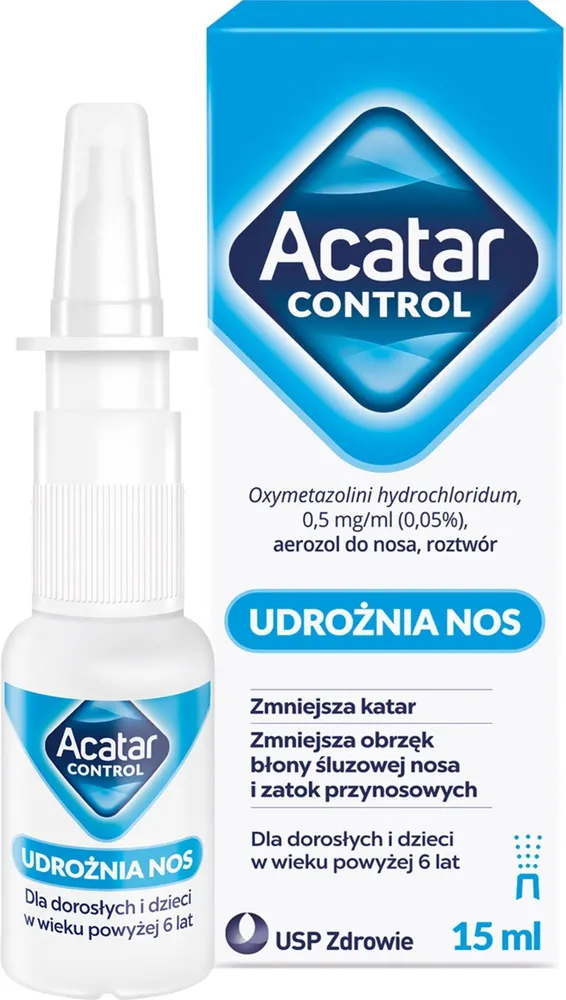
Table of Contents
Package leaflet: Information for the user
Acatar Control
0.5 mg/ml (0.05%) nasal spray, solution
Oxymetazolini hydrochloridum
Please read all of this leaflet carefully before using this medicine, because it contains
important information for you.
This medicine should always be used exactly as described in this patient information leaflet or as directed by your doctor or pharmacist.
- Keep this leaflet, as you may need to read it again.
- If you need advice or further information, consult your pharmacist.
- If you experience any adverse reactions, including any possible adverse reactions not listed in this leaflet, inform your doctor or pharmacist. See section 4.
- If there is no improvement or if your condition worsens after 7 days, consult your doctor.
Table of contents
- What Acatar Control is and what it is used for
- What you need to know before using Acatar Control
- How to use Acatar Control
- Possible side effects
- How to store Acatar Control
- Contents of the pack and other information
1. What Acatar Control is and what it is used for
The active substance in Acatar Control is oxymetazoline hydrochloride, which acts by reducing swelling of the nasal mucosa.
Administration of Acatar Control reduces inflammation-induced swelling of the nasal mucosa and inhibits excessive mucus production. This helps clear nasal congestion, facilitates nasal breathing, and reduces rhinorrhea. Reduction of nasal mucosal congestion also causes dilation and opening of the paranasal sinus drainage pathways and unblocks the Eustachian tubes. This facilitates mucus drainage and aids in the resolution of bacterial infection. The effect of the medicine begins within a few seconds after administration and lasts up to 12 hours.
Acatar Control is used for mucosal swelling occurring in acute rhinitis, allergic rhinitis, sinusitis, Eustachian tube inflammation, and otitis media.
2. Important information before using Acatar Control
When not to use Acatar Control
- if the patient is allergic (hypersensitive) to the active substance (oxymetazoline hydrochloride) or to any of the other ingredients of Acatar Control;
- if the patient has atrophic rhinitis (chronic inflammation of the nasal mucosa with formation of crusts).
Warnings and precautions
Before starting treatment with Acatar Control, consult a doctor or pharmacist if:
- taking other medicines that may increase blood pressure;
- suffering from increased intraocular pressure, particularly narrow-angle glaucoma;
- suffering from severe cardiovascular diseases (e.g. ischemic heart disease, hypertension);
- having a pheochromocytoma;
- suffering from metabolic disorders (e.g. hyperthyroidism, diabetes);
- being elderly, due to increased risk of systemic adverse effects.
Avoid using Acatar Control for longer than recommended and/or in doses higher than recommended.
Prolonged use of medications reducing nasal mucosal swelling may lead to diminished effectiveness.
Excessive use of topically applied nasal medications may result in atrophy of the nasal mucosa and reactive hyperemia (increased nasal mucosal swelling after the effect of the medication wears off, see section 4), leading to rebound rhinitis.
Children and adolescents
Acatar Control may be used only in adults and children above 6 years of age.
Acatar Control and other medicines
Concurrent use or use immediately prior to Acatar Control of tricyclic antidepressants or MAO inhibitors (medications used, among others, in depression) may cause increased blood pressure.
Inform your doctor or pharmacist about all medicines currently taken or recently taken, including those obtained without a prescription.
Pregnancy and breastfeeding
If the patient is pregnant or breastfeeding, suspects she may be pregnant, or is planning to have a child, she should consult a doctor or pharmacist before using this medicine.
Driving and operating machinery
When using medications containing oxymetazoline for prolonged periods or in doses higher than recommended, symptoms affecting the cardiovascular system and central nervous system cannot be ruled out. In such cases, the ability to drive or operate machinery may be impaired.
Acatar Control contains benzalkonium chloride
This medicine contains 0.01 mg of benzalkonium chloride per dose, equivalent to 0.2 mg/ml. Benzalkonium chloride may cause irritation or swelling inside the nose, especially when used for prolonged periods.
3. How to use Acatar Control
This medicine should always be used exactly as described in this patient leaflet or as advised by your doctor or pharmacist. If in doubt, consult your doctor or pharmacist.
Acatar Control is intended for nasal use only.
One container of this medicine should not be used by more than one person.
Acatar Control must not be used in children under 6 years of age.
Children aged 6 to 12 years: administer one dose into each nostril twice daily.
Adults and children over 12 years of age: administer one dose into each nostril 2 to 3 times daily.
Use only for a short period of 3 to 5 days, and not longer than 7 days. Do not use doses larger than those recommended.
Instructions for using the medicine
Before first use, prime the spray pump by pressing it several times until the first full spray appears.
While keeping your head in an upright position (do not tilt it backward), insert the applicator tip into the nostril, without completely blocking the nasal passage. Then press the pump quickly and firmly while simultaneously inhaling gently through the nose.
After use, clean the spray nozzle. Sharing the spray device among multiple users may lead to the spread of infection.
Overdose of Acatar Control
If an overdose is taken or the medicine is accidentally ingested orally, the following symptoms may occur:
pupil dilation, nausea, vomiting, cyanosis (bluish discoloration of the skin and mucous membranes), fever, muscle spasms, tachycardia (increased heart rate), cardiac arrhythmias, circulatory collapse (acute circulatory failure associated with a sudden drop in blood pressure, manifesting as severe weakness, often with loss of consciousness), cardiac arrest, elevated arterial blood pressure, pulmonary edema (fluid accumulation in the lungs, presenting with symptoms such as shortness of breath), breathing difficulties, and psychiatric disturbances.
Additionally, the following may occur:
central nervous system depression with drowsiness, decreased body temperature, bradycardia (slowed heart rate), drop in blood pressure resembling shock, apnea, and coma.
If an overdose is taken, seek immediate medical attention.
Missed dose of Acatar Control
Do not administer a double dose to make up for a missed dose.
If you have any further doubts about the use of this medicine, consult your doctor or pharmacist.
4. Possible adverse reactions
Like any medicine, oxymetazoline can cause adverse reactions, although not everyone experiences them.
Common adverse reactions (occurring in more than 1 in 100 but less than 1 in 10 people using the medicine): burning sensation of the nasal mucosa, dryness of the nasal mucosa, and sneezing, especially in sensitive patients.
Uncommon adverse reactions (occurring in more than 1 in 1,000 but less than 1 in 100 people using the medicine): palpitations, increased heart rate, and elevated arterial blood pressure following local, intranasal administration of the medicine.
Rare adverse reactions (occurring in more than 1 in 10,000 but less than 1 in 1,000 people using the medicine): headache, insomnia, fatigue, and restlessness.
In rare cases, after the effect of the medicine wears off, worsening of nasal mucosal swelling may occur (so-called reactive hyperemia).
Prolonged or frequent use of oxymetazoline, especially in doses higher than recommended, may lead to drug-induced rhinitis. This condition may develop as early as after 5–7 days of treatment and, if continued use of the medicine is not discontinued, may result in permanent damage to the nasal mucosa.
Reporting of adverse reactions
If any adverse reactions occur, including any possible adverse reactions not listed in this leaflet, consult a doctor or pharmacist.
Adverse reactions can be reported directly to the Department of Monitoring Adverse Drug Reactions at the Office for Registration of Medicinal Products, Medical Devices and Biocidal Products
ul. Al. Jerozolimskie 181C
02 - 222 Warszawa
Tel.: + 48 22 49 21 301
Faks: + 48 22 49 21 309
Website: https://smz.ezdrowie.gov.pl
Adverse reactions can also be reported to the marketing authorization holder.
Reporting adverse reactions helps provide more information on the safety of the medicine.
5. How to store Acatar Control
Keep this medicine out of the sight and reach of children.
Store the medicine at a temperature not exceeding 25°C.
After first opening, the medicine remains suitable for use for 1 year. Do not use this medicine after the expiry date stated on the packaging. The expiry date refers to the last day of the stated month.
Medicines must not be disposed of via wastewater or household waste. Ask your pharmacist how to dispose of medicines no longer required. These measures help protect the environment.
6. Contents of the pack and other information
What Acatar Control contains
The active substance is oxymetazoline hydrochloride. One ml of solution contains 0.5 mg of
oxymetazoline hydrochloride.
The other ingredients are: benzalkonium chloride, disodium edetate, propylene glycol, disodium phosphate dodecahydrate, sodium dihydrogen phosphate dihydrate, purified water.
One dose of the aerosol contains no more than 0.025 mg of oxymetazoline hydrochloride.
What Acatar Control looks like and contents of the pack
Acatar Control is a clear liquid.
Pack: 15 ml solution in a bottle (HDPE) with a metering pump (HDPE/PP/POM/LDPE/EVA/
PE/Stainless steel), and a cap (HDPE) in a cardboard box.
Marketing Authorisation Holder:
US Pharmacia Sp. z o.o., ul. Ziębicka 40, 50-507 Wrocław
Importer:
US Pharmacia Sp. z o.o.,
ul. Ziębicka 40,
50-507 Wrocław
For further information, please contact:
USP Zdrowie Sp. z o.o., ul. Poleczki 35, 02-822 Warszawa, tel. +48 (22) 543 60 00.