Zynyz
Italy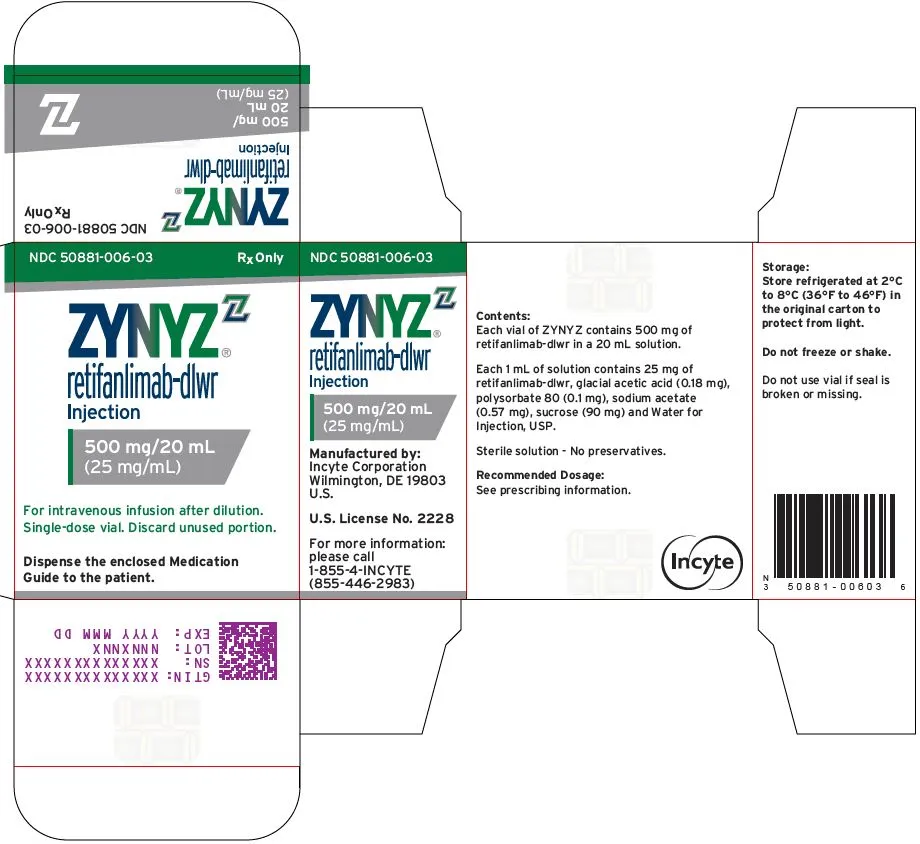
Table of Contents
- Package leaflet: Information for the patient
- ZYNYZ 500 mg concentrate for solution for infusion
- 1. What ZYNYZ is and what it is used for
- 2. What you should know before receiving ZYNYZ
- 3. How ZYNYZ is administered
- 4. Possible side effects
- 5. How to store ZYNYZ
- 6. Package contents and other information
- The following information is intended exclusively for healthcare professionals:
Package leaflet: Information for the patient
ZYNYZ 500 mg concentrate for solution for infusion
retifanlimab
This medicinal product is subject to additional monitoring. This will allow for rapid identification of new safety information. You can help by reporting any side effects you experience while taking this medicine. See the end of section 4 for information on how to report side effects.
Please read this leaflet carefully before receiving this medicine as it contains important information for you.
- Keep this leaflet. You may need to read it again.
- Your doctor will provide you with a patient card. Make sure to carry this card with you during treatment with ZYNYZ.
- If you have any questions, ask your doctor or nurse.
- If you experience any side effects, including those not listed in this leaflet, tell your doctor or nurse. See section 4.
Contents of this leaflet
- What ZYNYZ is and what it is used for
- What you must know before receiving ZYNYZ
- How ZYNYZ is administered
- Possible side effects
- How to store ZYNYZ
- Contents of the pack and other information
1. What ZYNYZ is and what it is used for
ZYNYZ contains the active substance retifanlimab, a monoclonal antibody (a protein capable of recognizing a specific target substance in the body and binding to it). ZYNYZ helps the immune system fight cancer.
ZYNYZ is used in adults for the treatment of:
- anal squamous cell carcinoma, the most common type of anal cancer. It is administered when the cancer has spread or recurred after initial treatment and cannot be treated with surgery. When ZYNYZ is used to treat this type of cancer, it is given in combination with chemotherapy. It is important to also read the package leaflets of the specific chemotherapy you may be receiving. If you have any questions about these medicines, please consult your doctor;
- Merkel cell carcinoma, a rare type of skin cancer. It is administered when the cancer has spread or recurred and cannot be treated with radiotherapy or surgery.
2. What you should know before receiving ZYNYZ
You must not receive ZYNYZ if
- you are allergic to retifanlimab or to any of the other ingredients of this medicine (listed in section 6).
Warnings and precautions
Speak to your doctor or nurse before receiving ZYNYZ if you:
- have an autoimmune disease (a condition in which the body attacks its own cells)
- have received a solid organ transplant or a bone marrow transplant (stem cells) using donor stem cells
- have lung or breathing problems
- have liver or kidney problems
- have diabetes
ZYNYZ acts on the immune system. It may cause inflammation in certain parts of the body. The risk of developing these side effects may be higher if you already have an autoimmune disease (a condition in which the body attacks its own cells). Frequent flare-ups of autoimmune disease may also occur, which in most cases are mild.
Tell your doctor immediately if during treatment you experience any of the following symptoms, or if these symptoms worsen:
- inflammation of the lungs (pneumonitis), such as difficulty breathing, chest pain, or new or worsening cough;
- inflammation of the intestine (colitis), such as frequent diarrhoea with blood and/or mucus, more frequent bowel movements than usual, blood in the stools, black or tar-like stools, and severe or tender abdominal pain;
- inflammation of the liver. Symptoms include: persistent nausea or vomiting, loss of appetite, pain on the right side of the stomach, yellowing of the eyes and/or skin, unusual tiredness, dark-coloured urine, or a tendency to bleed or bruise more easily than usual;
- problems with hormone glands (including the pituitary, thyroid, and adrenal glands) that may affect how these glands work; symptoms include: rapid heartbeat, dizziness, fainting, extreme tiredness, unusual or persistent headache, weight changes, hair loss, feeling cold or constipation;
- type 1 diabetes or diabetic ketoacidosis. Symptoms of diabetes include: increased hunger or thirst, frequent urination, weight loss, feeling tired or nauseous. Symptoms of diabetic ketoacidosis include: difficulty thinking clearly, drowsiness, stomach pain, fast and deep breathing, breath that smells sweet or fruity, sweet or metallic taste in the mouth, or unusual odour of urine or sweat.
- inflammation of the kidneys. Symptoms include: reduced urine volume, foamy urine, blood in the urine or traces of blood in the urine possibly changing its colour, swollen ankles, or loss of appetite;
- skin problems that may lead to a severe skin reaction called toxic epidermal necrolysis and Stevens-Johnson syndrome. Symptoms include: rash, itching, blistering of the skin, or ulcers in the mouth or inside the nose, throat, or genital area;
- inflammation in other parts of the body, such as the eyes (with changes in vision), joints, muscles, nerves, pancreas (symptoms include abdominal pain, nausea or vomiting), or heart muscle;
- infusion-related reactions such as chills, shaking, stiffness, fever, itching, rash, flushing or swelling of the face, shortness of breath or wheezing, dizziness or feeling faint.
If during treatment you experience any of the symptoms listed above, do not try to treat these symptoms yourself with other medicines. Your doctor may:
- prescribe other medicines to prevent complications and reduce these symptoms;
- monitor you closely;
- delay your next dose of ZYNYZ;
- stop treatment; or
- slow down or stop the infusion, depending on the severity of the reaction, if an infusion-related reaction occurs while you are receiving ZYNYZ.
Please note that the symptoms listed above may sometimes appear with a delay and could occur weeks or months after the last dose.
Complications due to rejection of transplanted solid organs, such as graft-versus-host disease, in patients who have received a donor bone marrow transplant (stem cells), can lead to death. These complications may occur if you have had a transplant before or after treatment with ZYNYZ. Your doctor will monitor you for any such complications.
Children and adolescents
ZYNYZ must not be given to children and adolescents under 18 years of age, as it has not been studied in this patient group.
Other medicines and ZYNYZ
Tell your doctor or nurse if you are taking, have recently taken, or might take any other medicines. This is particularly important for medicines that weaken the immune system, such as corticosteroids (an example is prednisone), which could interfere with the effectiveness of ZYNYZ. When starting treatment with ZYNYZ, your doctor may prescribe corticosteroids to reduce potential side effects during treatment.
Contraception
Women who could become pregnant must use effective contraception during treatment and for at least 4 months after the last dose of ZYNYZ.
Pregnancy
If you are pregnant, you must not receive ZYNYZ unless specifically advised by your doctor. ZYNYZ may cause harm or death to the unborn baby. If you are pregnant, suspect you may be pregnant, or are planning a pregnancy, consult your doctor before receiving this medicine.
Breastfeeding
It is not known whether ZYNYZ passes into breast milk. A risk to breastfed infants cannot be excluded. Consult your doctor if you are breastfeeding.
Driving and using machines
ZYNYZ may have a minor influence on the ability to drive and use machines. If you feel tired, do not drive or operate machinery until you feel better.
ZYNYZ contains sodium
This medicine contains less than 1 mmol (23 mg) of sodium per dose, i.e. it is essentially ‘sodium-free’. However, before administration, ZYNYZ is mixed with a solution that may contain sodium. Please consult your doctor if you are on a low-salt diet.
3. How ZYNYZ is administered
ZYNYZ will be administered to you in a hospital or medical clinic under the supervision of a doctor experienced in the treatment of cancers.
The recommended dose of ZYNYZ is 500 mg every 4 weeks.
For the treatment of squamous cell carcinoma of the anal canal, ZYNYZ is administered in combination with carboplatin and paclitaxel.
Your doctor will administer ZYNYZ to you as an intravenous infusion (IV infusion), which will last approximately 30 minutes.
Your doctor will decide how many treatments you will need.
If you miss an appointment for ZYNYZ administration
It is very important that you do not miss a dose of this medicine. Contact your doctor or hospital immediately to reschedule your appointment.
If you interrupt treatment with ZYNYZ
Interrupting treatment may interrupt the medicine's effects. Do not stop treatment with ZYNYZ without first obtaining your doctor's approval.
Patient card
You will find the important information contained in this leaflet in the patient card that has been given to you by your doctor. It is important that you keep this patient card and show it to your partner or caregiver.
If you have any questions about this treatment, speak to your doctor or nurse.
4. Possible side effects
Like all medicines, this medicine can cause side effects, although not everyone will experience them.
ZYNYZ may cause serious side effects, which sometimes can become life-threatening and lead to death. These side effects may occur at any time during treatment, or even after treatment has ended. You may experience more than one side effect simultaneously (for symptoms, see section 2, "Warnings and precautions").
The following side effects have been reported in clinical trials of patients with Merkel cell carcinoma treated with retifanlimab alone.
Contact your doctor immediately if you experience any of the following serious side effects:
Common (may affect up to 1 in 10 people):
- inflammation of the lungs (pneumonitis)
- inflammation of the intestine (colitis)
- inflammation of the liver (hepatitis)
- damage to liver cells (hepatocellular injury)
- sudden kidney damage (acute kidney injury)
- kidney failure
- infusion-related reactions that may cause symptoms such as chills, shaking or fever, itching or rash, flushing or facial swelling, shortness of breath or wheezing, dizziness or nausea.
Uncommon (may affect up to 1 in 100 people):
- inflammation of the pituitary gland, a gland located at the base of the brain (hypophysitis)
- presence of acid in the blood due to diabetes (diabetic ketoacidosis)
- nerve damage causing numbness and weakness (polyneuropathy)
- nerve compression due to damage to the root of one or more nerves in the spinal column (radiculopathy)
- damage to nerves of the larynx, which is involved in breathing, swallowing, and speaking (vocal cord paralysis)
- inflammation of the eyes (uveitis)
- inflammation of the cornea or the transparent tissue at the front of the eye (keratitis)
- inflammation of the tissue surrounding the heart, often with severe chest pain (pericarditis)
- inflammation of the heart muscle (myocarditis)
- inflammation of the pancreas (pancreatitis)
Other side effects may occur with the following frequencies:
Very common (may affect more than 1 in 10 people):
- reduced number of red blood cells (anaemia)
- decreased appetite
- diarrhoea
- nausea
- constipation
- rash
- itching of the skin
- joint pain (arthralgia)
- fatigue
- fever (pyrexia)
Common (may affect up to 1 in 10 people):
- reduced activity of the thyroid gland (hypothyroidism)
- increased activity of the thyroid gland (hyperthyroidism)
- abnormal sensations such as tingling or numbness in the hands or feet (paraesthesia)
- increased levels of liver enzymes, such as alanine aminotransferase and aspartate aminotransferase, in the blood
- increased levels of bilirubin in the blood
- increased levels of creatinine in the blood
- increased levels of thyroid-stimulating hormone in the blood
- increased levels of amylase, an enzyme that breaks down starches
- increased levels of lipase, an enzyme that breaks down fats
Uncommon (may affect up to 1 in 100 people):
- reduced secretion of hormones produced by the adrenal glands (adrenal insufficiency)
- inflammation of the thyroid gland (thyroiditis)
- inflammation of the bile ducts (cholangitis)
- increased levels of bilirubin in the blood, leading to yellowing of the eyes and skin (hyperbilirubinemia)
- inflammation of the joints (arthritis)
- inflammation of the muscles (myositis)
- inflammation of the tissue located between the muscles and the skin, possibly causing skin swelling (eosinophilic fasciitis)
- inflammation of the muscles causing pain or stiffness (polymyalgia rheumatica)
- reduced levels of thyroid-stimulating hormone in the blood
The following side effects have been reported in clinical trials of patients with anal canal squamous cell carcinoma treated with retifanlimab in combination with chemotherapy.
Contact your doctor immediately if you experience any of the following serious side effects:
Very common (may affect more than 1 in 10 people):
- inflammation of the intestine (colitis)
- nerve inflammation causing numbness, weakness, movement difficulties, tingling, or burning pain in the hands, arms, and legs
Common (may affect up to 1 in 10 people):
- inflammation of the pituitary gland, a gland located at the base of the brain (hypophysitis)
- inflammation of the liver (hepatitis)
- infusion-related reactions that may cause symptoms such as chills, shaking or fever, itching or rash, flushing or facial swelling, shortness of breath or wheezing, dizziness or nausea.
Other side effects may occur with the following frequencies:
Very common (may affect more than 1 in 10 people):
- reduced number of white blood cells (lymphopenia and neutropenia)
- reduced activity of the thyroid gland (hypothyroidism)
- itching of the skin
- rash
- fatigue or unusual weakness (asthenia)
- increased blood levels of a liver enzyme called alanine aminotransferase
Common (may affect up to 1 in 10 people):
- reduced secretion of hormones produced by the adrenal glands (adrenal insufficiency and secondary adrenal insufficiency)
- increased activity of the thyroid gland (hyperthyroidism)
- increased blood sugar levels (hyperglycaemia)
- reduced levels of sodium in the blood (hyponatraemia)
- inflammation of the gums (stomatitis)
- inflammation of the joints (arthritis)
- increased blood levels of liver enzymes such as aspartate aminotransferase
- increased levels of lipase, an enzyme that breaks down fats
- increased levels of creatinine in the blood
- increased levels of amylase, an enzyme that breaks down starches
Uncommon (may affect up to 1 in 100 people):
- inflammation of the thyroid gland (thyroiditis)
- inflammation of the bile ducts (cholangitis)
Reporting of side effects
If you experience any side effect, including those not listed in this leaflet, talk to your doctor or nurse. You can also report side effects directly via the national reporting system listed in Annex V. By reporting side effects, you can help provide more information on the safety of this medicine.
5. How to store ZYNYZ
ZYNYZ will be administered to you in a hospital or medical clinic, and storage of this
medicinal product will be the responsibility of healthcare professionals.
Keep this medicinal product out of the sight and reach of children.
Do not use this medicinal product after the expiry date stated on the carton and on the label of the
vial after Scad/EXP. The expiry date refers to the last day of that month.
Store in a refrigerator (2 °C - 8 °C). Do not freeze. Keep in the original packaging to protect from
light.
After preparation, the infusion may be stored for up to 24 hours at 2 °C - 8 °C or up to 8 hours at
20 °C - 25 °C, from the time of preparation until the end of the infusion.
Do not store unused medicine for later use. Any unused medicinal product and waste material
resulting from its use must be disposed of in accordance with local regulations.
6. Package contents and other information
What ZYNYZ contains
- The active substance is retifanlimab. One mL of concentrate for infusion solution contains 25 mg of retifanlimab. A 20 mL vial of concentrate contains 500 mg of retifanlimab.
- The other components are sodium acetate trihydrate (E262), acetic acid (glacial) (E260), sucrose, polysorbate 80 (E433), water for injections. See section 2 “ZYNYZ contains sodium”.
Description of the appearance of ZYNYZ and contents of the pack
ZYNYZ is a concentrate for infusion solution (sterile concentrate) ranging from clear to slightly opalescent, from colourless to pale yellow.
It is available in a pack containing one glass vial with 20 mL of concentrate.
Marketing Authorisation Holder and Manufacturer
Incyte Biosciences Distribution B.V.
Paasheuvelweg 25
1105 BP Amsterdam
The Netherlands
Other sources of information
More detailed information on this medicinal product is available on the website of the European Medicines Agency: https://www.ema.europa.eu.
The following information is intended exclusively for healthcare professionals:
Preparation and administration
- Parenteral medicinal products should be inspected visually for particulate matter and discoloration prior to administration. Retifanlimab is a solution that ranges from clear to slightly opalescent, colorless to pale yellow, and is free from visible particulate matter. Discard the vial if the solution is cloudy, discolored, or contains visible particulate matter.
- Do not shake the vial.
- Withdraw 20 mL (500 mg) of concentrated retifanlimab from the vial and transfer it into an intravenous infusion bag containing either 9 mg/mL (0.9%) sodium chloride injection solution or 50 mg/mL (5%) glucose injection solution to prepare a diluted solution with a final concentration between 1.4 mg/mL and 10 mg/mL. Use infusion bags made of polyvinyl chloride (PVC) and di-2-ethylhexyl phthalate (DEHP), polyolefin copolymer, polyolefin with polyamide, or ethylene vinyl acetate.
- Gently invert the infusion bag several times to mix the diluted solution. Do not shake the infusion bag.
- From a microbiological standpoint, the diluted solution should be used immediately after preparation. If not used immediately, chemical and physical in-use stability has been demonstrated:
- for 8 hours at room temperature (20 ºC to 25 ºC) (including infusion duration). OR
- for 24 hours under refrigeration (2 ºC – 8 ºC). If the diluted solution is refrigerated, allow it to reach room temperature before administration. The diluted solution must be administered within 4 hours (including infusion duration) after removal from the refrigerator. Do not freeze.
- Discard the diluted solution if it is discolored or contains foreign particulate matter other than traces of white to translucent particulate.
- Administer the retifanlimab solution as an intravenous infusion over 30 minutes using an in-line or add-on sterile, pyrogen-free, low-protein-binding filter made of cellulose acetate, polyvinylidene fluoride, or polyethersulfone with a pore size of 0.2 micron to 5 microns, or a 15-micron mesh filter.
- Do not administer other medicinal products concurrently through the same infusion line.
Disposal
- Retifanlimab is for single use only; dispose of any unused portion remaining in the vial.
- Unused medicinal product and waste material derived from this medicinal product must be disposed of in accordance with local regulations.
ANNEX IV
CONCLUSIONS ON THE ANNUAL MARKETING PROTECTION CLAIMS
SUBMITTED BY THE EUROPEAN MEDICINES AGENCY
Conclusions submitted by the European Medicines Agency on:
- one-year marketing protection
In consideration of the provisions set out in Article 14(11) of Regulation 726/2004/EC, the
Committee for Medicinal Products for Human Use (CHMP) has reviewed the data submitted by the marketing authorization holder and considers that the new therapeutic indication provides a clinically relevant benefit compared to currently available therapy(ies), as further described in the European Public Assessment Report (EPAR).