Zutectra
Italy
Table of Contents
- Package leaflet: Information for the user
- Zutectra 500 IU solution for injection in a pre-filled syringe
- 1. What Zutectra is and what it is used for
- 2. What you need to know before using Zutectra
- 3. How to use Zutectra
- 4. Possible side effects
- 5. How to store Zutectra
- 6. Package contents and other information
- 7. How to self-administer Zutectra injections, alone or with the help of an assistant
Package leaflet: Information for the user
Zutectra 500 IU solution for injection in a pre-filled syringe
Human hepatitis B immunoglobulin
Please read all of this leaflet carefully before you start using this medicine because it contains important information for you.
Keep this leaflet. You may need to read it again.
If you have any questions, ask your doctor or pharmacist.
This medicine has been prescribed for you only. Do not give it to other people, even if their symptoms are the same as yours, as it may be harmful.
If you experience any side effect, including those not listed in this leaflet, contact your doctor or pharmacist. See section 4.
Contents of this leaflet:
- What Zutectra is and what it is used for
- What you need to know before using Zutectra
- How to use Zutectra
- Possible side effects
- How to store Zutectra
- Contents of the pack and other information
- How to self-administer the injection of Zutectra, either alone or with the help of an assistant
1. What Zutectra is and what it is used for
What Zutectra is
Zutectra contains antibodies against the hepatitis B virus, which are the body's defence substances that protect against hepatitis B. Hepatitis B is an inflammation of the liver caused by the hepatitis B virus.
What Zutectra is used for
Zutectra is used to prevent hepatitis B reinfection in adults who have undergone a liver transplant at least one week earlier due to liver failure caused by hepatitis B.
2. What you need to know before using Zutectra
Do not use Zutectra
if you are allergic to human immunoglobulins or to any of the other ingredients of this
medicinal product (listed in section 6). In particular, in the very rare cases of
immunoglobulin A (IgA) deficiency with antibodies against IgA in the blood. This may lead to a
severe allergic reaction (anaphylaxis).
An allergic reaction may present as sudden shortness of breath, difficulty breathing, rapid pulse, swelling of the eyelids, face, lips, throat or tongue, skin rash or itching.
Zutectra is intended for subcutaneous injection (under the skin) only. Injection into a vein
or blood vessel may cause an allergic shock.
Warnings and precautions
Before treatment, inform your doctor or healthcare professional
if you have been told that you have antibodies against IgA immunoglobulins in your blood. This
is a very rare condition and may cause allergic reactions.
You may be allergic to immunoglobulins (antibodies) without knowing it, even if you have previously tolerated
treatments with human immunoglobulins. Especially if you have low levels of
IgA immunoglobulins in your blood, allergic reactions such as sudden drop in blood pressure or shock may occur.
You will be monitored during and shortly after the first injection of Zutectra to
ensure that no reaction occurs. If you have an allergic reaction to Zutectra, the injection
will be stopped immediately. Inform your doctor or healthcare professional immediately if you notice any reaction during the injection of Zutectra.
If you are HBsAg-positive, you will not receive Zutectra, as you would not benefit from it. Your doctor
will explain this situation to you.
For your safety, your antibody levels will be checked periodically.
Possible interference with blood tests Zutectra may alter the results of certain blood tests (serological tests). Before any blood test, inform your doctor that you are being treated with Zutectra.
Information on the source material of Zutectra and the possibility of transmission of infectious agents
Zutectra is produced from plasma (the liquid part of blood) of human origin.
When medicinal products are derived from human blood or plasma, measures are taken to prevent infections that may be transmitted to patients. These include
- careful selection of blood and plasma donors to ensure exclusion of those at risk of carrying infections, and
- testing of each individual donation and plasma pools to exclude signs of viruses/infections. Manufacturers of these medicinal products also include steps in the processing of blood or plasma capable of inactivating or removing viruses. Despite these precautions, when medicinal products prepared from human blood or plasma are administered, the possibility of transmitting an infection cannot be completely excluded. This also applies to unknown or emerging viruses and other types of infections.
The precautions taken are considered effective against enveloped viruses, such as human immunodeficiency virus (HIV), hepatitis B virus, hepatitis C virus, and against the non-enveloped hepatitis A virus. The precautions may have limited effectiveness against non-enveloped viruses, such as parvovirus B19
(causative agent of Erythema Infectiosum or Fifth Disease).
Immunoglobulins such as Zutectra have not been associated with hepatitis A or parvovirus B19 infections, possibly because the antibodies against these infections contained in the product are protective.
It is important to record the batch number of Zutectra. Therefore, each time you receive a new
package of Zutectra, write down the date and the batch number (shown on the package after "Lot") and
keep this information in a safe place, for example in your treatment diary (see section 3).
Other medicines and Zutectra
Inform your doctor or healthcare professional if you are taking, have recently taken, or might take any other medicines.
Vaccinations
Zutectra may reduce the effectiveness of certain vaccines (measles, rubella, mumps, varicella) for a period
of up to 3 months.
It may be necessary to wait at least 3 months after the last injection of Zutectra before receiving a vaccination with live attenuated vaccines.
Before any vaccination, inform your doctor about your treatment with Zutectra.
Pregnancy, breastfeeding and fertility
If you are pregnant, think you might be pregnant, are planning to become pregnant, or are breastfeeding,
please consult your doctor before using this medicinal product.
Driving and using machines
Zutectra has no effect or negligible effect on the ability to drive or use machinery.
3. How to use Zutectra
Zutectra is intended for subcutaneous injection only (under the skin). The contents of each pre-filled syringe
should be used only once. Do not inject into a blood vessel.
In most cases, the injection will be administered by a doctor or nurse. However, if antibody levels are sufficient and you are on a fixed-dose regimen, you or a caregiver may administer the injection at home after appropriate training (see below).
It is strongly recommended to use the treatment diary to record Zutectra injections. Your doctor will explain how to use it.
The dose may be individualized and adjusted from 500 IU up to 1,000 IU (in exceptional cases up to
1,500 IU) weekly or every two weeks. The dose will depend on your clinical condition. Your doctor will regularly monitor your condition and will tell you how much and how often to use Zutectra.
Injection administered by yourself or with the help of a caregiver
You may self-administer Zutectra without the doctor's assistance if you have received adequate training. If
you self-administer Zutectra, read carefully the instructions contained in the section “How to administer
the injection of Zutectra by yourself or with the help of a caregiver”.
Zutectra must be brought to room temperature (approximately 23 °C–27 °C) before use.
If you use more Zutectra than you should
The consequences of overdose are not known. However, if you have used a higher dose of Zutectra than prescribed, seek immediate advice from your doctor, a healthcare professional, or pharmacist.
If you forget to use Zutectra
Do not take a double dose to make up for the missed injection. Contact your doctor for dose management. Your doctor will tell you how much and how often to use Zutectra.
Make sure you use Zutectra as prescribed and according to your doctor’s instructions to avoid the
risk of re-infection with hepatitis B.
4. Possible side effects
Like all medicines, this medicine can cause side effects, although not everybody gets them.
Most of the side effects observed with Zutectra have been mild to moderate in nature.
In very rare cases, normal human immunoglobulins can cause a severe allergic reaction.
If you notice any of the following symptoms, stop the injection and inform your doctor
immediately:
rash,
itching,
wheezing,
difficulty breathing,
swelling of the eyelids, face, lips, throat or tongue,
low blood pressure, rapid pulse
These may be signs of a severe allergic reaction (anaphylactic shock).
In case of any adverse event after injection, consult your doctor immediately.
The following side effects have been reported with Zutectra:
Common (may affect less than 1 in 10 people):
injection site reactions: pain, hives at the injection site, bruising (accumulation of
blood in the tissues under the skin), redness of the skin (erythema)
Uncommon (may affect less than 1 in 100 people):
headache
abdominal pain in the upper part of the abdomen (from chest to navel)
In addition, the following reactions have been reported only once:
tiredness (fatigue)
high blood pressure (hypertension)
inflammation of the nose and throat (nasopharyngitis)
muscle spasms
allergic reactions (hypersensitivity)
irregular heartbeat (palpitations), cardiac disorders
itching, rash
pain in the mouth and throat
With other human immunoglobulin preparations, the following additional symptoms have been reported:
chills
headache
dizziness
fever
vomiting
mild allergic reactions
nausea (urgent need to vomit)
joint pain
low blood pressure
moderate back pain
injection site reactions: swelling, irritation, redness, hardening of the skin, local warmth,
itching, bruising and skin rashes.
Reporting of side effects
If you experience any side effect, including those not listed in this leaflet, talk to your doctor, healthcare
professional or pharmacist. You can also report side effects directly via the national reporting system
detailed in Annex V. By reporting side effects, you can help provide more information on the safety of
this medicine.
5. How to store Zutectra
Keep this medicine out of the sight and reach of children.
Do not use this medicine after the expiry date stated on the outer carton, blister, and on the prefilled syringe label after Scad./EXP. The expiry date refers to the last day of that month.
Store and transport in a refrigerator (2°C–8°C). Do not freeze. Keep the prefilled syringe in the outer packaging to protect the medicine from light.
After removing the protective cap from the prefilled syringe, the solution should be administered immediately.
Do not use Zutectra if the solution appears cloudy or contains suspended particles.
Do not dispose of medicines via wastewater or household waste. Ask your pharmacist how to dispose of medicines you no longer use. This will help protect the environment.
Immediately after completing the injection, dispose of all needles, syringes, and empty glass containers into the sharps container provided.
6. Package contents and other information
What Zutectra contains
The active substance is human anti-hepatitis B immunoglobulin, 500 IU/mL.
Zutectra contains 150 mg/mL of human plasma proteins, of which at least 96% are
immunoglobulins G (IgG). The maximum content of immunoglobulin A (IgA) is
6,000 micrograms/mL.
The other components are glycine and water for injections.
Description of the appearance of Zutectra and contents of the pack
Zutectra is a solution for injection supplied in pre-filled syringes (500 IU/mL – pack of five in a blister). The solution may vary in colour from clear to opalescent and from colourless to pale yellow.
One 1 mL pre-filled syringe of Zutectra contains 500 IU. Zutectra is supplied in a pack containing 5 pre-filled syringes, each in a blister.
Marketing Authorisation Holder and Manufacturer
Biotest Pharma GmbH
Landsteinerstrasse 5
D-63303 Dreieich
Germany
Tel.: + 49 6103 801–0
Fax: + 49 6103 801–150
E-mail: [email protected]
For further information on this medicinal product, please contact the local representative of the Marketing Authorisation Holder:
België/Belgique/Belgien Lietuva
Infarama BV Biotest AG
Ringlaan 39 Landsteinerstrasse 5
B-1853 Strombeek-Bever D-63303 Dreieich
Tél/Tel: +32 11 31 26 16 Tel: + 49 6103 801-0
България Luxembourg/Luxemburg
МЕДИС ФАРМА БЪЛГАРИЯ ЕООД Biotest AG
1700 София Landsteinerstr. 5
Ул. Проф. Атанас Иширков 31, офис 6 D-63303 Dreieich
T: +359 2 427 49 58 Tél/Tel: + 49 6103 801-0
Česká republika Magyarország
Reg-Pharm spol.s.r.o. Biotest Hungaria Kft.
Fialková 45 Torbágy u. 15/A
CZ-10600 Praha 10 H-2045 Törökbálint
Tel: + 420 2 7265 4004 Tel.: + 36 23 511 311
Danmark Malta
Unimedic Pharma AB Rodel Ltd
Box 6216 55, Ravina
S-102 34 Stockholm Triq ir-Russett
Tlf:+ 46 10 130 99 80 MT-Kappara SGN 4432
Tel: + 356 27 386221
Deutschland Nederland
Biotest AG Infarama BV
Landsteinerstrasse 5 Ringlaan 39
D-63303 Dreieich B-1853 Strombeek-Bever
Tel: + 49 6103 801-0 Tel: +32 11 31 26 16
Eesti Norge
Biotest AG Unimedic Pharma AB
Landsteinerstrasse 5 Box 6216
D-63303 Dreieich S-102 34 Stockholm
Tel: + 49 6103 801-0 Tlf:+ 46 10 130 99 80
Ελλάδα Österreich
Biotest AG Biotest Austria GmbH
Landsteinerstrasse 5 Einsiedlergasse 58
D-63303 Dreieich A-1050 Wien
Τηλ: + 49 6103 801-0 Tel: + 43 1 545 15 61-0
España Polska
Biotest Medical, S.L.U. Biotest AG
C/ Frederic Mompou, 5 – 6º 3ª A Landsteinerstrasse 5
E-08960 Sant Just Desvern D-63303 Dreieich
Barcelona Tel: + 49 6103 801-0
Tel: +34 935 952 661
France Portugal
Biotest AG SPCare Especialidades Farmacêuticas, Lda
Landsteinerstrasse 5 Rua Luciano Cordeiro, nº 123, 1º dto.
D-63303 Dreieich P-1050 139 Lisboa
Tél: 00800 98832872 Tel: + 351 21 193 14 20
Hrvatska România
Medis Adria d.o.o. Biotest AG
Buzinska cesta 58 Landsteinerstrasse 5
10010 Zagreb - Buzin D-63303 Dreieich
T: +385 1 2303 446 Tel: + 49 6103 801-0
Ireland Slovenija
Aquilant Pharmaceuticals MEDIS, d.o.o.
21 Fonthill Business Park Brnčičeva 1,
Fonthill Road SI-1231 Ljubljana-Črnuče,
Clondalkin Tel: +386 1 589 69 00
IRL-Dublin 22
Tel: + 353 1 404 8344
Ísland Slovenská republika
Biotest AG Reg-Pharm spol.s.r.o.
Landsteinerstrasse 5 Fialková 45
D-63303 Dreieich CZ-10600 Praha 10
Sími: + 49 6103 801-0 Tel: + 420 2 7265 4004
Italia Suomi/Finland
Biotest Italia S.r.l. Unimedic Pharma AB
Via Leonardo da Vinci 43 Box 6216
I-20090 Trezzano sul Naviglio S-102 34 Stockholm
Tel: + 39 02 4844 291 Puh/Tel: + 46 10 130 99 80
Κύπρος Sverige
ΑΚΗΣ ΠΑΝΑΓΙΩΤΟΥ & ΥΙΟΣ ΛΤΔ Unimedic Pharma AB
Γ. ΚΡΑΝΙΔΙΩΤΗ Box 6216
Τ. Θ. 22578 1522 ΛΕΥΚΩΣΙΑ S-102 34 Stockholm
Κ Υ Π Ρ Ο Σ Tel: + 46 10 130 99 80
Τηλ: + 357 22 611 038
Latvija United Kingdom (Northern Ireland)
Biotest AG Biotest AG
Landsteinerstrasse 5 Landsteinerstrasse 5
D-63303 Dreieich D-63303 Dreieich
Tel: + 49 6103 801-0 Tel: + 49 6103 801-0
More detailed information on this medicinal product is available on the European Medicines Agency website: http://www.ema.europa.eu.
7. How to self-administer Zutectra injections, alone or with the help of an assistant
The following instructions explain how to perform self-injection of Zutectra. Please read these instructions carefully and follow them step by step. Your doctor or a healthcare professional will demonstrate the procedure for self-administration.
Do not attempt to perform the self-injection until you are certain you understand how to prepare the solution and how to administer the injection.
General information:
Keep syringes and disposal units out of the reach of children; if possible, store supplies under lock and key.
Try to administer the injection at the same time each day. This will help you remember to take your dose.
Carefully check the dose.
Before use, allow the solution to reach room temperature (approximately 23 °C–27 °C).
Remove each pre-filled syringe from its packaging only when you are ready to inject. Once the protective cap has been removed from the pre-filled syringe, administer the injection immediately.
The solution may vary in appearance from clear to opalescent and from colorless to pale yellow. Do not use solutions that are cloudy or contain particles.
This medicine must not be mixed with others.
Before injection:
- Wash your hands. It is important that your hands and all materials used are as clean as possible.
- Gather all necessary items in advance. Choose a clean surface on which to place all materials:
two alcohol swabs,
one pre-filled syringe of Zutectra,
a needle suitable for subcutaneous injection.
Please note that alcohol swabs and needles are not included in the package and must be obtained separately.
Ensure that your treatment diary and a sharps container for safe disposal of waste are within easy reach.
- Before preparing the injection, decide where to inject. Inject Zutectra into the fatty tissue layer between the skin and muscle (approximately 8–12 mm beneath the skin). The best injection sites are areas where the skin is less tight and more pliable, such as the abdomen, upper arm, thigh, or buttocks. Avoid joints, nerves, and bones.
Important: Do not inject into areas with lumps, bruises, nodules, pain, or areas with skin discoloration, indentations, scabs, or damaged skin. Discuss with your doctor or healthcare provider if you have any of these conditions or other unusual symptoms. Rotate the injection site each time. If certain areas are difficult to reach, seek help from someone who can assist you with the injection.
- Preparation of the pre-filled Zutectra syringe:
Remove the pre-filled syringe from its packaging.
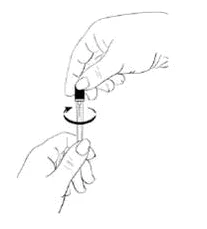
Carefully inspect the solution. It should appear clear and free of particles. If the solution has changed color, appears cloudy, or contains particles, discard it and use another pre-filled syringe.
Remove the protective cap from the syringe.
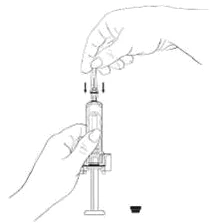
Remove the needle from its sterile packaging and attach it to the syringe.
- Removing any air bubbles from the pre-filled syringe.
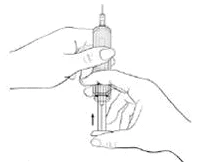
Hold the syringe with the needle pointing upward and gently tap it with your fingers to move air bubbles toward the tip.
Gently press the plunger to expel air bubbles.
Injection
- Choose the injection site and record it in your treatment diary. Also record the date and the batch number (see “Information on the source materials of Zutectra and the possibility of transmission of infectious agents” in section 2 of this package leaflet).
Abdomen (stomach): do not use sites within
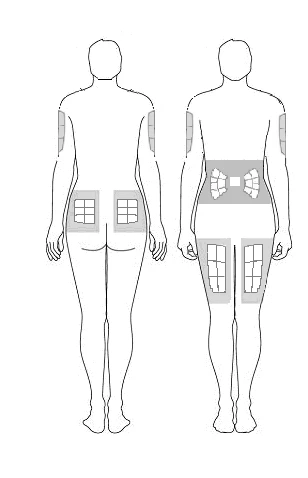
2.5 cm of the navel. Avoid the belt line, as friction may cause irritation at the injection site. Avoid surgical scars. These are the best sites for self-injection.
Thighs: use the central and outer areas where you can lift the skin with your fingers. Areas richest in fatty tissue are usually farther from the knee and closer to the groin.
Arms: the back of the upper arm should be used. It is difficult to lift the skin with your fingers and perform self-injection at this site. If you choose this site, try lifting the tissue by placing your arm against the back of a chair or a wall. It is easier to have someone assist you if you choose this site.
Buttocks: use areas where you can lift the skin with your fingers. Self-injection is more difficult in this area. Stand in front of a mirror to locate the site properly, or ask an assistant to help you administer the injection.
It is important to rotate the injection site each time. This helps keep the skin flexible and allows more uniform absorption of the medicine. Begin by injecting in one site, then use all other sites in turn before returning to the first site and repeating the rotation. To avoid problems, always record where you administered the injection. The following figure illustrates an example of administration on the thigh:
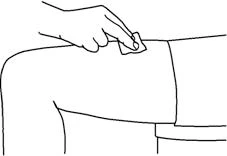
- Clean the injection site with an alcohol swab. Allow it to air dry.
- Gently pinch the disinfected skin at the injection site and insert the needle quickly and firmly at an angle of 45–90 degrees. Inject under the skin as demonstrated by your doctor or nurse.
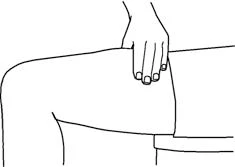
- Inject the solution by gently pressing the plunger of the syringe. Inject slowly until the syringe is completely empty.
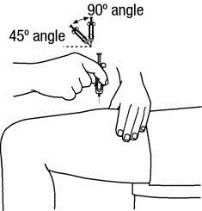
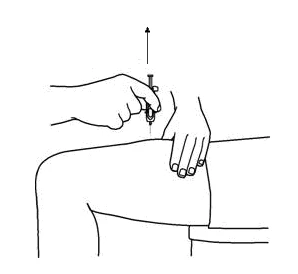
- Immediately withdraw the needle and release the skin.
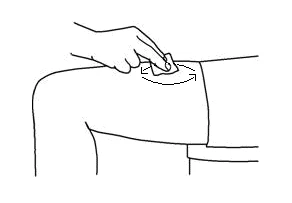
- Clean the injection site by gently rubbing with the alcohol swab in circular motions.
Disposal of all used materials
After completing the injection, immediately dispose of all used needles and empty glass containers in a sharps container.