Zorias
Italy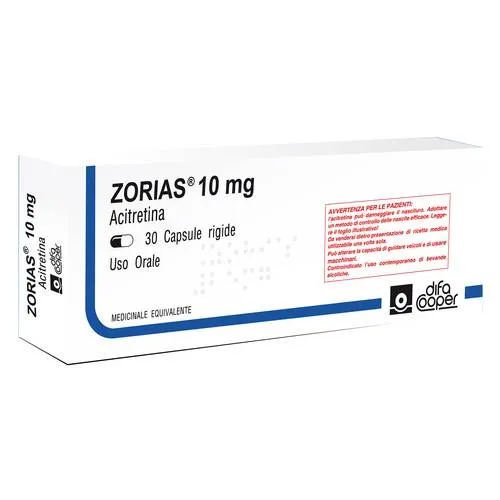
Table of Contents
PACKAGE LEAFLET
Package leaflet: information for the user
Zorias 10 mg capsule, 25 mg capsule
Acitretin
Generic Medicine
WARNING
CAN CAUSE SEVERE HARM TO THE FETUS
Women must use effective contraceptive methods
Do not use if you are or think you may be pregnant
▼ This medicine is under additional monitoring. This will allow rapid identification of new safety information. You can help by reporting any side effects you experience while taking this medicine. See the end of section 4 for information on how to report side effects.
Please read this leaflet carefully before taking this medicine as it contains important information for you.
- Keep this leaflet. You may need to read it again.
- If you have any questions, ask your doctor or pharmacist.
- This medicine has been prescribed for you only. Do not give it to others, even if their symptoms are the same as yours, as it may be harmful.
- If you experience any side effects, consult your doctor or pharmacist. This includes any side effect not listed in this leaflet. See section 4.
Contents of this leaflet:
- What Zorias is and what it is used for
- What you need to know before taking Zorias
- How to take Zorias
- Possible side effects
- How to store Zorias
- Contents of the pack and other information
1. WHAT ZORIAS IS AND WHAT IT IS USED FOR
Acitretin belongs to a group of medicines known as retinoids. Retinoids are derivatives of vitamin A.
This medicine is used to treat severe skin disorders characterized by thickening or
scaling of the skin that do not respond satisfactorily to other conventional treatments.
Zorias is used to treat:
- widespread and severe forms of various skin diseases resulting from abnormalities of the outer layer of the skin (epidermis), such as psoriasis, accompanied by dry, scaly, and waxy skin eruptions;
- specific skin disorders characterized by dry desquamation due to marked keratinization (ichthyosis, an organic process whereby keratin deposits in cells, making them thick like nails and hair) and similar conditions presenting with skin eruptions (pityriasis) or small elevations of the skin and mucosa (lichen ruber).
2. WHAT YOU SHOULD KNOW BEFORE USING ZORIAS
Do not take Zorias
- If you are pregnant or breastfeeding.
- If there is any possibility that you could become pregnant, you must follow the precautions outlined in the “Pregnancy Prevention Programme” described in the section “Warnings and precautions”.
- if your liver is not functioning properly
- if your kidneys are not functioning properly
- if you have very high levels of fat or cholesterol in the blood (a condition also known as “hyperlipidaemia”)
- if you are taking other retinoid medicines, or vitamin supplements or foods containing high levels of vitamin A. See section “Do not take Zorias with”
- if you are taking tetracycline antibiotics (for an infection). See section “Do not take Zorias with”
- if you are being treated with methotrexate (a medicine used to treat cancer, psoriasis and rheumatic diseases). See section “Do not take Zorias with”
- if you are using the so-called mini-pill (a low-progesterone oral contraceptive), the contraceptive effect of the mini-pill may be reduced by Zorias, and therefore reliable contraceptive protection is no longer assured. See section “Do not take Zorias with” 7. if you are allergic (hypersensitive) to the active substance, to any of the other components of the medicine (listed in section 6: “Contents of the pack and other information”) or to other “retinoid” medicines. Hypersensitivity usually manifests as skin reactions such as rashes, urticaria and/or itching.
Warnings and precautions
Talk to your doctor or pharmacist before taking acitretin.
Warning for all patients
Acitretin commonly increases blood fats such as cholesterol or triglycerides, which have been associated with pancreatitis. Inform your doctor if you experience severe abdominal or back pain (this may be a sign of inflammation of the pancreas).
Pregnancy Prevention Programme
Pregnant women must not use Zorias
This medicine can severely harm the unborn child (it is said to be “teratogenic”) – it may cause birth defects affecting the brain, face, ear, eye, heart and certain glands (thymus and parathyroid glands). It may also likely cause miscarriage. This can occur even if Zorias is used only briefly during pregnancy.
- You must not use Zorias if you are pregnant or think you may be pregnant.
- You must not use Zorias if you are breastfeeding. The medicine may pass into breast milk and harm the newborn.
- You must not use Zorias if you could become pregnant during treatment.
- You must not become pregnant for 3 years after stopping this treatment, as some medicines may remain in your body.
For women who could become pregnant, Zorias is prescribed under very strict rules due to the risk of fetal harm.
These rules are:
- Your doctor must explain the risk of fetal harm – you must understand that you must not become pregnant and what is required to prevent pregnancy.
- Your doctor must have discussed contraception (birth control) with you. Your doctor will provide information on how to avoid pregnancy. Your doctor may refer you to a specialist for contraceptive counselling.
- Before starting treatment, your doctor will instruct you to have a pregnancy test. The test must confirm that you are not pregnant when starting treatment with Zorias.
Women must use effective contraception before, during and after using Zorias
- You must agree to use at least one highly reliable contraceptive method (e.g. an intrauterine device or contraceptive implant) or two effective methods that work in different ways (e.g. hormonal contraceptive pill and a condom). Discuss with your doctor which method may be suitable for you.
- You must use contraception for one month before starting Zorias, during treatment and for 3 years after stopping treatment.
- You must use contraception even if you do not have periods or are not sexually active (unless your doctor tells you it is not necessary).
Women must agree to undergo pregnancy tests before, during and after using Zorias
- You must agree to regular follow-up visits, preferably every month.
- You must agree to undergo regular pregnancy tests, preferably every month during treatment and, since some medicines may remain in your body, 1 to 3 months apart for 3 years after stopping Zorias.
- You must agree to additional pregnancy tests if requested by your doctor.
- You must not become pregnant during treatment or within 3 years after stopping, as some medicines may remain in your body.
- Your doctor will discuss all these points with you, using a checklist, and will ask you (or a relative/guardian) to sign it. This document will confirm that the risks have been communicated to you and that you agree to follow the above rules. If you become pregnant while taking Zorias, stop taking this medicine immediately and contact your doctor. Your doctor may refer you to a specialist for consultation. Additionally, if you become pregnant within 3 years after stopping Zorias, you must contact your doctor. Your doctor may refer you to a specialist for consultation.
Advice for men
The levels of oral retinoids in the semen of men taking Zorias are too low to harm their partner’s unborn child. However, you must never share your medicine with anyone.
Additional precautions
Never give this medicine to anyone else. At the end of treatment, return any unused capsules to your pharmacist.
You must not donate blood during treatment with this medicine and for 3 years after stopping Zorias, as if a pregnant woman were to receive your blood, it could harm her unborn child.
Talk to your doctor before taking Zorias:
- If you have not had any mental health problems. This includes depression, aggressive tendencies or mood changes. This is because Zorias may affect your mood.
Mental health problems
You may notice some changes in your mood and behaviour, and it is very important that you inform your friends and family that this medicine may affect mood and behaviour. They may notice these changes and help you identify problems that need to be discussed with your doctor.
Pay special attention with Zorias
- if you are a woman of childbearing potential and your doctor decides to use this medicine, you must strictly follow a series of instructions (see “Instructions for women of childbearing potential” in section “Pregnancy, breastfeeding and fertility”)
- if you have high blood sugar levels (diabetes), drink a lot of alcohol, are overweight, have lipid metabolism disorders or high blood pressure. In such cases, you will need more frequent monitoring of your blood values when starting this medicine.
- if you notice problems with vision, especially in the dark (see “Driving and use of machinery”)
- if you wear contact lenses. Zorias causes dry eyes and therefore you should wear glasses during treatment.
- if Zorias is to be used in children. Growth and bone development must be checked at regular intervals. In long-term treatment of children, your doctor must carefully weigh the possible serious side effects against the benefits of therapy with this medicine.
- if you are exposed to intense sunlight or intend to use sunbeds. Zorias may intensify the effects of UV light on the skin. In such cases, avoid excessive sun exposure and do not use sunbeds. Before sun exposure, ensure you apply adequate sun protection (at least SPF 15).
- If you suffer from severe headache, nausea, vomiting and visual disturbances, as there have been rare cases of benign intracranial hypertension (increased pressure in the brain).
Tests before starting treatment
- Your doctor must perform a blood test before starting treatment to check liver function. The blood test should be repeated every 1–2 weeks for the first 2 months after starting treatment. After this period, tests should be repeated at least every 3 months during treatment. If abnormal values occur, your liver function must be monitored weekly. If abnormal liver function leads to premature discontinuation of treatment, liver function must be monitored for at least 3 months after stopping Zorias.
- Cholesterol and triglyceride levels in the blood (fasting values) must be checked before starting treatment, one month after starting and then every 3 months during treatment. In diabetics, retinoids may improve or worsen glucose tolerance. Blood sugar levels should therefore be monitored more frequently than usual in the early stages of treatment.
- For all high-risk patients where cardiovascular risk indicators do not return to normal or worsen further, dose reduction or discontinuation of acitretin treatment should be considered.
- Your doctor may monitor your blood pressure.
- Before treatment with Zorias and during long-term therapy, your doctor will perform additional regular bone examinations (e.g. once a year) as this medicine may cause bone changes (see section 4 “Possible side effects”). If this applies to you, your doctor will discuss with you the benefits and risks of continuing therapy.
- Inform your doctor if you notice the following signs of possible bone changes: bone, joint or muscle pain, limited mobility. There have been occasional reports of bone changes in children after long-term treatment with etretinate (another “retinoid” medicine). Therefore, in children, growth parameters and bone development must be closely monitored.
Very rarely, a serious condition causing increased permeability of small blood vessels (capillaries) (capillary leak syndrome/retinoic acid syndrome) has been reported. This may cause severe hypotension (low blood pressure), oedema (fluid accumulation leading to swelling) and shock (collapse).
Very rarely, a severe skin reaction has been reported, with symptoms such as rashes, blisters or skin peeling (exfoliative dermatitis).
Other medicines and Zorias
Inform your doctor or pharmacist if you are taking, using or have recently taken or used any other medicines, including those without a prescription.
The effect of phenytoin (a medicine for epilepsy) may increase when taking Zorias. Therefore, the dosage of phenytoin may need adjustment.
Do not take Zorias with:
- tetracycline antibiotics because they may cause increased pressure in the brain.
- methotrexate (a medicine used to treat cancer, psoriasis and rheumatic diseases), because this combination may cause liver inflammation.
- the so-called mini-pill (a low-progesterone oral contraceptive). The contraceptive effect of the mini-pill may be reduced by Zorias, so reliable contraceptive protection is no longer assured.
- medicines or vitamin supplements containing high levels of vitamin A (more than 5000 IU per day).
- other retinoid medicines, such as isotretinoin.
Zorias with food and drinks
During treatment with Zorias, you must not drink alcohol, as it would increase the risk of side effects.
Women of childbearing potential must absolutely avoid alcohol during treatment with acitretin and for 2 months after stopping treatment (see “Instructions for women of childbearing potential”).
Concomitant intake of Zorias and alcohol may lead to the formation of a compound (etretinate), which may be harmful to the fetus, and if formed, takes time to be completely eliminated from the body.
Pregnancy, breastfeeding and fertility
Pregnancy
Do not take Zorias if you are pregnant or if there is any possibility of becoming pregnant at any time during treatment and for 3 years after stopping.
If you become pregnant during treatment with Zorias, stop taking the medicine immediately and contact your doctor; if you become pregnant within 3 years after stopping treatment, contact your doctor immediately.
Acitretin, the active ingredient in this medicine, is likely to cause birth defects in the unborn child. If pregnancy occurs during treatment with Zorias or within 2 years after stopping, despite the precautions described (see “Instructions for women of childbearing potential” below and “Pregnancy Prevention Programme” in section “Warnings and precautions”), there is a high risk of severe birth defects.
Instructions for women of childbearing potential
Zorias is highly teratogenic. This means it is likely to severely harm the unborn child.
Typical malformations caused by acitretin include, for example, damage to the central nervous system, heart and major blood vessels, skull and face, skeleton and thymus gland.
The rate of malformations is high, even if the medicine was taken only briefly during pregnancy or if pregnancy occurs within 3 years after stopping treatment.
If you are a woman of childbearing potential, you may take Zorias only if:
- you suffer from a very severe or disabling skin disease that has not improved with other treatments
- you strictly follow the following precautions to prevent pregnancy during treatment with Zorias and for 2 years after stopping:
- your doctor has explained the teratogenic risk (severe fetal malformation) associated with using Zorias and you understand why you must not become pregnant and how to prevent it
- you use an effective birth control method (contraception), preferably two complementary methods (hormonal contraceptive or intrauterine device and condom or diaphragm) continuously, for at least 1 month before starting the medicine,
during treatment and for 3 years after stopping treatment. Discuss with your doctor the precautionary measures for effective contraception. Contact your doctor immediately if you suspect pregnancy.
- you have undergone a supervised pregnancy test (which must be negative) up to 3 days before starting the first dose of Zorias to confirm you are not pregnant. You may also be required to have regular pregnancy tests during treatment. After stopping treatment, the pregnancy test must be performed every 1–3 months for a period of 3 years after the last dose of Zorias.
- you start taking Zorias after a negative pregnancy test result, on the second or third day of the following menstrual cycle
- you understand and accept the need for monthly follow-up visits and possibly additional pregnancy tests, as decided by your doctor
- you strictly adhere to these precautions if undergoing repeated treatment with Zorias
- you do not consume alcohol (in drinks, food or medicines) during treatment with Zorias and for 2 months after stopping, because alcohol may increase the risk of malformations. Women of childbearing potential must not receive blood from patients being treated with acitretin.
Your doctor may ask you (or your legal guardian) to sign a declaration confirming that you have been informed of the risks of treatment with Zorias and accept the necessary precautionary measures.
If you have any questions about these instructions, consult your doctor or pharmacist before taking this medicine.
For further information on pregnancy and contraception, see section 2 of the “Pregnancy Prevention Programme”.
Breastfeeding
You must not take Zorias if you are breastfeeding, as acitretin passes into breast milk and may harm the newborn.
Prescription based on diagnosis and treatment plan by a dermatology specialist. Based on a treatment plan of up to 6 months, prescriptions may also be issued by the attending physician. The prescription of Zorias for women of childbearing potential is limited to 30 days of therapy, and continuation of therapy requires a new prescription. The pregnancy test, prescription issue and dispensing of Zorias should preferably occur on the same day. Zorias will be dispensed by the pharmacist within a maximum of seven days from the date of prescription. After this period, the pharmacist will dispense Zorias only upon presentation of a new prescription.
Driving and use of machinery
Night vision may worsen during treatment. This may occur suddenly. In rare cases, this effect has continued even after stopping treatment. Be cautious if driving or operating any type of equipment or machinery at night or in tunnels. (See “Pay special attention with Zorias”).
Zorias contains glucose (as maltodextrin derived from maize). If your doctor has told you that you have an intolerance to certain sugars, contact him before taking this medicine.
3. HOW TO TAKE ZORIAS
Zorias should only be prescribed by physicians, preferably skin specialists, who have experience in the
treatment with systemic retinoids and who can properly assess the risk of acitretin use during
pregnancy.
Always take this medicine exactly as instructed by your doctor or pharmacist. If you have any doubts,
consult your doctor or pharmacist.
- Take Zorias with meals or with a glass of milk.
- Swallow each capsule whole. The dose varies depending on the patient. Your doctor will determine the appropriate dose for your individual case.
For individual treatment, Zorias capsules are available containing either 10 mg or 25 mg of acitretin.
Adult and elderly patients
- The usual initial dose for adults and elderly patients is 25 mg or 30 mg once daily.
- After 2 or 4 weeks, your doctor may increase or decrease the dose. This decision will depend on the medicine’s effectiveness and the side effects you experience.
- The maximum dose is 75 mg per day.
- Most patients take Zorias for a maximum period of 3 months. However, your doctor may decide to extend the treatment further in your case.
If you take more Zorias than you should
If you take more Zorias than prescribed, you may experience headache, nausea or vomiting, drowsiness, irritability, and itching. In this case, stop taking the medicine immediately and contact your doctor or go to hospital without delay.
If you forget to take Zorias
Do not take a double dose to make up for the missed dose. If you forget a dose, take it as soon as you remember, then continue with your prescribed dosing schedule. However, if it is almost time for your next dose, skip the missed dose.
If you stop taking Zorias
Your doctor will best determine whether and how to discontinue treatment with Zorias.
Always consult your doctor before stopping this medicine.
If you have any questions about how to use this medicine, consult your doctor or pharmacist.
4. POSSIBLE ADVERSE REACTIONS
Like all medicines, Zorias may cause adverse reactions, although not everyone experiences them.
- The adverse reactions of Zorias are dose-related. The higher the dose, the greater the risk of adverse reactions.
- Treatment with high doses may cause mood changes, including irritability, aggression, and depression.
- Most adverse reactions occur at the beginning of treatment, when the dose has not yet been adjusted. Most adverse effects are reversible following dose adjustment or discontinuation of treatment.
- Occasionally, skin symptoms may worsen at the beginning of treatment.
- Since Zorias is a vitamin A derivative, most adverse reactions resemble symptoms occurring with excessive vitamin A intake.
Very common adverse reactions (may affect more than 1 in 10 patients treated)
- Dryness or inflammation of the lips
- Dryness, irritated or runny nose, nosebleeds, skin peeling, especially on the palms of the hands and soles of the feet
- Inflammation of the nasal mucosa
- Itching (pruritus)
- Hair loss
- Dry mouth, increased thirst
- Changes in liver function (shown in blood tests)
- Increased levels of fats (triglycerides, cholesterol) in the blood (shown in blood tests)
- Dry, irritated or swollen eyes, which may lead to intolerance of contact lenses
The use of moisturizers or emollients from the start of treatment may help relieve problems related to dry skin or lips.
Adverse effects on the skin and mucous membranes occur rather early (within a few days) after starting treatment, whereas hair loss tends to occur after several weeks.
These adverse effects are reversible following dose adjustment or discontinuation of treatment. However, hair regrowth may take several months due to the hair growth cycle.
Common adverse reactions (may affect up to 1 in 10 patients treated)
- Headache
- Muscle and joint pain
- Swelling of the hands, ankles and feet
- Inflammation of the mouth mucosa
- Gastrointestinal problems (e.g., nausea, vomiting, abdominal pain, diarrhea, indigestion)
- Fragile skin, sticky sensation on the skin, skin rashes, skin inflammation, changes in hair structure, brittle nails, nail infections, skin redness
Uncommon adverse reactions (may affect up to 1 in 100 patients treated)
- Dizziness
- Blurred vision
- Inflammation of the gums
- Inflammation of the liver (hepatitis)
- Cracks, fissures or fine linear scars in the skin, for example around the mouth (cheilitis), blisters and skin inflammation (bullous dermatitis)
- Increased skin sensitivity to sunlight
Rare adverse reactions (may affect up to 1 in 1,000 patients treated)
- Nerve damage to the peripheral nervous system, which may include symptoms such as muscle weakness, numbness and tingling in the hands and feet, or burning or shooting pain
Very rare adverse reactions (may affect up to 1 in 10,000 patients treated)
- Increased blood pressure in the skull
- Altered night vision, inflammation of the cornea (ulcerative keratitis)
- Yellowing of the skin or whites of the eyes (jaundice)
- Bone pain, changes in bone growth
Adverse reactions not known (frequency cannot be estimated from available data)
- Vaginal infection (also known as candida or thrush)
- Severe itchy rash with irregular pale or red raised patches (urticaria)
- Partial hearing loss, ringing in the ears (tinnitus)
- Hot flushes
- A serious condition causing increased permeability of small blood vessels (capillaries) (capillary leak syndrome / retinoic acid syndrome). This may cause severe hypotension (low blood pressure), edema (fluid accumulation leading to swelling), and shock (collapse)
- Changes in taste perception; rectal bleeding
- Small reddish bumps or nodules on the skin that may bleed easily (pyogenic granuloma)
- Loss of eyelashes and eyebrows (madarosis)
- A severe skin reaction with symptoms such as rashes, blisters or skin peeling (exfoliative dermatitis)
- Immediate allergic reaction with symptoms such as skin rash, swelling or itching of the skin, red and swollen eyes, severe nasal congestion, asthma or shortness of breath. The reaction may range from mild to life-threatening.
- Voice changes (dysphonia)
Children
Bone changes may occasionally occur. Growth parameters and bone development must be monitored.
Diabetics
Glucose tolerance may improve or worsen.
Reporting of adverse reactions
If you experience any adverse reaction, talk to your doctor or pharmacist. This includes any adverse reaction not listed in this leaflet. You can also report adverse reactions directly via the national reporting system at https://www.aifa.gov.it/content/segnalazioni-reazioni-avverse.
By reporting adverse reactions, you help provide more information on the safety of this medicine.
5. HOW TO STORE ZORIAS
Keep this medicine out of the sight and reach of children.
Do not use this medicine after the expiry date stated on the packaging and blister after the word EXP.
The expiry date refers to the last day of that month.
Do not store above 30°C. Keep in the original packaging to protect the medicine from moisture.
Do not dispose of any medicine via wastewater or household waste. Ask your pharmacist how to dispose of medicines you no longer use. This will help protect the environment.
6. PACK CONTENTS AND OTHER INFORMATION
What Zorias contains
The active substance is acitretin.
Zorias 10 mg capsule: each hard capsule contains 10 mg of acitretin.
Zorias 25 mg capsule: each hard capsule contains 25 mg of acitretin.
The other components are:
Zorias 10 mg capsules
Capsule contents:
- Glucose (as maltodextrin derived from maize)
- Sodium ascorbate
- Microcrystalline cellulose
Capsule shell: - Gelatin
- Propylene glycol
- Sodium lauryl sulfate
- Titanium dioxide (E 171)
- Black iron oxide (E172)
- Red iron oxide (E172)
- Shellac
- Purified water
Zorias 25 mg capsules
Capsule contents:
- Glucose (as maltodextrin derived from maize)
- Sodium ascorbate
- Microcrystalline cellulose
Capsule shell: - Gelatin
- Propylene glycol
- Sodium lauryl sulfate
- Titanium dioxide (E 171)
- Yellow iron oxide (E172)
- Black iron oxide (E172)
- Red iron oxide (E172)
- Shellac
- Purified water
Description of the appearance of Zorias and pack sizes
Zorias 10 mg consists of a white to off-white body and a brown cap, with the imprint “A10” printed in black on the body of the capsule, and contains a yellow powder.
Zorias 25 mg consists of a yellow to light yellow body and a brown cap, with the imprint “A25” printed in black on the body of the capsule, and contains a yellow powder.
The capsules are packaged in PVC/PVDC-aluminum blisters.
Pack sizes:
20, 30 and 50 hard capsules
Not all pack sizes may be marketed.
Marketing Authorization Holder
Difa Cooper S.p.A.
Via Milano 160
21042 Caronno Pertusella (VA)
Manufacturers
Industrial Farmacéutica Cantabria S.A.
C/ Pirita, 9
28850 Torrejón de Ardoz (Madrid) - Spain
Laboratorios Edefarm, S.L.
Polígono Industrial Enchilagar del Rullo, 117
46191 – Villamarchante, Valencia
Spain
This medicinal product is authorized in the European Economic Area Member States under the following
names:
ES: Acitretina IFC
IT: Zorias
NL: Acitretine IFC
This Patient Information Leaflet was last approved on
Detailed and updated information on this medicinal product is available at the following URL:
https://www.aifa.gov.it/hu/trova-farmaco