Zoledronic acid Accord
Italy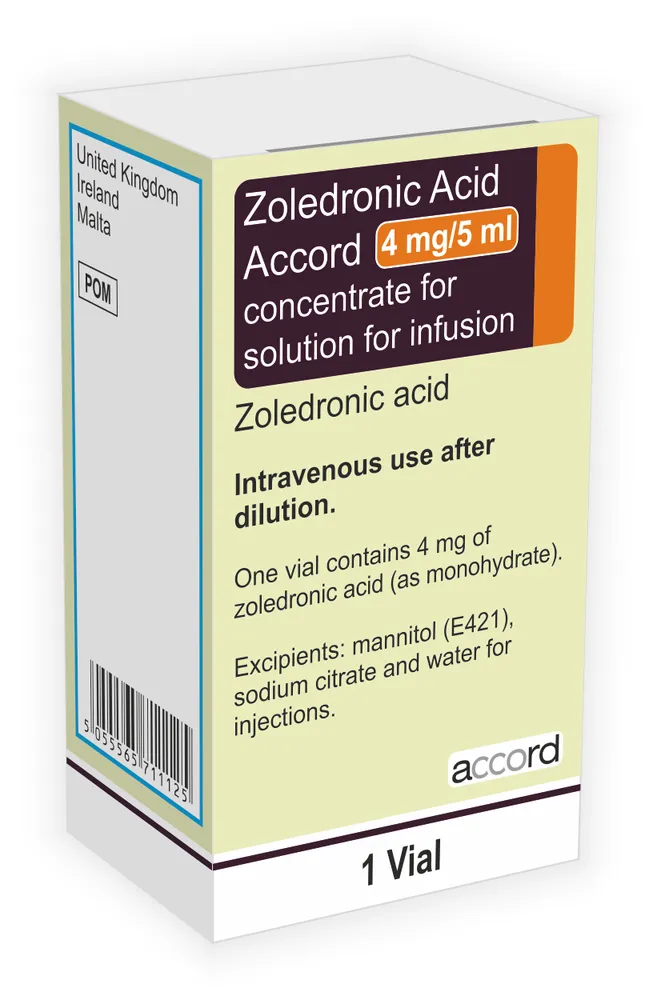
Table of Contents
- Package leaflet: Information for the user
- Zoledronic Acid Accord 4 mg/5 ml concentrate for solution for infusion
- 1. What Acido Zoledronico Accord is and what it is used for
- 2. What you should know before being given Acido Zoledronico Accord
- 3. How Acido Zoledronico Accord is used
- 4. Possible side effects
- 5. How to store Acido Zoledronico Accord
- 6. Package contents and other information
- The following information is intended for healthcare professionals only:
Package leaflet: Information for the user
Zoledronic Acid Accord 4 mg/5 ml concentrate for solution for infusion
Zoledronic acid
Please read this leaflet carefully before you are given this medicine because it
contains important information for you.
- Keep this leaflet. You may need to read it again.
- If you have any questions, ask your doctor, pharmacist or nurse.
- If you get any side effects, talk to your doctor, pharmacist or nurse. This includes any side effects not listed in this leaflet. See section 4.
Contents of this leaflet
- What Zoledronic Acid Accord is and what it is used for
- What you need to know before you are given Zoledronic Acid Accord
- How Zoledronic Acid Accord is used
- Possible side effects
- How to store Zoledronic Acid Accord
- Contents of the pack and other information
1. What Acido Zoledronico Accord is and what it is used for
The active substance of Acido Zoledronico Accord is zoledronic acid, which belongs to a group of substances called bisphosphonates. Zoledronic acid works by binding to bone and slowing down its rate of metabolism. It is used:
- To prevent bone complications, such as fractures, in adult patients with bone metastases (spread of tumour from the primary tumour site to the bones).
- To reduce the level of calcium in the blood in adult patients in whom it is too high due to the presence of a tumour. Tumours can accelerate normal bone metabolism so that the release of calcium from bone is increased. This condition is known as tumour-induced hypercalcaemia (TIH).
2. What you should know before being given Acido Zoledronico Accord
Carefully follow all instructions given to you by your doctor.
Before starting treatment with Acido Zoledronico Accord, your doctor will perform blood tests and monitor your response to treatment at regular intervals.
Acido Zoledronico Accord must not be given to you:
- if you are breastfeeding.
- if you are allergic to zoledronic acid, to any other bisphosphonate (the group of substances to which Acido Zoledronico Accord belongs), or to any of the other ingredients of this medicine (listed in section 6).
Warnings and precautions
Talk to your doctor, pharmacist, or nurse before you are given Acido Zoledronico Accord:
- if you have or have had kidney problems.
- if you have or have had pain, swelling, or numbness in the jaw or a feeling of heaviness in the jaw, or if you have lost a tooth. Your doctor may recommend that you undergo a dental examination before starting treatment with Acido Zoledronico Accord.
- if you are currently undergoing dental treatments or need to undergo dental surgery, inform your dentist that you are being treated with Acido Zoledronico Accord and inform your doctor about your dental treatments.
During treatment with Acido Zoledronico Accord, you must maintain good oral hygiene (including regular tooth cleaning) and have routine dental check-ups.
Immediately inform your doctor and dentist if you experience any problems in your mouth or with your teeth, such as tooth loss, pain, swelling, failure of wounds to heal, or discharge, as these may be signs of a condition called osteonecrosis of the jaw.
Patients receiving chemotherapy and/or radiotherapy, those taking steroids, those undergoing dental surgery, those not receiving routine dental care, those with gum disease, smokers, or those previously treated with bisphosphonates (used to treat or prevent bone disorders) have a higher risk of developing osteonecrosis of the jaw.
Low levels of calcium in the blood (hypocalcemia) have been reported in patients treated with Acido Zoledronico Accord, which may sometimes cause muscle cramps, dry skin, or a burning sensation. Cases of irregular heartbeat (cardiac arrhythmia), seizures, and muscle spasms and contractions (tetany) secondary to severe hypocalcemia have also been reported. In some cases, hypocalcemia may be life-threatening. If any of these conditions apply to you, inform your doctor immediately.
If you have pre-existing hypocalcemia, it must be treated before starting the first dose of Acido Zoledronico Accord. You will be given an adequate supplement of calcium and vitamin D.
Patients aged 65 years and older
Acido Zoledronico Accord may be administered to individuals aged 65 years and older.
There is no evidence that additional precautions are required.
Children and adolescents
Acido Zoledronico Accord is not recommended for use in adolescents and children under 18 years of age.
Other medicines and Acido Zoledronico Accord
Inform your doctor if you are taking, have recently taken, or might take any other medicines. It is particularly important that you inform your doctor if you are also taking:
- Aminoglycosides (medicines used to treat serious infections), calcitonin (a type of medicine used to treat postmenopausal osteoporosis and hypercalcemia), loop diuretics (a type of medicine used to treat high blood pressure or edema), or other medicines that lower calcium levels, as combining these with bisphosphonates may cause a marked decrease in blood calcium concentration.
- Thalidomide (a medicine used to treat certain types of bone-involving blood cancers) or any other medicine that may be harmful to the kidneys.
- Other medicines containing zoledronic acid used for the treatment of osteoporosis and other non-oncological bone disorders, or any other bisphosphonate, since the combined effects of these medicines when taken together with Acido Zoledronico Accord are unknown.
- Anti-angiogenic medicines (used to treat cancer), as their combination with zoledronic acid has been associated with an increased risk of jaw osteonecrosis.
Pregnancy and breastfeeding
Acido Zoledronico Accord must not be given to you if you are pregnant. Inform your doctor if you are pregnant or suspect you may be pregnant.
Acido Zoledronico Accord must not be given to you if you are breastfeeding.
Ask your doctor for advice before taking any medicine during pregnancy or while breastfeeding.
Driving and using machines
Drowsiness and numbness have been reported very rarely with the use of Acido Zoledronico Accord.
Therefore, you must exercise extreme caution when driving, operating machinery, or performing other activities requiring full attention.
Acido Zoledronico Accord contains sodium
This medicine contains less than 1 mmol of sodium (23 mg) per vial, i.e. it is essentially ‘sodium-free’.
3. How Acido Zoledronico Accord is used
- Acido Zoledronico Accord must be administered only by healthcare personnel trained in the use of intravenous bisphosphonates, i.e. through a vein.
- Your doctor will recommend that you drink sufficient water before each treatment to help prevent dehydration.
- Carefully follow all other instructions given by your doctor, pharmacist, or nurse.
How much Acido Zoledronico Accord is administered
- The usual single dose is 4 mg of zoledronic acid.
- If you have kidney problems, your doctor will administer a reduced dose based on the severity of your renal impairment.
How often Acido Zoledronico Accord is administered
- If you are being treated to prevent bone complications due to bone metastases, you will receive an infusion of Acido Zoledronico Accord every three or four weeks.
- If you are being treated to reduce the level of calcium in your blood, normally only a single infusion of Acido Zoledronico Accord will be administered.
How Acido Zoledronico Accord is administered
- Acido Zoledronico Accord is administered intravenously as an infusion lasting at least 15 minutes and must be given as a single intravenous solution through a separate infusion line.
Patients with not excessively high blood calcium levels may also be prescribed daily calcium and vitamin D supplements.
If you have been administered more Acido Zoledronico Accord than you should have received
If doses higher than recommended have been administered, you must be monitored particularly closely by your doctor. This is because you might develop serum electrolyte abnormalities (e.g. abnormal levels of calcium, phosphate, and magnesium) and/or changes in renal function, including severe kidney impairment. If calcium levels drop too low, you may require intravenous calcium supplementation.
If you have any doubts about the use of this medicine, consult your doctor, pharmacist, or nurse.
4. Possible side effects
Like all medicines, this medicine can cause side effects, although not everyone gets them. The most common side effects are usually mild and may disappear in a short time.
Tell your doctor if any of the following serious side effects occur:
Common (may affect up to 1 in 10 people):
- Severe kidney failure (this will be confirmed by your doctor through specific blood tests).
- Low levels of calcium in the blood.
Uncommon (may affect up to 1 in 100 people):
- Pain in the mouth, teeth and/or jaw, swelling or failure of healing of sores inside the mouth or jaw, discharge, numbness or a feeling of heaviness in the jaw, or loss of a tooth. These may be signs of jaw damage (osteonecrosis). If you experience any of these symptoms during or after stopping treatment with Acido Zoledronico Accord, inform your doctor and dentist immediately.
- In patients treated with zoledronic acid for postmenopausal osteoporosis, an irregular heart rhythm (atrial fibrillation) has been observed. It is currently unknown whether zoledronic acid causes this irregular heart rhythm, but you should report such symptoms to your doctor after receiving zoledronic acid.
- Severe allergic reactions: shortness of breath, swelling, especially of the face and throat.
Rare (may affect up to 1 in 1,000 people):
- As a consequence of low calcium levels: irregular heartbeat (cardiac arrhythmia secondary to hypocalcemia).
- A kidney function disorder called Fanconi syndrome (usually diagnosed by your doctor through urine tests).
Very rare (may affect up to 1 in 10,000 people):
-
As a consequence of low calcium levels: seizures, numbness, and tetany (secondary to hypocalcemia).
-
Contact your doctor if you experience ear pain, ear discharge, and/or ear infection. These events could be signs of bone damage in the ear.
-
Osteonecrosis has very rarely occurred in other bones besides the jaw, particularly in the hip or thigh. If you develop symptoms such as onset or worsening of pain, pain or stiffness during or after stopping treatment with Acido Zoledronico Accord, inform your doctor immediately.
Tell your doctor as soon as possible if any of the following side effects occur:
Very common (may affect more than 1 in 10 people):
- Low levels of phosphate in the blood.
Common (may affect up to 1 in 10 people):
- Headache and a flu-like illness with fever, fatigue, weakness, drowsiness, chills, and bone, joint, and/or muscle pain. In most cases, no specific treatment is needed and symptoms disappear after a short time (a few hours or days).
- Gastrointestinal reactions, such as nausea and vomiting, as well as loss of appetite.
- Conjunctivitis.
- Low levels of red blood cells in the blood (anemia).
Uncommon (may affect up to 1 in 100 people):
- Hypersensitivity reactions.
- Low blood pressure.
- Chest pain.
- Skin reactions (redness and swelling) at the infusion site, rash, itching.
- High blood pressure, shortness of breath, dizziness, anxiety, sleep disturbances, taste disturbances, tremor, tingling or numbness in hands or feet, diarrhea, constipation, abdominal pain, dry mouth.
- Low levels of white blood cells and platelets in the blood.
- Low levels of magnesium and potassium in the blood. Your doctor will monitor these and take necessary measures.
- Weight gain.
- Increased sweating.
- Drowsiness.
- Blurred vision, eye lesions, light sensitivity.
- Sudden chills with fainting, weakness, or collapse.
- Breathing difficulty with wheezing or cough.
- Hives.
Rare (may affect up to 1 in 1,000 people):
-
Slow heart rate.
-
Confusion.
-
Rarely, an unusual femur fracture may occur, particularly in patients receiving long-term treatment for osteoporosis. Contact your doctor if you experience pain, weakness, or discomfort in the thigh, hip, or groin, as this could be an early sign of a possible femur fracture.
-
Interstitial lung disease (inflammation of lung tissue).
-
Influenza-like symptoms including arthritis and joint swelling.
-
Painful redness and/or swelling of the eyes.
Very rare (may affect up to 1 in 10,000 people):
- Fainting due to low blood pressure.
- Severe bone, joint, and/or muscle pain, occasionally disabling.
Reporting of side effects
If you experience any side effect, including those not listed in this leaflet, talk to your doctor, pharmacist, or nurse. You can also report side effects directly via the national reporting system listed in Annex V. By reporting side effects, you can help provide more information on the safety of this medicine.
5. How to store Acido Zoledronico Accord
Your doctor, pharmacist or nurse knows how to appropriately store Acido Zoledronico Accord (see section 6).
6. Package contents and other information
What Acido Zoledronico Accord contains
- The active substance in Acido Zoledronico Accord is zoledronic acid. One vial contains 4 mg of zoledronic acid (as monohydrate).
- The other ingredients are: mannitol, sodium citrate, water for injections.
Description of the appearance of Acido Zoledronico Accord and package contents
Acido Zoledronico Accord is supplied as a liquid concentrate in a vial. One vial contains 4 mg of zoledronic acid.
Each pack contains the concentrate vial. Acido Zoledronico Accord is available in packs containing 1, 4 or 10 vials. Not all pack sizes may be marketed.
Marketing Authorisation Holder and Manufacturer
Marketing Authorisation Holder
Accord Healthcare S.L.U.
World Trade Center, Moll de Barcelona, s/n,
Edifici Est 6ª planta,
08039 Barcelona,
Spain
Manufacturer
Accord Healthcare Limited
Sage House
319, Pinner Road
North Harrow, Middlesex HA1 4HF
United Kingdom
Accord Healthcare Polska Sp.z o.o.,
ul. Lutomierska 50, 95-200 Pabianice, Poland
More detailed information on this medicinal product is available on the European Medicines Agency website: http://www.ema.europa.eu
The following information is intended for healthcare professionals only:
How to prepare and administer Zoledronic Acid Accord
- To prepare an infusion solution containing 4 mg of zoledronic acid, further dilute Zoledronic Acid Accord concentrate (5 ml) with 100 ml of an infusion solution free of calcium or other bivalent cations. If a reduced dose of Zoledronic Acid Accord is required, first withdraw the appropriate volume as indicated below and then further dilute it in 100 ml of infusion solution. To avoid potential incompatibilities, the infusion solution used for dilution must be either 0.9% w/v sodium chloride solution or 5% w/v glucose solution.
The reconstituted solution of Zoledronic Acid Accord must not be mixed with solutions
containing calcium or other bivalent cations, such as lactated Ringer’s solution.
Instructions for preparing reduced doses of Zoledronic Acid Accord:
Withdraw the appropriate volume of reconstituted solution (4 mg/5 ml) as follows:
- 4.4 ml for the 3.5 mg dose
- 4.1 ml for the 3.3 mg dose
- 3.8 ml for the 3.0 mg dose
- For single use only. Any unused solution must be discarded. Only use a clear, particle-free, colourless solution. Aseptic techniques must be followed during the preparation of the infusion.
- Chemical and physical in-use stability has been demonstrated for 36 hours at 2–8°C. From a microbiological standpoint, the diluted solution should be used immediately after first opening. If not used immediately, in-use storage times and conditions prior to use are the responsibility of the user and should normally not exceed 24 hours at 2°C–8°C. Refrigerated solution must be brought to room temperature before administration.
- The solution containing zoledronic acid must be administered as a single infusion lasting 15 minutes via a separate infusion line. The hydration status of patients must be assessed before and after administration of Zoledronic Acid Accord to ensure adequate hydration.
- Studies performed with infusion sets made of polyvinyl chloride, polyethylene, and polypropylene have not shown incompatibility with Zoledronic Acid Accord.
- Since compatibility data with other intravenously administered substances are not available, Zoledronic Acid Accord must not be mixed with other medicinal products and/or substances and must always be administered through a separate infusion line.
How to store Zoledronic Acid Accord
- Keep Zoledronic Acid Accord out of the sight and reach of children.
- Do not use Zoledronic Acid Accord after the expiry date stated on the packaging.
- The unopened vial does not require special storage conditions.
- The diluted infusion solution of Zoledronic Acid Accord must be used immediately to avoid microbiological contamination.