Zineryt
Italy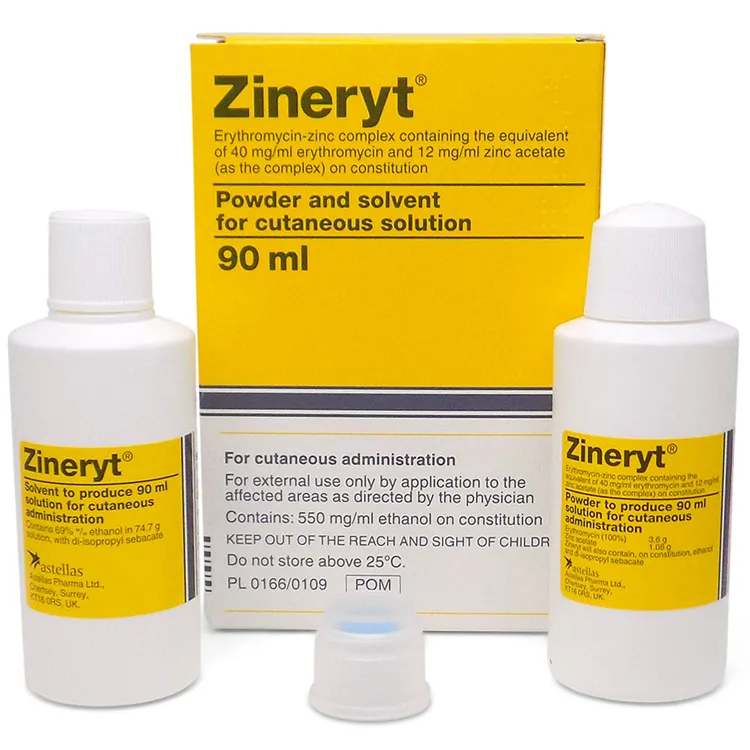
Table of Contents
- Patient Information Leaflet: Information for the User
- Zineryt 4% + 1,2% Powder and Solvent for Cutaneous Solution
- 1. What Zineryt is and what it is used for
- 2. What you need to know before using Zineryt
- 3. How to use Zineryt
- 4. Possible side effects
- 5. How to store Zineryt
- 6. Package contents and other information
Patient Information Leaflet: Information for the User
Zineryt 4% + 1,2% Powder and Solvent for Cutaneous Solution
erythromycin + zinc acetate dihydrate
Please read this leaflet carefully before using this medicine because it contains important information for you.
- Keep this leaflet. You may need to read it again.
- If you have any questions, consult your doctor or pharmacist.
- This medicine has been prescribed for you only. Do not give it to others, even if their symptoms are the same as yours, as it could be harmful.
- If you experience any side effects, including those not listed in this leaflet, consult your doctor or pharmacist. See section 4.
Contents of this leaflet:
- What Zineryt is and what it is used for
- What you need to know before using Zineryt
- How to use Zineryt
- Possible side effects
- How to store Zineryt
- Package contents and other information
1. What Zineryt is and what it is used for
Zineryt contains the active substances: erythromycin and zinc acetate dihydrate.
Erythromycin is an antibiotic with antimicrobial action that works by eliminating the bacteria causing acne
(an inflammatory skin condition characterized by pimples, with or without pus). Zinc acetate enhances
the effect of erythromycin.
Zineryt is used for the local treatment of all forms of acne.
If you do not notice any improvement after 12 weeks of treatment, consult your doctor.
2. What you need to know before using Zineryt
Do not use Zineryt
- if you are allergic to erythromycin, zinc acetate dihydrate, or any of the other ingredients of this medicine (listed in section 6).
- if you are allergic to other antibiotics belonging to the macrolide family (a class of medicines similar to Zineryt).
Warnings and precautions
Use Zineryt on the skin only.
Do not use Zineryt in the eyes and/or on mucous membranes. If Zineryt accidentally comes into contact with the eyes and/or mucous membranes, rinse immediately with plenty of water.
The use, especially if prolonged, of topical skin products may lead to sensitization reactions (allergy to one or more components). If this occurs, discontinue treatment and contact your doctor.
Children
This medicine should be used in children only when clearly necessary and under medical supervision.
The doctor will carefully evaluate the benefit of erythromycin therapy against the potential risk of adverse effects (see section “Additional adverse effects in children”).
Other medicines and Zineryt
Inform your doctor or pharmacist if you are taking, have recently taken, or might take any other medicines.
In particular, inform your doctor if you are taking:
- macrolide antibiotics (a class of medicines similar to Zineryt)
- lincomycin or clindamycin (antibiotics).
Pregnancy and breastfeeding
If you are pregnant, suspect you may be pregnant, planning to become pregnant, or are breastfeeding, consult your doctor or pharmacist before using this medicine. Use Zineryt only when clearly necessary and under direct medical supervision.
Driving and using machines
This medicine does not impair the ability to drive or operate machinery.
3. How to use Zineryt
Use this medicine exactly as instructed by your doctor or pharmacist. If you have any doubts, consult your doctor or pharmacist.
Zineryt should be applied twice daily.
Apply the medicine to the skin of the face or other affected areas (not only on the lesions) until the area to be treated is covered (approximately 0.5 ml per application).
Use in children
In children, this medicine should be used only when strictly necessary and under medical supervision.
Your doctor will carefully evaluate the benefit of treatment with erythromycin against the potential risk of developing adverse effects (see section “Additional undesirable effects in children”).
Instructions for use
Instructions for preparing the solution
- Remove the cap from both Zineryt vials and keep the cap from the vial containing the powder.
- Pour the liquid into the vial containing the Zineryt powder.
- Screw the previously kept cap onto the vial now containing powder and liquid.
- Shake the vial well for about one minute.
- Remove the cap, insert the applicator, and screw the cap back on, applying slight pressure to properly position the applicator.
- Check that the applicator is fully inserted (press if necessary).
- Once the solution has been prepared, write the expiry date on the vial (the prepared solution expires 8 weeks after preparation) (see section 5 “How to store Zineryt”).
Instructions for applying the product
Apply Zineryt by tilting the container downwards and rubbing the applicator over the skin to be treated, applying slight pressure simultaneously. The amount of Zineryt flow can be controlled by increasing or decreasing the pressure against the skin. After application, allow it to dry.
Caution: After application, use the container containing the medicine only for yourself. The container must not be used by others, to prevent the spread of infection.
Duration of treatment
The treatment period is generally 10–12 weeks. Normally, after this period, you should notice satisfactory improvement.
If after 12 weeks of treatment you do not observe visible improvement, contact your doctor, as bacterial resistance (presence of bacteria against which erythromycin is ineffective) may have developed. In this case, your doctor will prescribe appropriate therapy.
If you use more Zineryt than you should
Cases of overdose with this medicine are not known.
When used correctly, overdose is unlikely.
In case of accidental ingestion of the contents of the package, symptoms may occur due to the presence of alcohol in the medicine.
If you forget to use Zineryt
Do not use a double dose to make up for the forgotten dose.
If you have any doubts about how to use this medicine, consult your doctor or pharmacist.
4. Possible side effects
Like all medicines, this medicine can cause side effects, although not everybody gets them.
Contact your doctor immediately if you experience a severe skin reaction: red, scaly rash with formation of pustules and blisters (exanthematous pustulosis). The frequency of this reaction is unknown (cannot be estimated from the available data).
If you develop allergic reactions while undergoing treatment, stop treatment and contact your doctor immediately. These reactions occur especially with prolonged use of the medicine.
In addition, the following side effects may occur, according to the frequency reported below.
Uncommon (may affect up to 1 in 100 people)
- itching,
- erythema (skin redness),
- skin irritation,
- burning sensation,
- dry skin,
- skin exfoliation (shedding of thin, superficial layers of skin).
The burning sensation or skin redness are due to the alcohol content in Zineryt. These effects are transient and resolve upon discontinuation of treatment or by reducing the frequency of application.
Additional side effects in children
The following side effects have been reported with other medicines containing erythromycin (one of the active substances in Zineryt), but are unlikely to occur with Zineryt:
Frequency not known (cannot be estimated from the available data)
- hypertrophic pyloric stenosis (narrowing of the valve connecting the stomach to the intestine, causing difficulty in stomach emptying and resulting in persistent vomiting),
- vomiting.
If your doctor has prescribed Zineryt for your child, inform your doctor immediately if you notice feeding difficulties (with either breast or formula milk) and/or vomiting.
Reporting of side effects
If you experience any side effects, including those not listed in this leaflet, talk to your doctor or pharmacist. You can also report side effects directly via the national reporting system at the following website:
http://www.agenziafarmaco.gov.it/content/come-segnalare-una-sospetta-reazione-avversa .
By reporting side effects, you can help provide more information on the safety of this medicine.
5. How to store Zineryt
Keep this medicine out of the sight and reach of children.
After final preparation, the solution remains stable at room temperature for 8 weeks.
Store in the original packaging.
Do not use this medicine after the expiry date stated on the carton after EXP. The expiry date refers to the last day of that month.
Do not dispose of any medicine via wastewater or household waste. Ask your pharmacist how to dispose of medicines you no longer use. This will help protect the environment.
6. Package contents and other information
What Zineryt contains
- The active substances in the vial containing the powder are: erythromycin 1302 mg and zinc acetate dihydrate 389 mg.
- The other components in the vial containing the solvent (liquid) are: diisopropyl sebacate, ethanol.
1 ml of the product obtained by mixing the powder with the solvent contains: 40 mg of erythromycin and 12 mg of zinc acetate.
Description of the appearance of Zineryt and contents of the pack
Zineryt is supplied as a powder and solvent for topical application to the skin.
Each pack of Zineryt contains:
- one vial containing a powder of the active substances (erythromycin and zinc acetate dihydrate)
- one vial containing the solvent with the other components of the medicinal product (diisopropyl sebacate, ethanol)
- one applicator to be attached to the vial containing the medicinal solution (for instructions on preparing the solution, see section “Instructions for preparing the solution”).
The vial with the reconstituted solution contains 30 ml of Zineryt.
Marketing Authorization Holder
CHEPLAPHARM Arzneimittel GmbH
Ziegelhof 24
17489 Greifswald
Germany
Manufacturer
LEO Pharma A/S
Industriparken 55
DK-2750 Ballerup
Denmark